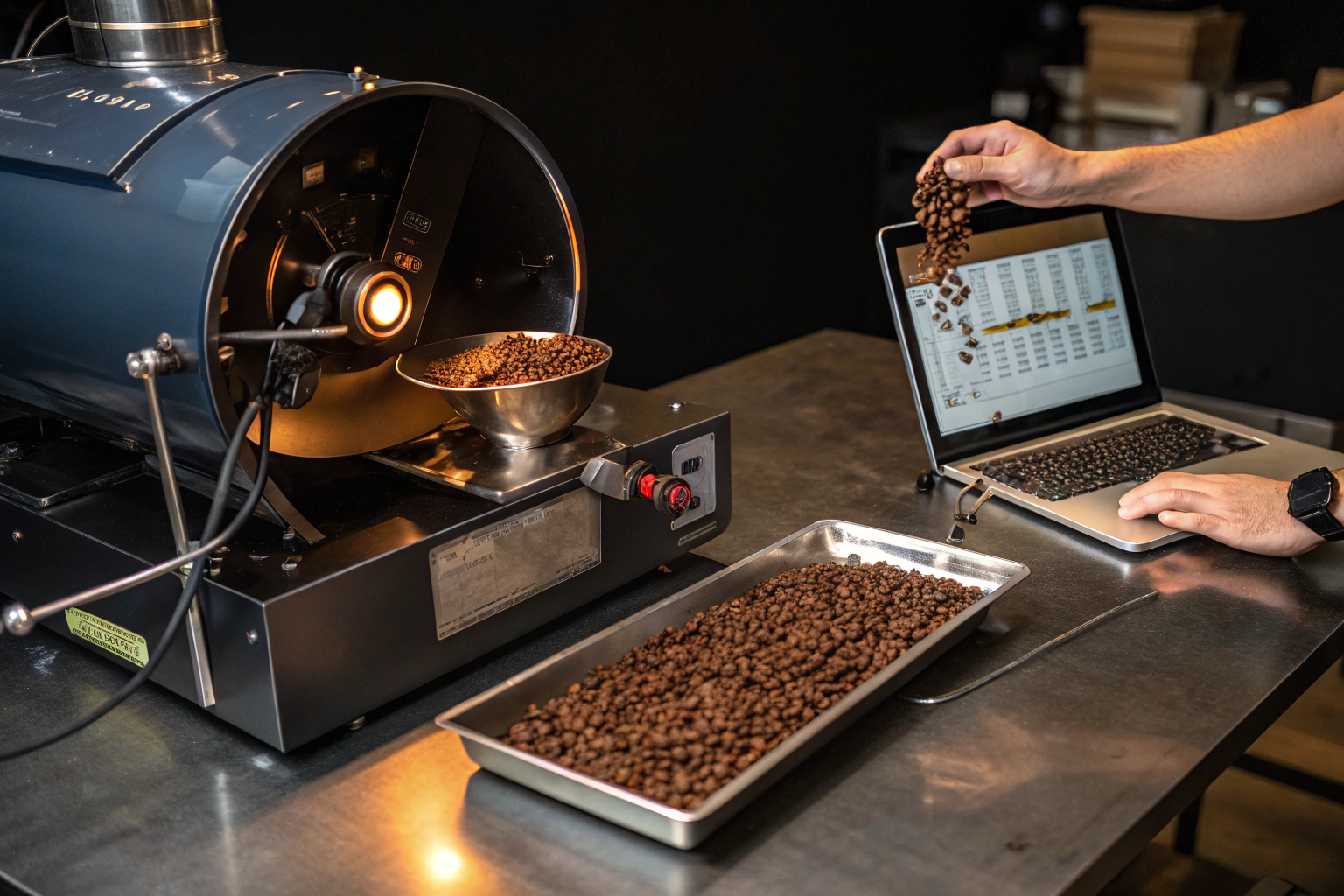
A roaster from a specialty café chain in London emailed me last week. He had just received his first pallet of our washed Catimor. "The sample roasted beautifully," he wrote. "Even color, perfect development. But my first production batch is mottled. Some beans are darker, some lighter. The cupping is still good, but the bag appeal is off. My customers notice the color. What am I doing wrong?"
I knew his problem immediately. He was roasting our dense, high-grown Catimor with the same profile he used for his softer Brazilian base. The beans were behaving differently in the drum. The heat transfer was different. The development was uneven. His roast color was inconsistent not because the coffee was bad, but because his profile was not matched to the bean.
Ensuring consistent roast color with a new wholesale bean requires measuring the green coffee's density and moisture content before roasting, adjusting the charge temperature and heat application to match those physical characteristics, and using an Agtron color meter to objectively verify the target roast level, then cupping to confirm that the color consistency delivers the expected cup quality.
Consistent roast color is not just about aesthetics. It is a proxy for roast evenness, which directly affects cup quality. A mottled roast produces a muddled cup—some scorched notes, some underdeveloped notes. A uniform roast produces a clean, balanced cup. Here is how to achieve that uniformity with any new bean.
What Physical Properties of the Green Bean Affect Roast Evenness?
The physical properties of the green coffee are the starting point for any roast profile. If you do not know the density, the moisture content, and the screen size of the beans, you are roasting blind. You are guessing at the heat transfer. Guessing leads to uneven roasts.
Density is the most important physical property for roast evenness. Density determines how quickly heat penetrates the bean. A high-density bean—720 grams per liter or above—has a compact cell structure. Heat moves slowly through the dense matrix. The bean needs a higher charge temperature and more aggressive heat application during the drying phase to get enough thermal energy to the core. If you apply too little heat, the surface roasts while the core remains underdeveloped. The result is a mottled roast—dark outside, light inside.
A low-density bean—below 680 grams per liter—has a more porous, open cell structure. Heat penetrates quickly. The bean needs a lower charge temperature and gentler heat application. If you apply too much heat, the surface scorches before the core develops. The result is also a mottled roast, but with scorched surfaces and undeveloped cores.
The three physical properties that most affect roast evenness are bulk density, which determines heat transfer speed; moisture content, which influences the energy required during the drying phase; and screen size uniformity, which ensures all beans in the batch absorb heat at similar rates.
Moisture content is the second critical property. Water absorbs a tremendous amount of energy before it turns to steam. A bean with higher moisture content—closer to 12 percent—requires more energy during the drying phase to drive off the water. If you do not apply enough heat, the drying phase drags on, and the roast stalls. A bean with lower moisture content—closer to 10 percent—dries quickly and can race into first crack if you are not careful.
Screen size uniformity is the third property. If the beans vary widely in size, the smaller beans roast faster than the larger beans. The small beans may scorch while the large beans are still underdeveloped. A well-sorted lot with a narrow screen size range roasts much more evenly than a poorly sorted lot. Our specialty lots are screened to 16/18 or 18+ to ensure uniformity.
How Do You Measure Bean Density Before Roasting?
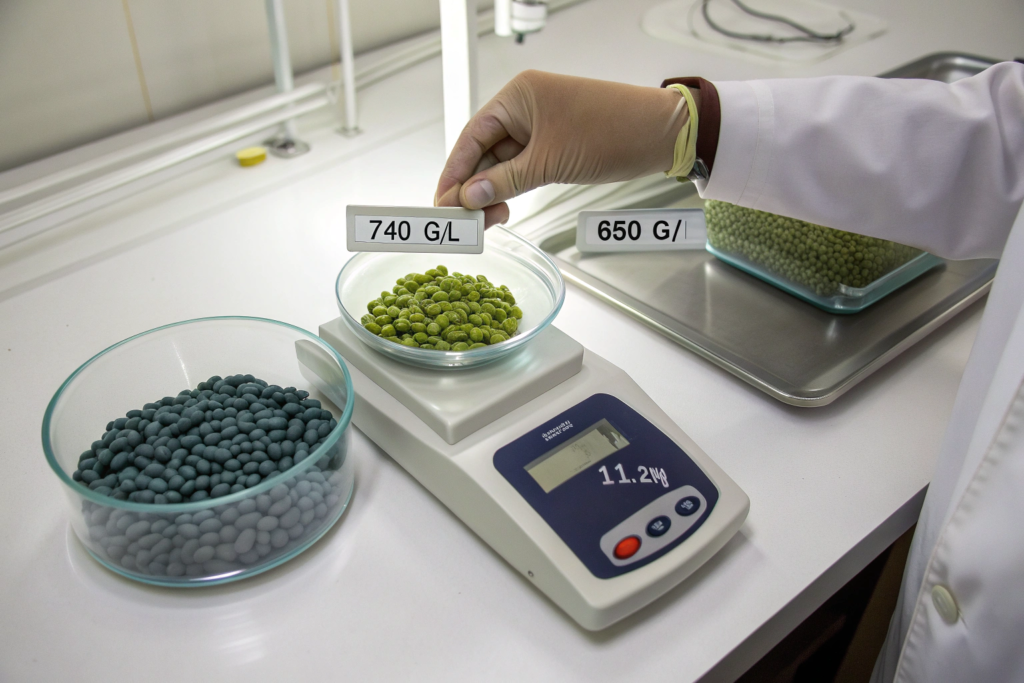
Measuring bean density is simple and requires only basic equipment. It should be done for every new lot before the first production roast.
The equipment needed is a one-liter graduated cylinder or a density cup, and a scale accurate to one gram. Fill the cylinder to exactly one liter with green coffee. Do not pack the beans down. Tap the cylinder gently to settle the beans, then top up to exactly one liter. Weigh the beans in grams. The weight in grams per liter is the bulk density.
For washed Catimor from our high-altitude plots, the typical density is 720 to 750 grams per liter. This is dense by global standards. For comparison, a Brazilian natural might be 650 to 680 grams per liter, and a wet-hulled Sumatra might be 620 to 660 grams per liter. The density number tells you immediately how the bean will behave in the roaster relative to other beans you know.
Record the density for every lot. Over time, you will build a database that correlates density with the roast profile adjustments you made. A lot with a density of 740 will require a similar profile to other 740-density lots. The database makes profile development faster and more accurate.
I provide density measurements with every lot card I ship. The buyer knows the density before the coffee arrives. They can plan the roast profile in advance. For more on density measurement and its impact on roasting, Cropster allows roasters to log density data alongside roast curves.
Why Is Moisture Content Critical for Charge Temperature Decisions?
The moisture content of the green coffee determines how much energy is consumed by the drying phase. Water has a high specific heat capacity and a high latent heat of vaporization. It takes a lot of energy to heat water and turn it into steam. That energy is not available for developing the bean's sugars and aromatics until the water is gone.
A coffee with higher moisture content—11.5 to 12 percent—needs more energy early in the roast. The charge temperature should be slightly higher. The gas during the drying phase should be higher. The drying phase will be slightly longer. The goal is to drive off the water efficiently without stalling the roast.
A coffee with lower moisture content—10 to 10.5 percent—needs less energy early. The charge temperature should be slightly lower. The gas during drying should be more moderate. The drying phase will be shorter. The goal is to avoid racing through drying and scorching the beans.
I measure the moisture content of every lot before shipment using a calibrated moisture meter. The reading is on the lot card. The buyer knows the exact moisture content of the coffee they are receiving. They can adjust their charge temperature and drying phase accordingly.
The moisture content should always be within the specialty range of 10.5 to 12 percent. If a lot arrives with moisture outside this range, the drying was either insufficient or excessive. The lot should be evaluated carefully. Uneven moisture content—some beans wetter than others—is a common cause of uneven roasts. A moisture meter reading is an average. The cupping and the visual inspection will reveal if the moisture is uneven.
How Should You Adjust Your Roast Profile for a New Bean?
When you receive a new wholesale bean, do not assume your existing profile will work. Even if the bean is the same variety and origin as a previous lot, small differences in density, moisture, and screen size can shift the roast behavior. The first roast of a new lot should be a cautious, exploratory batch.
Start with a baseline profile adjusted for the measured density and moisture content. If the new bean is denser than your usual bean, increase the charge temperature by 5 to 10 degrees Celsius. Increase the gas during the drying phase slightly. Expect the drying phase to be longer and first crack to arrive later.
If the new bean is less dense, do the opposite. Decrease the charge temperature. Reduce the gas during drying. Expect a shorter drying phase and an earlier first crack.
The first roast of a new bean should be a small, exploratory batch using a profile adjusted for the bean's measured density and moisture content, with the roaster watching the rate of rise closely and pulling a sample every 15 seconds after first crack to visually assess color development.
Roast a small batch—no more than 50 to 70 percent of the roaster's rated capacity. A smaller batch gives you more control and more margin for error. Watch the rate of rise carefully. It should be smooth and declining. Any spikes, stalls, or crashes indicate that the profile is not matched to the bean.
Pull a sample with the trier every 15 seconds after first crack ends. Lay the samples on a white tray in order. You will see the color progression from light cinnamon to dark chocolate. The samples should be uniform in color at each time point. If they are mottled, the heat transfer is uneven. Adjust the airflow or the drum speed on the next batch.
What Is the Role of the Development Time Ratio in Even Color?
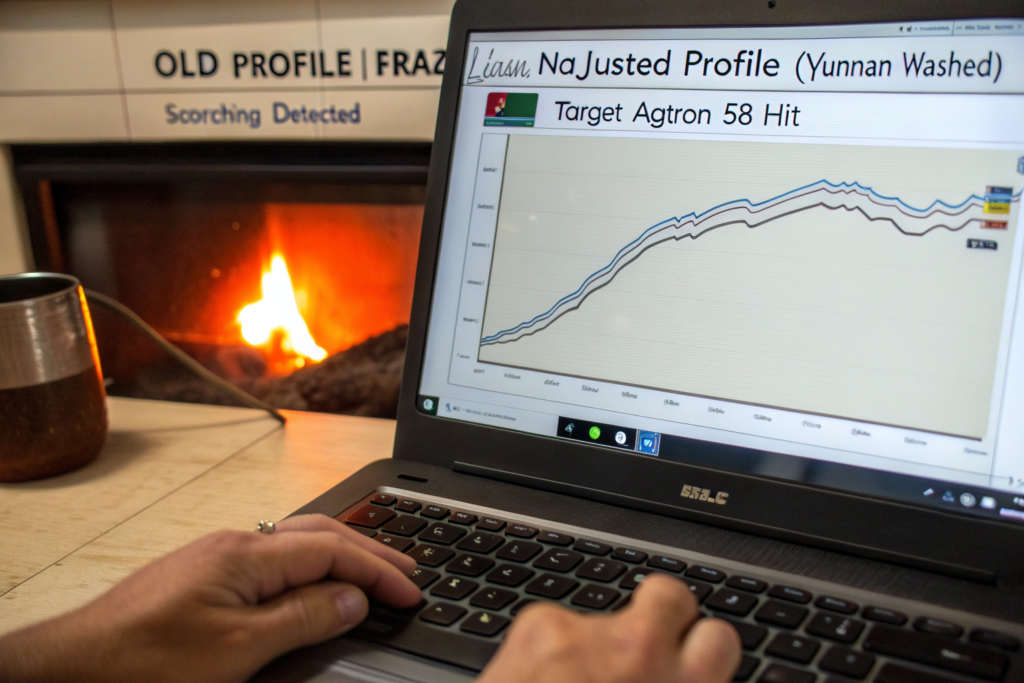
The development time ratio—the percentage of total roast time that occurs after first crack—is a key variable for roast evenness and color consistency. Too little development time, and the beans are underdeveloped. The color is pale and mottled. Too much development time, and the beans are overdeveloped. The color is dark and oily, possibly with scorched spots.
For a new bean, I recommend starting with a development time ratio of 15 to 17 percent for a medium roast target. This is a conservative range that gives the beans enough time to develop fully without risking over-roasting.
Monitor the bean temperature and the color during development. The rate of rise should be declining but still positive—2 to 4 degrees Celsius per minute at the drop. If the rate of rise crashes to zero, the roast is stalling. The color will be uneven because the beans are baking, not roasting.
The development time should be adjusted based on the first batch results. If the color is pale and the cup tastes vegetal, increase the development time slightly on the next batch. If the color is dark and the cup tastes roasty, decrease the development time. The goal is the minimum development time that produces a uniform color and a fully developed cup.
The development time ratio is not a fixed rule. It is a starting point. Each bean has its own sweet spot. The cupping and the visual inspection tell you whether you found it.
How Can Airflow Adjustments Prevent Mottling?
Airflow is the underappreciated variable in roast evenness. Air carries heat to the beans and carries smoke and chaff away. Proper airflow ensures that all beans in the drum experience a similar thermal environment.
Too little airflow, and heat distribution is uneven. The beans near the heat source roast faster. The beans away from the heat source roast slower. The result is a mottled roast—some dark, some light. Too much airflow, and heat is sucked out of the drum. The roast stalls. The beans bake. The color is flat and dull.
The airflow setting should be adjusted for the bean density and the batch size. Dense beans can tolerate higher airflow without stalling. Lighter, softer beans need gentler airflow. A larger batch size needs more airflow to penetrate the bean mass. A smaller batch size needs less.
I recommend marking the airflow setting that works for your standard bean and adjusting up or down for the new bean based on the density difference. A bean that is 10 percent denser may need 5 to 10 percent more airflow. A bean that is 10 percent less dense may need 5 to 10 percent less.
The visual inspection of the roasted beans reveals airflow problems. A mottled roast with no clear pattern—random dark and light beans—often indicates poor airflow or inadequate drum speed. The beans are not mixing properly. Adjust the airflow and the drum speed until the roast color is uniform.
How to Verify Roast Consistency with Objective Tools?
The human eye is good at detecting large color differences but poor at detecting small, consistent shifts. A roast that looked "fine" yesterday may look slightly darker today, and slightly lighter next week. Over time, the roast color drifts. The customer may notice. The cupping may suffer. Objective measurement prevents this drift.
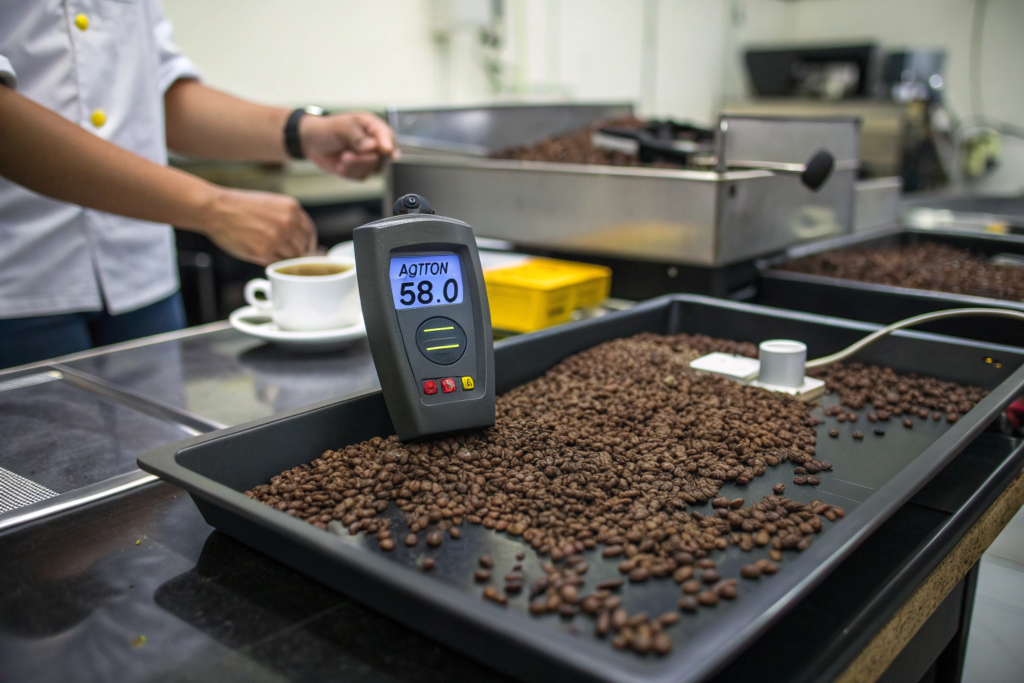
The Agtron color meter is the standard tool for measuring roast color in the specialty coffee industry. It shines a specific wavelength of light onto a sample of ground coffee and measures the reflectance. The darker the roast, the less light is reflected, and the lower the Agtron number. The Agtron scale is the objective reference that keeps roast color consistent batch to batch, week to week, year to year.
Agtron color measurement provides an objective, numerical target for roast color that eliminates subjective visual assessment, allowing the roaster to maintain consistency across batches, across roasters, and across seasons by measuring every batch against the target and adjusting the profile when the reading drifts.
For a new wholesale bean, establish the target Agtron range based on the cupping results. Cup the exploratory batch. Find the roast level that produces the best cup. Measure the Agtron reading at that roast level—both whole bean and ground. The Agtron reading becomes the target for all future batches of that bean.
Measure the Agtron reading on every production batch. If the reading is within the target range, the batch is approved. If the reading is outside the range, the batch is flagged. The profile is adjusted on the next batch to bring the color back to target. The Agtron meter removes guesswork and prevents drift.
What Agtron Range Defines the Sweet Spot for Wholesale Consistency?
The Agtron target range depends on the bean and the intended application. For a new wholesale bean, the range should be established through cupping, not assumed from a general guideline.
For a washed high-grown Arabica like our Yunnan Catimor, the sweet spot for a filter roast is typically Agtron 55 to 65 whole bean, 70 to 80 ground. Within this range, the coffee expresses its acidity, sweetness, and origin character fully. The roast color is a uniform milk chocolate brown. The beans are dry, with no surface oils.
For an espresso roast of the same bean, the sweet spot is typically Agtron 50 to 55 whole bean, 65 to 70 ground. This slightly darker roast develops more body and caramel sweetness. The beans may show a few droplets of oil. The color is a darker chocolate brown.
The target range should be narrow—plus or minus 2 Agtron points. A batch that measures 56 is acceptable if the target is 55 to 59. A batch that measures 52 is not. The narrow range ensures that the customer experience is consistent from bag to bag.
I provide recommended Agtron ranges with every lot I sell. The ranges are based on my own roasting and cupping of the lot. They are a starting point. The roaster should adjust the range based on their own cupping and their customers' preferences.
How Often Should You Cup Production Batches to Confirm Consistency?
Cupping is the final verification of roast consistency. The Agtron meter confirms that the color is consistent. The cupping confirms that the flavor is consistent. Color and flavor are correlated but not identical. A batch can have perfect color but taste baked or scorched due to profile issues. Only the cupping catches these defects.
I recommend cupping every production batch for the first five to ten batches of a new bean. This frequency establishes the baseline and confirms that the profile is stable. Once the profile is locked in and the Agtron readings are consistent, the cupping frequency can be reduced to one batch per day or one batch per roast session.
The cupping should compare the current batch against a reference sample. The reference is a sample from the first successful production batch, sealed in a vacuum bag and stored in a freezer. The side-by-side comparison makes subtle flavor shifts obvious. A batch that tastes slightly flatter or slightly more acidic than the reference indicates a profile drift that may not be visible in the Agtron reading.
If a cupping reveals a flavor deviation, investigate the roast curve for that batch. Look for differences in the rate of rise, the development time, or the drop temperature. Adjust the next batch to correct the deviation. The cupping and the data together keep the roast on target.
For wholesale customers, the cupping is also a customer confidence tool. A roaster who cups every batch and can provide cupping notes demonstrates a commitment to quality that justifies a premium price. I encourage my buyers to cup regularly and to share their cupping feedback with me. The feedback helps me select and process lots that meet their consistency requirements.
How to Build a Long-Term Consistency Program with Your Supplier?
Roast consistency starts with the green coffee, not the roaster. If the green coffee varies from lot to lot, the roaster must constantly adjust the profile. The roast color will drift. The cupping will drift. The customer experience will drift. The best way to ensure roast consistency is to source from a supplier who delivers consistent green coffee.
A long-term consistency program with a supplier involves several elements. The first is data transparency. The supplier should provide the density, moisture, water activity, screen size, and cupping scores for every lot. The data allows the roaster to anticipate the bean's behavior and adjust the profile proactively.
The second element is lot consistency. The supplier should deliver lots that are as similar as possible from shipment to shipment. The density should not swing by 30 grams per liter. The moisture should not swing by 2 percent. The cupping score should not swing by 3 points. The supplier should select and blend lots to maintain a consistent profile.
A long-term roast consistency program with a supplier is built on data transparency, lot-to-lot consistency of physical and sensory characteristics, forward contracting to secure access to the same plots and processing protocols, and open communication about any seasonal shifts that require profile adjustments.
The third element is forward contracting. A roaster who needs consistent roast color year-round should contract for the full year's supply from a specific farm or region. The supplier commits to delivering a consistent product. The roaster commits to buying it. The long-term relationship incentivizes both parties to invest in consistency.
At Shanghai Fumao, we have built our business around consistency. Our lots are plot-segregated. Our processing is standardized. Our documentation is complete. Our cupping scores for a given plot vary by less than one point year to year. Our moisture and density are stable. Roasters who contract with us for their annual supply can lock in a roast profile and trust that it will work for every shipment.

What Data Should You Request with Every Shipment?
The data that accompanies a coffee shipment is the foundation of roast consistency. Without it, the roaster is guessing. With it, the roaster can plan, adjust, and verify.
For every lot, the supplier should provide the density, the moisture content, the water activity, the screen size distribution, and the cupping score and notes. This data should be measured at the time of shipment, not at the time of harvest. The storage and transit conditions can change the coffee. The shipment data reflects the actual condition of the beans when they leave the supplier.
The data should be specific to the lot being shipped. A generic data sheet that is the same for every lot is useless. The lot card should reference the specific lot code, the specific plot, and the specific harvest.
The data should be provided in a format that is easy to file and compare. A digital lot card is ideal. The roaster can store the lot cards in a database and track the density, moisture, and cupping scores over time. Trends become visible. A slow drift in density or moisture can be addressed before it becomes a roast consistency problem.
I provide a digital lot card with every shipment. The card includes all the physical and sensory data, plus the processing log and the GPS coordinates. The buyer has everything they need to roast with confidence.
How Can You Partner with a Farm for Proprietary Roast Profiles?
The deepest level of consistency partnership is a proprietary roast profile developed in collaboration with the farm. The roaster and the producer work together to create a coffee that is tailored to the roaster's specific roast profile and flavor target.
The collaboration starts with a visit or a video call. The roaster explains their roast philosophy, their target Agtron range, their development time preferences, and the flavor profile they want to achieve. The producer recommends specific plots, varieties, and processing methods that will perform well under those roast conditions.
The producer processes a small test lot according to the agreed specifications. The roaster roasts it with their production profile. They cup it. They provide feedback. The producer adjusts the processing for the next lot. The cycle repeats until the coffee is dialed in.
Once the profile is established, the producer commits to delivering that same coffee, processed the same way, from the same plots, for the duration of the contract. The roaster commits to buying it. The roast profile is locked in. The color is consistent. The flavor is consistent. The customer experience is consistent.
This level of partnership requires trust, communication, and time. It is not for every roaster. But for roasters who have built their brand on a specific flavor profile and who need that profile to be consistent year after year, the investment is worth it.
I have developed proprietary roast profiles with several long-term wholesale clients. Their roast color and cup quality are as consistent as any blend component on the market. The partnership works because both sides are committed to the same goal.
Conclusion
Consistent roast color with a new wholesale bean is achievable, but it requires a systematic approach. Start by measuring the green coffee's density, moisture, and screen size. Adjust the roast profile—charge temperature, gas, airflow, development time—to match the bean's physical characteristics. Use an Agtron meter to objectively verify the roast color on every batch. Cup the production batches to confirm that the flavor matches the color.
The investment in measurement, adjustment, and verification pays off in a uniform roast that looks beautiful in the bag and tastes clean and balanced in the cup. The customer sees the even color and perceives quality. The customer tastes the even development and experiences quality. The roaster's brand is strengthened.
The best way to ensure long-term roast consistency is to partner with a supplier who delivers consistent green coffee. The supplier should provide the physical and sensory data with every lot. The lots should be consistent shipment to shipment. The relationship should be built on transparency and shared commitment to quality.
If you want to experience the consistency of our Yunnan lots—and receive the density, moisture, and cupping data that makes roast consistency achievable—contact Cathy Cai at BeanofCoffee. She can send you a sample with the full lot card, including the physical measurements and the cupping scores. She can also discuss long-term consistency partnerships and proprietary roast profile development. Her email is cathy@beanofcoffee.com. She responds quickly and can answer any questions about our lot consistency and documentation.