I remember a buyer from a major European supermarket chain visiting our dry mill for the first time. He did not want to see the cupping lab first. He did not ask about our cupping scores. He walked straight to the production floor, pulled out a flashlight, and inspected the metal traps on our conveyor belts. He asked to see our glass and brittle plastic register. He audited our staff locker rooms. He was not evaluating our coffee; he was evaluating our food safety culture. He was looking for the invisible systems that prevent a physical hazard from reaching a consumer. At the end of the day, he said, "I can buy great coffee anywhere. I can only put it on my shelf if it comes with a BRCGS certificate."
To find a coffee supplier with BRCGS Food Safety Certification, you must look beyond generic claims of "high quality" and specifically request a valid, audit-rated certificate issued by a BRCGS-approved certification body, then independently verify the supplier's current grade on the BRCGS public directory to ensure the site has achieved at least an "A" or "B" grade in its most recent unannounced audit.
This is not about trusting a supplier's word. It is about verifying a specific, measurable, and globally recognized level of food safety competence. BRCGS is the gold standard for manufacturers and processors. Let me explain what that means and how to find a partner who meets it. At Shanghai Fumao, our entire operation is built to this standard, as detailed on our Quality Control page.
What Is BRCGS and Why Is It a Higher Bar Than ISO 22000?
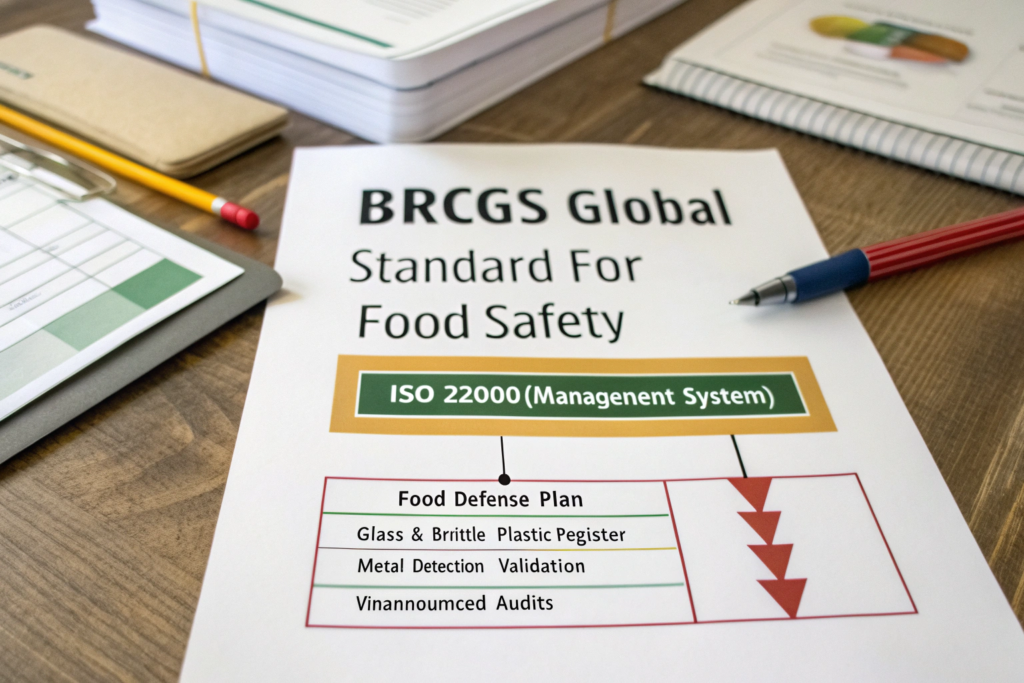
In the world of food safety, all certifications are not created equal. Many coffee buyers are familiar with ISO 22000, which is a strong, foundational standard for a food safety management system. BRCGS is different. It is a product safety and quality culture standard that is far more prescriptive, technical, and rigorously enforced. It is the standard demanded by the world's most risk-averse retailers.
BRCGS (Brand Reputation Compliance Global Standard) is a higher bar than a generic ISO 22000 management system because it is a product-focused, prescriptive standard that mandates specific, audited technical practices—including a comprehensive food defense plan, a detailed glass and brittle plastic register, validated metal detection, and a site-wide food safety culture assessment—that a general management standard does not explicitly require.
It is the difference between having a policy that says "we will prevent foreign object contamination" and being audited on whether you have a numbered, registered, and regularly inspected list of every single piece of glass on your entire production floor. BRCGS leaves no room for interpretation.
How Does a "Comprehensive Food Defense Plan" Go Beyond Basic Traceability?
Traceability tells you where your coffee came from. A food defense plan protects your coffee from intentional contamination or adulteration. This is the crucial difference in mentality. ISO 22000 requires traceability; BRCGS requires a proactive defense against intentional harm.
- The Threat Assessment: Our BRCGS-compliant food defense plan begins with a formal, documented "TALENT" threat assessment. We analyze every point in our process—from the cherry arriving at our gate to the sealed container leaving our loading dock—and ask, "Where is this product vulnerable to deliberate attack?" This covers not just production areas, but also raw material storage and the container loading area.
- Security Measures & Culture: The plan then mandates specific, audited security controls. This includes things like visitor sign-in procedures, secured access to production areas, and background checks for employees in sensitive roles. But more importantly, BRCGS requires that we train all staff on food defense awareness. Every single worker on our mill floor is part of our security team. They know to question an unauthorized person or an unusual activity. This is a culture of vigilance that a basic ISO 22000 system does not explicitly require or audit. For official guidance, you can learn more from the U.S. Food and Drug Administration's (FDA) resources on food defense.
Why Is the "Unannounced Audit" the Ultimate Test of Integrity?
In a standard certification model, the auditor calls and schedules a specific date. The factory cleans for a week and prepares. The audit is a performance. The BRCGS unannounced audit option is the ultimate test of a factory's true, everyday operational culture, not just its ability to perform on a planned day.
- The Unknown Date: For a site to achieve the highest AA or A grade, they must opt into the unannounced audit program. The auditor can show up at any point within a specified 90-day window. We do not know the date. We cannot stage a performance.
- The "Day-of-Life" Verification: What the auditor sees is a genuine "day in the life" of our factory. They see the real conditions on a random Tuesday morning. This audited reality is what gives a BRCGS AA-rated certificate its immense credibility with retailers. It is a guarantee that the high standards are maintained every single day, every single shift, not just for a scheduled inspection.
- A Supplier You Can Trust: This is the level of trust you gain when you work with a BRCGS-certified partner. It is an audited guarantee that our commitment to your product's safety is constant and unshakeable. This is the standard we uphold at Shanghai Fumao because we know it is the foundation of a trusted partnership.
What Does a BRCGS Audited Coffee Mill Look Like in Practice?
To truly understand the difference, it helps to visualize what the BRCGS standard means on the ground, on the floor of a coffee mill. It is not about fancy offices or high-tech machines. It is about a thousand small, auditable physical details that collectively create an environment where a food safety hazard is extraordinarily difficult to occur and is almost certain to be caught if it does.
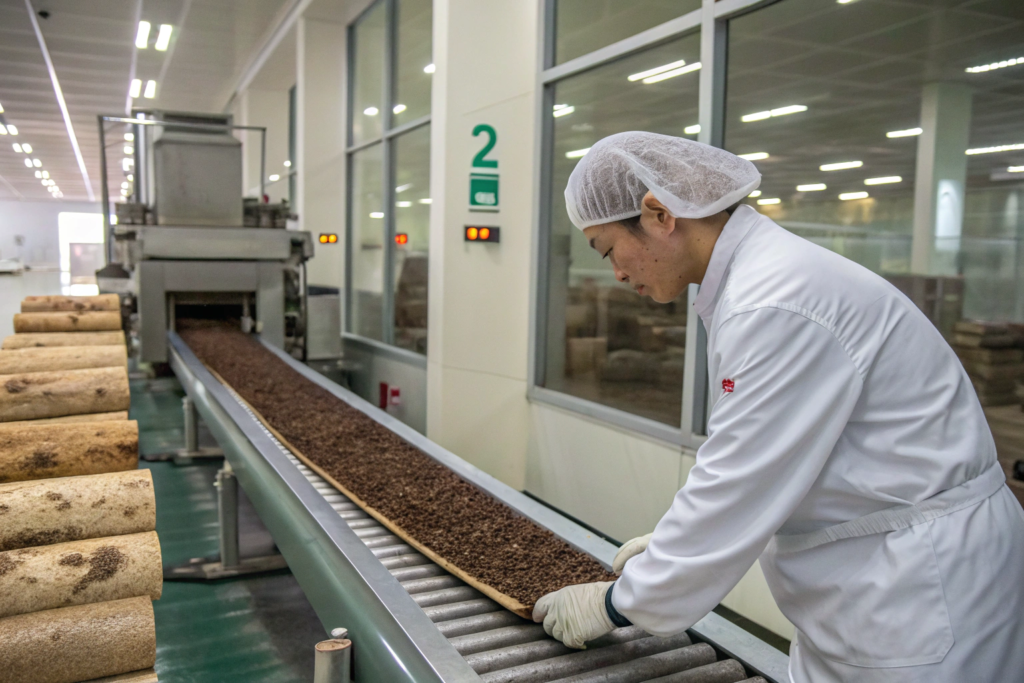
A BRCGS audited coffee mill is characterized by specific, physically verifiable conditions: all staff are in designated, pocketless work uniforms with hairnets, every piece of glass or brittle plastic on the site is registered and regularly inspected, and all product passes through calibrated metal detection and density sorting as a verified foreign body control.
These are the details the auditor checks. These are the details that protect your customer and your brand. At Shanghai Fumao, our daily operations are built around these systems.
Why Are "Glass and Brittle Plastic Registers" a Key Auditable Detail?
This is one of the most famous and feared elements of a BRCGS audit. It is a simple, painstaking, but powerfully effective tool to eliminate a specific physical hazard.
- The Hazard: Imagine a glass lens from a pressure gauge on a piece of machinery shatters over a conveyor belt of green coffee beans. Without a system, those tiny, transparent shards are impossible to see and would be an invisible physical contaminant for a roaster.
- The Register: Our BRCGS system requires a comprehensive "Glass and Brittle Plastic Register." Every single item on the entire production floor that could shatter is uniquely identified with a number, from the pressure gauge on the huller to the clock on the wall and the light fixture on the ceiling. Each is recorded in a logbook with its location and its condition.
- The Audited Inspection: At a defined frequency (e.g., weekly), a trained team member inspects every single item on the register. They check for cracks and chips, and they sign and date the log. The BRCGS auditor will physically pick an entry from the log, walk to that specific pressure gauge, and verify its condition. This is not a conceptual system. It is a physical, traceable, audited chain of custody for safety. This is the level of detail that defines a BRCGS facility.
How Does Validated Metal Detection Work as a "Critical Control Point"?
Foreign metal contamination is one of the most common and serious physical hazards in any dry food processing facility. A single screw or a piece of wire from a machine in a bag of coffee could cause serious injury to a consumer. BRCGS requires this risk to be managed as a Critical Control Point (CCP).
- Validated Equipment & Placement: Our production lines are equipped with powerful "rare-earth" magnets and a metal detector (often placed after the gravity separator and before the bagging station). The equipment is not just installed; it is validated. This means we have tested it with certified test pieces—a small ferrous sphere, a non-ferrous sphere, and a stainless-steel sphere of a known, small diameter (e.g., 1.5mm)—to prove it can detect and reject the minimum size of metal hazard.
- Continuous Monitoring: The metal detector is a CCP, meaning it is monitored in real-time. Our operators perform a documented "CCP check" with the test pieces at a defined frequency (e.g., every 2 hours) to prove it is still working. If the check fails, a documented corrective action procedure is triggered.
- The Audit Verification: The BRCGS auditor will review the CCP monitoring logs, check the calibration certificates for the test pieces, and ask the operator to perform a live test to demonstrate competence. This rigorous, audited system ensures that metal contamination is not just a possibility, but a controlled and verified risk. This is the standard we apply to every lot of our Grade 1 Arabica.
How Can a Roaster Verify a Supplier's BRCGS Certification is Valid?
A PDF of a certificate is easily forged. The power of the BRCGS system lies in its public, transparent directory. You can and absolutely should independently verify any supplier's claim of BRCGS certification. This is a simple, five-minute check that confirms you are working with a legitimate, high-performing partner, not someone with a fake certificate.
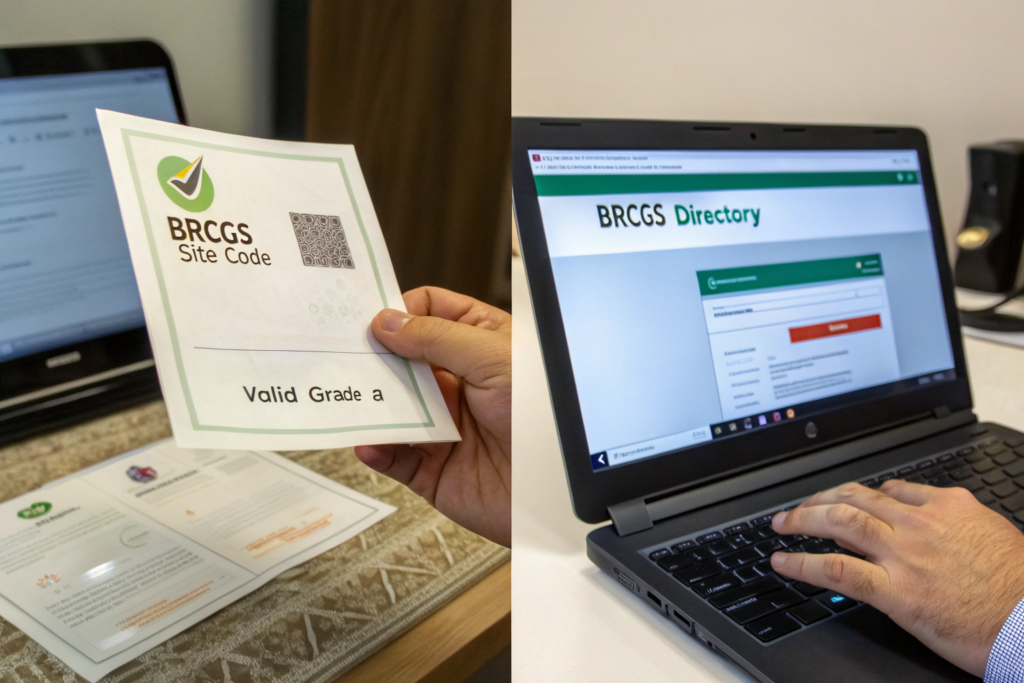
A roaster can instantly verify a supplier's BRCGS certification by requesting the supplier's unique BRCGS Site Code, going directly to the official BRCGS Directory online, and entering that code to confirm the site's certification status, its current audit grade, and the exact product scope covered by the certificate.
If a supplier hesitates to provide their site code, that is an immediate and major red flag. A legitimate, proud supplier will give it to you willingly.
What Is a BRCGS "Site Code" and Why Must It Be on the Certificate?
The BRCGS Site Code is the unique digital fingerprint of every certified production facility. It is the key to the BRCGS public database and is the most important piece of information on the entire certificate.
- A Unique Identifier: Unlike a company name, which can be similar to others, every single production site in the BRCGS system is assigned its own unique alphanumeric code. Our dry mill in Baoshan has its own specific code. This allows you to verify the status of the exact facility that will process your coffee.
- The Location of the Code: On a valid BRCGS certificate, this Site Code is prominently displayed, usually near the top of the certificate or in a designated "Site Details" section, along with the site's legal address. If a supplier provides a certificate without this code, or claims not to know it, the certificate is likely fraudulent. Do not accept the document. Demand the code and verify it yourself.
How Can You Check the Supplier's Audit "Grade" and Scope Online?
The BRCGS Directory does more than just confirm a certificate is valid. It tells you exactly how well the supplier performed on their audit, which is a crucial and often overlooked piece of information.
- The Audit Grade: BRCGS audits result in a grade: AA, A, B, C, or D. The grades are crucially linked to the audit type. An AA or A grade is typically required for an unannounced audit, which is the gold standard. These top grades signal a mature, everyday food safety culture. A "B" grade is a pass on a pre-announced audit. While still certified, it represents a lower level of demonstrated continuous compliance.
- The Critical Scope: The directory entry will also list the exact "Product Scope" of the certification. You must verify that this includes the processing of green coffee. The certificate for our farm should explicitly list something like "Green Coffee Beans" or "Dried Food Products." If the scope is for something completely different, the certification does not apply to the coffee you are buying.
- The Proactive Supplier: At Shanghai Fumao, we are proud of our audit performance. We provide our BRCGS Site Code and direct links to the BRCGS Directory on our Certifications page. We do not wait for you to ask; we give you the tools to verify us, because our certification is a core part of our value proposition.
Conclusion
Finding a coffee supplier with a valid, high-grade BRCGS Food Safety Certification is the single most effective way to de-risk your supply chain and protect your brand's reputation. It moves the conversation from subjective trust to objective, verifiable competence. BRCGS is not just another logo. It is a globally recognized guarantee of a deeply embedded, rigorously audited, and unshakeable food safety culture, demonstrated through unannounced audits and specific technical practices that a generic standard like ISO 22000 does not require.
For you, the buyer, verification is simple: demand the supplier's unique BRCGS Site Code, check their grade on the public directory, and only partner with those who are transparent and proud of their AA or A-rated, unannounced audit result.
At Shanghai Fumao, our commitment to food safety is the non-negotiable bedrock of our operation. We do not just have a certificate; we live the standard every day. Our BRCGS certification is your guarantee that our exceptional Yunnan coffee is also an exceptionally safe product.
If you are looking for a supplier whose food safety credentials you can verify in five minutes, we invite you to check our BRCGS certificate online and then start a conversation. Email Cathy Cai. Ask for our "BRCGS Site Code and Certificate." Contact Cathy at: cathy@beanofcoffee.com