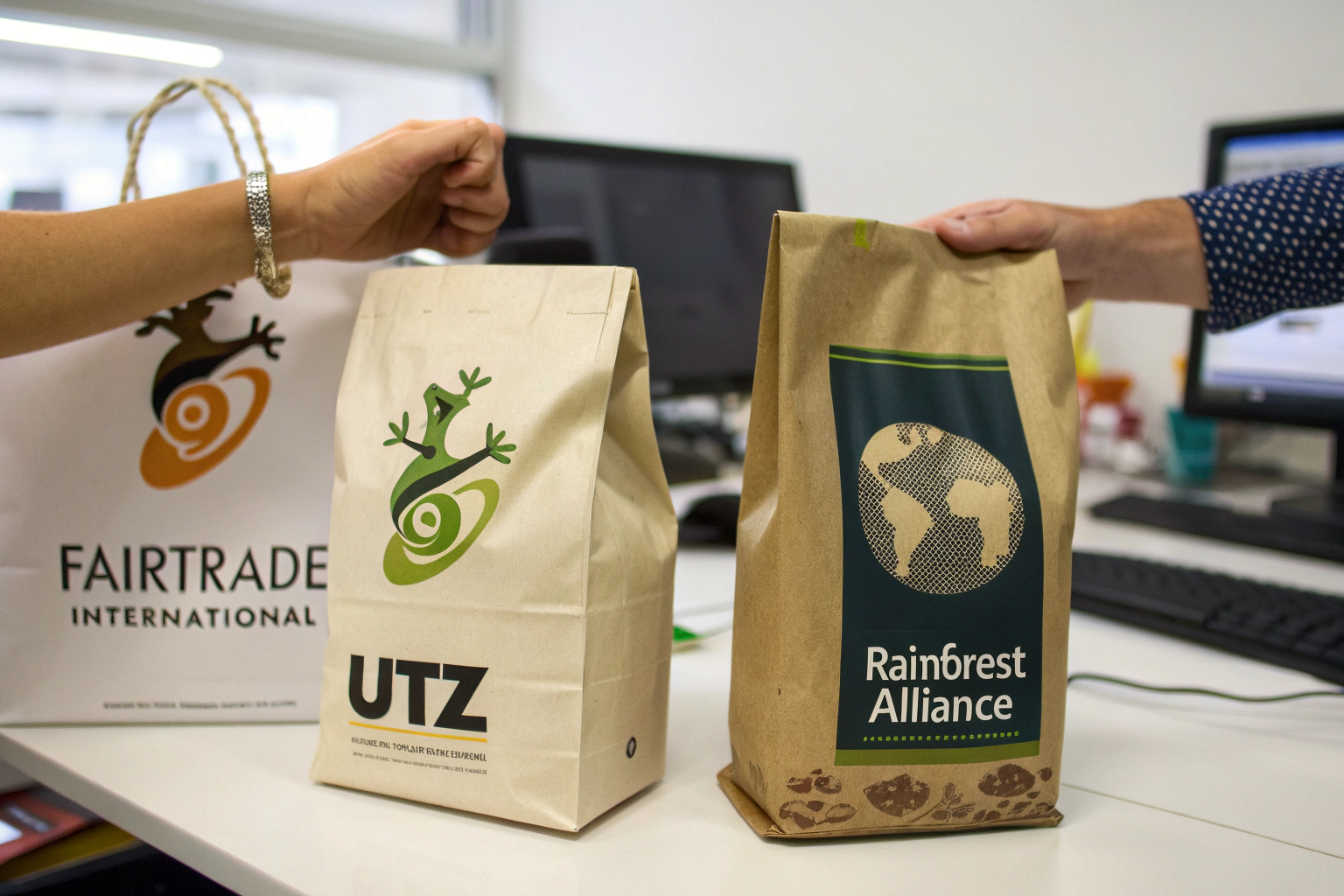
I once had a buyer ask me, "Which is better, UTZ or Fair Trade?" I paused. It was like asking whether a seatbelt or a minimum wage law was better. They both protect people, just in fundamentally different ways. The question assumed they were two competing brands doing the same thing. In reality, they represented two completely different philosophies of sustainability. And in 2026, the landscape has evolved further. One has been absorbed into a larger ecosystem, and the other has doubled down on its unique economic model. The pain for a distributor is choosing the right certification story for a specific product and customer. Putting the wrong label on the wrong coffee misses the target market entirely.
In 2026, the primary difference is that UTZ, having fully merged into the Rainforest Alliance in 2019, now represents a holistic, baseline-to-advanced "Farm Standard" focused on environmental and social management practices, while Fair Trade certification centers on a specific, minimum price guarantee and an economic development "Premium" paid directly to producer organizations, representing a distinct narrative of economic justice and empowerment.
Neither is inherently "better." They are different tools for different sustainability goals. As a producer holding both, let me explain the practical difference. You can learn more about our integrated approach on our Sustainability page at Shanghai Fumao.
How Did the Rainforest Alliance "Frog" Absorb the UTZ Program?
To understand the certification landscape today, you must first understand a major corporate merger that reshaped it. The UTZ certification you see on older coffee bags no longer exists as an independent entity. It was fully absorbed into the Rainforest Alliance, consolidating two of the world's largest coffee certification programs under a single, unified standard.
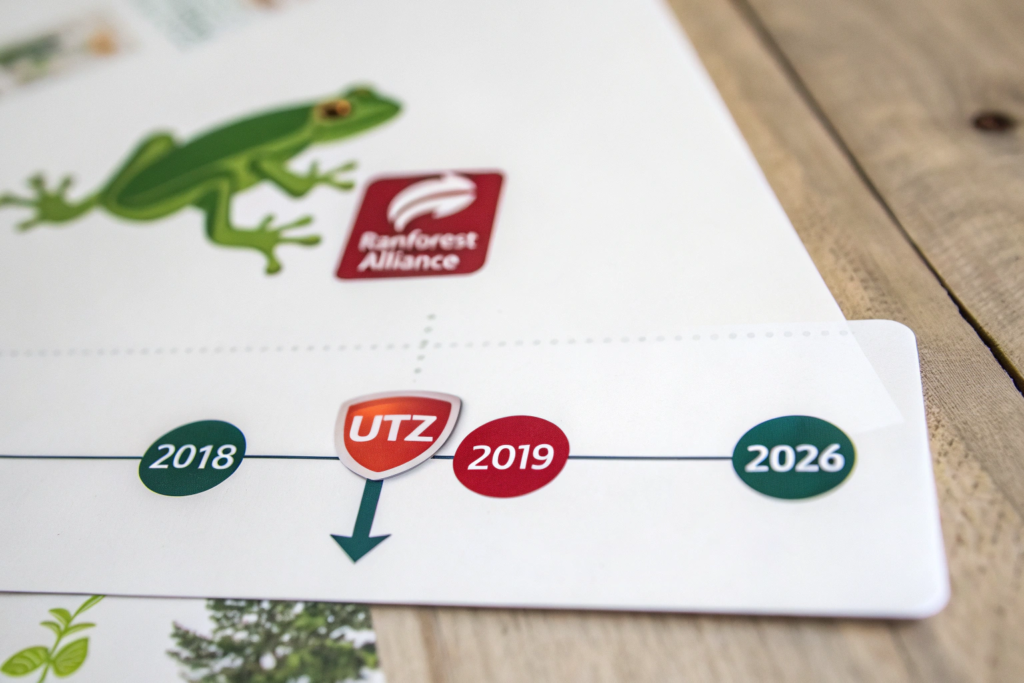
The Rainforest Alliance successfully merged with UTZ in 2019, a strategic consolidation that combined the Rainforest Alliance's deep expertise in biodiversity and ecosystem conservation with UTZ's strengths in good agricultural practices and farm management, creating a single, more powerful, and more efficient standard. This new, unified standard, which came into full force in 2021, is the only active certification today. A UTZ certificate issued before the merger is valid, but all new audits are conducted against the single 2020 Rainforest Alliance Sustainable Agriculture Standard.
What Core UTZ Principles Were Integrated into the New Standard?
UTZ was not discarded. Its most impactful ideas and focus areas were deliberately woven into the DNA of the new Rainforest Alliance program. The merger took the best of both worlds.
- From UTZ: The "Good Agricultural Practices" Engine. UTZ was famous for its practical, hands-on focus on helping farmers professionalize their operations. It emphasized better farm management, record-keeping, efficient water use, and safe pesticide handling. This entire "better farming" philosophy became the core of the "Climate-Smart Agriculture" pillar of the new standard.
- From UTZ: The Digital Traceability Backbone. UTZ invested heavily in a robust, digitized chain-of-custody system, operated through the "Good Inside Portal." This technology and expertise were critical in building the powerful, unified "MultiTrace" platform that the Rainforest Alliance uses today to issue and track Transaction Certificates for every sale of certified coffee.
- From UTZ: A Broad, Scalable Foundation. UTZ was designed for mainstream adoption. Its pragmatic approach made it accessible to large-scale farms and cooperatives, not just niche specialty growers. This commitment to scale has been fully absorbed into the Rainforest Alliance's mission, making it a viable certification for our high-volume, mainstream partners. You can see how this baseline is so important in our article on Why Is 4C Certification Important for Mainstream Coffee Distributors?.
How Does the Unified Rainforest Alliance Standard Differ from the Old UTZ?
The new standard is more than just a combination; it is an evolution. While it retained the practical farm management DNA of UTZ, it is fundamentally different from the old program in its structure and core philosophy.
- A Stronger "Zero" Standard on Deforestation: The unified standard takes a much harder line on deforestation, adopting a strict 2014 cut-off date and requiring farms to use satellite monitoring and geolocation data to prove their land has not been recently converted from forest. This is more rigorous than the old UTZ standard.
- A Mandatory "Continuous Improvement" Journey: The new program is not a pass/fail checklist. It is built on a journey of "continuous improvement." Farms are assessed against a "Smart Meter," and they must demonstrate measured progress against a set of sustainability indicators over time. You cannot just stand still; you must get better.
- A Deeper Focus on Social Equity: While the old UTZ tackled child labor, the new standard takes a much deeper dive into systemic social issues, explicitly addressing forced labor, gender equality in farming communities, and the step-by-step journey toward a living wage for all farm workers. For the official documentation on the merger, you can visit the Rainforest Alliance website.
What Is the Unique Economic Guarantee of the Fair Trade Model?
While the Rainforest Alliance focuses on the "how" of farming—the practices on the land—Fair Trade is fundamentally an economic model. Its unique power lies not in the agricultural standard, but in a radical, audited financial guarantee. It is a direct intervention in the global coffee market, designed to rebalance power between the smallholder producer and the commodity buyer.
The unique economic guarantee of the Fair Trade model in 2026 consists of two connected financial mechanisms: the Fairtrade Minimum Price, which acts as a safety net floor price to cover the cost of sustainable production when the volatile C-market crashes, and the Fairtrade Premium, an additional sum of $0.20 per pound, which is paid directly to the farmer cooperative's democratically managed bank account to invest in community-chosen projects.
This economic premium is mandatory, audited, and paid directly to the producer. It is not a suggestion; it is the core feature of the certification.
What Are the 2026 Fairtrade Minimum Price and Premium for Arabica?
These are not abstract concepts. They are specific, verifiable numbers that are updated periodically. When you buy a container of Fairtrade certified washed Arabica, a mathematical calculation determines the absolute minimum amount that must be paid to the producer.
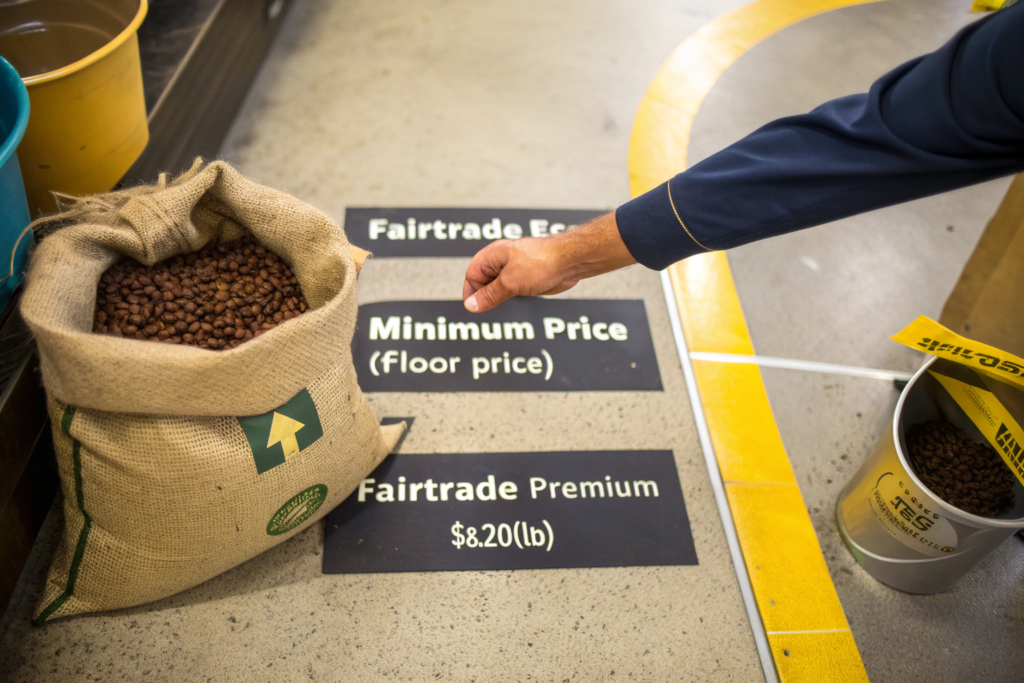
- The Safety Net in Action: The Fairtrade Minimum Price for washed Arabica is currently set at $1.80 /lb (FOB origin). As I write this, the C-market price is significantly higher than that. Therefore, the "Fair Trade price" you pay is effectively the higher of the two: the current C-market price OR the $1.80 Fairtrade floor. The power of the Fairtrade floor is that if the volatile C-market were to crash to $1.10/lb tomorrow, you would still pay $1.80/lb. The farmer's cost of production is covered.
- The Mandatory Premium: Regardless of the market price, an additional $0.20 per pound is paid on top. This is the Fairtrade Premium. This money is never absorbed into a farmer's general operating revenue. It is a separate payment, legally ring-fenced into the cooperative's democratically managed "Premium Committee" account.
- What the Premium Funds: The cooperative's general assembly democratically votes on how to spend this collective fund. It might invest in a new community health clinic, scholarships for farmers' daughters, or a technical assistance program to improve coffee quality. The distributor buying the coffee can often request a "Premium Impact Report" to see exactly how their purchase contributed to these community projects. This creates a powerful, verified story of direct impact for a brand. You can find the official, current pricing table on the Fairtrade International website.
How Does Fair Trade's "Democratic Premium Committee" Empower Communities?
This is the single most powerful and human part of the Fair Trade model. It is the mechanism that turns a financial premium into real, community-led development. It is the ultimate form of accountability.
The Premium is not a top-down aid donation. It is a legal and audited empowerment structure. The 4C standard ensures a baseline of decent work; Fair Trade creates a structure where workers actively decide how development money is spent. The Premium Committee, which is legally separate from the farm's business management, must be democratically elected by the workers and farmers themselves.
During our annual Fair Trade audit, the auditor thoroughly reviews the Premium Committee's meeting minutes, the spending receipts, and the democratic election records. They verify that the money was spent as the community intended. This system directly gives power and agency to the people who grow the coffee in a way that no other major certification standard does. It is a powerful, human-centric story that deeply resonates with consumers who want their purchase to have a tangible impact.
How Do You Choose the Right Seal for Your Brand's Sustainability Story?
You now understand the fundamental difference between the seals. The final, crucial question is: which one is right for your specific product and your specific customer? This is a strategic marketing decision, not a moral one. The best choice is the one that tells the most authentic story about that particular coffee and creates the strongest connection with your target audience.
As a distributor or roaster in 2026, you should choose the Rainforest Alliance seal when your brand story focuses on environmental action, biodiversity, and a holistic, scientifically managed path to sustainability, and you should choose the Fair Trade seal when your narrative is centered on social justice, economic empowerment, and creating a direct, human link between the consumer's purchase and a specific, verifiable community project.
A "Single-Estate, Regeneratively Grown" micro-lot is perfectly matched with the story of the Rainforest Alliance. A "Community Breakfast Blend" sourced from a smallholder cooperative is an ideal vehicle for the story of Fair Trade. And at Shanghai Fumao, because we hold both certifications, we can often offer the same high-quality Yunnan coffee under the seal that best fits your brand. Learn more about our full certification portfolio on our Certifications page.
When Is the "Holistic Sustainability" Story of the Frog the Best Fit?
The unified Rainforest Alliance seal tells a story of comprehensive, professional, and scientifically grounded environmental action. It is a seal that communicates a big-picture commitment to the planet.
- The Brand Story: "We are committed to a coffee that is grown in harmony with nature. Our coffee is sourced from a certified farm in Yunnan that is actively protecting primary forests, restoring native tree cover, conserving water, and fighting climate change through healthy soil. This seal verifies that our coffee is part of the solution."
- The Ideal Product: The Rainforest Alliance seal is an ideal fit for a premium single-origin coffee where the estate's specific environmental story—like our work in the Gaoligong Mountains—is a core part of its value. It powerfully appeals to a consumer who is motivated by a love of nature, wildlife, and a fear of deforestation and climate change. The seal acts as a scientific, third-party verification of that environmental commitment. This is a core part of the narrative we help build in our Private Label Program.
When Does the "Community Empowerment" Story of Fair Trade Win?
The Fair Trade seal, conversely, tells a story that is centered entirely on people. It is not about the tree; it is about the farmer. Its power is in its specific, human economic narrative.
- The Brand Story: "Your morning cup of coffee is a powerful vote for a better world. This coffee was sourced under strict Fair Trade terms, which guaranteed the farmer a fair, stable price that covered their costs, plus an additional cash premium that was invested directly into a community health project voted on by the farmers themselves. Your purchase made that project happen."
- The Ideal Product: A Fair Trade seal is a natural and perfect fit for a broader "Community Blend," a core espresso offering, or a product specifically targeting the values-driven grocery consumer. The narrative of the specific, localized impact of the Fairtrade Premium is the most potent marketing tool in the certification world, as it allows a consumer to directly connect their daily purchase to a tangible, positive outcome for a real farming community. It is the certification of economic justice.
Conclusion
The difference between UTZ-Rainforest Alliance and Fair Trade in 2026 is a difference in their core mechanism of change. The unified Rainforest Alliance seal, which has absorbed the legacy of UTZ, is fundamentally an audited standard for environmental and social management practices. It is about the "how" of farming. Fair Trade is fundamentally an audited guarantee of an economic price floor and a community development premium. It is about the "how much" and "who decides."
They are not in competition; they are complementary tools in the drive for a more sustainable and ethical coffee industry. A distributor should not ask which is "better" but rather, "Which authentic story am I trying to tell with this specific product?"
At Shanghai Fumao, we are proud to hold both certifications. Our vertical integration allows us to offer you both a pure environmental story and a powerful economic justice story, all from the same exceptional coffee grown on our land in Baoshan.
If you are planning your product line and want to discuss which certification is the best strategic fit for your brand, we are happy to provide samples and documentation for both our Rainforest Alliance and Fair Trade certified lots. Email Cathy Cai. Ask for a "Comparative Certification Sample Pack." Contact Cathy at: cathy@beanofcoffee.com