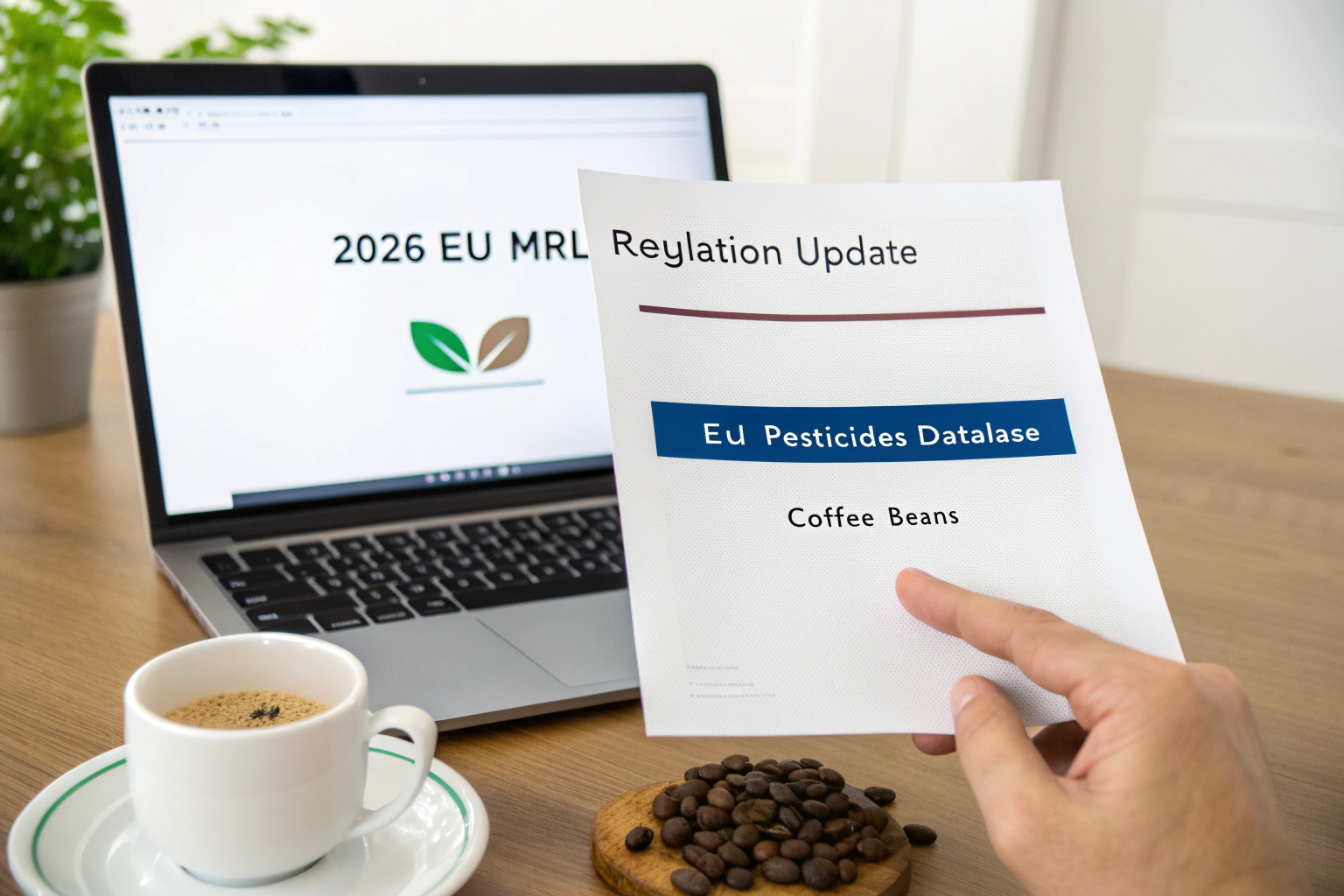
I sat in on a tense meeting last year between a European buyer and a potential supplier from another origin. The buyer asked, "Can you guarantee your coffee meets the new EU MRLs for glyphosate coming into force next year?" The supplier's face went blank. He had no idea what an MRL was. He lost a half-million-euro contract on the spot. The buyer turned to me. I pulled up our latest SGS multi-residue report on my laptop. I showed him the Certified Analysis for our most recent lot. For a panel of over 500 pesticides, the result for every single one was the same: "Not Detected." Our coffee was already compliant with the proposed 2026 levels. The buyer sighed with relief. The pain of a failed pesticide test is absolute rejection at the border, the destruction of your coffee, and a black mark on your importer record.
The new EU pesticide MRLs for coffee beans in 2026 are defined by a general default Maximum Residue Limit of 0.01 mg/kg for all pesticides not explicitly listed in the EU's commodity database, along with significantly lowered limits for commonly detected substances, all rigorously enforced through the RASFF system and import controls.
This is the new reality of the European market. It is no longer enough to be "specialty" or "organic" by word. You need the laboratory evidence. Let me explain exactly what the rules are, what they mean for Chinese coffee, and how to navigate them. At Shanghai Fumao, we have a proactive food safety program to ensure our coffee meets these strict standards. This is part of our Quality Control commitment.
What Is a "Default MRL" and How Does It Apply to Coffee?
To understand EU pesticide regulations, you must first understand the core legal principle: the "default MRL." Most coffee buyers mistakenly believe that if a pesticide is not mentioned on a list, it is allowed. The terrifying truth is the exact opposite. If a pesticide is not on the list, it is effectively banned at the most miniscule trace level scientifically detectable.
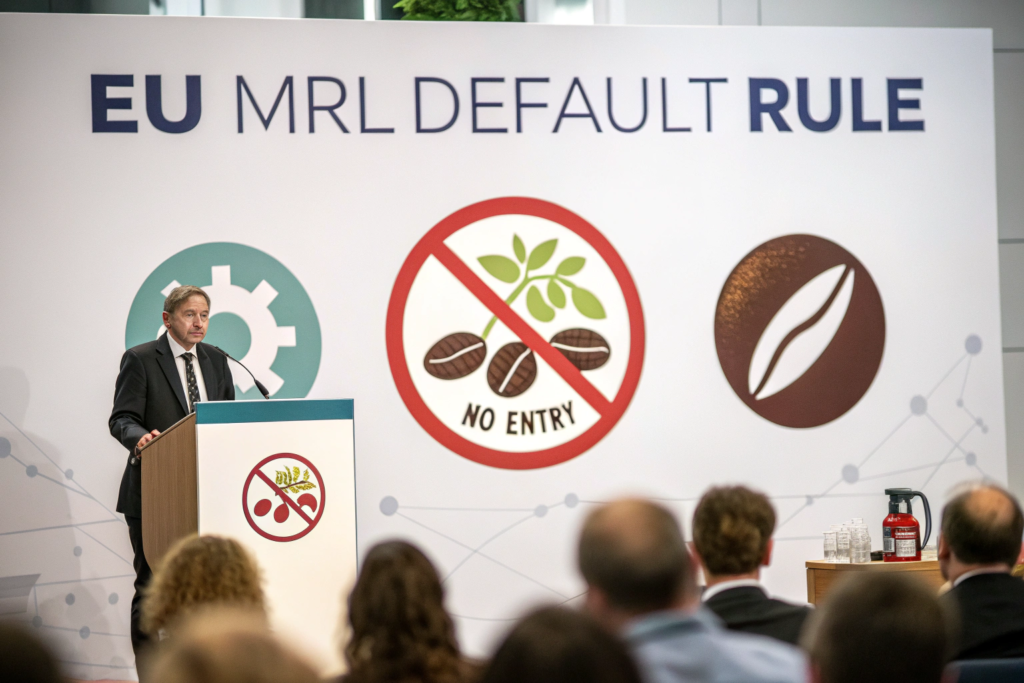
The "default MRL" is a cornerstone of EU food law that sets the Maximum Residue Limit for any active pesticide substance not explicitly listed in the EU's MRL database at the analytical limit of determination, which is 0.01 mg/kg, effectively banning the presence of hundreds of unregistered, obsolete, or generic chemicals in coffee at anything above a trace background level.
This is the invisible net that catches a vast number of chemicals. It is not a suggestion. It is the law. The burden of proof is on the seller to demonstrate the absence of any of these substances above that microscopic threshold. This is why our testing is so rigorous.
Why Is the 0.01 mg/kg Default Limit a Major Hurdle?
The number 0.01 mg/kg (milligrams of pesticide per kilogram of coffee) is extraordinarily small. It is 10 parts per billion (ppb). To help visualize this, imagine one drop of an active substance dissolved in an Olympic-sized swimming pool. The EU considers this a potentially significant residue and an unacceptable risk. This is a level that can only be reliably detected and quantified by advanced analytical chemistry, not a cheap field test. The default MRL effectively acts as a near-zero-tolerance policy. It immediately bans the use of hundreds of older, broad-spectrum insecticides and fungicides that are still legal in some producing countries, unless the exporter can prove they are not present at this unbelievably low level. This is the standard we test against.
What Is the EU "RASFF" System and How Does It Enforce MRLs?
The EU does not just write rules; it actively polices them through a powerful, public, and highly effective alert system called the Rapid Alert System for Food and Feed (RASFF). This is the enforcement arm of the regulations. It is a real-time, cross-border digital network connecting all EU member states' food safety authorities. When a container of coffee from any origin is tested at any EU port and a laboratory confirms a pesticide residue above the legal MRL, an instant RASFF alert notification is issued. This alert is seen by every border control point in the entire EU. The specific exporter and the country of origin are immediately flagged. This leads to systematic checks on subsequent shipments. A single failed test can be devastating; it blacklists the exporter and results in the mandatory destruction or costly re-export of the contaminated coffee. You can see live, public data on these alerts on the official RASFF website.
Which Specific Pesticides Are Being Tightened for Coffee in 2026?
While the "default MRL" covers the vast majority of chemicals, the EU also actively maintains a list of specific, commonly used pesticides for which they have set explicit, and often drastically changed, residue limits. These are the substances that have been detected in the past, and the regulatory focus is tightening on them in 2026. Knowing which specific compounds are under the most scrutiny is essential for a responsible buyer to understand what to test for.
For 2026, the EU is specifically tightening Maximum Residue Limits on a range of active substances relevant to coffee production, including a deepening restriction on the once-common herbicide Glyphosate and stricter limits on various neonicotinoid insecticides and triazole fungicides, reflecting the EU's Farm to Fork strategy of accelerating the reduction of chemical pesticide use.
These changes are not academic; they directly dictate which tests your supplier must be running to guarantee legal access to the European market. A clean test from three years ago is irrelevant if it did not measure these substances at the newly required, lower levels.
Why Are Glyphosate and Neonicotinoids Under Intense Scrutiny?
Glyphosate and neonicotinoids have become the focal point of intense regulatory and public scrutiny in the European Union. These chemicals are emblematic of the EU's broader political and legal shift away from chemical-intensive agriculture, making them the highest-risk substances for any coffee importer.
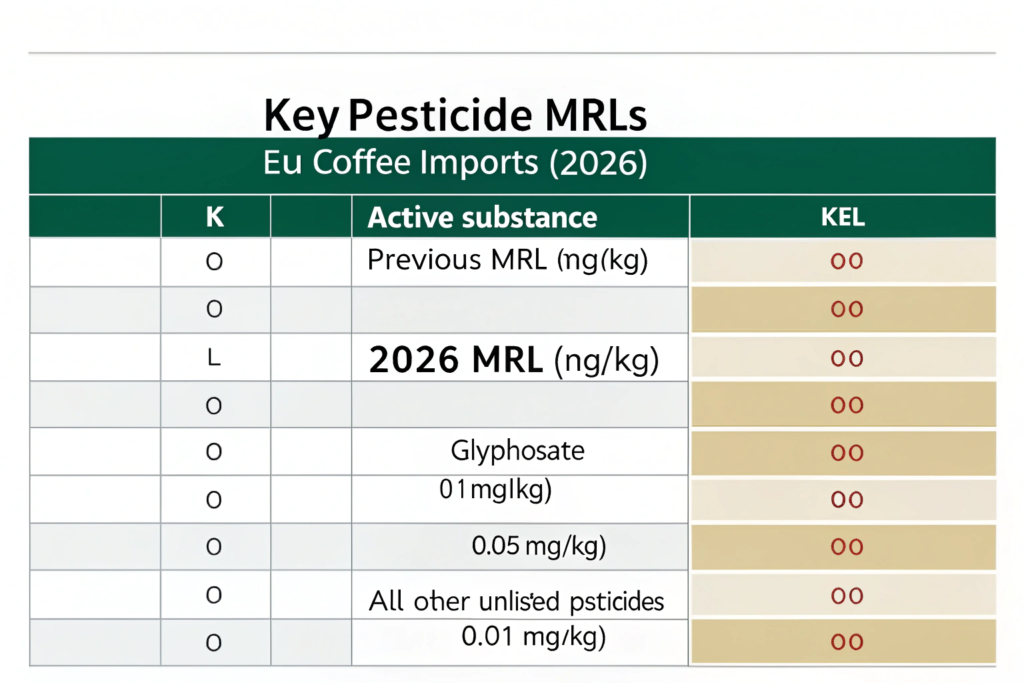
Glyphosate's EU approval has been a decade-long political battle, with its current authorization expiring in 2026. Regardless of its re-approval, the MRL for glyphosate in imported coffee will almost certainly be lowered. Its presence is a major reputational risk. Neonicotinoids, such as imidacloprid and clothianidin, are largely banned for outdoor use within the EU due to their proven toxicity to bees and pollinators. Consequently, their import tolerances are incredibly strict. Finding any trace of a banned neonicotinoid on an imported coffee is an automatic rejection and a major RASFF alert. A single positive test for either of these chemical classes can destroy a roaster-importer relationship and brand. This is why our program at Shanghai Fumao is built on a foundation of not just passing a test, but actively avoiding these high-risk chemistries entirely. For more on the EU's strategy on pesticides, you can visit the European Commission's Farm to Fork page.
How Can a Supplier Prove Their Coffee Is "Below Detection Limits"?
Given the extreme sensitivity of these limits and the devastating consequences of a failure, a responsible supplier will not just talk about quality—they will provide the objective, verifiable evidence of it. The proof is a laboratory report that a competent buyer can verify.
To prove a coffee is compliant, you cannot rely on a generic sales guarantee. You must request a current, lot-specific Certificate of Analysis (CoA) from an ISO 17025 accredited laboratory that performed a multi-residue pesticide screen using LC-MS/MS and GC-MS/MS methods. This is the exact same verification process we discuss in How Do I Know If a Coffee Factory Certificate of Analysis Is Real?. The CoA must list the individual Limit of Quantification (LOQ) for each substance, and that LOQ must be at or below the required 0.01 mg/kg default MRL. A result that simply says "< MRL" is insufficient without stating the actual detection limit. A result of "Not Detected" is only valid if the report states the LOQ was 0.01 mg/kg or lower. This is the only language a customs authority will accept.
How Is Yunnan Arabica Produced to Meet These Stringent MRLs?
The best way to pass a pesticide test is not to use pesticides. A clean laboratory report is not an accident. It is the final, documented proof of a deliberate, holistic farming and processing system that begins months before the coffee is ever harvested. The coffee's extraordinary cleanliness is a result of our geography and our disciplined agricultural practices.
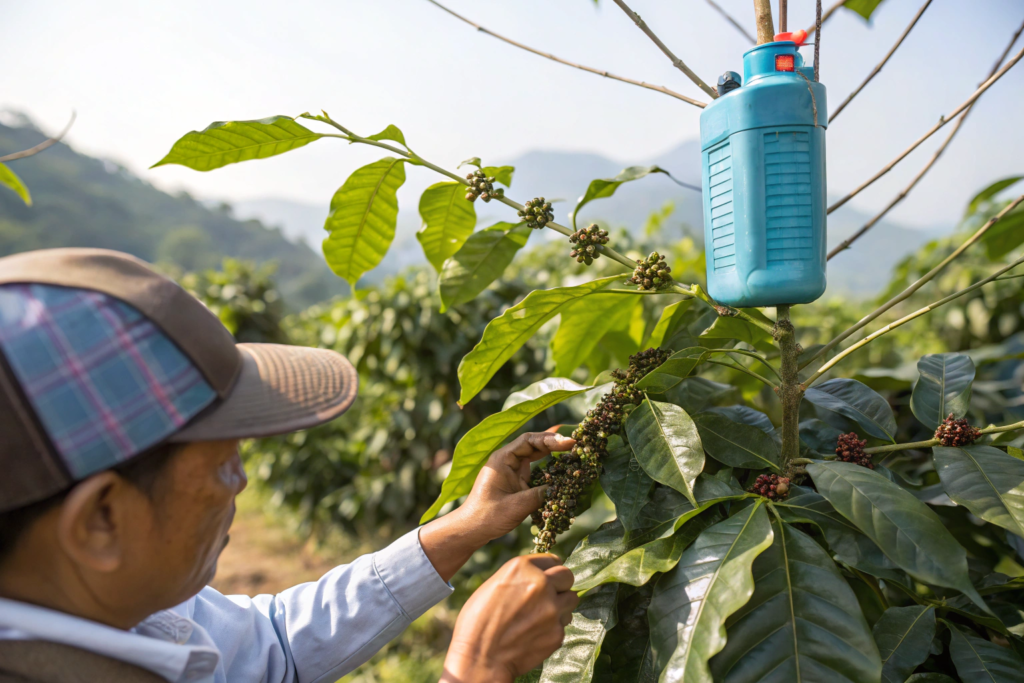
Our Yunnan Arabica meets stringent EU MRLs through a combination of our high-altitude, isolated terroir which naturally reduces pest pressure, an Integrated Pest Management (IPM) system that uses non-chemical controls like pheromone traps and sticky insect traps as the first line of defense, and an industry-leading commitment to certified organic production on a significant and growing portion of our estate.
The clean test is the evidence, but the farming system is the guarantee. This is the story we discussed in Are Yunnan coffee beans organic and non-GMO?.
How Does an Integrated Pest Management (IPM) System Replace Pesticides?
The most effective way to ensure a clean pesticide test is to build a farming ecosystem where synthetic pesticide use is not the first response. Integrated Pest Management (IPM) is a scientific, decision-making process that uses a deep understanding of the pest's life cycle and its interaction with the environment.
The IPM pyramid starts with prevention: selecting disease-resistant Catimor varietals like our P3 and P4 and maintaining plant health through optimal soil nutrition. Our first line of direct defense is not a chemical spray. It is biological and physical. We deploy pheromone traps across the estate to monitor pest populations and disrupt mating cycles. We use powerful sticky blue and yellow insect traps to capture flying adult pests. Targeted, organic-approved biopesticides are only considered as a last resort, when monitoring indicates a specific, localized outbreak that these other methods cannot control. This is a deeply knowledge-intensive approach, but it is the only one that guarantees a clean product while maintaining a healthy ecosystem for our workers and the surrounding biodiversity of the Gaoligong Mountains.
Why Is Organic Certification the "Master Key" to MRL Compliance?
For a buyer who wants to eliminate the risk of a synthetic pesticide failure entirely, there is a single, definitive solution: certified organic. Organic certification acts as a comprehensive, legally recognized system that makes a synthetic pesticide contamination event extraordinarily unlikely.
Certified organic farming, as detailed in our Sustainability and Certifications pages, is not a partial process. It is a complete, audited prohibition on the use of synthetic pesticides, herbicides, and fertilizers. For our certified organic lots, the entire farming system—the inputs, the field management, the worker training—has been verified by an independent, accredited certifier like OFDC. A multi-residue pesticide test of an organic lot is therefore a final, analytical confirmation of a systemic reality. For a roaster importing into the EU, a certified organic coffee is the lowest-risk product available. It is the master key to MRL compliance.
Conclusion
Navigating the new 2026 EU pesticide MRLs for coffee is a test of a supplier's competence and a buyer's due diligence. The regulations are unforgiving and the penalties for failure are absolute. The path to compliance is not a single certificate, but a complete, transparent system.
For the buyer, the solution is clear: partner with a supplier who can provide the verifiable data—a lot-specific, multi-residue, ISO 17025 accredited lab report with the required detection limits. For the producer, the solution is a commitment to a farming system, like IPM and certified organic, that makes a clean report a foregone conclusion.
At Shanghai Fumao, our entire operation is built to meet this challenge. Our coffee is not just delicious; it is meticulously farmed, tested, and documented to be among the cleanest in the world.
If you are shipping to the EU and need to secure a documented, fully compliant supply of Yunnan Arabica, I invite you to review our latest multi-residue pesticide report.Email Cathy Cai. Ask for the "EU MRL Compliance Data Pack." Contact Cathy at: cathy@beanofcoffee.com