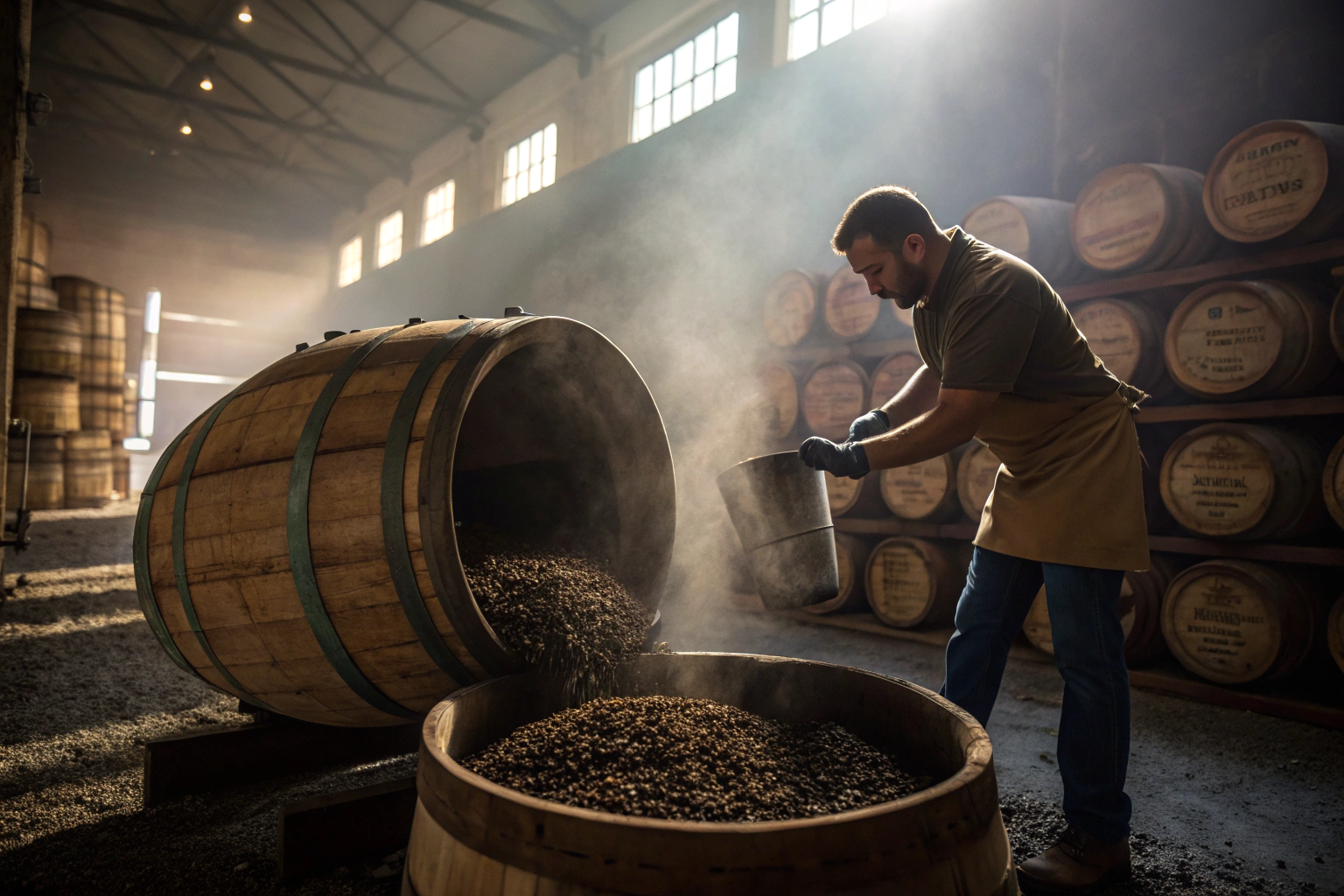
A craft roaster from Portland emailed me three months ago. "I want a barrel aged coffee," he wrote. "Not flavored coffee. Not beans sprayed with extract. I want green coffee that actually rested in a bourbon barrel for weeks and absorbed the character of the wood and the spirit. Do you do this? Because every supplier I find is either selling fake barrel aged coffee or sending samples that taste like cheap whiskey and regret."
I smiled at the email. We had started barrel aging experiments in Baoshan two harvests ago. The first batch was a disaster—moldy beans, overpowering whiskey notes, a cupping score I am embarrassed to remember. The second batch was better. The third batch scored 86 points and sold out to three roasters in a week. Finding a real barrel aged coffee supplier is hard because the process is genuinely difficult to do well.
To find a legitimate supplier of barrel aged green coffee, you must seek out producers who age the green beans—not roasted beans—in freshly emptied spirit barrels for a controlled period, who monitor moisture and mold risk obsessively, and who can provide documentation of the barrel source, aging duration, and pre- and post-aging cupping scores.
This is a niche within a niche. The volumes are tiny. The process is risky. The margin for error is zero. But when barrel aging is done correctly, the result is a coffee with authentic spirit notes integrated into the bean's natural flavor—not a coating, not an additive, but a genuine transformation. Here is how to find it, verify it, and buy it.
What Is Authentic Barrel Aged Green Coffee?
There is a lot of confusion in the market about what barrel aged coffee actually is. Some roasters sell "barrel aged" coffee that is simply roasted beans tossed in a barrel for a few days with whiskey-soaked wood chips. This is flavoring, not aging. The beans smell like a cocktail, but the flavor is superficial. It sits on the surface. It fades quickly. It is not integrated into the bean.
Authentic barrel aged green coffee is different. The aging happens before roasting. Green coffee beans are placed into freshly emptied spirit barrels—usually bourbon, whiskey, rum, or wine barrels—and left to rest for a period of days to weeks. The green beans are porous. They absorb moisture and volatile compounds from the barrel wood. The compounds penetrate into the bean structure. The flavor becomes part of the bean, not a coating on it.
Authentic barrel aged coffee is green coffee rested in freshly emptied oak barrels so the porous beans slowly absorb aromatic compounds—vanillin, lactones, tannins, and residual spirit notes—from the wood, resulting in an integrated flavor that survives roasting and emerges in the cup as a genuine marriage of coffee and barrel character rather than a superficial additive.
The key word is "green." Aging roasted coffee in barrels produces a different product. The roasted bean is dry, brittle, and full of roasted oils. It does not absorb barrel compounds the same way. The green bean, with its higher moisture content and intact cellular structure, is a better sponge. The absorption is deeper and more uniform. The result after roasting is a more balanced, integrated flavor.
What Barrels Are Used for Aging Green Coffee?
The barrel matters enormously. It is not just a container. It is an ingredient.
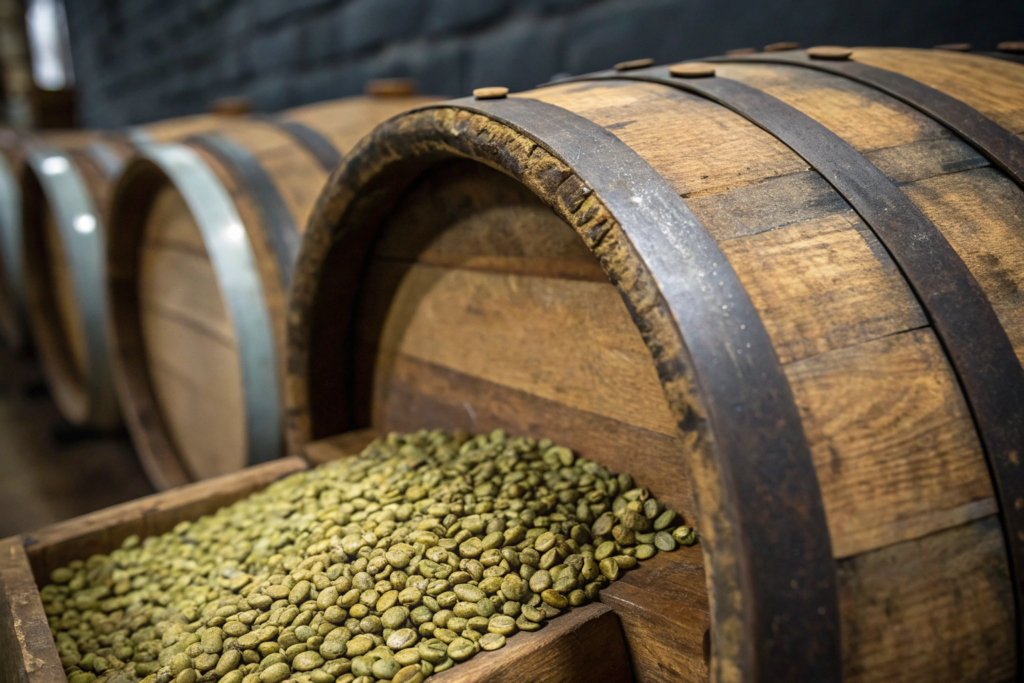
Most producers use freshly emptied spirit barrels. Bourbon barrels are the most common because they are widely available and because bourbon's sweet vanilla, caramel, and oak notes pair beautifully with coffee's natural chocolate and nut flavors. By law, bourbon must be aged in new charred oak barrels, so each barrel is used only once for bourbon. After the whiskey is bottled, the barrel is emptied and sold. These once-used barrels still contain significant residual spirit soaked into the wood. They are perfect for coffee aging.
Wine barrels are also used, particularly for lighter, fruitier coffees. A Chardonnay barrel imparts buttery, oaky notes. A red wine barrel adds deeper tannins and dark fruit character. Rum barrels contribute sweeter, molasses-like notes. Tequila barrels are less common but have been used experimentally.
The barrel history matters. A barrel that held a cheap, harsh whiskey will impart those notes to the coffee. A barrel from a reputable distillery with a known flavor profile gives the producer some predictability. I source our barrels from a distillery in Yunnan that produces a well-regarded single malt. The barrels arrive still wet with spirit, sealed in plastic to preserve the moisture. We fill them with green coffee within 24 hours.
The wood type also matters. American oak is the standard for bourbon barrels. It is high in vanillin, the compound that gives vanilla its flavor. French oak, used for wine and some whiskeys, is tighter-grained and imparts more tannin and spice. The barrel is not just a processing vessel. It is a flavor ingredient. For more on barrel selection in beverage aging, the Specialty Coffee Association has published resources on flavor development in alternative processing methods.
How Does Barrel Aging Change the Green Bean Chemically?
The chemical changes inside the barrel are more complex than most buyers realize. This is not just "beans sitting in a barrel." It is an active process of absorption, diffusion, and mild fermentation.
When green beans enter a freshly emptied barrel, they encounter a humid, alcohol-rich environment. The residual spirit in the wood contains ethanol, water, and dozens of volatile organic compounds. The ethanol acts as a solvent. It helps extract compounds from the wood—vanillin, oak lactones, tannins, and sugars—and carries them into the bean. The bean's moisture content rises. The internal chemistry shifts.
Over the aging period, typically two to four weeks, the beans slowly absorb these compounds. The vanillin imparts vanilla and caramel notes. The lactones add coconut and woody character. The tannins contribute structure and a slight drying sensation. The residual spirit adds whiskey-specific notes—honey, spice, stone fruit, depending on the spirit.
A mild fermentation can also occur. The beans contain residual sugars. The warm, humid barrel environment can activate dormant yeasts and bacteria on the bean surface. If not carefully controlled, this fermentation can produce off-flavors. If managed well, it adds complexity.
After aging, the beans are removed from the barrel and dried back down to a stable moisture content, usually 10.5 to 12 percent. They are then rested for a period to allow the absorbed compounds to equilibrate within the bean. The result is a green bean that smells like a combination of coffee and barrel—vanilla, oak, whiskey, and the underlying coffee varietal character.
How to Verify the Authenticity of a Barrel Aged Lot?
The market for barrel aged coffee is small, which means it attracts both passionate craftspeople and opportunistic frauds. I have seen samples labeled "barrel aged" that were clearly just green beans sprayed with a whiskey-flavored solution and dried. The aroma was overwhelming for the first day and then vanished. The cup tasted thin, with a chemical, boozy burn. The roaster who sent it to me was disappointed and embarrassed.
Verifying authenticity requires a combination of visual inspection, olfactory evaluation, and cupping. The green beans from a genuine barrel aged lot look different from standard green beans. The color shifts. The aroma shifts. The cup shifts. If all three align, the lot is likely authentic.
To verify a barrel aged coffee lot, inspect the green beans for a mottled amber or mahogany tint, smell for integrated vanilla-oak-spirit notes rather than harsh alcohol, cup the roasted coffee for balanced barrel character that enhances rather than overwhelms the base coffee, and request documentation of the barrel source and aging duration.
Ask for the barrel source. A real producer knows where the barrels came from—the distillery name, the spirit type, the barrel's previous use. If the supplier says "bourbon barrels" but cannot name the distillery, the barrels may not be fresh or may not be real. Ask for the aging duration. The duration should be specified in days or weeks, not a vague "aged to perfection." Ask for pre-aging and post-aging cupping scores. The barrel should add character, not mask defects.
What Visual and Olfactory Clues Indicate Genuine Barrel Aging?
The green bean tells the first part of the story. Barrel aged green beans do not look like normal green coffee.
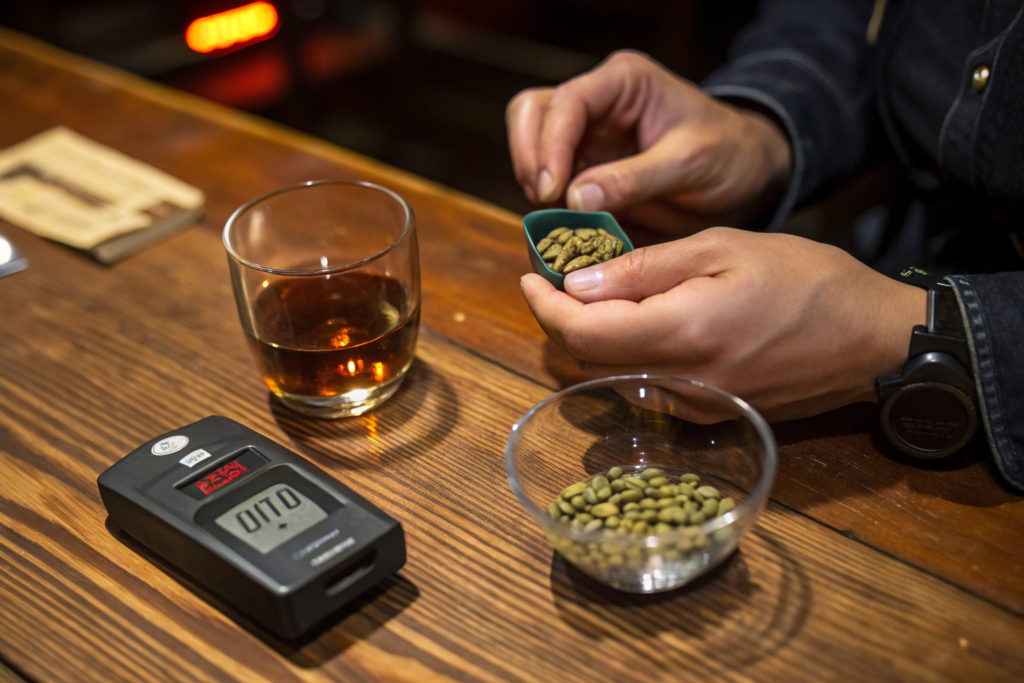
The color changes. Beans that have rested in a bourbon barrel often take on an amber, mahogany, or slightly reddish tint. The color is not uniform—some beans may be darker than others depending on their position in the barrel. The beans closest to the barrel wall absorb more compounds and darken more. The beans in the center of the barrel mass may be lighter. This mottling is a sign of genuine barrel aging. Uniform color suggests an artificial process.
The surface may feel slightly different. Barrel aged beans can feel a little tacky or oily to the touch due to absorbed barrel compounds. This is subtle. If the beans feel wet or sticky, they were not dried properly and may be at risk for mold.
The dry fragrance is the most telling olfactory clue. Grind a sample of the green beans—or simply crush a few—and smell. Genuine barrel aged green coffee smells like a blend of coffee, oak, vanilla, and the spirit. The aroma is integrated. It smells like a single, unified product. Artificially flavored coffee smells like coffee plus something else. The spirit note is separate, sharp, and chemical. It hits the nose as an additive, not an integration.
A hot water soak test, similar to the one used for over-fermentation detection, also works here. Pour hot water over the green beans and smell the steam. Genuine barrel aged coffee releases a warm, oaky, vanilla aroma. Fake barrel aged coffee releases a sharp, boozy, extract-like smell. The difference is clear with practice.
Should You Request a GC-MS Report for Flavor Verification?
Gas chromatography-mass spectrometry is an analytical technique that identifies volatile compounds in a sample. Some specialty producers now use GC-MS to verify the chemical profile of their experimental lots, including barrel aged coffees. It is the ultimate verification tool, but it is also expensive and not universally available.
A GC-MS report for a genuine barrel aged coffee would show elevated levels of compounds characteristic of oak aging: vanillin, oak lactones, eugenol, and furfural. It would also show the presence of ethanol-derived esters if the barrels contained residual spirit. The report would confirm that these compounds are present inside the bean, not just on the surface.
For most commercial transactions, GC-MS is overkill. The cost of the test—several hundred dollars—is disproportionate to the value of a micro-lot that might be 100 kilograms. But for a large forward contract, or for a roaster building a flagship barrel aged product, GC-MS provides objective proof of authenticity.
I do not provide GC-MS reports as standard with our barrel aged lots. I provide the barrel source, the aging duration, the pre- and post-aging moisture readings, and the cupping scores. For buyers who want GC-MS, I can arrange it through a third-party lab at their cost. The combination of documentation, visual inspection, and cupping is sufficient for most buyers to verify authenticity. For additional verification techniques, Perfect Daily Grind has published articles on analyzing experimental coffee processing methods.
How to Source Barrel Aged Yunnan Coffee?
Sourcing barrel aged coffee from Yunnan is a relationship business. The volumes are tiny. The process is artisanal. The suppliers who do it well are selective about who they sell to because they want their product represented properly at retail. You are not buying a commodity. You are buying a collaboration.
Start by contacting specialty coffee exporters in Yunnan who also offer experimental processing—anaerobic fermentation, carbonic maceration, lactic processing. Barrel aging often sits alongside these other methods as part of an innovation program. Ask explicitly about barrel aged offerings. Many suppliers experiment with it but do not list it publicly because the volume is too small for a catalog.
Expect to provide information about your roasting business and your intended use. A serious barrel aged coffee producer wants to know that their coffee will be roasted with care and sold with an honest story. They may ask about your roast profile, your packaging, and your customer base. This is not gatekeeping. It is quality control. A bad roast of a barrel aged lot can ruin the producer's reputation as well as the roaster's.
To source barrel aged Yunnan coffee, identify specialty exporters with experimental processing programs, request barrel aged samples directly, be prepared to share your roast approach and retail concept, and book lots months in advance since barrel aging is a seasonal, micro-lot process with limited volume.
At Shanghai Fumao, we produce barrel aged lots using our washed Catimor as the base coffee, aged in freshly emptied Yunnan single malt whiskey barrels for 21 to 28 days, then dried, rested, and cupped. Each lot is small—typically 60 to 150 kilograms. We announce availability to our existing clients first, then offer remaining lots to new inquiries. Booking early is essential.
What Questions Should You Ask a Potential Barrel Aged Supplier?
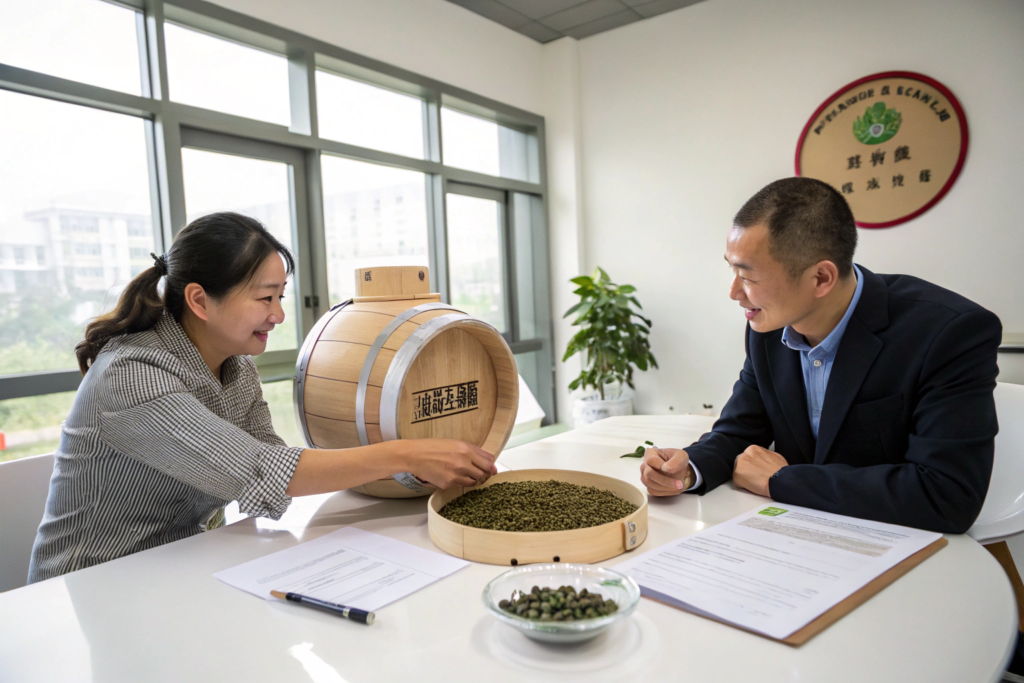
Here are the seven questions that separate a genuine barrel aged coffee supplier from a pretender:
First: "What is the source of your barrels?" The answer should name a specific distillery and spirit type. "Yunnan single malt whiskey barrels from XYZ Distillery" is a real answer. "Bourbon barrels" without a source is vague.
Second: "How long do you age the green coffee in the barrels?" The answer should be a specific range. "21 to 28 days, depending on the ambient temperature and the barrel freshness" is a real answer. "Until it tastes ready" is not.
Third: "What coffee variety and processing method do you use as the base?" The base coffee matters. A washed high-grown Catimor or a natural processed bean will interact differently with the barrel. The supplier should know and specify the base.
Fourth: "How do you control moisture and mold risk during aging?" The answer should describe monitoring, turning, and drying protocols. Barrel aging creates a humid environment. Mold is a real risk. A supplier who cannot explain their mold prevention strategy is a supplier you should avoid.
Fifth: "What moisture level do the beans reach in the barrel, and how do you dry them back down?" The peak moisture and the drying method affect the final bean quality and shelf stability.
Sixth: "Can I see the pre-aging and post-aging cupping scores?" The base coffee should score well on its own. The barrel should add value, not cover defects. If the base coffee scored 80 and the barrel aged version scores 83, the barrel is doing too much work. The base should be quality coffee in its own right.
Seventh: "What is the minimum order quantity and the FOB price?" Barrel aged lots are micro-lots. The MOQ should be flexible. The price will be premium. If a supplier quotes a low price for a large volume, they are not selling genuine barrel aged coffee. The economics do not support it.
How Much Does Barrel Aged Green Coffee Cost?
Barrel aged green coffee is expensive. The premium reflects the cost of the barrels, the extra labor, the extended processing time, the risk of batch loss, and the tiny volumes.
Here is a rough cost comparison for different Yunnan processing methods from our farm:
| Processing Method | FOB Price per Pound (USD) | Cost Factor vs. Washed |
|---|---|---|
| Washed Catimor | $2.80 - $3.20 | Baseline |
| Anaerobic Fermented | $4.00 - $5.00 | 1.4x - 1.6x |
| Carbonic Maceration | $5.00 - $6.50 | 1.8x - 2.0x |
| Barrel Aged (Bourbon/Whiskey) | $6.00 - $9.00 | 2.1x - 2.8x |
The barrel aged premium is the highest among our experimental processing methods. The barrels are expensive. Each barrel holds only about 50 to 60 kilograms of green coffee. The barrel can be used for two, maybe three, aging cycles before the wood is exhausted. The cost of the barrel must be amortized over a very small volume of coffee. The labor for filling, monitoring, turning, emptying, and drying is intensive. The risk of losing a batch to mold or over-absorption is real.
For a roaster, the retail price must reflect the green cost. A barrel aged coffee retailing at $28 to $38 per 12-ounce bag is positioned correctly. The story—"aged in Yunnan single malt whiskey barrels for 28 days"—and the unique flavor justify the premium. The customer who buys barrel aged coffee is looking for an experience, not a daily drinker. They expect to pay more.
The Shanghai Fumao team provides transparent pricing for barrel aged micro-lots, including the base coffee cost, the barrel cost allocation, and the processing premium. Cathy Cai can provide current FOB pricing and availability for upcoming lots.
What Are the Risks and Rewards of Buying Barrel Aged Coffee?
I do not want any roaster to buy barrel aged coffee without understanding what they are getting into. This product is not a standard single origin. It carries unique risks alongside its unique rewards. I have seen roasters build a cult following around a barrel aged release. I have also seen roasters lose money because they over-ordered and could not sell through fast enough.
The reward is differentiation. A well-executed barrel aged coffee tastes like nothing else on your menu. It generates conversation. It draws in customers who are curious about the process. It commands a premium retail price that supports a healthy margin. A single successful barrel aged release can elevate a roaster's brand perception and create loyal customers who come back for the next release.
The main risks of buying barrel aged coffee are shorter shelf life due to accelerated staling of the altered bean structure, the potential for mold if the producer's drying was inadequate, the high upfront cost of a micro-lot, and the polarizing flavor profile that some customers love and others find undrinkable.
The risk is twofold. First, shelf life. Barrel aged beans, having absorbed moisture and been dried back down, have a slightly altered cell structure. They can stale slightly faster than standard washed beans. Roast what you can sell within 60 days. Do not carry large inventory. Second, customer reception. Barrel aged coffee is divisive. Some customers will find it extraordinary and buy multiple bags. Others will take one sip and complain that their coffee tastes like whiskey. Know your customer base. If your audience is traditional and conservative, barrel aged coffee is a risk. If your audience is adventurous and trusts your curation, it is an opportunity.
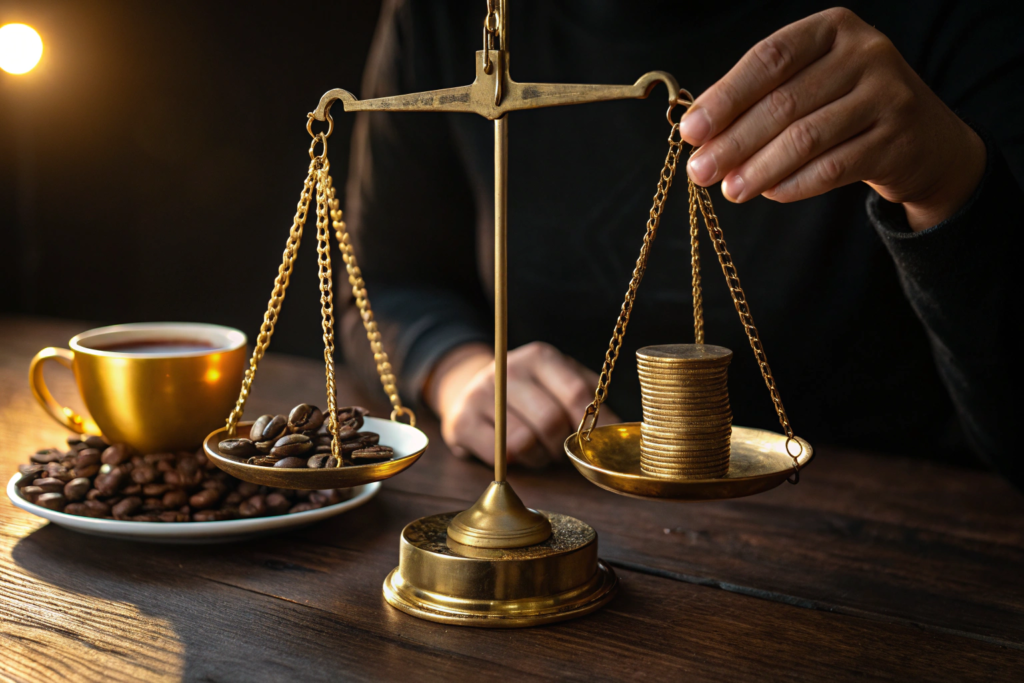
How Does Barrel Aging Affect Green Coffee Shelf Life?
The shelf life of barrel aged green coffee is slightly shorter than standard washed green coffee. This is a practical concern for importers and roasters who hold inventory.
The absorption and drying process alters the bean's internal structure. The ethanol exposure and subsequent drying can create micro-fissures in the cell walls. These fissures make the bean more permeable to oxygen and moisture. The volatile aromatic compounds—both the natural coffee aromatics and the absorbed barrel compounds—dissipate faster than in an unaged bean.
I recommend using barrel aged green coffee within six to nine months of the aging date. This is shorter than the twelve to eighteen months I would recommend for a standard washed Catimor stored in GrainPro. After nine months, the barrel notes begin to fade noticeably. The vanilla becomes less pronounced. The oak character flattens. The whiskey notes recede. What remains is a slightly unusual-tasting coffee with none of the magic that justified the premium price.
Roasters should order barrel aged lots in volumes they can sell through within two to three roast cycles. Do not stock a year's supply. Order smaller, more frequent shipments if possible. Store the green beans in GrainPro bags in a cool, dry environment. Use them while they are vibrant. The clock is ticking from the day the beans leave the barrel. For more on green coffee storage, the Coffee Quality Institute provides guidance on shelf-life extension for processed lots.
Why Might a Roaster Choose Not to Buy Barrel Aged Coffee?
Barrel aged coffee is not for every roaster. I have advised potential buyers against purchasing it when their business model did not align with the product's characteristics.
A roaster whose core business is wholesale to cafés and restaurants should think carefully. The café customer orders a drip coffee or a latte. They do not read flavor notes. They expect coffee to taste like coffee. If their morning drip suddenly tastes like bourbon and vanilla, they may complain. The café owner gets frustrated. The relationship strains. Barrel aged coffee works best in a direct-to-consumer model where the customer actively chooses the product based on the description.
A roaster with limited storage space or slow inventory turnover should also be cautious. Barrel aged coffee does not wait. It fades. If the lot sits on the shelf for months before roasting, the customer receives a diminished product. The premium price becomes hard to justify.
A roaster whose brand is built on transparency and purity should consider whether barrel aging fits their narrative. Some specialty purists believe that coffee should express only terroir and processing, not external flavor additions. Even though barrel aging is not artificial flavoring, it does introduce flavors from outside the coffee plant. Some roasters embrace this as craft. Others reject it as adulteration. Know where your brand stands before you buy.
Conclusion
Barrel aged green coffee is a genuine craft product that marries high-quality Arabica with the complex aromatic compounds of oak and spirit. The beans rest in freshly emptied barrels. They absorb vanillin, lactones, and whiskey notes deep into their structure. The result is an integrated flavor that no artificial spray or flavoring can replicate.
Finding a supplier means looking for transparency, documentation, and a willingness to share the barrel source, aging protocol, and cupping data. The visual and olfactory clues in the green bean tell most of the story. The cupping confirms it. The relationship with the supplier is collaborative, not transactional.
The price is high. The volumes are small. The shelf life is shorter. The customer reception is polarized. But for a roaster who wants to offer something truly distinctive and who has an adventurous customer base, barrel aged coffee is a product that builds brand identity and commands premium pricing.
If you want to explore what a barrel aged Yunnan Catimor tastes like when it has rested for 28 days in a freshly emptied single malt barrel, contact Cathy Cai at BeanofCoffee. She manages our barrel aged allocations and can tell you what lots are currently aging, what the cupping scores are, and when they will be available for shipment. She can send samples so you can taste the result yourself. Her email is cathy@beanofcoffee.com. She answers quickly and will give you honest advice about whether this product fits your program.