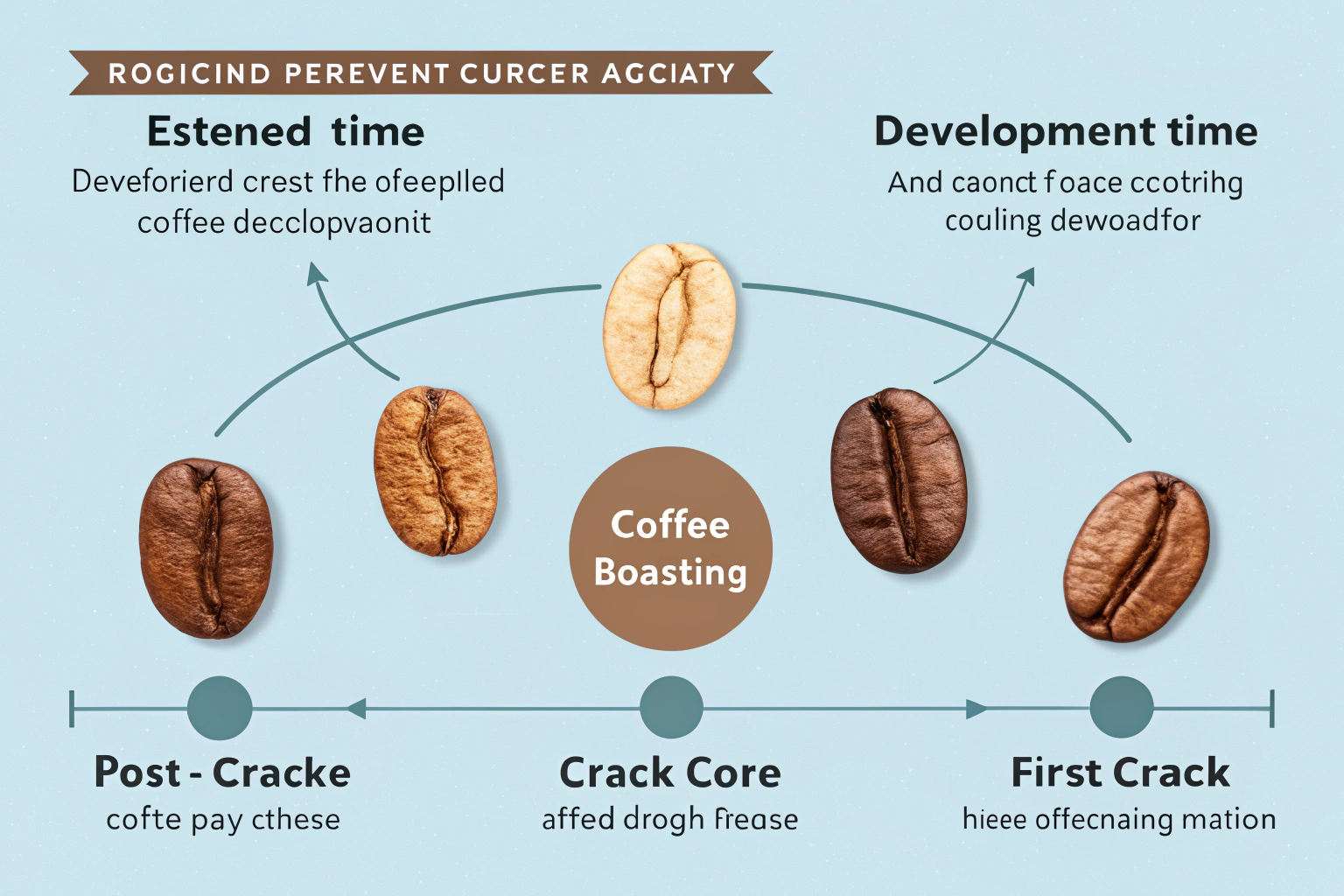
You've cupped a promising green coffee—bright, floral, vibrant. But your target market, maybe a large commercial buyer or a regional with a preference for smoother, chocolatey cups, finds it "too sharp" or "too fruity." Do you reject the bean? Not necessarily. As a roaster and an exporter who provides both raw and roasted beans, I can tell you that the roast profile is a powerful tool to shape and, when needed, tame acidity. You can't create what isn't there, but you can guide the development to highlight or subdue certain attributes.
To reduce perceived acidity in coffee through roasting, you extend the development time, particularly in the post-first-crack phase, and ensure a thorough, even development of the bean's core. This allows acids to break down into sweeter compounds, promotes the formation of bittering agents that balance acidity, and reduces the bright, tart notes associated with underdevelopment. Key techniques include using a lower charge temperature, extending the Maillard phase, and ensuring the roast reaches a sufficient development time ratio (e.g., 20-25% of total roast time after first crack).
That's the technical blueprint. But acidity isn't a monolith. The bright, crisp malic acid of an apple is different from the sharp, tangy citric acid of a lemon, and both behave differently under heat. The goal isn't to obliterate all acidity—that leads to a flat, baked coffee—but to transform it into a perceived sweetness and body, or to balance it with deeper flavors. Let's explore how to use heat to reshape the flavor landscape of your coffee deliberately.
Why Does Roasting Technique Affect Perceived Acidity?
Acidity in coffee is a complex mix of organic acids (citric, malic, chlorogenic, etc.) present in the green bean. During roasting, these acids are not static; they are created, transformed, and destroyed at different temperature thresholds. The roaster's job is to steer these chemical reactions.
Roasting affects acidity because heat drives specific chemical pathways. In simple terms: Light Roasts (Fast, High Heat): Preserve more of the origin's inherent acids, leading to perceived brightness and fruitiness. Medium-Dark Roasts (Slower, Extended Development): Break down chlorogenic acids (which can taste harsh) into milder compounds. They also catalyze the Maillard reaction and caramelization more deeply, producing melanoidins (which contribute body and sweetness) that mask or balance the remaining acidity. Essentially, you're trading some bright, pointy acidity for rounder, sweeter, and more bitter notes. This is crucial for creating a stable, consistent profile for commercial blends or for markets that prefer a "smoother" cup. It's a core part of quality control for any roasting business.
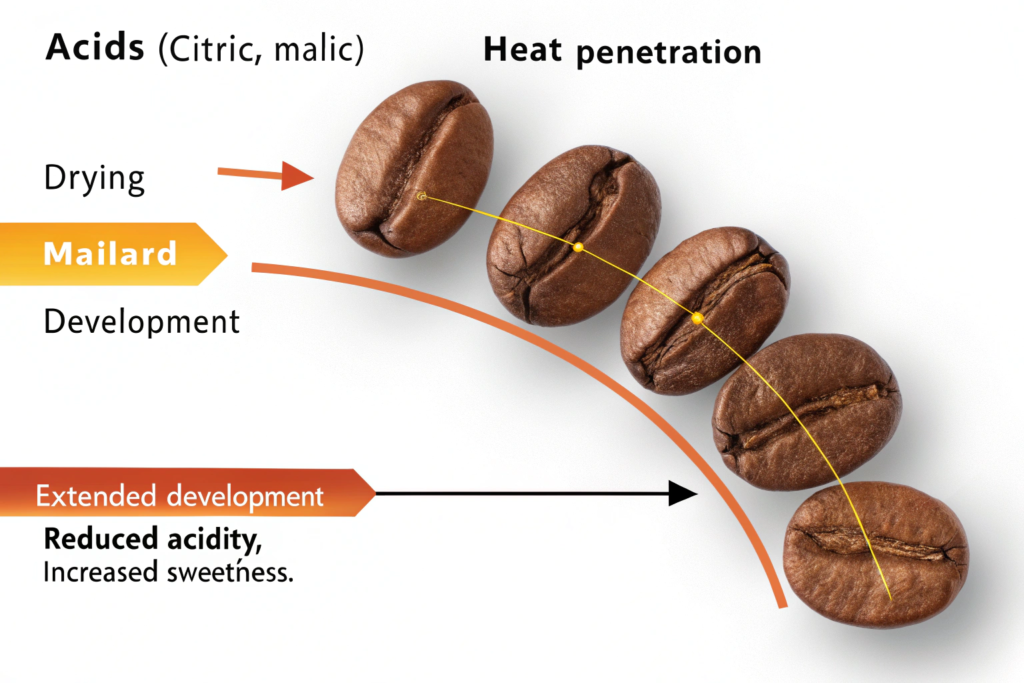
What Happens to Acids During the Maillard Reaction?
The Maillard reaction (browning) is where the magic of flavor development happens, roughly between 150°C and 200°C. During this phase, amino acids and sugars react to create hundreds of new flavor compounds. Crucially, this process consumes acids. Citric and malic acids begin to break down, their sharpness diminishing. Meanwhile, the reaction generates compounds that provide roasted, nutty, and chocolaty flavors, which the palate perceives as less acidic. If you cut the roast short (drop it quickly after first crack), you halt this acid transformation prematurely. To reduce acidity, you need to give the Maillard reaction enough time to do its work after the bean's structure has opened up at first crack. This is the "development time."
How Does Bean Development Influence "Brightness" vs. "Sourness"?
This is a critical distinction. A well-developed light roast can have a pleasant, sparkling brightness. A poorly developed roast (underdeveloped) will have a sharp, unpleasant sourness that tastes grassy or green. The difference is in the bean's core temperature. In an underdeveloped bean, the outside is roasted but the inside is still "baked," retaining harsh acids. To reduce unwanted sourness, you must ensure the heat penetrates the bean fully. This often means using a slightly lower initial charge temperature to prevent scorching the outside before the inside heats up, and then applying steady heat to carry the bean through a sufficient development phase. A well-developed bean, even at a medium roast level, will have its acidity integrated into the overall flavor, coming across as "winey" or "juicy" rather than "sour."
What Are the Key Roast Profile Adjustments to Lower Acidity?
You don't need a radical new profile; you need strategic tweaks to your existing approach. Focus on heat application and timing in three key areas.
The key adjustments are: 1) Lower Charge Temperature: Start with a lower drum temperature (e.g., 180-190°C vs. 205-215°C for a bright profile). This allows for a gentler, more even heat penetration from the start, preventing a rushed, acidic development. 2) Extend the Maillard Phase: After the drying phase, aim for a gradual, steady temperature rise (Rate of Rise - RoR) through the Maillard stage. Avoid a "flick" or sudden increase in RoR. This longer browning time allows for more acid degradation and sugar development. 3) Prioritize Post-Crack Development: This is the most important lever. Once first crack begins, do not drop the coffee quickly. Instead, maintain gentle heat to extend the development time. A common target is a Development Time Ratio (DTR) of 20-25%—meaning the time from the start of first crack to the drop is 20-25% of the total roast time. This deep development transforms the flavor profile.
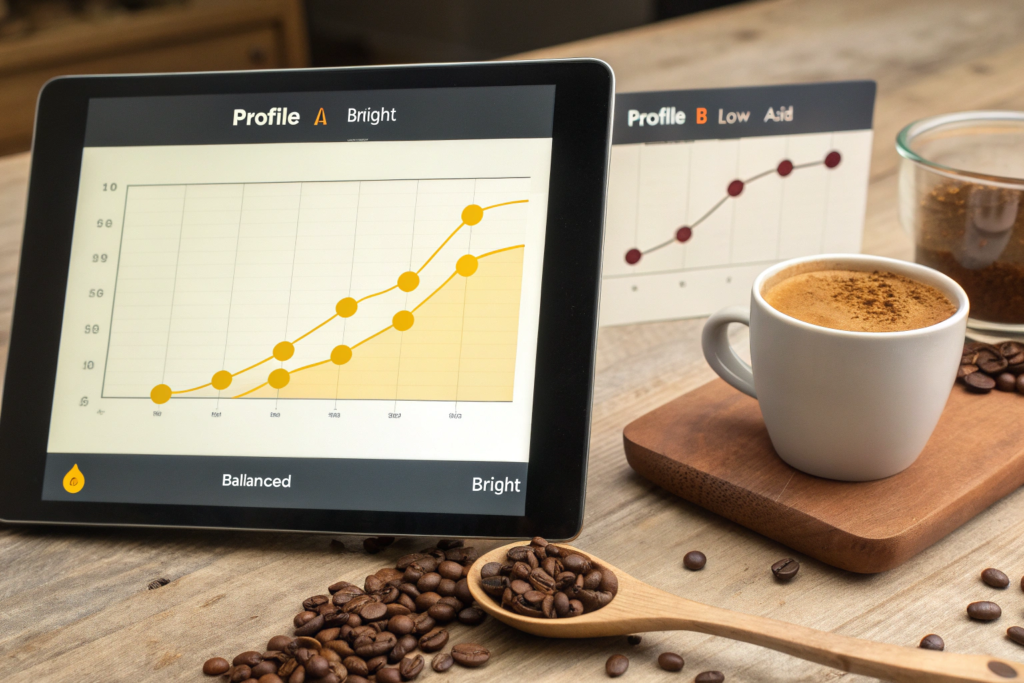
Should You Use a Slower Rate of Rise (RoR)?
For the goal of reducing acidity, yes, a slower and declining RoR through the late Maillard and development phases is generally beneficial. A high, rising RoR can "shock" the bean, trapping acidity and creating a baked, sour taste on the inside. A slower RoR allows for a more thorough and even chemical transformation throughout the bean's structure. Think of it as simmering versus boiling. However, the RoR must not crash or stall, as that can lead to baked, flat flavors. The goal is a smooth, gradual decline. Monitoring your RoR curve is essential. This kind of control is what allows a roaster to reliably produce a stable product batch after batch, which is exactly what large company buyers need.
How Does Drop Temperature Impact Perceived Acidity?
Drop temperature is the final result of your profile, not a standalone lever. However, as a rule, a higher end temperature (e.g., into second crack, around 225-230°C) will result in significantly less perceived acidity. The organic acids have been largely broken down, and the roast flavors (bitter, chocolaty, spicy) dominate. For a medium roast that is less acidic but not fully into dark roast territory, target a drop temperature just before or at the very beginning of second crack (e.g., 218-222°C). It's vital to reach this temperature gradually with sufficient development time. A bean rushed to a high temperature will taste both sour and bitter—the worst of both worlds. This precision is what separates a generic roast from a professionally crafted one that meets a buyer's specific quality request.
Can Roasting Fix Acidity in All Coffee Beans?
This is the most important reality check. Roasting can manage and transform acidity, but it cannot perform miracles. The raw material sets the ceiling. You cannot roast a low-acid, nutty Brazil to taste like a vibrant Kenya, nor can you roast a high-altitude Ethiopian to completely lose its citric sparkle without destroying its other qualities.
Roasting cannot "fix" a fundamentally flawed or wildly unsuitable bean. If a green coffee is intrinsically high in certain acids and that is not the desired profile, the best solution is to blend it with a lower-acid component. For example, blending a bright Yunnan Arabica with a smoother, heavier-bodied Catimor or a Robusta from our plantations can achieve balance before the roast even begins. Roasting then fine-tunes the blend. As an exporter, we often advise clients on this. If you need a low-acid profile for a commercial espresso blend, starting with a green coffee mix designed for that purpose is far more effective than trying to roast a single-origin Ethiopian into submission. This is part of providing good quality and reliable consultation to our buyers.
What Green Bean Characteristics Suggest Suitability for Low-Acid Profiles?
Look for these traits when sourcing:
- Origin: Beans from Brazil, Sumatra, India, or lower-altitude Yunnan tend to have lower inherent acidity.
- Processing: Natural or pulp-natural processed coffees often have heavier body and fermented sweetness that reads as less acidic than washed coffees from the same farm.
- Variety: Some varieties like Catimor or certain Bourbons are known for balanced, rather than sharp, acidity.
- Altitude: Generally, lower altitude equals lower acidity (and often lower price).
Starting with beans that have a natural inclination toward your target profile makes the roaster's job easier and the result better. This is a key sourcing consideration that addresses the pain point of inconsistent quality.
When Is Blending a Better Strategy Than Profile Adjustment?
Blending is the superior strategy when a single-origin's acidity is a core, unmovable part of its identity, and you need to achieve a specific, consistent flavor for a large-scale product. For instance, a bright Guatemalan might add wonderful complexity to a blend but be too sharp on its own for a target market. By blending it with 60% of a low-acid Brazilian, you can retain some of its character while achieving the desired smooth base. The roast profile can then be optimized for the blend as a whole. This approach offers security and stability for production runs, ensuring that minor variations in one origin's crop don't destabilize the final product. It's the pragmatic choice for distributors and brand buyers.
How to Test and Validate Your Low-Acidity Roast Profile?
You've made adjustments. Now, you need proof. Validation requires both objective measurement and subjective tasting, in a structured way.
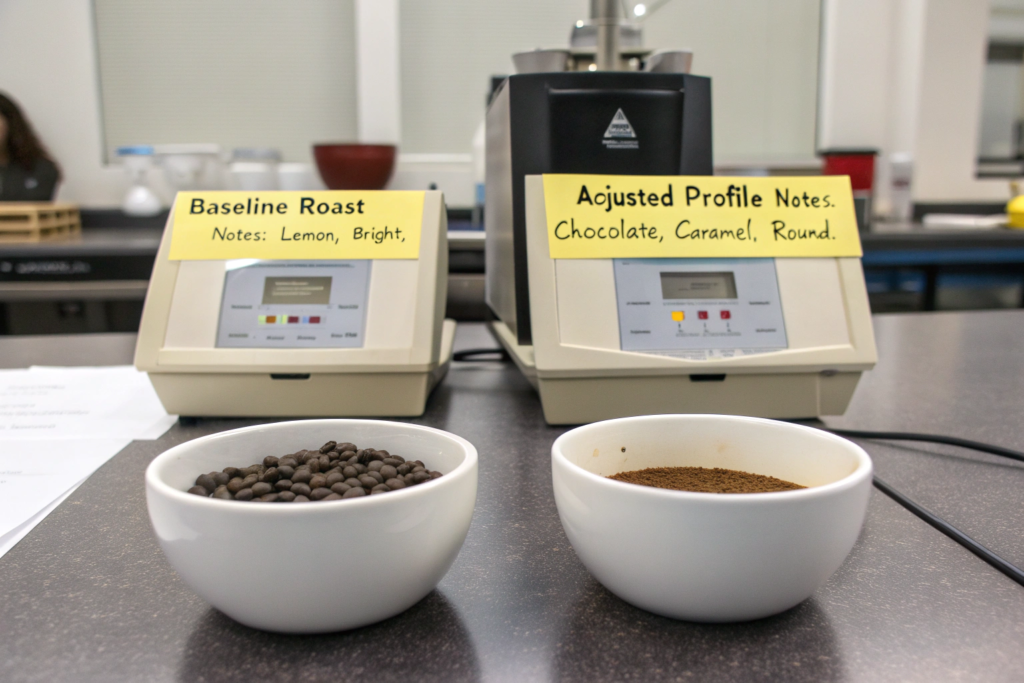
To test your profile, you must roast sequentially and cup comparatively. Step 1: Create a Baseline. Roast the target coffee with your standard profile. Step 2: Roast the Adjusted Profile. Apply your modifications aimed at reducing acidity (e.g., +1 minute development time, -10°C charge temp). Keep all other variables (batch size, green coffee) identical. Step 3: Controlled Cupping. Cup both coffees side-by-side under identical conditions (grind, water, time). Use a structured tasting form. Focus on attributes: Acidity (intensity and quality), Sweetness, Body, Balance, and Aftertaste. The goal is to see a clear shift: reduced sharp/tart acidity, increased perceived sweetness and body, and a more balanced finish. Also, check for the development of any new negative traits like bitterness, ashiness, or a baked flavor.
What Cupping Notes Indicate Successful Acidity Reduction?
Look for a shift in language. An unsuccessful roast might go from "bright lemon" to "sour, underdeveloped grass." A successful reduction will shift the notes toward:
- Acidity: "Soft malic," "gentle tartness," "wine-like" instead of "sharp citric," "pungent."
- Sweetness: Notes of "brown sugar," "caramel," "molasses" become more prominent.
- Flavor: "Chocolate," "nutty," "spicy" notes emerge over "floral," "berry."
- Mouthfeel: Increased "body," "creaminess," "roundness."
The coffee should taste intentionally different, not just muted. It should have a clear, clean sweetness where the acidity once dominated.
How to Use a Roast Color Analyzer for Consistency?
For commercial production, subjective tasting alone isn't enough. A roast color analyzer (like an Agtron or a light meter) provides an objective, numerical value for roast degree (e.g., Agtron #55 for medium, #35 for dark). Once you've developed a profile that achieves the desired flavor (lower acidity), note its final color reading. This number becomes your quality control checkpoint for all future batches of that product. If the color is within range, the chemical development (and thus acidity level) is likely consistent. This tool is essential for delivering a stable and trustworthy product to clients who order the same blend month after month. It turns an art into a reproducible science.
Conclusion
Reducing acidity through roasting is an exercise in applied chemistry and patience. It requires an understanding of how heat transforms the acids inherent in green coffee, and the discipline to apply that heat in a controlled, extended manner to promote sweetness and body. The key is not to fear heat, but to guide it—extending development time to allow for the desirable breakdown and transformation of compounds.
Remember, the green bean sets the potential. Start with a coffee suited to your end goal, use blending as a powerful pre-roast tool, and then apply a roast profile designed for development and balance. This holistic approach ensures you can meet specific market demands, whether for a smooth, approachable single-origin or a consistent, low-acid commercial blend.
At Shanghai Fumao, we support our clients through this entire process. We can supply green beans with known acidity profiles, provide roasting advice for our lots, and even deliver pre-roasted products tailored to a "low-acid" specification with our own controlled profiles.
If you are a roaster or buyer looking to consistently achieve a smoother, less acidic cup profile, let's collaborate. We can provide the right raw materials and the technical insights to help you succeed.
To discuss your specific needs and request samples of our Yunnan Arabica and Catimor—which are excellent candidates for balanced, medium-roast profiles—contact Cathy Cai at cathy@beanofcoffee.com. Let's roast for your market's perfect balance.