
I received an email once from a new client. It said, "I need good coffee for espresso. Send me a container." That was it. No numbers. No grades. No specifics. I had to send back a long list of questions. What does "good" mean? Bright and fruity? Chocolatey and heavy? What screen size? What defect tolerance? That email delayed his order by two weeks while we figured out what he actually wanted. The pain here is ambiguity. If you are not specific, you leave the door open for the supplier to interpret your request in the way that is cheapest or easiest for them, not best for you.
To write a clear coffee specification sheet, you must define the physical parameters (screen size, defect count, moisture content), the sensory parameters (cup profile, roast degree target), the certification requirements (organic, traceability), and the logistical parameters (packaging type, lot size, delivery window) in a single, signed document that becomes the legal basis for the contract.
This document is your shield. It is what you point to if the container arrives and the coffee is not what you expected. Let me walk you through exactly how to build a spec sheet that protects your interests and gets you the coffee you actually want.
What Are the Essential Physical Parameters to Specify for Green Coffee?
This is the foundation. The physical specs define the raw material. They are objective and measurable. If there is a dispute, these are the parameters that an arbitrator or a third-party lab can verify with a set of screens and a moisture meter.
The essential physical parameters to specify for green coffee include the acceptable screen size distribution (e.g., 90% minimum retention on Screen 17), the maximum allowable primary and secondary defect counts per 350 grams, the target moisture content range (e.g., 10.5% to 11.5%), and the water activity level (aw) to ensure microbiological stability.
If you leave these blank, you are essentially agreeing to accept whatever the supplier's "standard" is. And their standard might be lower than yours.
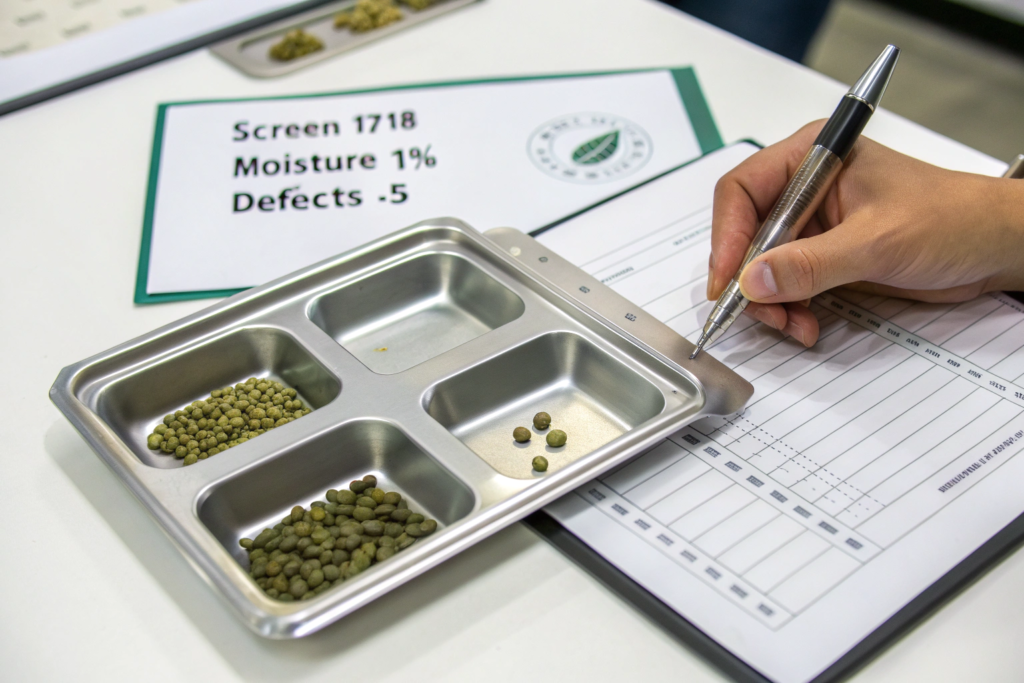
How Do I Specify Screen Size and Defect Tolerance Like a Pro?
Do not just say "Grade 1." Grade 1 means different things in different countries. Be specific using the SCA Green Coffee Grading standards.
Screen Size Specification:
Instead of "Large Beans," write:
"Minimum 90% by weight shall be retained on a Screen 17 (6.75mm) and Screen 18 (7.10mm) combined. No more than 5% by weight shall pass through Screen 16. Zero tolerance for beans below Screen 15."
This is precise. It is measurable. It leaves no room for interpretation.
Defect Tolerance Specification:
Instead of "Clean Cup," write:
"Per 350-gram sample: Zero (0) Category 1 Primary Defects (Full Black, Full Sour, Fungus Damage, Severe Insect Damage). No more than five (5) Category 2 Secondary Defects (Partial Sour, Parchment, Floater, Broken/Chipped). Foreign matter (stones, sticks, metal) shall be zero (0)."
This is the language of the SCA Green Coffee Defect Handbook. If a supplier agrees to this language, they know you are a professional. At Shanghai Fumao, we prefer to work with buyers who give us specs like this. It tells us exactly what standard to meet. For the official defect definitions, refer to the Specialty Coffee Association Green Coffee Grading Protocols.
What Is the Ideal Moisture Content and Water Activity Range to Specify?
Moisture is the most critical number for shelf life and food safety. Too wet (12.5%) and you risk mold. Too dry (9.5%) and the coffee is dead, faded, and roasts poorly.
The ideal specification is a range, not a single number.
"Moisture Content: 10.5% to 11.5%, as measured by a calibrated capacitance meter or oven-dry method."
"Water Activity (aw): Less than or equal to 0.60, as measured by a calibrated aw meter."
Water Activity (aw) is more important than moisture content alone. It measures the "free" water available for mold to use. A coffee at 12% moisture stored in a cold place might have a safe aw of 0.55. The same coffee in a hot place might have a risky aw of 0.65. Specifying both moisture content and water activity is the gold standard for professional buyers.
At our mill, we check both parameters on every lot before bagging. We record the numbers on the lot card. If your spec says "aw 0.60" and we measure 0.62, we do not ship it. We recondition it. Specifying this number gives you that protection.
How Do I Define the Desired Cup Profile and Roast Characteristics?
Physical specs tell you if the coffee is clean and well-graded. Sensory specs tell you if it tastes good. This is the art side of the spec sheet. It is subjective, but you can make it as objective as possible by using a standardized language.
To define the desired cup profile, use the SCA Flavor Wheel or World Coffee Research Sensory Lexicon terms to describe the target acidity level (e.g., Citric, Malic, Medium Intensity), the primary flavor notes (e.g., Black Tea, Cocoa, Stone Fruit), the body (e.g., Syrupy, Medium-Full), and the aftertaste (e.g., Clean, Sweet, Lingering). Avoid vague words like "smooth" or "strong." Use specific, agreed-upon descriptors.

Should I Reference the SCA Cupping Form or Score in My Spec Sheet?
Yes. This is the single most powerful tool you have to ensure you and the supplier are calibrated. The SCA Cupping Form assigns a numerical score (0-100) based on a standardized protocol.
Specification Language:
"The coffee shall cup at a minimum score of 83 points on the SCA Cupping Form, with no individual attribute scoring below 7.5. The cup profile shall be characterized by Medium Citric Acidity, Heavy Body, and flavor notes of Dark Chocolate and Toasted Almond. The coffee shall be free of Ferment, Phenolic, or Earthy taints."
By setting a minimum score and calling out specific attributes, you create a verifiable sensory benchmark. If the coffee arrives and your Q-Grader scores it an 81 with a ferment note, you have a clear, objective basis for a quality claim.
At Shanghai Fumao, we cup every export lot and assign it an internal score. If your spec sheet says "83 minimum" and we score it 82.5, we will downgrade the lot or offer it to you at a lower price with full disclosure. The spec sheet drives our internal quality control.
How Can I Specify the Intended Roast Degree to Guide the Supplier's Sample Roast?
This is crucial for the pre-shipment sample phase. You want the supplier to evaluate the coffee the way you will use it.
Specification Language:
"Supplier shall provide a Pre-Shipment Sample roasted to an Agtron Ground color of 55 (+/- 2) to simulate a Light-Medium / City+ roast profile suitable for filter brewing."
Or:
"Supplier shall provide a Pre-Shipment Sample roasted to an Agtron Ground color of 45 (+/- 2) to simulate a Full City / Light Espresso roast profile, with a Development Time Ratio of 20-22%."
This tells us exactly how to roast the sample. It ensures that the coffee you approve is evaluated under conditions that mimic your production environment. It prevents the "It tasted great on the cupping table but died in my roaster" scenario. For more on Agtron scales and roast color, Roast Magazine has excellent technical articles.
What Packaging, Labeling, and Logistics Details Belong in the Spec Sheet?
You have specified the coffee. Now you must specify how it gets to you. A surprising number of disputes arise from packaging and logistics, not the coffee itself.
The packaging and logistics details in a spec sheet must include the bag type and weight (e.g., 60kg jute with GrainPro liner), the palletization standard (e.g., 20 bags per pallet, stretch-wrapped), the required markings on the bag (Lot Number, ICO Code, Destination), and the shipping terms (e.g., FOB Shanghai, CIF Oakland). This ensures the coffee arrives in the condition you expect and is easy to receive and track in your warehouse.
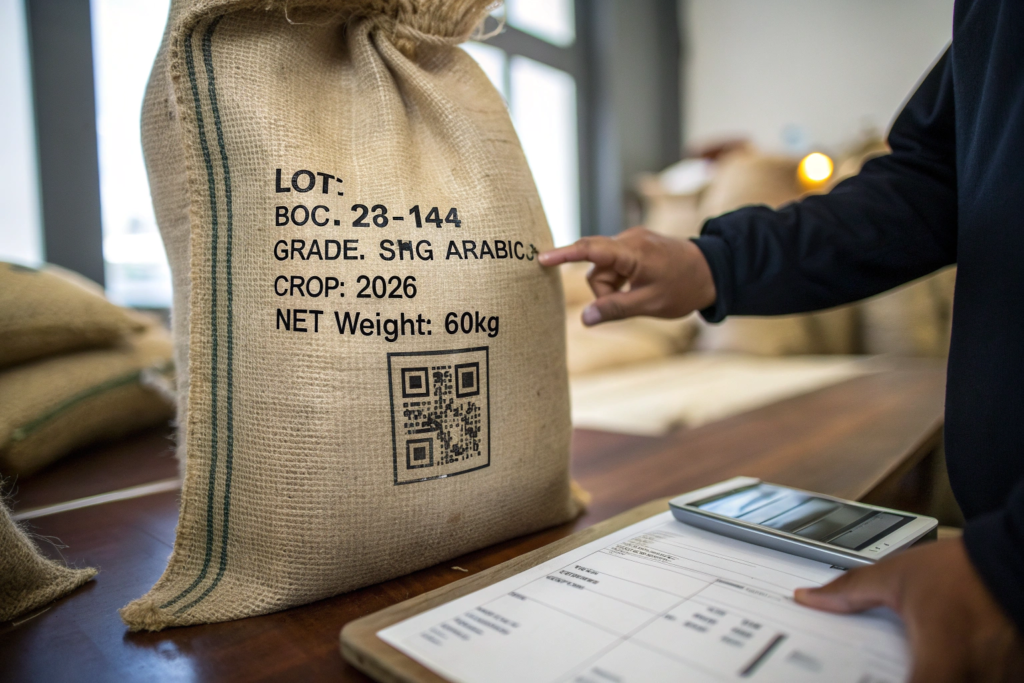
Why Is Specifying the GrainPro Liner and Bag Markings Critical?
We have talked about GrainPro bags as a quality tool. In your spec sheet, they should be a non-negotiable requirement.
Specification Language:
"All green coffee shall be packed in new, clean jute bags of approximately 60kg net weight. Each jute bag must contain a sealed, food-grade, high-barrier hermetic liner (GrainPro TranSafeliner or equivalent). Bags shall be closed with a machine-sewn top closure."
Why is this critical to specify? Because some exporters will charge you for GrainPro and then ship in standard jute to save money. If it is in the spec sheet and signed, it is a contractual obligation.
Bag Markings Specification:
"Each bag shall be clearly stenciled on one side with the following information:
Shipper's Name: Shanghai Fumao Agricultural Development Co., Ltd.
Product: Green Coffee Beans, Arabica, Washed
Lot Number: [To be assigned]
Crop Year: 2025/2026
Net Weight: 60 KG
Destination: [Your City, State]
ICO Code: [Our Code]"
This makes receiving and inventory management seamless. When the truck arrives, your warehouse team can instantly identify the pallets. At Shanghai Fumao, we use a standard stencil template. If you have custom marking requirements, we just need them in the spec sheet.
How Do I Clearly Define the Shipping Terms and Documentation Requirements?
This section prevents the "I thought you were handling that" arguments.
Specification Language:
"Shipping Terms: CIF Oakland, USA (INCOTERMS 2020).
Seller is responsible for ocean freight and marine insurance to the Port of Oakland.
Required Documents (to be emailed within 7 days of vessel departure):
- Signed Commercial Invoice
- Packing List
- Clean On Board Bill of Lading
- Certificate of Origin (Form E)
- Phytosanitary Certificate
- SGS Certificate of Analysis (Ochratoxin A, Moisture, Screen Size)"
By listing the exact documents and the timeframe, you ensure there are no delays in customs clearance. You know exactly what to expect and when to expect it. This level of detail in the spec sheet makes the logistics process boring and predictable, which is exactly what you want. For a full list of INCOTERMS definitions, refer to the International Chamber of Commerce resources.
How Does a Detailed Spec Sheet Protect Both the Buyer and the Seller?
A detailed spec sheet is not a sign of mistrust. It is a sign of professionalism. It protects both parties from the painful ambiguity of "I thought it would be different."
A detailed spec sheet protects both the buyer and the seller by establishing a clear, objective, and mutually agreed-upon standard of quality and performance, which serves as the sole reference point in the event of a dispute, thereby reducing the likelihood of costly arbitration or damaged business relationships. It is the foundation of a good partnership. It sets clear expectations from day one.

What Happens If the Shipment Doesn't Match the Agreed Spec Sheet?
This is where the spec sheet becomes your most powerful tool. Let's walk through a scenario.
Scenario: The container arrives. You pull a sample. The moisture content is 13.2%. Your spec sheet clearly stated "Moisture: 10.5% to 11.5%."
The Process:
- Immediate Notification: You email the seller with the lab results and photos, referencing the specific clause in the spec sheet.
- Joint Verification: The seller may request a test of the sealed retention sample. This is why the PSS and retention sample protocol is important.
- Remedies (as defined in contract):
- Rejection: You have the right to reject the shipment and receive a full refund.
- Discount: You agree to accept the coffee at a discounted price to cover the cost of re-drying or the loss of quality.
- Replacement: The seller agrees to replace the lot with a compliant lot.
Without the spec sheet, the seller could argue, "13.2% is acceptable for export." With the spec sheet, there is no argument. The number is in black and white. It is a breach of contract. This is why banks and insurers like spec sheets. They provide certainty.
Can I Update the Spec Sheet for Different Lots or Harvest Years?
Yes. In fact, you should. The spec sheet is a living document.
- Different Lots: You might have one spec sheet for your Espresso Blend (which allows Robusta and requires a specific screen size) and a different spec sheet for your Single-Origin Microlot (which requires a higher cup score and specific varietal). Keep them separate.
- New Harvest Year: When the new crop arrives, you might tweak the sensory spec slightly. "Based on the 2026 harvest, we are adjusting the target flavor notes to include Dried Apricot."
At Shanghai Fumao, we keep a file for each of our contract clients with their latest approved spec sheet. When a new crop is ready, we review the spec sheet together. We cup the new crop against the old spec. If adjustments are needed, we update the sheet and sign a new addendum.
This ongoing calibration is the essence of a long-term, quality-focused partnership. The spec sheet is the document that guides that journey.
Conclusion
Writing a clear specification sheet for your coffee bean order is the single most important thing you can do to ensure you get what you pay for. It transforms a vague hope into a measurable contract. It protects your business from quality surprises, logistical headaches, and legal gray areas.
Take the time to write it down. Define the physical parameters. Describe the cup profile. Specify the packaging and documents. Make it detailed. Make it specific. Make it part of the contract.
At Shanghai Fumao, we welcome detailed spec sheets. They make our job easier. They tell us exactly what you need so we can deliver it without guesswork.
If you are not sure where to start, or if you want to see a template of the spec sheet we use internally, let us know. We are happy to share our format and help you build a document that works for your business. Email Cathy Cai. Tell her you want to start building a spec sheet for your next order. She can send you our template and walk you through it. Contact Cathy at: cathy@beanofcoffee.com