I remember a negotiation I had with a European buyer early in my export career. He was interested in our top lot. The cupping score was 85. The moisture was perfect. The price was agreed. Then he asked, "What's the screen size retention above 18?" I told him it was about 60%. He shook his head. "For this price, I need 90% above Screen 18." He walked away. I was stunned. The coffee tasted amazing. Why did he care so much about the size of the bean? I learned a hard lesson that day. In the premium coffee market, size matters. It is not just about flavor. It is about perception, roasting physics, and tradition.
Screen Size 18+ is critical for premium coffee bean pricing because it serves as a universally recognized visual proxy for bean density, altitude, and careful processing, commanding higher prices from roasters who associate large, uniform beans with superior cup quality and who rely on that physical uniformity for consistent heat transfer during the roasting process.
This is a reality of the global coffee trade. You, as a buyer, need to understand the "Screen Size Premium" so you can decide when it is worth paying for and when you are better off focusing purely on the cup score. Let me break down the economics and the physics of big beans.
What Does "Screen Size 18+" Actually Mean in the Coffee Trade?
The term "Screen Size 18+" is thrown around casually. But it has a very specific, measurable meaning. It is not just a marketing term. It is a physical grading standard that is verified with a set of metal screens.
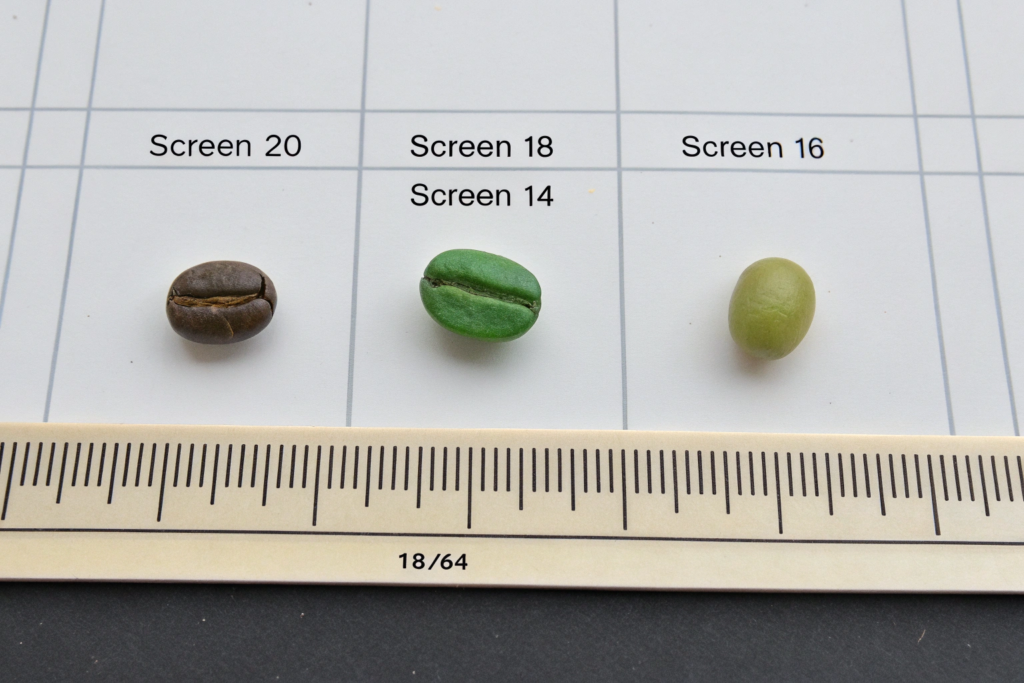
Screen Size 18+ means that the green coffee beans are too large to pass through a metal screen with round holes that are exactly 18/64 of an inch (or 7.14 millimeters) in diameter, indicating a large, typically dense bean that is visually appealing and associated with higher growing altitudes and more careful cultivation and processing.
It is the "Large Grade" designation. In some origins, it is called "Supremo." In others, "AA." The principle is the same: bigger is perceived as better.
How Is Screen Size Measured and Verified at the Dry Mill?
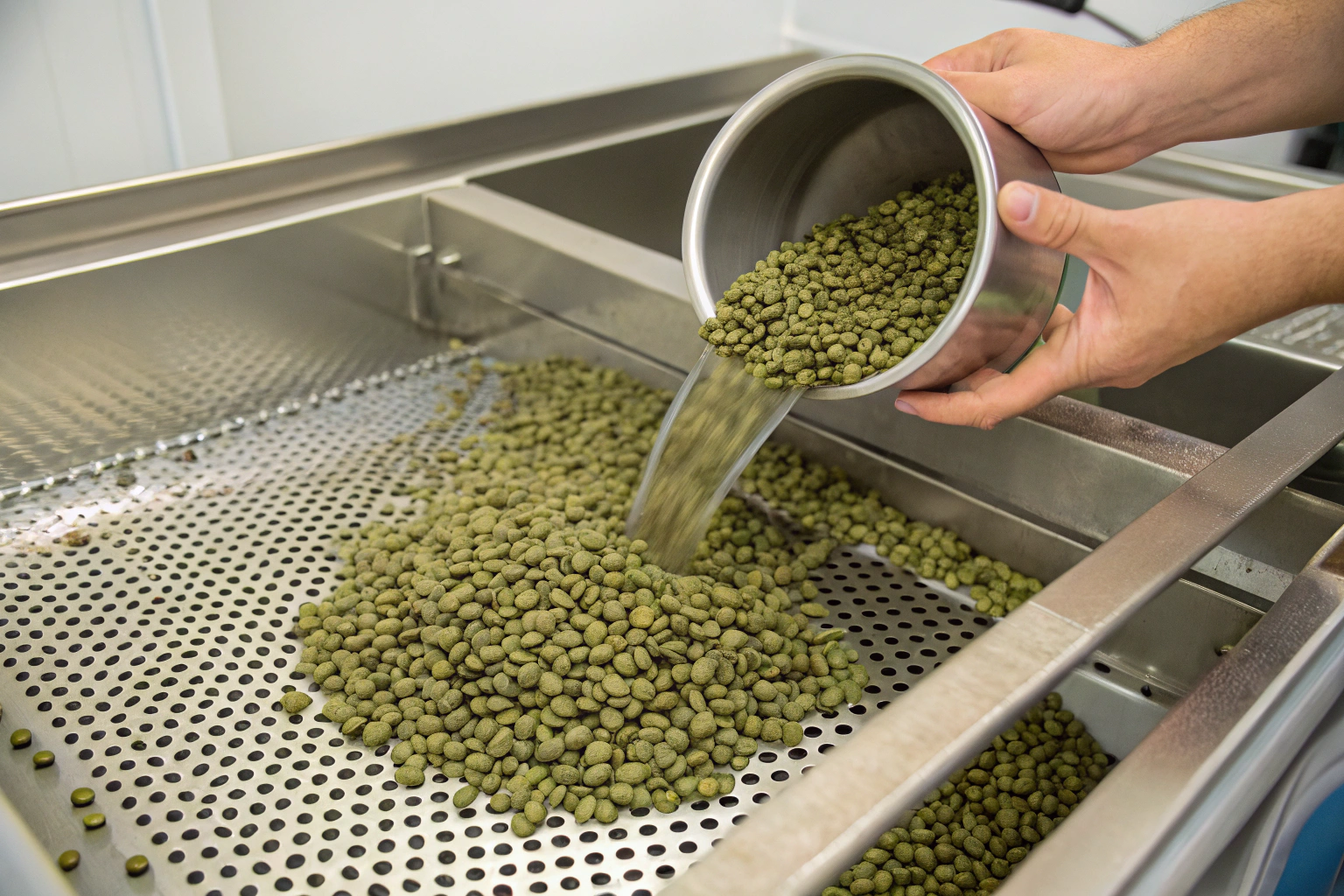
This is not a visual guess. It is a mechanical process. At our dry mill, we use a machine called a Sizing Grader or Sieve Sorter. It is a series of stacked, vibrating screens with progressively smaller holes.
The Process:
- The green coffee is fed into the top of the machine.
- The stack of screens vibrates. The top screen has the largest holes (e.g., Screen 20).
- Beans that are larger than Screen 20 stay on the top screen. These are Screen 20+ beans (rare, very large).
- Beans that fall through Screen 20 but stay on top of Screen 18 are Screen 18 beans. This is the premium fraction.
- Beans that fall through Screen 18 are collected on Screen 16, Screen 14, and so on.
The fraction we call "Screen 18+" is actually the combination of the beans retained on the Screen 18 screen and the Screen 20 screen. It means "Screen 18 and larger."
We verify the accuracy of the machine by taking a 100-gram sample from the Screen 18+ fraction and hand-screening it with a manual set of screens. We weigh the beans that pass through Screen 18. The percentage that passes is the "below screen" tolerance. For a true premium lot, this tolerance should be less than 5%.
At Shanghai Fumao, we run every specialty lot through the sizing grader and document the screen size distribution on the lot card. For more technical details, the Specialty Coffee Association Green Coffee Grading standards provide the official definitions.
Why Do Roasters Visually Associate Large Beans with High Quality?
This is the psychological and historical part of the equation. It is not entirely rational, but it is real. For decades, the coffee industry has trained buyers to look at bean size.
- The Kenya AA Effect: Kenyan AA coffee is legendary. It is large, bold, and commands extremely high prices. The "AA" designation is purely based on screen size (17/18+). This has created a global association: Big Bean = Expensive Bean = Good Bean.
- Visual Consistency: A bag of large, uniform Screen 18+ beans looks beautiful. It is impressive to show to a wholesale client. A bag of mixed small and large beans (even if they cup well) looks messy and "commercial."
- Defect Hiding: Small beans can hide defects like insect damage or broken bits more easily. A pile of large beans puts every individual bean on display. Any defect is immediately obvious. This transparency signals confidence from the producer.
I have had roasters tell me, "My customers expect to see big beans in the hopper for the premium blend." It is a visual cue that justifies the higher retail price. As a producer, I cannot ignore this market reality. If I want to command a premium price, I have to deliver a premium visual, and that means maximizing the Screen 18+ fraction. You can read more about consumer perception of coffee quality in market research reports from the National Coffee Association.
How Does Screen Size 18+ Impact the Roasting Process and Cup Profile?
The visual preference for large beans is real. But there is also a physical reason why roasters prefer Screen 18+ lots for their premium offerings. It comes down to heat transfer and roast consistency.
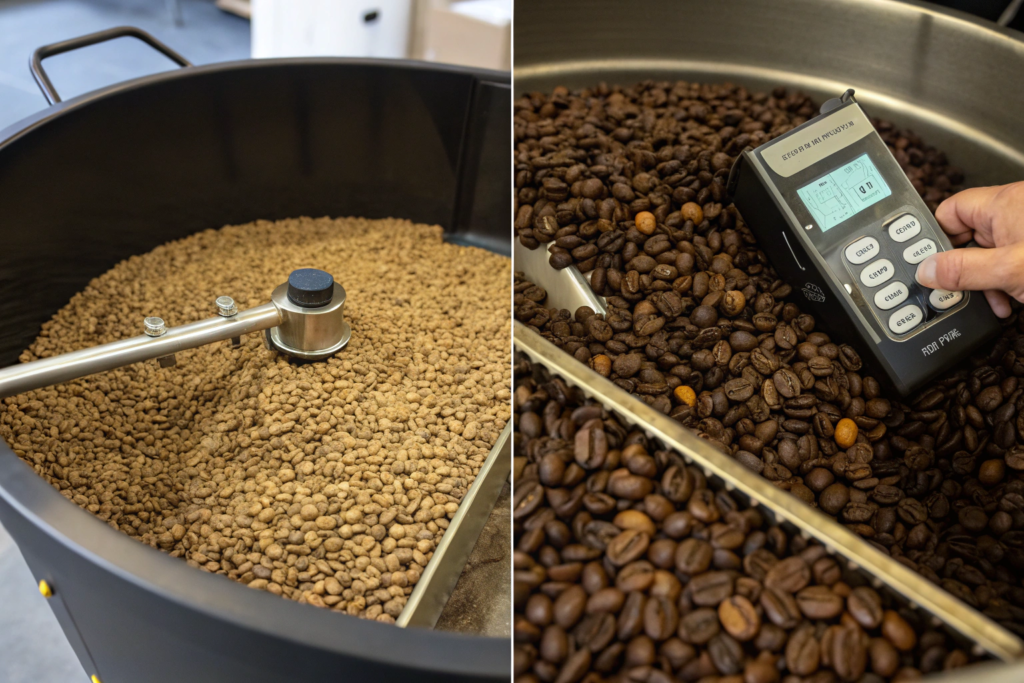
Screen Size 18+ impacts the roasting process by providing a more uniform bean mass with a higher density and a lower surface-area-to-volume ratio, which allows for more even heat absorption, a more predictable progression through the Maillard phase, and a significantly reduced risk of scorching, tipping, or underdevelopment compared to a batch of mixed screen sizes.
It makes the roaster's job easier. And an easier job means a more consistent, higher-quality roast.
What Is the Relationship Between Large Screen Size and Bean Density?
There is a general, but not absolute, correlation between large screen size and high density. It is a common assumption in the trade. Let's clarify.
- High Altitude: High-altitude coffee grows slowly. The beans are denser and often, but not always, larger. The slow maturation allows the bean to fill out more fully.
- Genetics: Some varietals are naturally large-beaned (e.g., Pacamara, Maragogype). Some are naturally small-beaned (e.g., Geisha, some Ethiopian heirlooms). A small Geisha bean can be denser than a large Catimor bean.
- Processing: Poor drying can make a large bean light and hollow (a floater).
So, size alone does not guarantee density. You can have a huge, low-density bean. That is why we use the Gravity Separator after the sizing grader. We take the large Screen 18+ beans and we run them over the density table to kick out any hollow "floaters" that made the size cut but not the weight cut.
The result is a lot that is both large and dense. This combination is the roaster's dream. The large size ensures even heat penetration. The high density ensures the bean can withstand aggressive heat application without scorching. At Shanghai Fumao, our "Premium Screen 18+" specification implies both the size and the density sort. It is a guarantee of roasting consistency.
Why Is Uniform Bean Size Critical for Avoiding Roast Defects?
Imagine roasting a batch of mixed vegetables. You have large potato chunks and thin carrot slices in the same pan. The carrots will burn before the potatoes are cooked through. This is exactly what happens in a coffee roaster with mixed screen sizes.
- Small Beans (Screen 14-16): They have a high surface-area-to-volume ratio. They absorb heat very quickly. They are prone to scorching (burned flat sides) and tipping (burned ends).
- Large Beans (Screen 18+): They have a lower surface-area-to-volume ratio. They absorb heat more slowly and evenly. They need more energy to get the heat to the center of the bean.
If you mix them together, the roaster's temperature probe reads an average. You apply heat based on that average. The small beans over-roast and get ashy. The large beans under-roast and get grassy, sour, and peanutty.
The result is a batch of coffee with a muddled, conflicted flavor profile. You taste both the ash and the grass. It is a roasting disaster.
By insisting on a narrow screen size distribution (e.g., 90% Screen 18+), you ensure that every bean in the roaster has nearly the same thermal mass. They all cook at the same rate. You get a uniform roast color, a uniform development, and a clean, transparent expression of the coffee's flavor. For more on the science of roasting, Roast Magazine is an excellent technical resource.
What Is the Price Premium for Screen 18+ Yunnan Arabica vs. Lower Screens?
Let's get down to the dollars and cents, Ron. You are very concerned about price. So you need to know exactly what that "Screen Size Premium" costs you and whether it is worth it for your specific application.
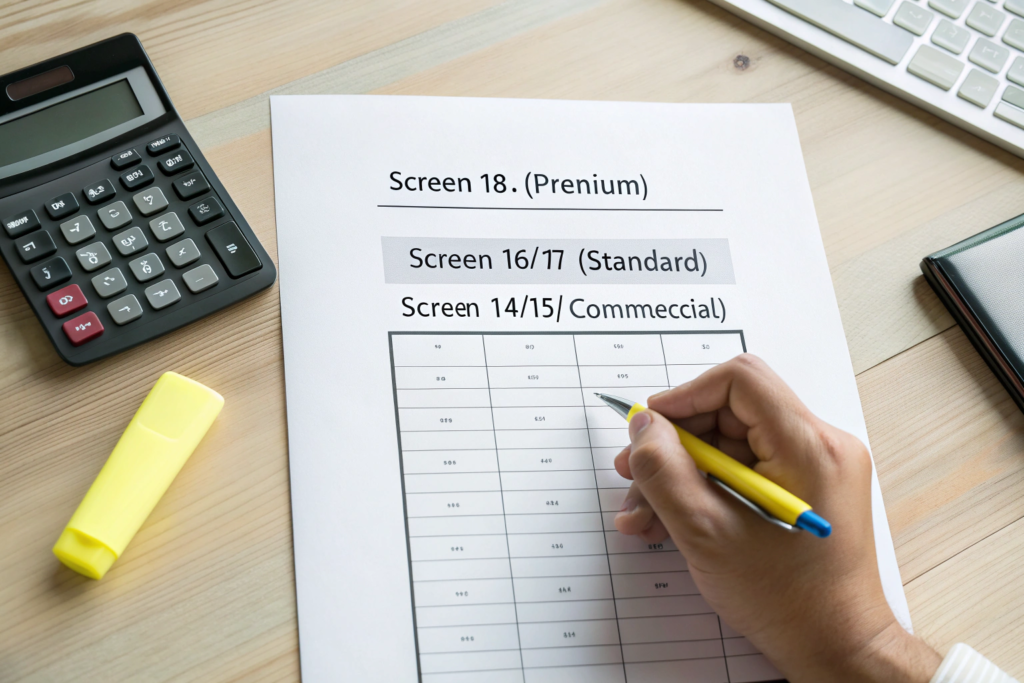
The price premium for Screen 18+ Yunnan Arabica is typically $0.40 to $0.80 per pound higher than the comparable Screen 16/17 fraction from the same lot, reflecting both the scarcity of the large beans (which may only make up 50-60% of the total production) and the additional processing steps and yield loss required to isolate them.
You are not just paying for size. You are paying for the privilege of separation. The mill has to do extra work to give you only the big beans. And the rest of the crop has to be sold at a lower price.
How Much of Our Crop Actually Makes the Screen 18+ Cut?
This is the key to understanding the price. Not every bean is born large. Even on our best high-altitude blocks, the Screen 18+ fraction is a limited resource.
Typical Yield from a High-Altitude Baoshan Lot:
- Screen 18+: 50% - 65% of the total volume. (This is the premium fraction).
- Screen 16/17: 30% - 40% of the total volume. (This is excellent coffee, just slightly smaller. Often cups just as well).
- Screen 14/15 & Below: 5% - 10% of the total volume. (Brokens, triage, smalls).
If a buyer wants a full container of exclusively Screen 18+ beans, we have to sort through almost two containers' worth of coffee to get enough volume. The remaining Screen 16/17 beans have to be sold to a different buyer, likely at a lower price for a commercial blend.
The premium you pay for the Screen 18+ lot compensates the mill for the yield loss on the rest of the production. It is the same reason a butcher charges more for filet mignon than for chuck roast. It is a smaller, more desirable portion of the animal.
At Shanghai Fumao, we are transparent about this. If you want an 84-point coffee at the absolute best price, I will recommend you buy the Screen 16/17 fraction. It cups identically to the Screen 18+. You save $0.60 per pound. For espresso blending, where the beans are ground anyway, this is often the smartest financial decision.
Is the Screen 18+ Premium Justified for Espresso Blends vs. Single Origins?
This is the practical question you need to answer for your business. The answer depends entirely on the application.
| Application | Recommended Screen Size | Rationale |
|---|---|---|
| Premium Single-Origin Bag | Screen 18+ | Justified. The visual appeal and the "story" of the large bean command a higher retail price. Customers expect it. |
| Signature Espresso Blend | Screen 16/17 (or a blend) | NOT justified. The coffee is ground fine. The visual size is irrelevant. Roast consistency is still important, so a uniform 16/17 screen is better than a mixed bag. You save significant money. |
| Wholesale Drip / Bulk | Screen 16/17 | Not justified. Focus on cup score and price. The screen size is invisible to the end user of a batch brew. |
| Cold Brew Concentrate | Screen 14/15+ (Triage) | Not justified. Use the lower screens. The long extraction and dark roast cover up origin nuances. Save the money. |
This is how smart buyers optimize their green coffee spend. They buy the Screen 18+ for the front of the house, where it tells a story and justifies a premium price. They buy the Screen 16/17 (from the exact same lot, same cup score) for the back of the house, where it drives volume and margin. It is the same coffee, just a different size.
How Does BeanofCoffee Ensure Consistency in Its Screen 18+ Specialty Lots?
It is easy to claim "Screen 18+." It is harder to deliver it consistently, bag after bag, container after container. This requires disciplined process control in the dry mill.
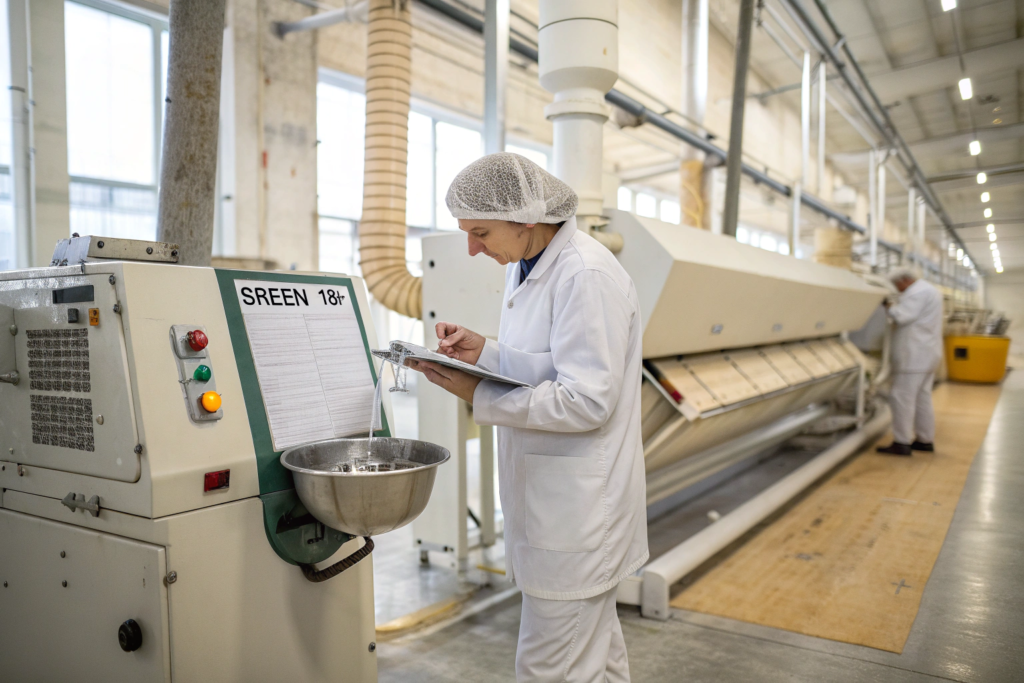
BeanofCoffee ensures consistency in its Screen 18+ specialty lots by calibrating our sizing graders at the start of every shift, continuously monitoring the output fractions with hand-screen spot checks, and rigorously cleaning the equipment between different client orders to prevent cross-contamination of screen sizes. This is not a "set it and forget it" process. It is an active quality control function.
What Are Our Internal Tolerance Standards for "Screen 18+"?
We do not just say "mostly big beans." We have a specific, measurable internal standard that is stricter than the general industry norm.
BeanofCoffee Screen 18+ Specification:
"Minimum 90% by weight shall be retained on a Screen 18 (7.14mm) round-hole sieve. No more than 5% by weight shall be below Screen 16. Zero tolerance for foreign matter."
How We Verify:
- Hourly Spot Checks: The mill operator takes a 100-gram sample from the Screen 18+ out-feed conveyor every hour.
- Hand Screening: The operator pours the sample over a calibrated hand screen set (Screens 18, 16, 14).
- Weighing: The fraction that falls through Screen 18 is weighed. If it exceeds 10 grams (10%), the operator stops the line and adjusts the feed rate or the screen vibration.
- Logging: The result of every hourly check is recorded on the Mill Processing Log for that lot.
This log is part of the traceability documentation. If a client ever questions the screen size, we can produce the hourly logs to prove the consistency of the sort. This level of documentation is rare. It is the result of our investment in an industrial-scale mill and a professional quality management system. At Shanghai Fumao, we treat screen size as a measurable quality parameter, not a rough guess.
Can I Request a Custom Screen Size Cut for a Large Contract?
Yes. This is one of the advantages of working directly with a large estate mill. We have the volume and the equipment to do custom separations.
Custom Cut Scenarios:
- "Super Premium Screen 18 Only": You want only the beans that stay on Screen 18, with the Screen 20 beans removed. This gives you an incredibly uniform, ultra-premium lot. The yield is very low, so the price is high.
- "Wide Cut Screen 17+": You want a larger volume at a better price, but still want to avoid smalls. We combine the Screen 17 and Screen 18 fractions. This is an excellent value option for espresso.
- "Peaberry Separation": You want us to separate the small, round Peaberry beans from the main lot. Peaberries are a specific, high-value product.
We can do all of this. We just need the specification in writing. There is usually a small setup fee for a custom cut to cover the time required to change the screens and clean the machine. But for a multi-container contract, this fee is often waived. This flexibility is something a smallholder cooperative simply cannot offer.
Conclusion
Screen Size 18+ is critical for premium coffee pricing because it is a tangible, visual, and physical marker of quality that the market has been trained to value for decades. It is not the only measure of quality—cup score is ultimately king—but it is a powerful factor in the perception of value and the physics of roasting.
For you, the buyer, understanding the "Screen Size Premium" allows you to make strategic decisions. You can pay for the big beans when the application demands it, and you can save money by buying the smaller beans from the same high-quality lot when the application allows it.
At Shanghai Fumao, we give you that choice. We are transparent about our screen size distributions and our pricing tiers. We want to help you find the right balance of quality, visual appeal, and cost for your specific business needs.
If you want to see a sample of our current Screen 18+ offering and compare the price to our Screen 16/17 from the same lot, we can send you the samples and the spec sheets. Email Cathy Cai. Tell her you want to see the "Size Comparison Pack." Contact Cathy at: cathy@beanofcoffee.com