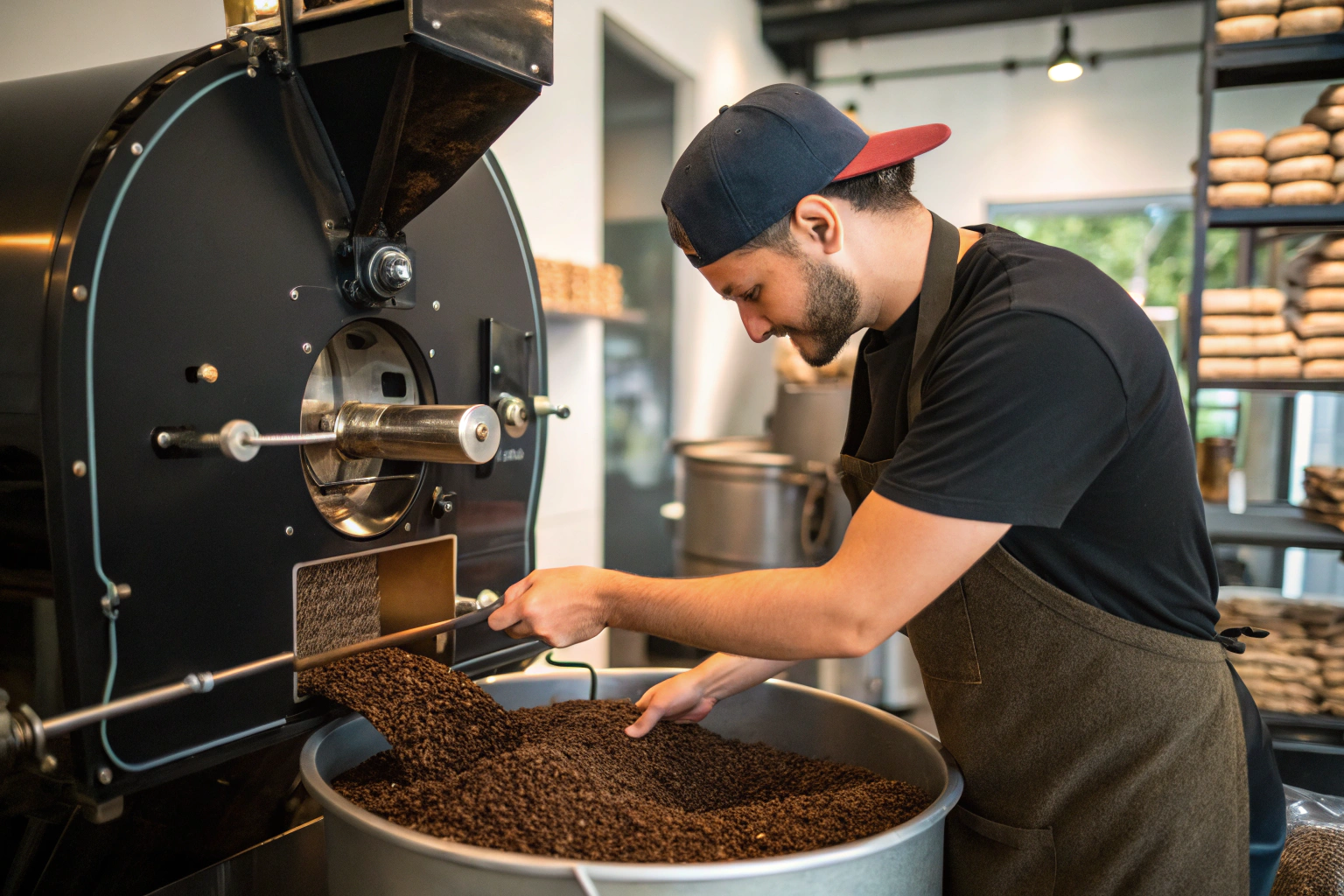
I remember standing in a cafe in Melbourne three years ago, watching the owner pull shot after shot and dump them down the sink. He was muttering to himself, adjusting his grinder, checking his pressure. The problem was not his machine. It was not his technique. The problem was the beans. He had bought a high-acidity, single-origin Ethiopian lot that was stunning as a pour-over but was an absolute disaster in his high-volume espresso blend. His customers were complaining. His baristas were embarrassed. And he was pouring his margin straight down the drain, literally, because no one had helped him match the bean to his business.
Selecting the right coffee bean for a local cafe is not about chasing the highest cupping score. It is about ruthlessly aligning three factors: your cafe's core beverage menu, your customer's palate expectation, and your target cost of goods per cup. A high-volume espresso bar needs a consistent, medium-roast-friendly Arabica base like a washed Yunnan or a Brazilian blend. A specialty filter bar can showcase bright, single-origin Arabicas. And a business focused on milk drinks might find its soulmate in a chocolatey, full-bodied Catimor that cuts beautifully through steamed milk while keeping the bean cost per drink firmly under control.
So, how do you make this decision without wasting money on samples you will never use? How do you think like a buyer instead of a consumer? This is the exact framework I use with my wholesale clients, and it starts with looking at your business, not just the coffee.
Why Does Your Core Menu Determine Which Coffee Bean You Should Buy First?
This is the conversation I start with every single new cafe client. They often come to me excited about an 88-point anaerobic fermentation lot. And I get it. That coffee is delicious. But I always ask the same question: "What do you sell the most of?" If 70% of their orders are lattes and cappuccinos, that 88-point lot is going to get smothered in milk, and its delicate jasmine notes will completely disappear. They just paid a premium for complexity that no one will ever taste.
Your menu is a blueprint for your bean selection, not a suggestion. An espresso-dominant menu demands a bean with strong body, low-to-medium acidity, and a classic "coffee" flavor profile that punches through milk and sugar. A filter-focused menu needs clarity, brightness, and distinct origin character. The bean that makes your best pour-over might make your worst flat white. You are not buying the coffee you like; you are buying the coffee your menu math demands.
Another way to look at this is through the lens of waste. If you run a specialty filter cafe, you can afford a bean that has a narrow sweet spot because your baristas are manually brewing each cup with precision. But if you run a high-volume drive-thru, your bean needs to be forgiving. It has to taste good even when the shot runs a second too fast or the water temperature fluctuates slightly during a rush. A fragile, finicky bean in a high-speed environment is a recipe for inconsistency and complaints.
What coffee profile works best for a 70% milk-based drink menu?
For a menu where most drinks are lattes and cappuccinos, you need a bean that acts as a backbone, not a soloist. Look for tasting notes that include dark chocolate, toasted nuts, brown sugar, and caramel. Avoid descriptors like "delicate white florals" or "lemongrass." The body should be heavy and syrupy. A washed Arabica grown at 1,200-1,400 meters or a specialty-grade Catimor with a clean processing profile is perfect for this. The coffee's job is to say "I am coffee" loudly and clearly, even after you pour eight ounces of steamed whole milk on it. The Specialty Coffee Association's flavor wheel is a useful tool for understanding these descriptors, and the Barista Hustle blog has excellent resources on how milk chemistry interacts with different coffee compounds.
Can a single-origin bean work as an all-day espresso, or do you need a blend?
A single origin can absolutely work, but it has to be selected for its consistency and balance. Our washed Yunnan Arabica is often used as a single-origin espresso because it is naturally balanced, sweet, and has a round mouthfeel. A blend gives you the option to engineer a specific flavor by mixing, say, a 60% chocolatey Catimor base with a 40% bright Arabica top note for complexity. The advantage of a blend is consistency across seasons; if one component's crop profile shifts slightly, you can adjust the ratio. If you are a smaller cafe with less roasting flexibility, a reliable single-origin espresso is simpler and reduces your inventory complexity. It keeps your ordering process clean.
How Do You Match a Coffee Bean's Flavor Profile to Your Local Customers' Taste?
I have made this mistake myself. Years ago, I sent a beautifully bright, citrus-forward Kenyan-style lot to a client whose customer base was almost entirely older, traditional coffee drinkers. They hated it. They called it "sour" and asked for their old coffee back. It was not a bad coffee. It was just completely wrong for that audience. The local palate is a real thing, and ignoring it is a fast way to alienate your regulars.
Understanding your customer's taste is an act of observation, not assumption. If your regulars consistently describe good coffee as "smooth" and "bold," they are signaling a preference for low-acidity, heavy-bodied, dark-chocolate profiles. If they ask for tasting notes and ask about origin, they are signaling readiness for brighter, more complex lots. You are not trying to educate your customers into liking something they don't. You are finding the bean that says "this is delicious" in their own, familiar flavor language.
You know how you figure this out without a formal survey? Listen to what they complain about. A customer who says "this coffee is too bitter" might actually mean it is too roasted. But a customer who says "this coffee is too sour" is almost always reacting to high acidity. If you hear "sour" more than twice a week, your bean's acidity level is mismatched with your clientele. This is a sign to shift to a lower-elevation, more chocolate-forward profile, perhaps something from our mid-altitude Baoshan plots.

How can you survey your cafe customers' coffee preferences without being pushy?
Put two options on your retail shelf or as a "barista's choice" pour-over. Call one "Classic Comfort: Chocolate & Roasted Nut" and the other "Adventure: Bright & Fruity." Track which bag sells out faster. That is your data. Another low-friction method is to offer a free small drip coffee with any whole-bean purchase, and let the customer choose between "bright" or "smooth." The terminology you use and their choices will tell you everything about their true preferences, not what they think they should say. I have seen cafes successfully use this method and make very clear, data-backed decisions about their next wholesale order from us. For more on how top cafes think about this, you can explore our product range to see how we categorize coffee by flavor profile for different business types.
Why do "smooth" and "bold" mean very different things to different demographics?
To a specialty coffee enthusiast, "smooth" might mean well-extracted and balanced. To a traditional diner-coffee drinker, it means "no acidity whatsoever, tastes like the coffee my grandparents drank." "Bold" for a younger audience might mean "intense and complex." For an older audience, it means "dark roasted and strong." You have to decode these words within your specific community. I once listened to a cafe owner translate his customers' feedback for me in a way that completely changed what we sent him. They said "smooth," but after he probed, what they meant was "chocolatey and clean, no weird aftertaste." That is not just any smooth coffee. That is a clean, washed process, medium-roasted Arabica. He switched to our washed Catimor lot and his complaints dropped to zero.
What Is the Difference in Cup Profile and Cost Between Arabica, Robusta, and Catimor?
Now we get down to the numbers. I cannot tell you how many cafe owners I have talked to who have never really had someone break down the real, practical differences between these three main types in a way that connects directly to their profit and loss statement. They know Arabica is "better," but that is where their knowledge stops. The gap between knowing the names and knowing how to buy them profitably is enormous.
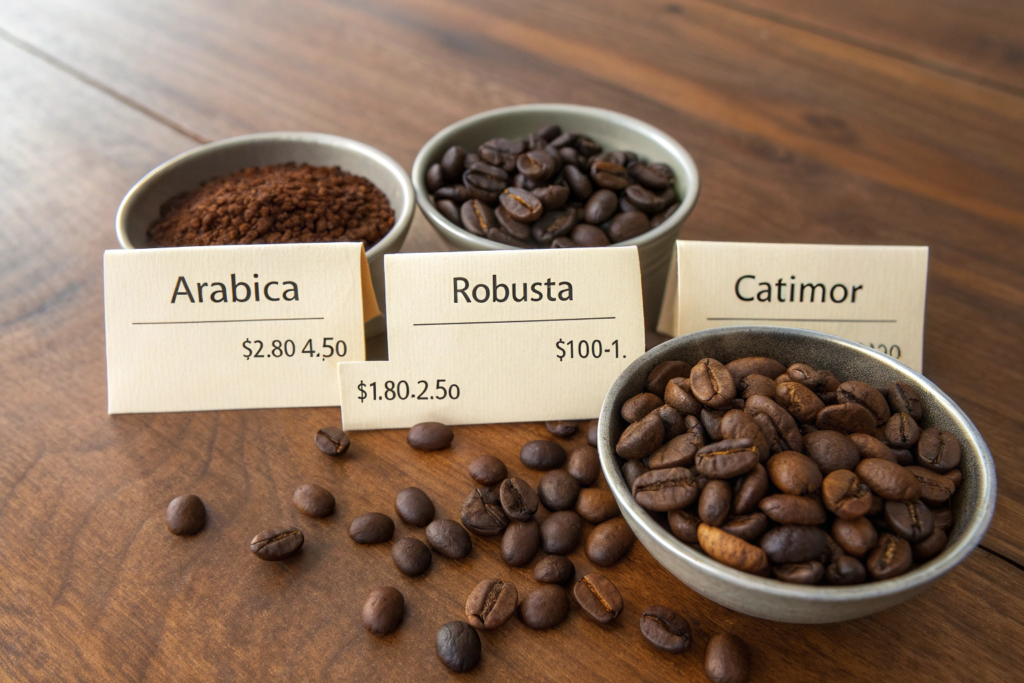
Arabica, Robusta, and Catimor exist on a spectrum of flavor quality, caffeine content, and raw bean cost. A high-grade washed Arabica delivers a complex, sweet, and acidic cup experience but comes at a premium price of roughly $2.80-$4.50/lb for specialty lots. Robusta is harsh, earthy, rubbery, and packed with caffeine at $1.00-$1.50/lb, used primarily for instant coffee and as a cost-cutting filler in cheap espresso blends. Catimor, a hybrid, sits in the middle, offering much of the clean body and chocolate notes of Arabica at a price closer to $1.80-$2.50/lb for specialty-grade lots, making it a strategic, high-value option for espresso bases.
An often-overlooked detail: crema. If your customers judge an espresso by the thickness of the crema, a tiny percentage of high-quality Robusta in a blend can boost it significantly. But you have to be careful. Too much, and the rubbery flavor breaks through. I usually recommend specialty Catimor over a Robusta blend for anyone who cares about flavor but needs cost control. It is a cleaner, more modern solution.
How do Arabica, Robusta, and Catimor differ in caffeine content and bitterness?
Robusta contains almost twice the caffeine of Arabica. Caffeine itself is bitter. This is a big part of why Robusta tastes the way it does. Here is a simple comparison based on our Baoshan crop data:
| Bean Type | Approx. Caffeine Content | Typical Cup Profile | Price Range (FOB) |
|---|---|---|---|
| Arabica | 1.2% - 1.5% | Sweet, acidic, complex | $2.80 - $4.50/lb |
| Catimor | 1.5% - 1.8% | Chocolatey, nutty, full body | $1.80 - $2.50/lb |
| Robusta | 2.2% - 2.7% | Bitter, earthy, harsh | $1.00 - $1.50/lb |
If your cafe needs a true caffeine kick for a "power blend," a 10-15% Robusta addition can achieve that without wrecking the flavor profile. But frankly, for most specialty cafes, a clean Catimor espresso base does the job better. This is why our Yunnan Arabica Green Coffee Beans for Espresso is one of the most popular products we sell to independent cafes—it is a 100% Arabica product at a price that gives them breathing room.
Why is Catimor becoming a serious option for specialty cafes on a budget?
For a long time, Catimor had a terrible reputation. Old Catimor varieties did have a rough, herbaceous edge. The modern Catimor we grow in Baoshan, processed meticulously as a double-washed or honey lot, is a completely different product. It cups clean. It has a heavy, syrupy body that makes amazing espresso. Its dominant notes are caramel, roasted almond, and dark chocolate—the exact profile that an espresso blend demands. And it costs 30-40% less than an equivalent-scoring pure Arabica lot. For a cafe that is just starting out, or one that is trying to protect its margins against rising costs everywhere else, ignoring Catimor is leaving real profit on the table.
How Do You Assess Whether a Coffee Supplier's Bean Selection Fits Your Cafe's Unique Niche?
Here is the final piece of the puzzle. You can know exactly what bean you need on paper, but if you pick the wrong supplier, you will never actually get it. Or you will get something that is close, but just slightly off, season after season. Your supplier is not just a vendor. They are a curator of your cafe's most important ingredient. They have to understand what makes your cafe different.
The right supplier acts as a silent menu consultant. They do not just send you a price list. They ask you: "What is your number one selling drink?", "What does 'good coffee' mean to your customers?", and "What is your target cost per shot?" They should be able to look at their own production and say, "This specific lot from our 1,100-meter farm is the one for you," and explain exactly why. If all they can offer is "good quality Arabica," they are a commodity trader, not a strategic partner for your cafe.
I always tell cafe owners to test a supplier with a specific scenario. Say to them: "My best-selling drink is a 12oz oat milk latte. My customers complain if the coffee tastes too acidic. My target cost per shot, green bean only, is 0.25 cents. What lot do you recommend?" A great supplier will give you a specific answer, with a specific lot number and a rationale. A mediocre one will say "we have many good coffees, please check our website." That difference is everything. Shanghai Fumao builds its client relationships on this kind of consultative approach, starting from the cafe's menu and working backward to the farm.

What questions should a quality supplier ask about your cafe before recommending a bean?
They should ask about your grinder and espresso machine, because a high-acidity bean on a cheap grinder is going to taste terrible. They should ask about your water composition, because water hardness directly changes how acidity and body are extracted. They should ask about your barista's skill level, because a forgiving, easy-to-dial-in bean is what a high-turnover cafe needs. If a supplier is not asking these operational questions, they are not thinking about your success, only about moving inventory.
How can a sample roast test reveal if a supplier truly understands your niche?
Do not just cup the sample. Roast it to your exact production roast profile, pull it as your signature drink, and serve it to your baristas and a few trusted regulars blind. Do not tell them what it is. Just ask, "What do you think?" Watch their faces. Listen to their words. If they start describing your cafe's identity back to you—"this tastes like us"—then the bean and the supplier are the right fit. The goal of the test is not to see if the coffee is "good." The goal is to see if it integrates invisibly into what you have already built. A few of our best long-term partnerships started with a cafe owner doing exactly this and then emailing us to say, "My team didn't even notice it was a new bean. That's the highest compliment I can give."
Conclusion
Selecting the right coffee bean for your cafe is not a romantic quest for the best coffee in the world. It is a business decision with a sensory outcome. It starts with the hard math of your menu and your cost per cup. It flows through the honest understanding of what your customers actually mean when they say "smooth" or "bold." It uses real knowledge of the bean types—Arabica, Robusta, and the under-appreciated Catimor—to find the sweet spot between quality and margin. And it ends with a supplier who does not just sell you beans but helps you think through the fit for your unique niche.
If you are running a cafe and you feel like you have been guessing with your green coffee, I would like to help you stop guessing. Let us talk about your menu, your customers, and your numbers. Cathy Cai, who heads our international cafe partnerships, can walk you through a curated set of options based on your actual business, not a generic catalog. Contact her at cathy@beanofcoffee.com. Tell her about your best-selling drink and your biggest bean frustration. She will get you a recommendation and a sample that makes sense for you. You are not just buying coffee. You are dialing in your business.