
A roaster who supplies cold brew to a chain of grocery stores in California called me last month. "My cold brew tastes sour," he said. "I am using the same single-origin Ethiopian I use for filter. It tastes great hot. It tastes terrible cold. What am I doing wrong?"
I knew his problem immediately. He was using the wrong coffee. Cold brew is not just hot coffee served cold. It is a fundamentally different extraction process. The cold water, the long steep time, and the absence of heat change which flavor compounds are extracted and which are left behind. A coffee that shines in a pour-over can taste thin, sour, or astringent in cold brew. A coffee that tastes unremarkable hot can taste rich, chocolatey, and smooth cold.
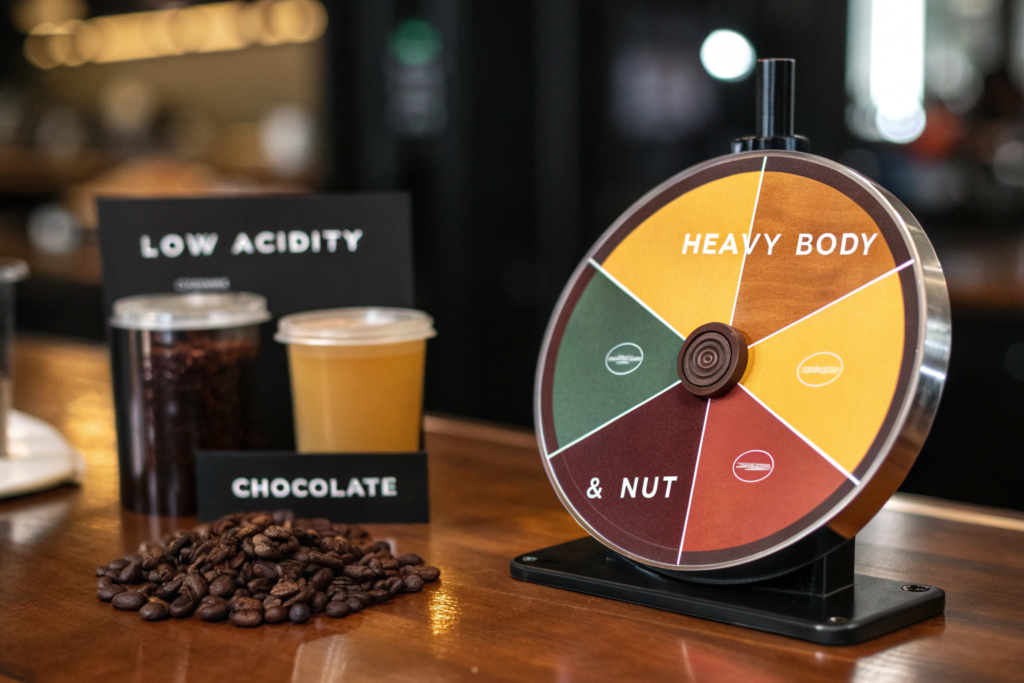
Sourcing coffee beans for cold brew requires selecting lots with naturally low acidity, heavy body, and dominant chocolate, nut, and caramel flavor notes—the bright, floral, and citric characteristics prized in filter coffee become sour, thin, and unbalanced when extracted with cold water over long durations.
This is not about buying cheap coffee. It is about buying the right coffee. The best cold brew starts with green coffee that has the intrinsic characteristics cold extraction amplifies rather than punishes. Here is exactly what to look for, which origins and processes deliver it, and how to verify that the lot will perform before you commit to a container.
What Bean Characteristics Make a Great Cold Brew?
Cold water is a less efficient solvent than hot water. Heat accelerates extraction. It pulls out acids, sugars, oils, and aromatic compounds quickly. Cold water, over 12 to 24 hours, extracts more slowly and selectively. The compounds that extract most readily in cold water are sugars, Maillard products, and heavier organic compounds. The compounds that extract less readily are volatile acids and delicate florals.
This means the ideal cold brew coffee is one that is rich in the compounds that cold water extracts well and low in the compounds that cold water extracts poorly or that taste unpleasant when extracted slowly. A coffee with high citric acidity will taste sour in cold brew because the cold water extracts the acid but does not extract enough sweetness to balance it. A coffee with delicate floral notes will taste flat because those volatiles are not efficiently extracted and are further muted by the cold serving temperature.
The ideal cold brew green coffee has a cupping profile dominated by dark chocolate, roasted nuts, caramel, and brown sugar, with a body score of 8.0 or higher, acidity below 7.5, and a clean, sweet finish—attributes that cold water extracts efficiently into a smooth, rich, syrupy beverage.
Body is particularly important. Cold brew is often served over ice, which numbs the palate and thins the perceived texture. A coffee with naturally heavy body—scoring 8.0 or above on the SCA cupping form—will still feel rich and coating when cold and diluted. A coffee with light, tea-like body will taste watery and thin.
Sweetness is the other critical factor. Cold brew drinkers expect a smooth, naturally sweet beverage. Bitterness and sourness are amplified by the cold serving temperature. A coffee with high intrinsic sweetness and low bitterness will produce a cold brew that tastes balanced and pleasant without added sugar or milk. This is the holy grail for ready-to-drink cold brew brands.
Why Does High Acidity Ruin Cold Brew Flavor?
Acidity is the most common complaint about cold brew. "It tastes sour." "It tastes like lemon juice." "It is harsh." These complaints almost always trace back to a coffee with acidity that is too high for cold extraction.
Hot water extracts acids quickly, but it also extracts sugars, proteins, and lipids that balance those acids on the palate. The result in a well-brewed hot coffee can be a pleasant, bright, balanced cup. Cold water extracts acids at roughly the same relative rate, but extracts sugars and body compounds more slowly. The balance is lost. The acid dominates the flavor profile. The cold serving temperature makes the acid taste sharper and more unpleasant.
The acid composition also matters. Citric acid, the primary acid in high-grown washed Arabica, tastes particularly harsh in cold brew. Malic acid, common in some origins, is slightly softer but still problematic. Phosphoric acid, found in Kenyan coffees, can add a pleasant sparkle in hot coffee but tastes metallic and strange in cold brew.
Cold brew amplifies perceived acidity while muting the sweetness and body that balance it, so coffees with cupping acidity scores above 7.5 or prominent citric notes will almost always produce a sour, unbalanced cold brew regardless of roast level or brew recipe.
The fix is not to roast darker to burn off the acid. A dark roast can mask acidity with roast bitterness, but that creates a different problem—a cold brew that tastes ashy and bitter. The fix is to select green coffee with intrinsically low acidity. The acidity should be mild, soft, and integrated, not bright, sharp, and dominant. On the SCA cupping form, I recommend an acidity score between 6.5 and 7.5 for cold brew candidates. Below 6.5, the coffee may taste flat. Above 7.5, it risks sourness.
How Does Body and Sweetness Survive the Cold Extraction?
Body in cold brew comes from dissolved solids—sugars, Maillard products, and partially broken-down polysaccharides. These compounds extract well in cold water, given enough time. A coffee with naturally high body will produce a cold brew with a thick, syrupy mouthfeel that coats the tongue and feels satisfying.
The green coffee characteristics that contribute to body include the varietal, the altitude, the processing method, and the roast level. Catimor and SL28 tend to have heavier body than Typica or Geisha. Natural and honey processed coffees tend to have heavier body than washed coffees. Medium roasts tend to produce more body in cold brew than light roasts, because the Maillard reaction has created more of the melanoidin compounds that contribute to mouthfeel.
Sweetness in cold brew comes primarily from the caramelization of sugars during roasting. The green coffee's intrinsic sucrose content is the fuel for this caramelization. Coffees grown at high altitude, with slow cherry maturation, have higher sucrose content. Washed processing preserves the clean sugar profile. Medium roasting develops the sugars into caramel and butterscotch notes without burning them into bitter carbon.
I cup every lot specifically for cold brew potential. I brew the coffee hot, to evaluate its full profile. Then I brew it as a cold brew—a 1:8 ratio, 16-hour steep at room temperature, filtered and served cold. The cold brew cup tells me whether the body and sweetness survive the cold extraction and whether any harsh notes emerge. A lot that cups beautifully hot but falls apart cold is not a cold brew lot. It is a filter lot. The two are not interchangeable.
Which Origins and Processes Naturally Fit Cold Brew Profiles?
Not every origin produces coffee suited to cold brew. The bright, acidic coffees of East Africa, the floral and tea-like coffees of Central America—these are magnificent as filter coffees, but they are often the wrong choice for cold extraction. The origins that work best for cold brew are those with naturally lower acidity, heavier body, and chocolate-driven flavor profiles.
Brazil is the world's largest cold brew coffee supplier for a reason. Brazilian naturals and pulped naturals have intrinsically low acidity, heavy body, and notes of chocolate, nut, and caramel. They are soft, sweet, and approachable. They produce cold brew that tastes like chocolate milk. The volumes are massive. The prices are competitive. For a large-scale cold brew operation, Brazilian coffee is the safe, reliable foundation.
Colombia occupies a middle ground. Washed Colombian coffees have more acidity than Brazils, but the acidity is often soft and caramel-like rather than sharp and citric. A medium-roasted washed Colombian can produce a balanced cold brew with more complexity than a Brazilian while still avoiding sourness. The volumes are large. The quality is consistent.
Yunnan, China is an emerging powerhouse for cold brew sourcing, as its washed Catimor naturally cups with low acidity, heavy chocolate body, and clean processing, providing the ideal cold brew profile at a competitive price point with the added advantage of direct trade traceability.
Sumatra and other Indonesian wet-hulled coffees are the wild cards. They have almost no acidity, enormous body, and deep earthy, spicy flavors. A small percentage of Sumatra in a cold brew blend adds bass notes and texture. Too much, and the cold brew tastes muddy and strange. But at 20 to 30 percent of a blend, Sumatra adds depth that Brazilian and Yunnan bases lack.

Why Is Yunnan Catimor Ideal for Cold Brew Blends?
Our washed Catimor from Baoshan is almost purpose-built for cold brew. The cup profile aligns with every characteristic cold extraction demands.
The acidity is low and soft—citric, but mild, scoring around 7.0 on the SCA scale. In hot filter coffee, this provides a gentle brightness. In cold brew, it registers as smooth and round, with no sourness. The body is heavy—consistently 8.0 or above—creating a syrupy mouthfeel that holds up to ice and dilution. The flavor profile is chocolate, roasted almond, and brown sugar, with no fruit or floral notes to turn sour or disappear.
The washed processing ensures the coffee is clean and free of ferment. Ferment defects that might be subtle in hot coffee become aggressively unpleasant in cold brew. The clean cup is essential. The high altitude—1,500 to 1,600 meters—provides the sugar development for sweetness without the high acidity that often accompanies altitude in other origins.
For a roaster building a cold brew program, Yunnan Catimor can serve as the base—60 to 80 percent of the blend—providing body, chocolate, and smoothness. The remaining percentage can be a Brazilian natural for added sweetness or a Sumatra for earthy depth. The blend is balanced, consistent, and affordable. The traceability is direct from our farm to the roaster.
At Shanghai Fumao, we offer specific cold brew grade lots. These are Catimor lots selected for their low acidity and heavy body, cupped specifically for cold brew performance. The FOB pricing is competitive with Brazilian bases. The quality is consistent lot to lot, harvest to harvest.
Can Natural Process Coffees Work for Cold Brew?
Natural processed coffees can work for cold brew, but they require careful selection. A clean, well-dried natural with chocolate and dried fruit notes can add complexity and sweetness to a cold brew blend. A poorly processed natural with ferment or mold notes will ruin the batch.
The advantage of naturals in cold brew is their heavy body and intense sweetness. The fruit mucilage drying on the bean drives sugars into the seed. The result is a coffee with higher perceived sweetness and more body than a washed lot from the same origin. In cold brew, these characteristics translate into a richer, more decadent beverage.
The risk is the fermented fruit character. In hot coffee, a hint of ferment can add complexity. In cold brew, that same hint can taste like overripe fruit or vinegar. The cold extraction amplifies the fermented notes. A natural that cups clean at 84 points hot may cup funky and unpleasant cold.
I recommend using naturals in cold brew blends at low percentages—10 to 20 percent—to add sweetness and complexity without risking off-flavors. The natural should be cupped specifically for cold brew before buying. The hot cupping score is not sufficient. The cold brew cupping is the only reliable evaluation.
For roasters who want a 100 percent natural cold brew, the natural must be exceptionally clean. It should have no ferment notes, no vinegar, no overripe character. It should taste like dried fruit and dark chocolate, clean and sweet. These lots exist but are rare and expensive. Most cold brew programs are better served by a washed base with a small natural addition. For more on processing and flavor, World Coffee Research provides sensory profiles for different processing methods.
How to Cup Coffee Specifically for Cold Brew Performance?
The standard SCA cupping protocol evaluates coffee brewed hot. It is the industry benchmark for quality and scoring. But it does not predict cold brew performance. A coffee that scores 85 points hot may score 80 points cold. A coffee that scores 82 points hot may score 85 points cold. The only way to know is to cup the coffee as cold brew.
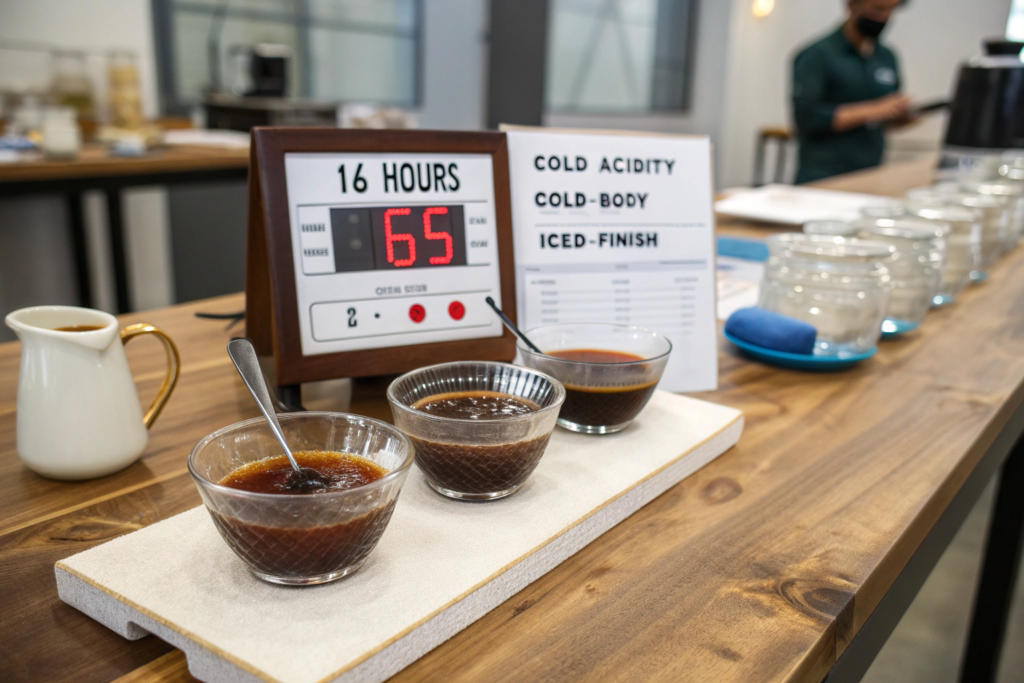
I recommend a parallel evaluation protocol. Cup the coffee hot, using the standard SCA protocol, to evaluate its full flavor profile and to score it against the specialty grade threshold. Then brew the same coffee as a cold brew—a 1:8 coffee-to-water ratio by weight, steeped for 16 hours at room temperature, filtered, and served chilled. Cup the cold brew side by side with the hot cupping.
The cold brew evaluation should focus on the attributes that matter most for the final product. Acidity: is it smooth and balanced, or sour and harsh? Body: is it heavy and syrupy, or thin and watery? Flavor: are the chocolate and nut notes present and pleasant, or do strange fermented or astringent notes emerge? Finish: is it clean and sweet, or dry and bitter?
A proper cold brew sourcing protocol requires cupping the coffee both hot, to assess overall quality, and cold-brewed, to evaluate how the cold extraction transforms the acidity, body, and flavor, ensuring the lot performs as intended in the final product rather than revealing unpleasant characteristics that hot cupping conceals.
Lots that pass the cold brew cupping should also be tested in the roaster's actual production process. The roast profile, the grind size, the steep time, and the filtration method all affect the final flavor. A coffee that cups well in a lab cold brew may behave differently in a large-scale commercial cold brew system. The final test is a production batch, tasted by the team and, ideally, by a sample of target consumers.
What Is the Ideal Roast Profile for Cold Brew Extraction?
The roast profile for cold brew is different from the roast profile for filter or espresso. The goal is to maximize body and sweetness while minimizing acidity and roasty bitterness.
I recommend a medium to medium-dark roast for cold brew. Agtron whole-bean reading of 45 to 55. This is darker than a typical filter roast but lighter than a dark French or Italian roast. At this roast level, the Maillard reaction has progressed far enough to develop chocolate and caramel notes fully. The body is heavy. The acidity is softened. But the roast has not entered the territory where carbon notes and bitterness dominate.
The development time after first crack should be on the longer side—16 to 20 percent of the total roast time. The extended development builds body and sweetness. The rate of rise should be managed carefully to avoid baking. The drop temperature should be around 215 to 220 degrees Celsius.
A roast that is too light will produce a cold brew with sour acidity and thin body. A roast that is too dark will produce a cold brew with ashy, bitter, carbon notes. The medium to medium-dark window is the sweet spot where the coffee's natural chocolate and nut flavors are maximized and the acidity and bitterness are minimized.
I provide roast recommendations for cold brew with every cold brew grade lot I sell. The recommendations are based on my own profiling and feedback from roasters who use our coffee for cold brew production. For more on roast profiling for different extraction methods, Cropster allows roasters to track and share roast curves optimized for cold brew.
What Grind Size and Steep Time Work Best for Evaluation?
The grind size and steep time for cold brew evaluation should mimic the roaster's production process as closely as possible. If the roaster uses a coarse grind and a 16-hour steep, the evaluation should use the same parameters.
For general cold brew cupping, I use a coarse grind—similar to French press, around 800 to 1,000 microns. The coarse grind slows extraction and prevents over-extraction during the long steep. A fine grind, like pour-over, will over-extract and produce a bitter, astringent cup.
The steep time is 16 hours at room temperature, around 20 to 22 degrees Celsius. This is the industry standard for cold brew. Shorter times—8 to 12 hours—produce a lighter, more acidic cup. Longer times—20 to 24 hours—produce a heavier, more extracted cup with increased risk of bitterness and astringency.
The coffee-to-water ratio for cold brew concentrate is typically 1:4 to 1:8 by weight. For cupping evaluation, I use a 1:8 ratio. This produces a concentrate that can be tasted directly and also diluted with water or milk to simulate the final serving format.
The cold brew should be filtered through paper or a fine mesh to remove sediment. Sediment continues to extract and can make the cup taste muddy and over-extracted. The filtered cold brew should be chilled to serving temperature—around 5 to 10 degrees Celsius—before cupping. Temperature affects flavor perception. The cold brew should be tasted at the temperature the consumer will experience.
How to Build a Cold Brew Sourcing Strategy for Your Roastery?
Sourcing coffee for cold brew is not a one-time purchase. It is a program. The cold brew line needs consistent flavor, consistent volume, and consistent pricing across seasons. The sourcing strategy must deliver all three.
The first step is to define the target flavor profile for the cold brew product. Is it a single-origin cold brew with a distinct origin character? Is it a blend designed for maximum smoothness and approachability? Is it a ready-to-drink product sold in cans, or a concentrate sold to cafés? The target profile determines the green coffee specifications.
The second step is to identify one or two base coffees that can supply the body, chocolate notes, and low acidity that the product requires. These base coffees should be available in sufficient volume, with consistent quality across harvests. The relationship with the supplier should be direct and long-term to lock in pricing and allocation.
A successful cold brew sourcing strategy identifies a reliable base coffee—typically a washed low-acidity origin like Yunnan Catimor or Brazilian natural—secures it under a forward contract to ensure year-round supply and pricing stability, and then layers in smaller percentages of specialty lots to create seasonal variations or limited editions.
The third step is to consider seasonal or limited-edition variations. The base cold brew stays consistent year-round. But a summer seasonal cold brew with a natural processed coffee addition, or a winter seasonal with a Sumatran addition, creates marketing excitement and brings in new customers. These seasonal variations use small volumes of more expensive lots, so they do not disrupt the base program.
At Shanghai Fumao, we work with roasters to develop custom cold brew sourcing strategies. We provide consistent base lots for the year-round product and micro-lots for seasonal variations. The pricing is structured to support both. The quality is verified through hot and cold brew cupping for every lot.
How Much Green Coffee Should You Allocate to Cold Brew?
The volume allocation depends on the roaster's sales mix. Cold brew is a growing category. Many roasters now report that cold brew accounts for 10 to 30 percent of their total coffee volume, particularly in summer months.
To calculate the green coffee requirement, start with the cold brew sales volume in finished product. A liter of cold brew concentrate at a 1:8 brew ratio requires roughly 125 grams of green coffee, accounting for roast shrinkage and extraction efficiency. A roaster who sells 1,000 liters of cold brew concentrate per month needs roughly 125 kilograms of green coffee per month, or 1,500 kilograms per year, for the cold brew program alone.
The green coffee should be ordered in shipments sized to maintain freshness. Cold brew base coffee, being a medium-roast product, does not require the ultra-fresh turnover of a light roast filter coffee. But the green coffee should still be used within 12 months of harvest. Order shipments every three to six months, depending on the volume.
I recommend holding a buffer stock of one month's usage. If the roaster uses 125 kilograms per month, the warehouse should have 125 kilograms in reserve at all times. The buffer protects against shipping delays, quality issues, or unexpected demand spikes. The buffer is part of the sourcing contract. The supplier should be able to ship replenishment orders on short notice.
How Should You Price Your Cold Brew Product for Profitability?
Cold brew commands a premium price at retail, but the green coffee cost is only one component of the total cost. The pricing must cover the green coffee, the roasting, the packaging, the labor, the distribution, and a healthy margin.
The green coffee for cold brew base is typically less expensive per pound than the green coffee for single-origin filter offerings. A washed Catimor cold brew base at $2.80 to $3.20 per pound FOB is significantly cheaper than an $8.00 per pound Geisha. This lower green cost allows a higher margin on the finished product, or a more competitive retail price.
A typical cost breakdown for a bottled cold brew concentrate might look like this. Green coffee: $3.50 per pound landed. Roasting and packaging: $2.00 per unit. Labor and overhead: $1.50 per unit. Distribution: $1.00 per unit. Total cost: $8.00 per unit. Retail price: $14.00 per unit. Gross margin: $6.00 per unit, or 43 percent.
The margin on cold brew can be higher than on whole bean coffee because the green coffee cost is a smaller percentage of the total product cost. The packaging, the distribution, and the brand are the larger cost drivers. The roaster who sources smartly on the green coffee can invest more in branding and still achieve a healthy margin.
For roasters who sell cold brew concentrate to cafés and restaurants, the wholesale pricing must leave room for the café's margin as well. A concentrate that costs the café $8.00 per liter and yields 8 liters of served cold brew at $4.00 per cup generates $32.00 in revenue for the café. The café is happy. The roaster is happy. The margin structure works for both.
Conclusion
Cold brew is not just hot coffee served cold. It is a distinct product category with its own sourcing requirements, its own evaluation protocols, and its own economics. The best cold brew starts with green coffee that has low acidity, heavy body, and chocolate-driven flavor—attributes that cold water extracts efficiently and that taste balanced when served chilled.
Yunnan Catimor is a natural fit for cold brew bases, alongside Brazilian naturals and Colombian washed coffees. The washed processing ensures cleanliness. The altitude provides sweetness without excessive acidity. The body is heavy and satisfying. The flavor is chocolate and nut, not fruit and acid. The volumes are available. The pricing is competitive.
Sourcing for cold brew requires cupping the coffee as cold brew, not just hot. The evaluation must focus on the attributes that matter in the final product: cold acidity, cold body, cold finish. The roast profile must be optimized for cold extraction—medium to medium-dark, with extended development. The sourcing strategy must deliver consistency across seasons, with a reliable base and optional seasonal additions.
If you are building or expanding a cold brew program and want to taste what Yunnan Catimor brings to cold extraction, contact Cathy Cai at BeanofCoffee. She can send you samples specifically selected for cold brew performance, along with hot and cold cupping scores, roast recommendations, and FOB pricing for container or pallet volumes. Her email is cathy@beanofcoffee.com. She responds quickly and can help you build a cold brew sourcing strategy that fits your volume, your flavor target, and your budget.