A roaster from Sydney once asked me why our washed Catimor tasted vibrant twelve months after harvest, while another supplier's coffee tasted flat and papery after six months. "Same variety," he said. "Same altitude. Same processing method on paper. What is the difference?"
I asked him how the other supplier dried their coffee. He did not know. He had never asked. I told him to find out. A week later, he called me back. "They dry on concrete patios," he said. "It takes five days. Your coffee takes two weeks on raised beds. Does that really make that much difference?" I told him it makes all the difference in the world. The drying method is not a detail. It is the single biggest determinant of how long the coffee will stay alive in the bag.
Slow drying on raised beds extends coffee longevity by allowing moisture to migrate evenly from the bean's core to its surface over 10 to 20 days, preserving the cellular structure, preventing micro-fissures that admit oxygen, and stabilizing water activity below 0.60, which collectively slow the oxidation and staling reactions that degrade flavor over time.
This is not folklore. It is physics and chemistry. Let me walk you through exactly what happens inside the bean during drying, why the speed and the surface matter, and how to verify that the coffee you are buying was dried in a way that will keep it fresh on your shelf and your customer's shelf.
What Happens Inside a Green Bean During the Drying Phase?
When coffee leaves the washing channel or the fermentation tank, it is not a stable product. It is a living seed, saturated with water, and biologically active. The moisture content is around 50 to 55 percent. The bean is swollen. The cells are turgid. Enzymes are still working. If the bean stays wet for too long, mold and bacteria will consume it. If it dries too fast, the cell structure will crack.
The goal of drying is to bring the moisture content down to 10.5 to 12 percent, where the bean is stable and biologically inactive. But the path the bean takes from 55 percent to 11 percent matters enormously. The path determines whether the bean's cellular structure remains intact or develops micro-fissures. The path determines whether the water activity stabilizes at a safe level or remains too high, even after the moisture reading looks correct.
During slow drying, the moisture inside the bean migrates gradually to the surface. The water molecules travel through the cell walls and the intercellular spaces. The cell walls, which are flexible when wet, shrink slowly and evenly as they lose water. The bean contracts uniformly. The internal structure remains intact. The parchment shell, which surrounds the bean, moderates the rate of moisture loss and protects the bean from direct environmental exposure.
Proper drying is not just about reaching a target moisture percentage; it is a biological transition where the seed moves from a living, respiring state to a dormant, stable state without the physical trauma of case hardening or internal cracking that would later allow oxygen to penetrate and degrade the coffee.
During fast drying, the surface moisture evaporates rapidly. The outside of the bean dries and hardens while the inside is still wet. This is called case hardening. The hard outer shell traps moisture inside. The trapped moisture continues to try to escape. It pushes against the hardened surface. The internal pressure creates micro-fissures—tiny cracks in the cell walls. The bean may reach 11 percent moisture on the meter, but the water activity remains high because the moisture is unevenly distributed and the damaged cell structure does not bind water properly.

How Does Moisture Migration Differ in Fast Versus Slow Drying?
Moisture migration is the movement of water from the interior of the bean to the surface. It is driven by a moisture gradient. The surface, exposed to air, dries first. The interior, still wet, sends moisture outward to replace what was lost. The rate of migration depends on the temperature, the humidity, and the physical structure of the bean.
In slow drying on raised beds, the moisture gradient is gentle. The surface does not dry out drastically faster than the interior. The migration is steady and controlled. The water moves through intact cell walls and capillary spaces. The bean dries from the outside in, but the difference in moisture between the surface and the core is never extreme. The entire bean reaches the target moisture level at roughly the same time.
In fast drying on a hot patio, the moisture gradient is steep. The surface, in direct contact with hot concrete and exposed to full sun, dries extremely fast. The surface moisture drops to near zero while the interior is still at 40 percent. The steep gradient creates stress. Water from the interior rushes to the surface to compensate. The rapid movement of water through delicate cell walls can rupture them. The damage is microscopic but permanent.
Slow drying maintains a gentle moisture gradient from core to surface, allowing water to migrate without rupturing cell walls, while fast drying creates a steep gradient that forces water through the bean's structure so aggressively that it leaves behind micro-fissures and a hardened, impermeable outer layer.
You can observe the difference in the dried bean. A slowly dried bean has a uniform color, a smooth surface, and a tight center cut. A fast-dried bean often shows a mottled color, a rougher surface, and a slightly opened or frayed center cut. The visual differences are subtle but real. The cupping differences are dramatic. For more on the physics of moisture migration in seeds, World Coffee Research has published technical guides on drying and storage.
What Are Micro-Fissures and How Do They Accelerate Staling?
Micro-fissures are tiny cracks in the cell walls of the coffee bean. They are not visible to the naked eye. You need a microscope to see them. But their effect on cup quality and shelf life is enormous.
The cell walls of a coffee bean are its primary defense against oxygen. Oxygen is the enemy of coffee freshness. Oxygen reacts with lipids, oxidizing them into stale, cardboardy compounds. Oxygen reacts with volatile aromatics, degrading them. A bean with intact cell walls has a robust barrier against oxygen. The oxygen must diffuse slowly through the intact cellulose matrix. The process takes months.
A bean with micro-fissures has a compromised barrier. The cracks provide direct pathways for oxygen to enter the bean. The surface area available for oxidation increases dramatically. The lipids and aromatics that should be protected inside the cell structure are exposed. The staling reactions that should take months now take weeks.
This is why two coffees with the same moisture content and the same water activity can have completely different shelf lives. The coffee with intact cell walls will taste fresh for twelve to eighteen months in proper storage. The coffee with micro-fissures will taste flat and stale within six to nine months. The moisture meter and the water activity meter do not measure cell wall integrity. Only the cup reveals the difference over time.
I have tracked this with our own lots. Our slow-dried, raised-bed Catimor consistently cups fresh and vibrant at twelve months post-harvest. We once experimented with a faster mechanical drying protocol. The coffee met all our moisture and water activity specifications. It cupped well immediately after drying. But at six months, it had faded noticeably. The fruit notes were gone. The body was thinner. The finish was papery. The micro-fissures had done their damage. We never used that protocol again. For more on the relationship between drying and shelf life, the Coffee Quality Institute provides storage and quality preservation resources.
How Do Raised Beds Compare to Concrete Patios and Mechanical Dryers?
The surface on which coffee is dried determines the drying speed, the drying uniformity, and the risk of defects. Not all drying surfaces are created equal. The difference between a raised bed, a concrete patio, and a mechanical dryer is the difference between gentle preservation and aggressive damage.
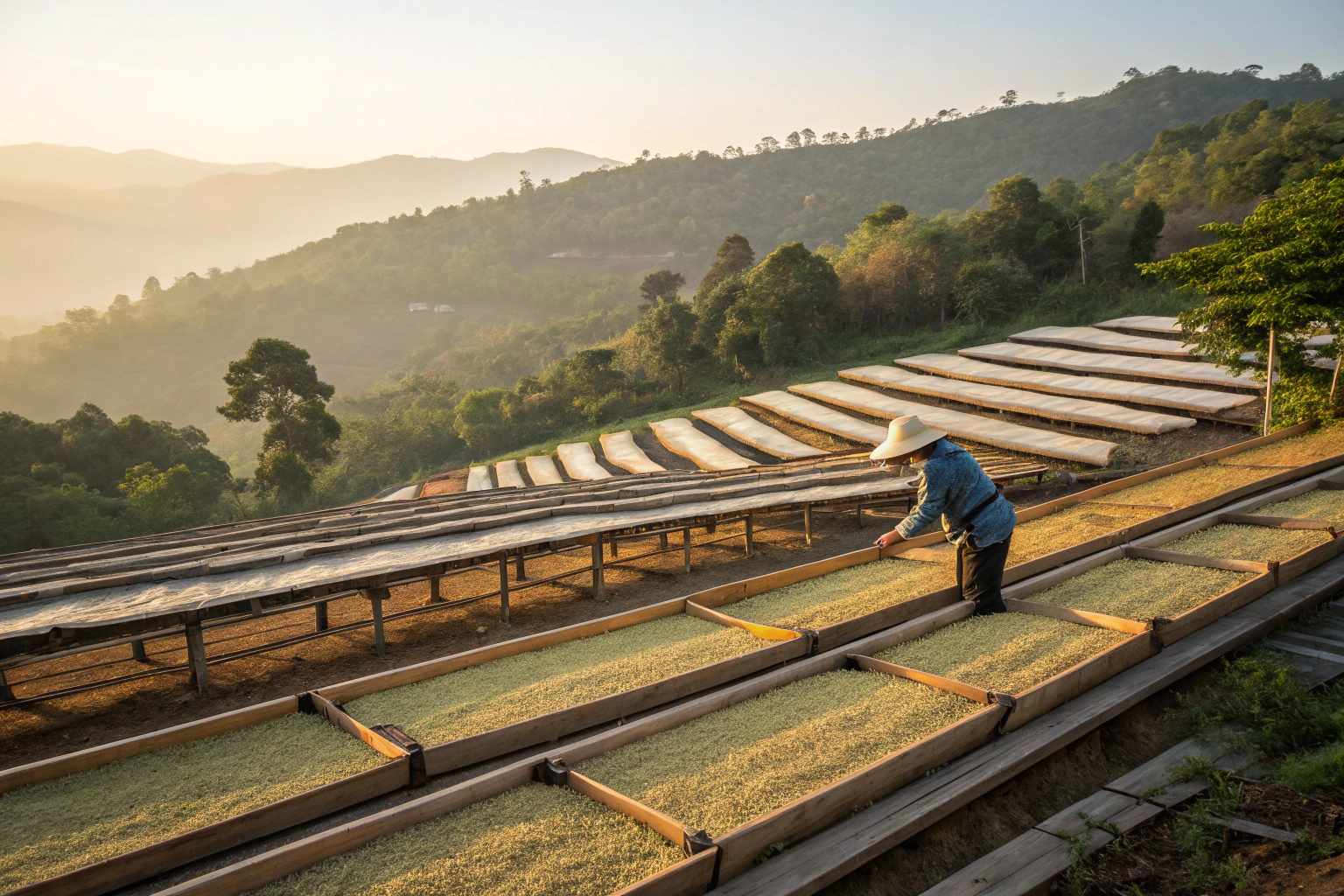
Raised beds are the gold standard for specialty coffee drying. The beds are constructed of wooden frames with mesh or netting stretched across them. The coffee parchment is spread on the mesh in a thin layer. Air circulates around the beans from above and below. The drying is driven by natural convection—sunlight warming the beans from above, breeze carrying moisture away from all sides. The beans do not sit in contact with a hot, impermeable surface. The temperature of the bean mass stays moderate, rarely exceeding 35 to 40 degrees Celsius even in direct sun.
Concrete patios are the traditional drying surface for commodity coffee. The coffee is spread directly on a concrete slab. The sun heats the concrete. The concrete transfers heat directly to the beans resting on it. The surface temperature of the concrete can exceed 50 degrees Celsius on a sunny day. The beans in contact with the concrete dry much faster than the beans on top of the pile. The drying is uneven. The beans must be raked constantly to prevent scorching. Even with raking, the temperature stress and the rapid moisture loss damage the bean structure.
Raised beds dry coffee gently through natural air convection from all sides, maintaining moderate, uniform temperatures and a controlled drying rate over 10 to 15 days, while concrete patios and mechanical dryers apply excessive, uneven heat that case-hardens the bean surface and creates the micro-fissures responsible for rapid staling.
Mechanical dryers are used when the weather does not permit sun drying or when the volume is too large for raised beds. The coffee is loaded into a rotating drum or a vertical column and hot air is blown through it. The temperature can be controlled, but the process is inherently more aggressive than sun drying. The direct contact with heated surfaces and the forced hot air can dry the bean surface too rapidly. Mechanical drying is often combined with sun drying—the coffee is pre-dried on beds and finished in the dryer, or vice versa. Used carefully, mechanical drying can be acceptable. Used as the sole drying method at high temperatures, it damages the bean.

Why Does Airflow Under the Bed Matter for Drying Uniformity?
Airflow is the invisible advantage of raised beds. The mesh surface allows air to pass under the beans as well as over them. This is not a minor detail. It is the reason raised beds dry coffee evenly.
On a concrete patio, the beans are in direct contact with a solid, impermeable surface. The bottom of the bean pile receives no airflow. Moisture can only escape from the top and sides. The bottom stays wet longer. The drying is inherently uneven. The beans on top may be dry while the beans on the bottom are still damp. Turning the pile helps, but it is never perfectly uniform.
On a raised bed, the mesh allows air to circulate under the beans. Moisture escapes from the bottom as well as the top. The drying is three-dimensional. The entire surface area of every bean is exposed to moving air. The moisture gradient is gentler. The drying is more uniform.
The height of the bed also matters. Raising the coffee off the ground separates it from ground moisture and ground heat. The ground can be a source of humidity, especially in the morning when dew forms. A raised bed, typically one meter off the ground, keeps the coffee in a drier, breezier micro-environment.
The mesh material matters too. A fine, food-grade mesh prevents beans from falling through while maximizing airflow. The mesh should be clean and in good condition. Old, clogged mesh reduces airflow and can harbor mold spores. We replace our bed mesh every two seasons to maintain optimal drying conditions. For more on drying infrastructure, Perfect Daily Grind has published features on raised bed construction and management from various origins.
What Temperature Thresholds Damage the Bean During Drying?
Temperature is the stressor that does the most damage during drying. The bean is a living tissue. At moderate temperatures, it dries gently and its cell walls remain intact. At high temperatures, the cell walls are damaged and the volatile aromatics begin to degrade.
The maximum safe temperature for coffee drying is generally considered to be 40 to 45 degrees Celsius for the bean mass temperature, not the air temperature. Above this threshold, the risk of cellular damage increases. The proteins in the cell walls begin to denature. The lipids begin to oxidize. The volatile aromatics begin to evaporate.
On a raised bed in Baoshan, with an air temperature of 25 degrees Celsius and moderate sun, the bean mass temperature typically stays around 30 to 35 degrees Celsius. This is well within the safe range. The drying is gentle. The bean structure is preserved.
On a concrete patio under the same sun, the surface temperature of the concrete can reach 50 to 55 degrees Celsius. The beans in contact with the concrete experience that temperature directly. Even if the bean mass temperature averages lower, the beans at the bottom are being cooked. The damage is localized but real.
In a mechanical dryer, the air temperature is controlled but often set too high to speed up the process. A dryer set at 50 degrees Celsius air temperature may produce a bean mass temperature of 45 degrees Celsius or higher. The drying is fast, but the quality cost is high.
I monitor bean mass temperature on our raised beds using a simple probe thermometer. It is checked three times a day during the peak drying phase. If the bean mass temperature approaches 40 degrees Celsius, we deploy shade netting to reduce the solar radiation. The shade netting also slows the drying rate and protects the beans from UV damage. This level of monitoring is labor-intensive. It is one reason our dried coffee costs more than commodity patio-dried coffee. It is also why our coffee tastes better and lasts longer.
How Does Slow Drying Stabilize Water Activity for Long Term Storage?
Water activity is not the same as moisture content. Moisture content is the total amount of water in the bean, expressed as a percentage of the bean's weight. Water activity is a measure of the free, unbound water available for chemical reactions and microbial growth. Two beans can have the same moisture content but different water activities. The bean with the lower water activity will be more stable and last longer.
Slow drying on raised beds promotes low, stable water activity. The gentle, extended drying allows the water molecules to bind properly to the bean's cellular matrix. The water becomes chemically bound to proteins and carbohydrates. It is not free to participate in oxidation reactions or support mold growth.
Fast drying, especially on a hot surface, traps water inside the bean. The surface dries and hardens. The interior water is sealed in. The moisture content reading may be 11 percent, but the water activity may be 0.65 or higher, compared to 0.55 or lower for a properly slow-dried bean. The trapped water is free water. It is available for chemical reactions. The bean stales faster. It is at higher risk of mold.
Slow drying stabilizes water activity below the critical 0.60 threshold by giving water molecules time to chemically bind to the bean's cellular matrix, converting free water that would accelerate staling into bound water that does not participate in degradation reactions.
I measure water activity on every export lot. The target is below 0.60, and ideally below 0.55 for micro-lots intended for long storage or slow turnover. A lot with water activity of 0.53 will taste fresh at twelve months. A lot with water activity of 0.65 may taste flat at six months, even if both lots read 11 percent moisture on the meter. The water activity measurement is a better predictor of shelf life than moisture content alone. For more on water activity standards, the Green Coffee Association provides grading guidelines that reference water activity targets.

What Is the Ideal Moisture Content and Water Activity Target?
The specialty coffee industry has converged on a set of targets for moisture content and water activity that balance stability, flavor preservation, and safety.
The ideal moisture content for export green coffee is between 10.5 and 12 percent. Below 10.5 percent, the bean is over-dried. The cell structure may be damaged. The cup may taste flat and woody. The bean is also more brittle and prone to breakage during milling and transport. Above 12 percent, the bean is at risk of mold and microbial spoilage. The free water is high enough to support fungal growth.
The ideal water activity for export green coffee is below 0.60. This is the threshold below which mold cannot grow. Aspergillus and Penicillium, the most common storage molds, require water activity above 0.60 to germinate. A coffee with water activity below 0.60 is microbiologically stable.
For micro-lots and coffees intended for long-term storage, I target water activity below 0.55. At this level, even if the storage conditions are not ideal—a warm warehouse, a long voyage—the coffee has a buffer. The water activity can drift up slightly without crossing the 0.60 threshold.
The moisture content and the water activity must be measured together. A coffee with 11.5 percent moisture and 0.53 water activity is in excellent condition. A coffee with 11.5 percent moisture and 0.63 water activity is a red flag. The moisture content looks fine, but the water activity tells a different story. The drying was likely too fast, and the water is not properly bound. That coffee will stale quickly.
How Does Proper Drying Prevent Mold in Transit?
Transit is the most vulnerable period for coffee. A container crossing the equator experiences temperature swings from 10 degrees Celsius at night to 50 degrees Celsius during the day. The humidity inside the container can spike as the beans respire and release moisture. If the coffee was not dried properly, these conditions can trigger mold.
Properly dried coffee, with moisture below 12 percent and water activity below 0.60, is resilient to transit stress. The low water activity means there is insufficient free water for mold spores to germinate, even if the temperature spikes. The intact cell structure, preserved by slow drying, means the bean does not release moisture as readily. The interior environment of the container stays more stable.
Coffee that was dried too quickly, with case hardening and trapped moisture, is vulnerable. The trapped moisture is released slowly during transit as the temperature fluctuates. The humidity inside the container rises. The water activity of the beans drifts up. If it crosses 0.60, mold spores germinate. The coffee arrives with musty, moldy notes. The container is rejected. The loss is total.
I have shipped containers of our slow-dried Catimor to warehouses in Houston, Hamburg, and Melbourne. The containers cross the equator. The transit time is four to six weeks. The coffee arrives clean, with water activity unchanged from the pre-shipment measurement. The slow drying on raised beds, the careful moisture and water activity monitoring, and the GrainPro packaging combine to protect the coffee during the journey.
For buyers, this means the coffee on the warehouse shelf is the coffee that left our farm. There is no transit degradation. The shelf life clock starts from the arrival date, not from some earlier point when the coffee was already slowly staling inside the container. For more on transit and storage best practices, the Specialty Coffee Association has published guidelines on green coffee logistics and quality preservation.
How Can Buyers Verify That Coffee Was Slow-Dried?
You cannot tell how a coffee was dried just by looking at the green bean. A fast-dried bean and a slow-dried bean can look similar to the untrained eye. But there are clues, and there are questions you can ask the supplier that will reveal the truth.
The first clue is the color and uniformity of the green bean. Slow-dried beans tend to have a more uniform blue-green or jade-green color. The surface is smooth and clean. The center cut is tight and pale. Fast-dried beans may show a mottled, uneven color, a slightly rough surface, and a darker or more open center cut. These visual cues are subtle. They require experience to read reliably. But they are part of the evaluation.
The second clue is the cup. Slow-dried coffee cups cleaner and sweeter. There is no hint of harshness, no astringency, no flatness. The acidity is bright and integrated. The body is smooth. Fast-dried coffee may cup with a slightly harsh, roasty, or flat note. The difference is more apparent as the coffee ages. A six-month-old slow-dried coffee will cup significantly better than a six-month-old fast-dried coffee.
Buyers can verify slow drying by requesting the supplier's daily moisture logs that show a gradual, 10 to 15 day drying curve, cupping the lot for clean sweetness and absence of harsh or flat notes, and asking specific questions about drying surface, bed thickness, and turning frequency.
The third clue, and the most reliable, is the supplier's documentation. A producer who dries on raised beds and monitors the process carefully will have drying logs. The logs will show the daily moisture readings over the drying period. A slow-dried lot will show a smooth, gradual decline in moisture over 10 to 15 days. A fast-dried lot will show a steep, short curve over 4 to 7 days. The logs do not lie.
What Documentation Should a Supplier Provide About Drying?
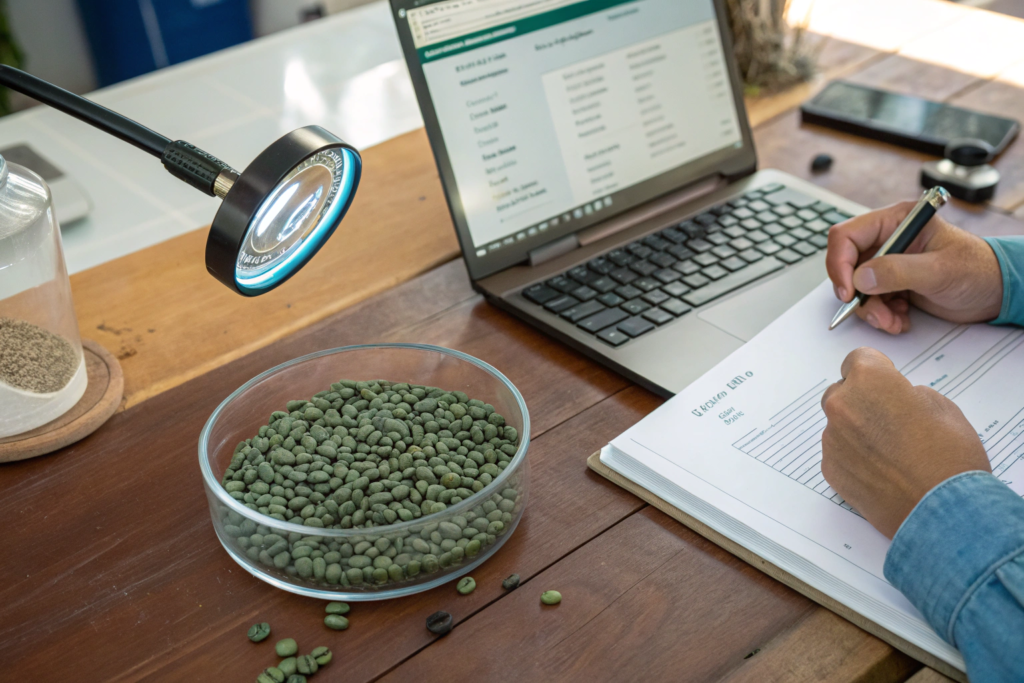
I provide a drying log with every lot I ship. The log is a simple spreadsheet that shows the date, the moisture reading, the bean mass temperature, the ambient temperature and humidity, the bed turning frequency, and any shade or cover deployment. The log covers every day from the start of drying to the day the coffee reached the target moisture.
Here is what a typical drying log entry looks like for one of our washed Catimor lots:
| Day | Moisture % | Bean Temp °C | Ambient Temp °C | Humidity % | Turnings | Notes |
|---|---|---|---|---|---|---|
| 1 | 52 | 28 | 24 | 55 | 4 | Thin layer, full sun |
| 3 | 38 | 30 | 25 | 50 | 5 | Steady drying |
| 7 | 22 | 32 | 26 | 48 | 4 | Entering mid-phase |
| 10 | 15 | 31 | 25 | 52 | 3 | Slowing down |
| 14 | 11.2 | 29 | 24 | 55 | 2 | Shade cloth deployed, target reached |
A buyer who receives this log can see the entire drying history. The moisture declined gradually. The bean temperature never exceeded 32 degrees Celsius. The turning was frequent. The shade cloth was used at the end to slow the final phase. This is a coffee that was dried with care.
A supplier who cannot or will not provide a drying log is either not monitoring the drying or does not want the buyer to see the data. In either case, it is a red flag. The buyer should ask why. If the answer is not satisfactory, the buyer should consider sourcing from a supplier who provides full transparency.
At Shanghai Fumao, drying logs are part of our standard lot documentation. Every buyer receives the log along with the cupping scores, the moisture and water activity readings, and the fermentation data. The transparency is part of the quality promise.
How Can Sample Roasting Reveal Drying Defects?
A sample roast can reveal drying defects that the green bean hides. The roast profile for sample evaluation should be light, to preserve the bean's intrinsic character. A heavy roast buries drying defects under roast character.
The sample roast should be evaluated for evenness. A well-dried bean roasts evenly. The color is uniform across the batch. A poorly dried bean may roast unevenly. Some beans are lighter. Some are darker. The unevenness reflects uneven moisture distribution in the green bean, a hallmark of fast or uneven drying.
The cup evaluation should focus on the finish and the aftertaste. Drying defects often appear as astringency, harshness, or a flat, papery finish. The coffee may taste pleasant on the first sip but leave a dry, puckering sensation on the tongue. This is a sign of cell wall damage and lipid oxidation, both of which trace back to poor drying.
The cup should also be evaluated over time. Roast the sample. Cup it at 24 hours post-roast. Cup it again at seven days post-roast. Cup it again at 14 days. A well-dried coffee will hold its flavor or even improve as the roast gases dissipate. A poorly dried coffee will fade quickly. The fruit notes will disappear. The body will thin. The papery finish will intensify. The difference between day one and day 14 tells you more about the drying than the day one cup alone.
I encourage all buyers to do this aging test on samples, especially for lots they are considering for long-term inventory. The test simulates what will happen on the retail shelf. A coffee that cannot hold its flavor for 14 days post-roast will not make a customer happy when they brew it three weeks after buying the bag. For more on sample evaluation protocols, the Specialty Coffee Association provides cupping standards and roast sample guidelines.
Conclusion
Slow drying on raised beds is not a romantic tradition. It is a scientifically grounded processing choice that directly determines how long a coffee will stay fresh and vibrant. The gentle, extended drying preserves the bean's cellular structure, stabilizes water activity below the critical 0.60 threshold, and prevents the micro-fissures that allow oxygen to invade and stale the coffee prematurely.
Concrete patios and aggressive mechanical dryers, by contrast, prioritize speed over structure. The rapid, uneven drying case-hardens the bean, traps moisture, and creates the microscopic damage that shortens shelf life. The coffee may meet the moisture specification on paper, but it will not meet the longevity expectation in the cup.
For roasters who hold inventory, who sell retail bags that sit on shelves, or who export to distant markets, the drying method is not a technical footnote. It is a purchasing criterion. Slow-dried coffee costs more because the labor, the infrastructure, and the time are greater. But the return on that investment is a coffee that tastes fresh at twelve months, not six. The return is a customer who opens a bag and tastes vibrancy, not flatness. The return is a reputation for quality that holds up over time.
If you want to taste the difference that slow drying on raised beds makes, and to receive the drying logs and documentation that verify it, contact Cathy Cai at BeanofCoffee. She can send you samples of our raised-bed dried lots along with their full drying data, cupping scores, and water activity readings. She can also arrange a video call so you can see the raised beds and the drying process yourself. Her email is cathy@beanofcoffee.com. She responds quickly and can discuss your specific shelf-life and quality requirements.