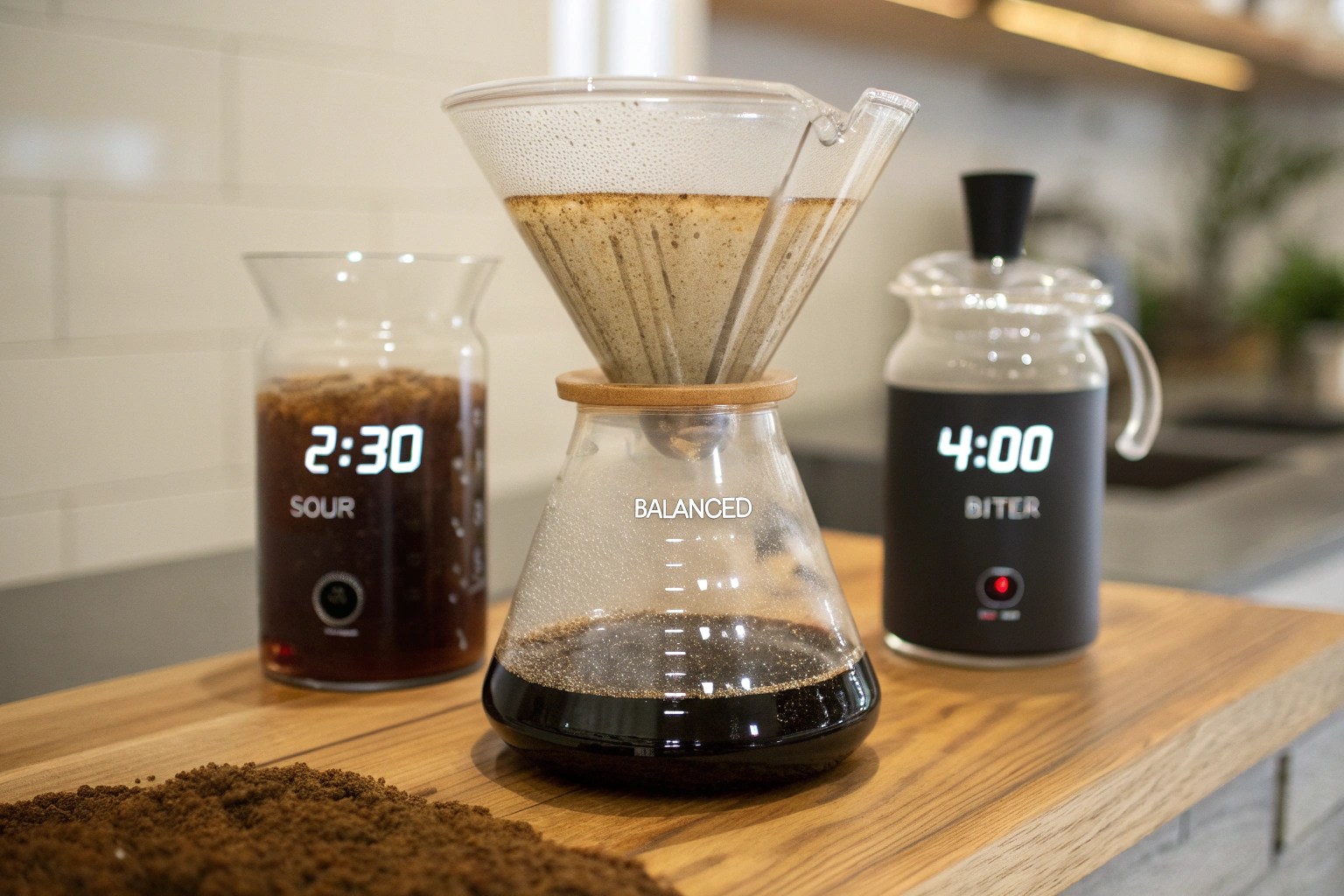
I’ll never forget the first time I ruined a perfectly good batch of coffee with bad timing. It was early in my roasting days. I had just roasted a beautiful lot of our Yunnan Arabica. I was excited to taste it. So I brewed it the way I always did—except I got distracted. I left it steeping in the French press for almost eight minutes instead of four. When I finally poured it, the coffee was bitter. Harsh. Almost undrinkable. I thought the roast was bad. But my father walked in, took one sip, and said, “The roast is fine. You just brewed it too long.”
So, what’s the real impact of brewing time on coffee? Brewing time controls how much flavor gets extracted from the grounds. Too short, and you get under-extraction—sour, weak, empty. Too long, and you get over-extraction—bitter, astringent, harsh. The right brewing time pulls out the sweetness, the balance, the complexity. It’s the difference between a cup that tastes like the bean and a cup that tastes like a mistake. At BeanofCoffee, we help our buyers understand this because even the best coffee will taste bad if it’s brewed wrong.
Let me walk you through what I’ve learned. I’ll explain the science of extraction, how different brewing methods need different times, and how you can dial in the perfect brew.
What Happens to Coffee During Brewing?
To understand brewing time, you have to understand extraction. Extraction is what happens when water meets coffee. It pulls out the compounds that give coffee its flavor. And it happens in stages.
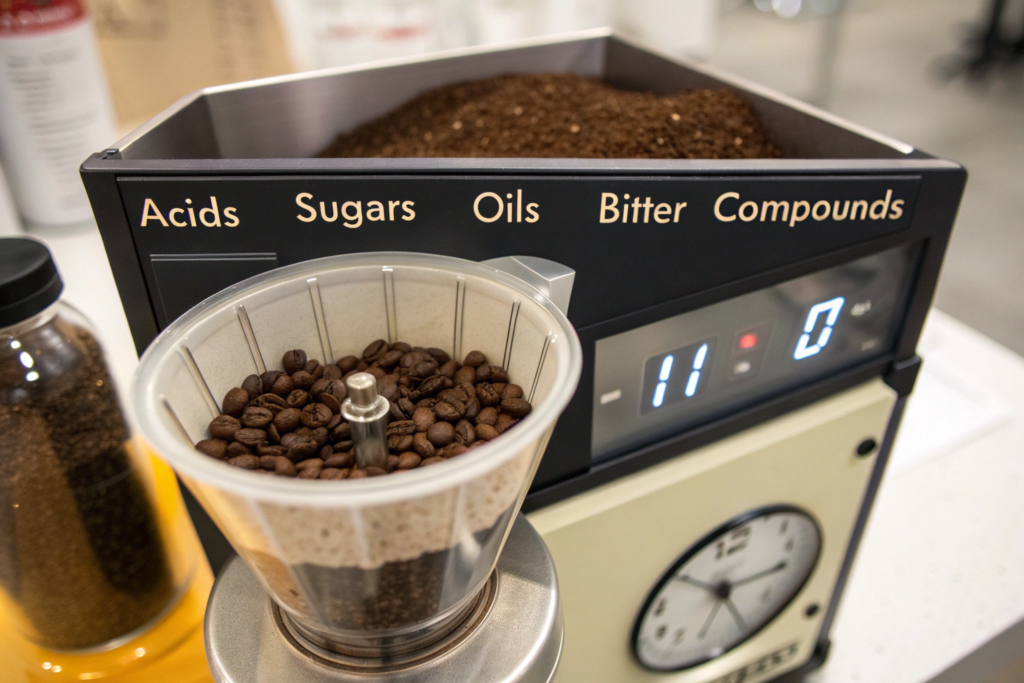
What extracts first, second, and third?
When water first hits the coffee, it pulls out the acids and the fruity compounds. These come out quickly. They’re the first to dissolve.
Next come the sugars and the caramelized compounds. These take a little more time. They’re what give coffee its sweetness and body.
Last come the bitter compounds, the tannins, the astringent notes. These take the longest to extract. They come out at the end of the brewing process.
The goal of brewing is to stop at the right moment. You want the acids and the sugars. You want some of the oils. But you want to stop before the bitter compounds dominate.
I think of it like cooking an egg. You want the white set and the yolk runny. Cook it too short, it’s raw. Cook it too long, it’s rubbery. There’s a sweet spot. Brewing coffee is the same.
What is the difference between under-extraction and over-extraction?
Under-extracted coffee tastes sour. Sharp. Sometimes salty. It’s thin. There’s no sweetness. The flavors are incomplete. That happens when the brewing time is too short. The water didn’t have enough contact with the grounds to pull out the sugars.
Over-extracted coffee tastes bitter. Dry. Astringent. It leaves a drying feeling in your mouth, like over-steeped tea. That happens when the brewing time is too long. The water pulled out the bitter compounds that should have stayed in the grounds.
The sweet spot is in the middle. Balanced. Sweet. Complex. That’s where the coffee tastes like what the roaster intended.
I’ve cupped thousands of coffees. When I’m training new staff, I have them taste under-extracted and over-extracted samples side by side. They learn the difference in one session. It’s unmistakable once you know what to listen for.
How Does Brewing Time Vary by Brewing Method?
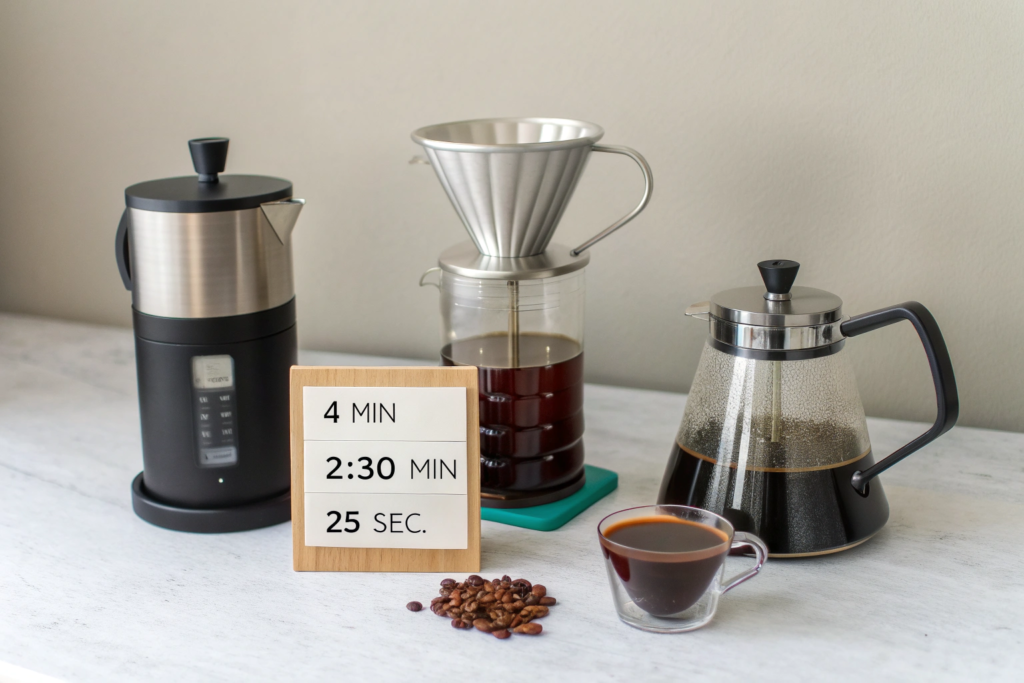
Every brewing method has its own ideal brew time. You can’t use the same time for espresso that you use for French press. The equipment changes everything.
What brew time works for pour-over?
Pour-over methods—like V60, Chemex, Kalita—typically need a brew time between two and a half and three and a half minutes.
The water flows through the grounds by gravity. If the grind is too coarse, the water flows too fast and you under-extract. If the grind is too fine, the water slows down and you over-extract.
I’ve watched baristas dial in pour-over times. They adjust the grind until the brew time hits that two-and-a-half to three-minute window. Then they taste. Small adjustments from there.
If you’re brewing our Yunnan Arabica as a pour-over, I’d start with three minutes. Then adjust based on taste. Sour? Grind finer. Bitter? Grind coarser. The brew time will shift with the grind.
What brew time works for espresso?
Espresso is different. The brew time is measured in seconds, not minutes. A typical espresso shot takes 25 to 30 seconds.
In espresso, the water is forced through the puck under pressure. The grind is the main control. Finer grind = slower flow = longer brew time. Coarser grind = faster flow = shorter brew time.
I’ve seen baristas pull amazing shots at 22 seconds. I’ve seen great shots at 32 seconds. The number is a starting point. Taste is what matters.
If you’re using our Catimor for espresso, start with a 25-second target. Then adjust. Sour? Grind finer, aim for 28 seconds. Bitter? Grind coarser, aim for 22 seconds.
How Does Brewing Time Interact with Grind Size and Water Temperature?
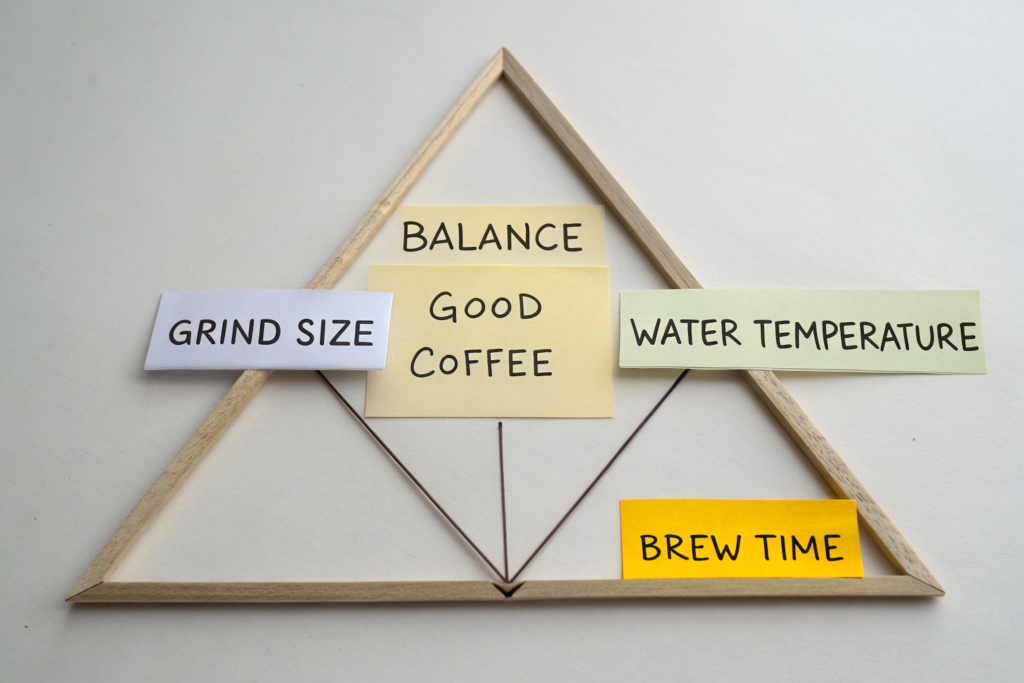
Brewing time doesn’t exist in isolation; it weaves through the intricate tapestry of grind size and water temperature, each thread dependent on the others to create harmony. Imagine the dance of coffee particles: too coarse a grind, and water slips through like a gentle stream, leaving behind a weak, under-extracted brew that tastes flat and uninspiring, as if the beans’ rich flavors never had a chance to bloom. Too fine, and water clings, extracting bitter, astringent compounds that turn your cup into a harsh, unbalanced experience, sharp as a blade against the tongue.
How do you balance grind size and brew time?
Think of it this way. Finer grind = more surface area. More surface area = faster extraction. So if you use a finer grind, you need a shorter brew time to avoid over-extraction.
Coarser grind = less surface area. Less surface area = slower extraction. So if you use a coarser grind, you need a longer brew time to get enough extraction.
In pour-over, this is the main dialing-in variable. If your coffee tastes sour, your grind is probably too coarse. Make it finer. The brew time will increase. The extraction will improve.
If your coffee tastes bitter, your grind is probably too fine. Make it coarser. The brew time will decrease. The bitterness will fade.
How does water temperature affect brew time?
Hotter water extracts faster. Cooler water extracts slower.
If your water is too hot—say, straight off the boil—the extraction happens quickly. You might need a shorter brew time to avoid over-extraction.
If your water is too cool—maybe 80°C—the extraction is slow. You might need a longer brew time to get enough out of the grounds.
I recommend starting with water between 92°C and 96°C for most brewing. That’s just off the boil. Then adjust brew time from there.
For dark roasts, use cooler water. 85°C to 90°C. They extract more easily. For light roasts, use hotter water. 95°C to 98°C. They’re denser and need more heat to extract fully.
Our article on the difference between light and medium roast goes deeper into how roast level affects extraction.
How Do You Dial In the Perfect Brew Time?
Dialing in brew time is a skill, a delicate dance of precision and intuition that transforms ordinary coffee into a symphony of flavors. But it’s not magic, no shimmering incantations or secret rituals—just a process, a methodical exploration of variables that unfold with the patience of a master craftsman.
The air hums with the promise of aroma as water heats, its gentle gurgle a prelude to the ritual. Anyone can learn it, anyone with an open mind and a willingness to observe, to taste, to adjust.
What’s a simple method for dialing in?
I teach a simple three-step method.
Step one: pick a starting point. For pour-over, start with three minutes. For French press, start with three and a half minutes. For espresso, start with 25 seconds.
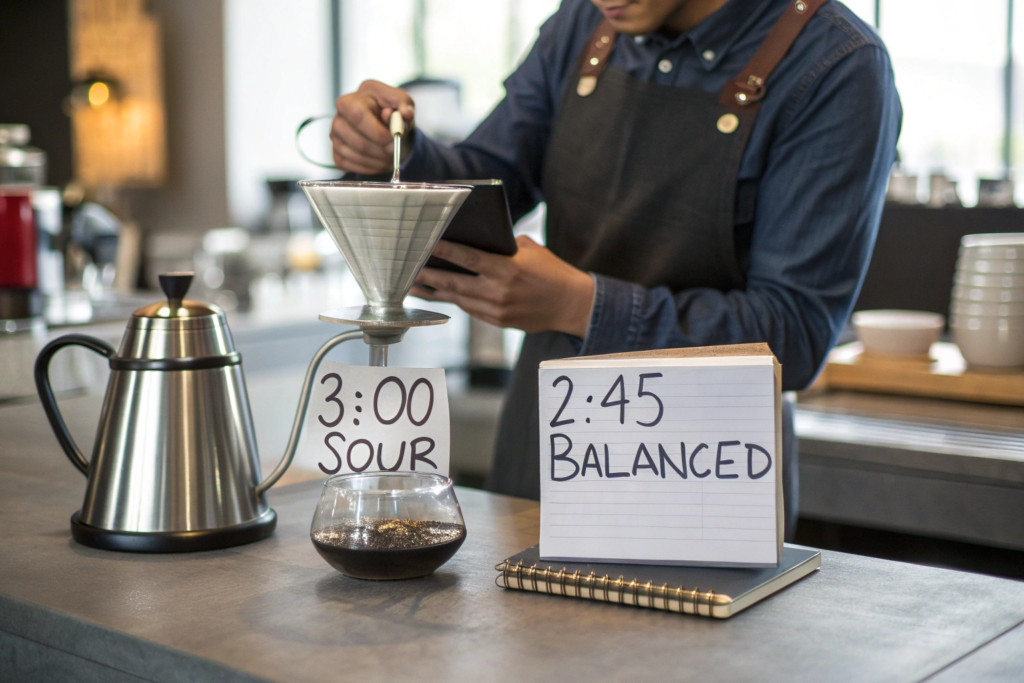
Step two: brew and taste. Write down what you taste. Sour? Bitter? Balanced?
Step three: adjust. If it’s sour, extract more. That means finer grind, or hotter water, or longer brew time. If it’s bitter, extract less. That means coarser grind, or cooler water, or shorter brew time.
Change one variable at a time. Don’t change grind and time together. You won’t know which one fixed the problem.
One of our buyers in the UK told me they used this method to train their new baristas. They said it took the guesswork out of training. New staff could dial in a coffee in three tries instead of ten.
How do you know when you’ve found the right brew time?
You know when the coffee tastes balanced. Not sour. Not bitter. Sweet. Complex. Pleasant.
There’s a range, not a single number. A coffee might taste great between two minutes forty seconds and three minutes fifteen seconds. That’s fine. The goal is consistency, not perfection.
We provide brew guides for our coffees. They’re starting points. We tell our buyers: start here, then adjust for your taste.
If you’re brewing our Yunnan Arabica, we recommend a three-minute pour-over as a starting point. For our Catimor espresso blend, start at 26 seconds. For our cold brew, start at 18 hours. Then taste. Then adjust.
Conclusion
Brewing time is one of the most powerful controls you have over coffee flavor. Too short, and the coffee tastes sour and weak. Too long, and it tastes bitter and harsh. The right time pulls out the sweetness, the balance, the complexity that the roaster built into the bean.
At BeanofCoffee, we spend months growing our coffee, carefully processing it, and roasting it to bring out the best flavors. But the last step is yours. How you brew matters. Get the time right, and you taste the mountains of Yunnan. Get it wrong, and you taste the mistake.
We help our buyers understand this. We provide brew guides. We share our experience. We want you to succeed, because when your customers taste great coffee, they come back for more.
If you’re sourcing from us and you want to learn more about brewing, reach out to Cathy Cai. She can connect you with our quality team. We’re happy to share what we’ve learned. Her email is: cathy@beanofcoffee.com.