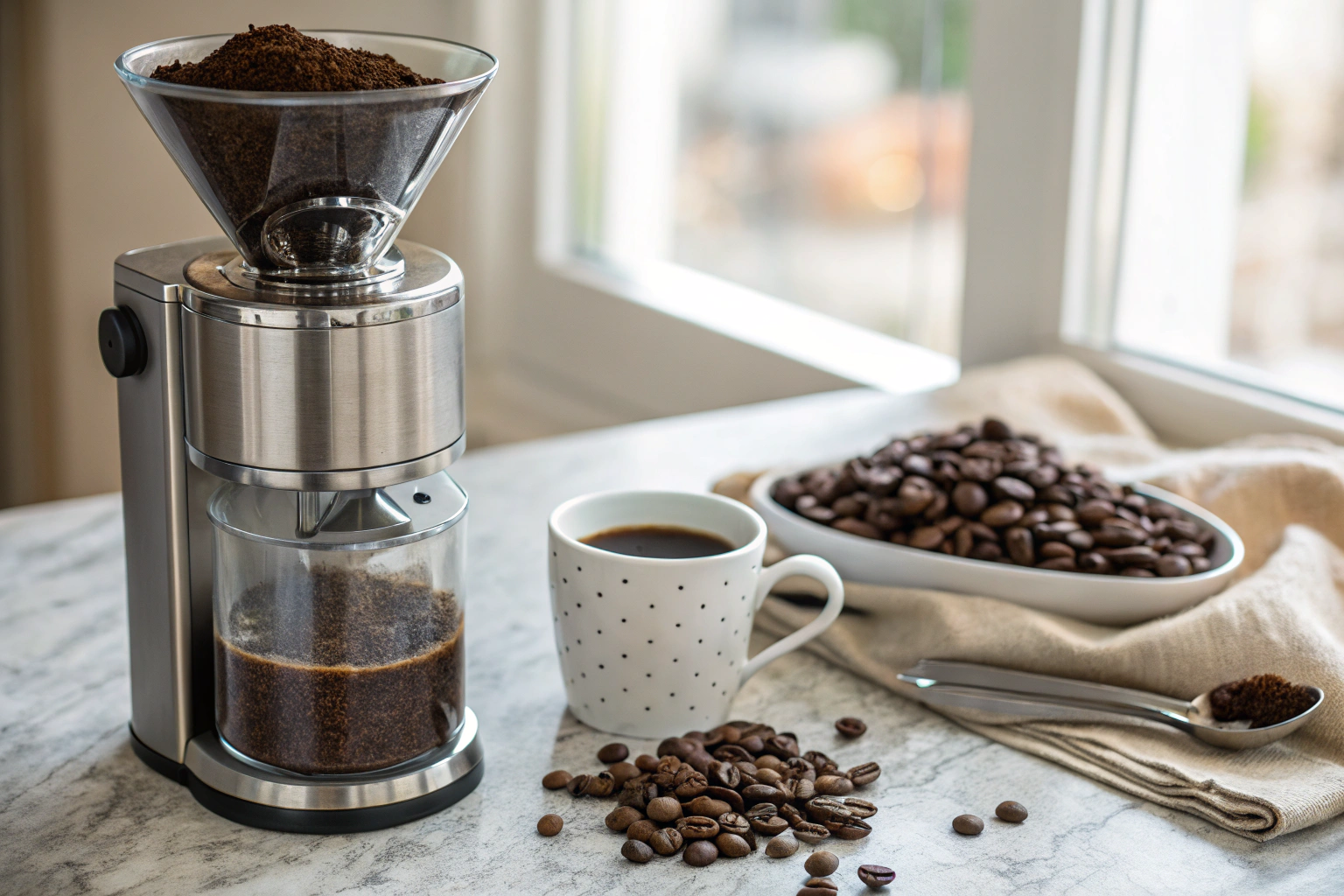
I still remember the day I realized I had been grinding coffee wrong for years. I was at a coffee trade show in Europe, and a veteran roaster pulled me aside. He asked me how I ground coffee at home. I told him I used a blade grinder. He smiled and said, “You’re doing yourself a disservice.” Then he handed me a cup of coffee made from the same beans I roasted—but ground in a burr grinder. The difference was shocking. The flavor was cleaner. The sweetness was clearer. There was no muddiness, no random bitterness. I went home and bought a burr grinder the next week. And I’ve never looked back.
So, what is the best way to grind coffee beans? Use a burr grinder, not a blade grinder. Burr grinders crush the beans between two revolving surfaces, producing uniform particles. This consistency leads to even extraction, balanced flavor, and a predictable brew. Blade grinders chop the beans unevenly, creating a mix of fine dust and large chunks that extract at different rates—giving you a cup that’s both bitter and sour at the same time. At BeanofCoffee, we grind our sample batches on burr grinders, and we recommend every serious coffee drinker and business do the same.
Let me walk you through what I’ve learned. I’ll explain why the grinder matters, how to choose the right one, and how to get the best results from your grind.
Why Does Grind Consistency Matter?
The single most important factor in grinding coffee is consistency. Imagine the dance of tiny beans being transformed into a cascade of particles—each one a potential contributor to the final cup. Uniform particle size, where every fragment is roughly the same shape and dimension, is the cornerstone of this transformation. It leads to uniform extraction, a harmonious process where water weaves through the grounds, gently coaxing out the rich tapestry of flavors, oils, and aromas without favoring any single particle.
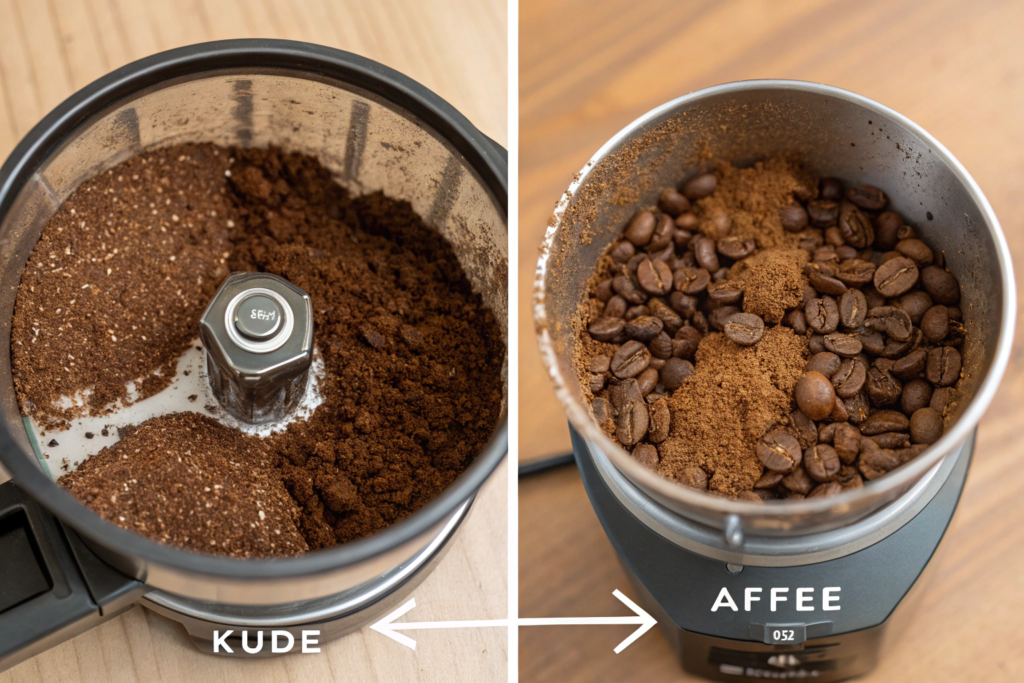
What happens when grind is inconsistent?
When you use a blade grinder, you get a mix of particle sizes. Some pieces are dust-fine. Some are large chunks.
When you brew, the fine dust over-extracts immediately. It releases bitter, harsh compounds. The large chunks under-extract. They release sour, weak flavors.
The result is a cup that tastes both bitter and sour at the same time. It’s confusing. You don’t know if the problem is the coffee, the roast, or your brewing. Usually, it’s the grind.
I’ve cupped coffees that were roasted perfectly but ground poorly. The difference is night and day. The same coffee, ground on a burr grinder, tastes clean and balanced. Ground on a blade grinder, it tastes muddy and unpredictable.
What’s the ideal particle size distribution?
In an ideal grind, every particle is the same size. That’s impossible in practice. But a good burr grinder gets you close.
The particles should be uniform enough that they all extract at roughly the same rate. That means the water flows through them evenly. The flavors come out together.
When you achieve that, the coffee tastes the way the roaster intended. The sweetness comes through. The acidity is bright but balanced. The finish is clean.
For a deeper dive on how extraction works, check out our article on how to understand the impact of brewing time. Grind consistency and brew time work together.
What’s the Difference Between Blade Grinders and Burr Grinders?
There are two main types of coffee grinders. They work completely differently. And they produce completely different results.
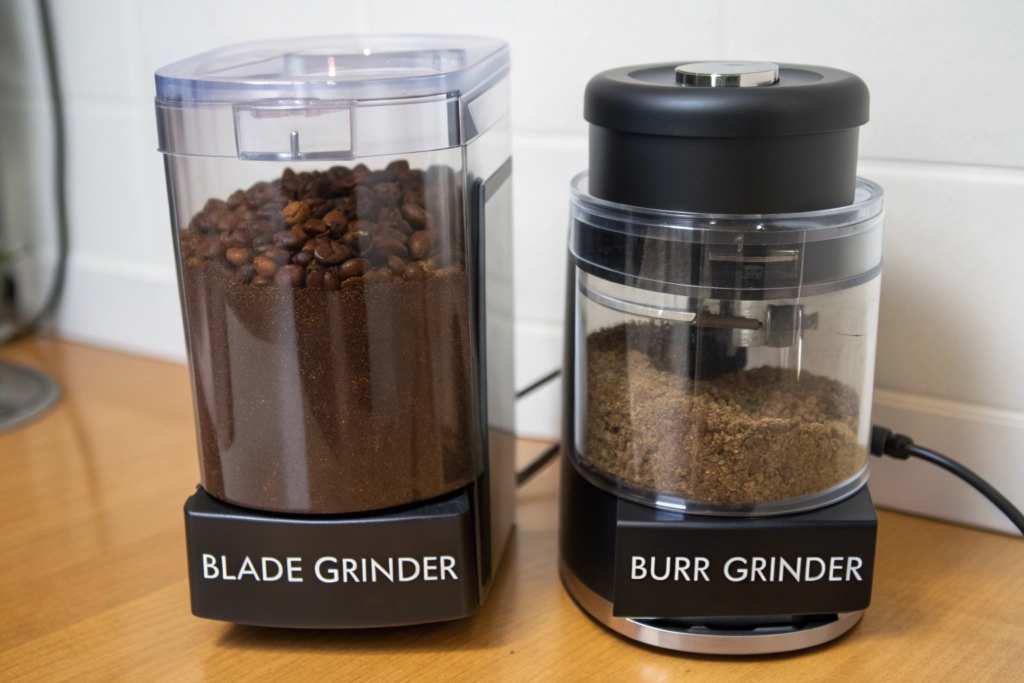
How does a blade grinder work?
A blade grinder is essentially a spinning blade inside a chamber. You put beans in, press a button, and the blade chops them up. It’s like a mini food processor.
The problem is the blade spins so fast that it creates a whirlwind. The beans get thrown around. The pieces on the bottom get chopped more than the pieces on top. The result is a mix of fine dust and large chunks.
Blade grinders are cheap. They’re small. They’re convenient. But they’re the worst option for quality.
I used a blade grinder for years. I thought it was fine. But once I switched to burr, I realized how much flavor I had been losing.
How does a burr grinder work?
A burr grinder uses two abrasive surfaces—called burrs—that crush the beans between them. You set the distance between the burrs, and the grinder produces particles of that size.
There are two types of burr grinders.
Flat burr grinders use two flat, ring-shaped burrs that face each other. The beans fall between them and get crushed. These are common in commercial settings. They’re precise. They produce very uniform particles.
Conical burr grinders use a cone-shaped burr inside a ring-shaped burr. The beans get crushed as they move down. These are common in home grinders. They’re quieter than flat burrs and generate less heat.
Both are excellent. Either is far better than a blade grinder.
If you’re a home brewer, a good conical burr grinder is a great investment. If you’re a café or roastery, flat burr grinders are worth the extra cost.
How Do You Choose the Right Burr Grinder?
Not all burr grinders are the same. Some hum softly as they grind, their ceramic or steel burrs spinning with a satisfying whir, while others rattle and clatter, leaving behind uneven grounds that can ruin a perfectly brewed cup. The right choice depends on your volume—whether you’re a casual sipper who grinds a single serving each morning or a dedicated barista prepping dozens of espressos for a bustling café. It hinges on your budget, too: from affordable manual models with simple, sturdy designs to high-end electric grinders boasting precision engineering and sleek, modern aesthetics. And most importantly, it aligns with your brewing method.
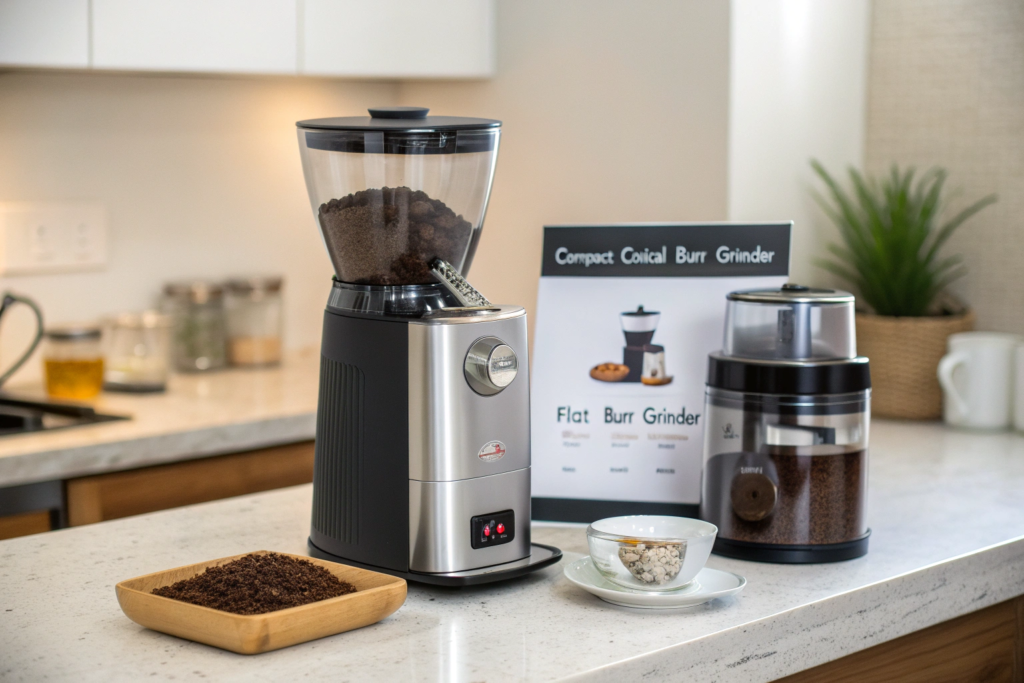
What should you look for in a home burr grinder?
For home use, I recommend a conical burr grinder with a motor. Look for one with at least 40 grind settings. You want the ability to dial in precisely.
Stepless adjustment is even better. That means there are no preset clicks. You can turn the dial continuously and make tiny adjustments.
The grinder should have a low-speed motor. High-speed motors generate heat, which can affect the flavor of the grounds before they even hit the brewer.
I’ve tested several home grinders over the years. The ones in the $150 to $300 range are the sweet spot. Below that, the burrs are often poor quality. Above that, you’re paying for features most home brewers don’t need.
What should you look for in a commercial burr grinder?
For a café or roastery, flat burr grinders are the standard. They’re faster. They’re more precise. They handle high volume.
Look for large burrs—at least 64mm, up to 98mm for espresso-focused shops. Larger burrs grind faster and generate less heat.
The grinder should have programmable dosing. That allows baristas to grind directly into the portafilter with consistent weight.
Commercial grinders are expensive. Expect to pay $1,000 to $3,000 for a quality unit. But they last for years. And they pay for themselves in consistency and reduced waste.
Our roasting facility uses flat burr grinders for cupping. We need consistent grounds to evaluate our Yunnan Arabica and Catimor lots accurately. If the grind is inconsistent, the cupping results are unreliable.
What Grind Size Should You Use for Different Brewing Methods?
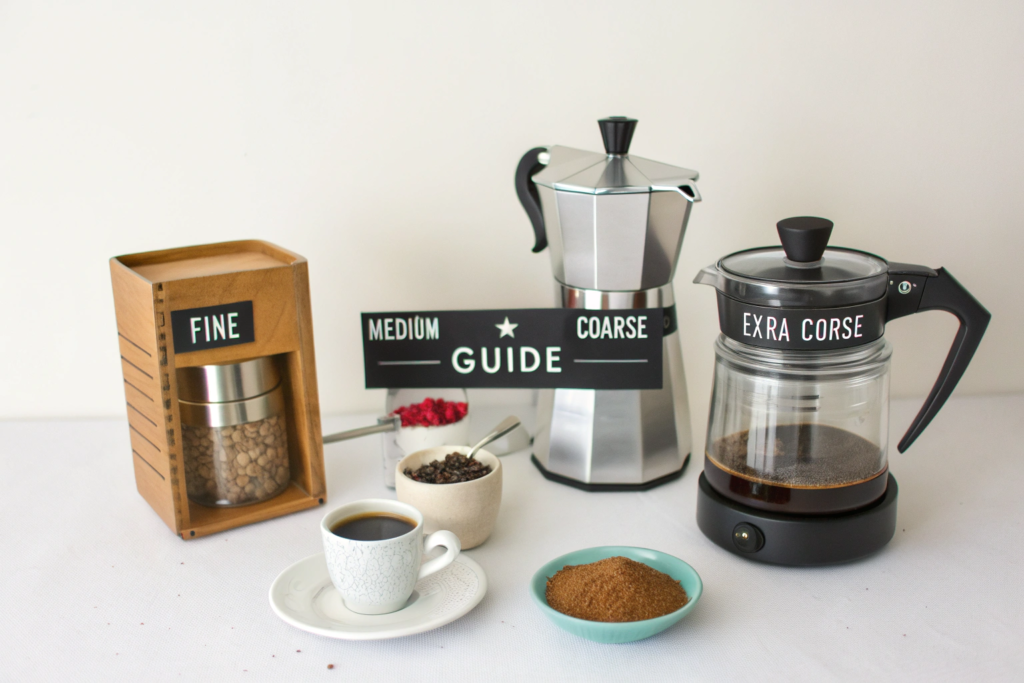
Once you have a good grinder, its true potential lies in knowing precisely which setting to use, for the magic of a perfect cup begins with the grind. Different brewing methods demand distinct grind sizes, each tailored to unlock unique flavors and textures.
A coarse grind, like the rough texture of sea salt or the grit of crushed nuts, is essential for methods such as French press, where hot water gently seeps through loose grounds, extracting rich, full-bodied notes without bitterness.
What grind size works for espresso?
Espresso needs fine grind. Think table salt. Maybe a little finer.
The grind should be fine enough that the water takes 25 to 30 seconds to pull a shot. Too fine, and the shot runs slow and tastes bitter. Too coarse, and the shot runs fast and tastes sour.
If you’re using our Catimor for espresso, start with a fine setting and adjust from there. The right grind will give you a thick, syrupy shot with a rich crema.
What grind size works for pour-over and drip?
Pour-over and drip machines need medium grind. Think sand. Not beach sand—finer than that. But not as fine as espresso.
The grind should be consistent enough that the water flows through evenly. If it’s too fine, the water pools and the brew takes too long. If it’s too coarse, the water rushes through and the brew tastes weak.
For our Yunnan Arabica in a pour-over, I use a medium setting. Three-minute brew time is my target. Then I adjust based on taste.
Conclusion
The best way to grind coffee beans is with a burr grinder. Blade grinders are convenient and cheap, but they ruin the coffee. They create inconsistent particles that extract unevenly, giving you a cup that’s both bitter and sour.
A burr grinder—whether flat or conical, electric or manual—gives you uniform particles. That consistency leads to even extraction. Balanced flavor. A clean finish. It’s the single biggest upgrade you can make to your coffee routine.
At BeanofCoffee, we grind our sample lots on high-quality burr grinders. We need that precision to evaluate our Yunnan Arabica and Catimor accurately. We recommend the same for our buyers. Whether you’re a home brewer, a café owner, or a roaster, the grinder matters.
Our partnership with Shanghai Fumao ensures that our roasted products arrive fresh and ready to brew. But the last step is yours. Grind right. Taste the difference. If you have questions about grinders, grind settings, or brewing, reach out to Cathy Cai. She can connect you with our quality team. We’re happy to share what we’ve learned. Her email is: cathy@beanofcoffee.com.