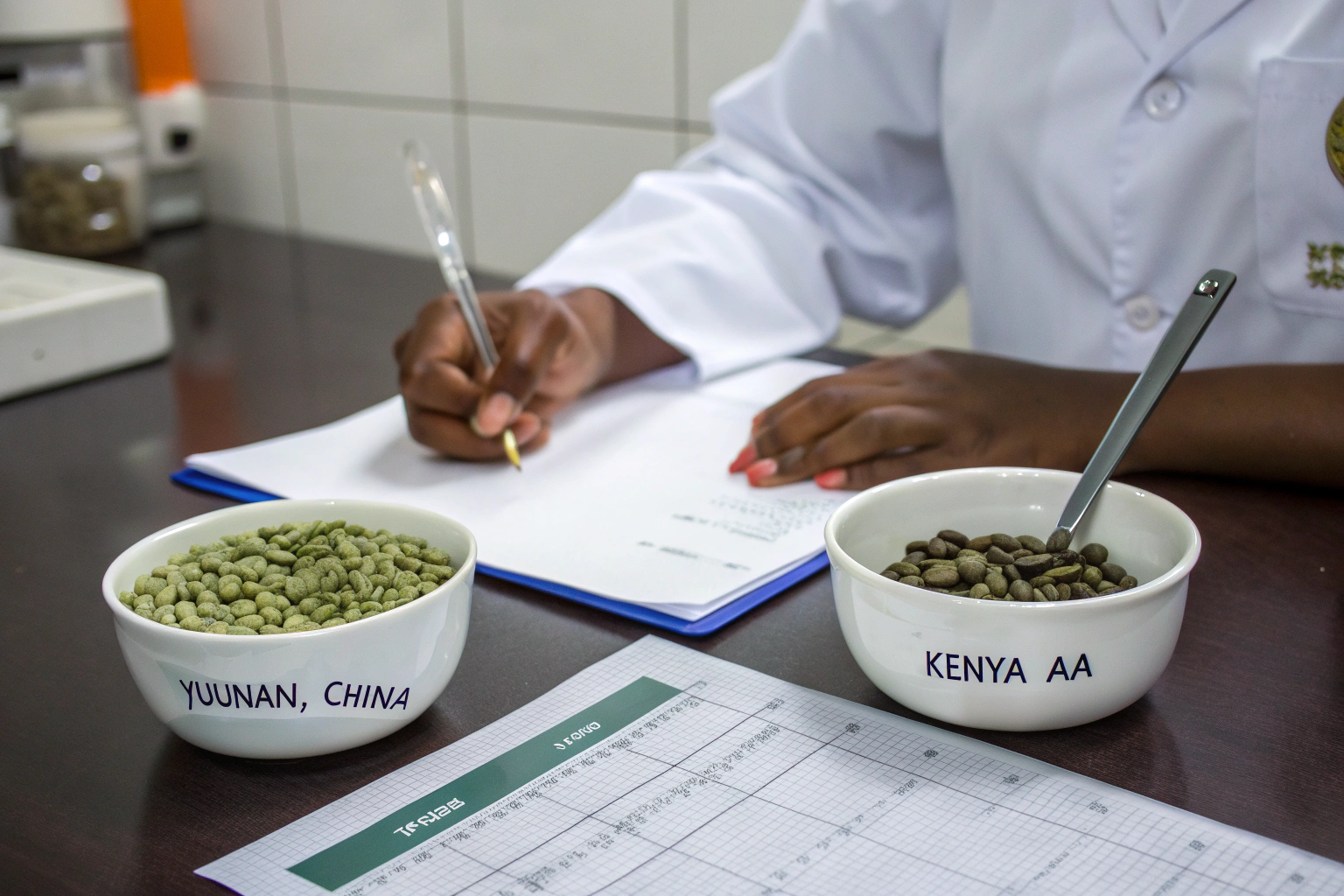
I have a confession. I used to be a coffee snob. Before I owned this farm, I was a buyer just like you. And I believed the gospel. Kenya is the king of acidity. Ethiopia is the birthplace of flavor. And China? China was for tea and instant coffee. I would walk past Yunnan samples at trade shows without a second glance. I was wrong. Not about Kenya. Kenya is still spectacular. I was wrong about China. The quality gap is not what it used to be. And if you are making buying decisions based on reputation from ten years ago, you are leaving money and flavor on the table.
The quality difference between Chinese and Kenyan AA beans is primarily a contrast in flavor architecture: Kenyan AA offers intense, wine-like acidity with bold blackcurrant and citrus notes, while high-grade Yunnan Arabica provides a cleaner, more balanced cup with black tea, brown sugar, and stone fruit notes, often at a more stable price point and with superior body and mouthfeel for espresso blending.
This is not a contest. It is a choice. It is like comparing a Napa Cabernet to a Burgundy Pinot Noir. They are both great. They do different jobs. The question is not "Which is better?" The question is "Which is better for your blend and your customer?" Let me break down the differences from a farmer's perspective—from the dirt, the genetics, and the processing that shapes what ends up in your cup.
What Defines the AA Grade in Kenya vs. Top Grade Arabica in Yunnan?
Before we talk about taste, we have to talk about size. The coffee world is obsessed with screen size. And Kenya's AA grade is the poster child for this obsession. But size is not everything. It is a piece of the puzzle.
The AA grade in Kenya is a strictly physical classification based on bean screen size (17/18 and above), whereas top-grade Yunnan Arabica is defined by a combination of screen size, defect count, altitude designation, and increasingly, cup score, aligning more closely with the Specialty Coffee Association's comprehensive grading protocols.
This distinction matters because it tells you what the market values. Kenya values size. Yunnan is learning to value flavor.
How Do Physical Screen Size Requirements Compare Between the Two Origins?
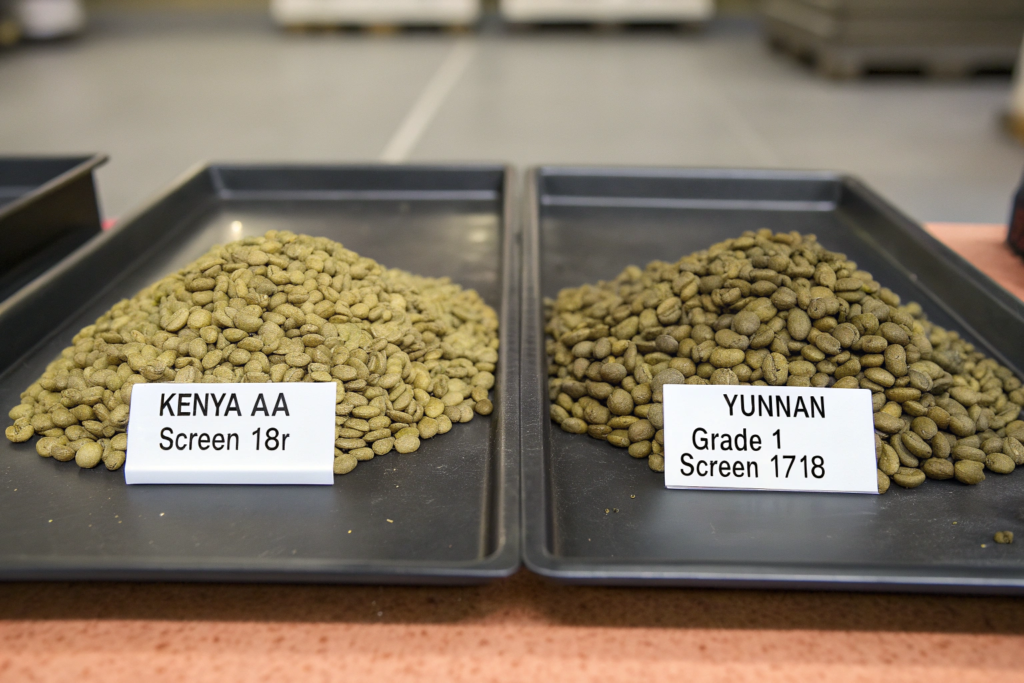
Let's look at the numbers. This is the spec sheet comparison you need when you are writing a contract.
| Attribute | Kenya AA | Yunnan Grade 1 (Washed Arabica) |
|---|---|---|
| Screen Size | 17/18 (7.2mm - 7.5mm+) | 15+ or 17/18 depending on lot |
| Bean Shape | Elongated, bold, often curved | Rounder, dense, compact |
| Primary Defect Count | Near zero in top lots | per 350g (Grade 1 standard) |
| Basis of Grading | Size first, then density | Defect count first, then size |
Kenya AA beans are physically impressive. They are big. They are heavy. They look expensive. And in the roaster, that large, dense bean takes heat beautifully. It allows for aggressive roast curves without scorching. That is a real advantage.
Yunnan Grade 1 Arabica, especially from high-altitude Baoshan, is also dense. Our screen 17/18 lots are heavy and uniform. But the bean shape is different. It is plumper, rounder. This is the Catimor genetics showing. It does not look like a classic longberry. Some old-school buyers see a round Yunnan bean and think "low quality" automatically. That bias is fading fast. When they cup it, they change their mind. For official grading standards, you can reference the Specialty Coffee Association Green Coffee Grading protocols.
What Role Does Altitude Play in Bean Density for Both Regions?
Altitude is the engine of density. Both Kenya and Yunnan have it. But they use it differently.
Kenya's prime coffee land sits at 1,500 to 2,100 meters above sea level. That is extreme altitude for coffee. The plants grow slowly. The cherries mature for a long, long time. The result is a bean with an incredibly hard, dense cellular structure. That structure is what traps the volatile compounds that translate into that explosive, juicy acidity in the cup.
Yunnan's best coffee is grown between 1,200 and 1,700 meters. It is slightly lower than the Kenyan highlands. But the latitude is different. Baoshan is further north. The temperature swings between day and night are severe. This is called the diurnal shift. It creates stress on the plant. That stress pushes the plant to produce more sugars in the bean. So while the absolute altitude number is lower, the effective growing conditions produce a bean that is nearly as dense and very high in sugar content.
At Shanghai Fumao, we measure density religiously. Our top blocks hit a density reading comparable to many Central American Strictly Hard Bean (SHB) lots. It is not Kenyan AA hard. Nothing is. But it is dense enough to take a solid roast and develop deep sweetness. For more on how altitude affects coffee quality, the World Coffee Research sensory lexicon provides excellent scientific context.
How Does Cup Profile Compare Between Yunnan Arabica and Kenyan AA?
This is where the rubber meets the road. You can talk about screen size and altitude all day. But the only thing that matters to the person drinking the coffee is what is in the cup. And here, the differences are stark and wonderful.
The cup profile of Yunnan Arabica is characterized by medium body, low to medium acidity reminiscent of black tea and lemon zest, with sweetness notes of brown sugar and caramel, while Kenyan AA is defined by high, juicy acidity with distinct blackcurrant, red berry, and sometimes savory tomato notes, supported by a lighter, cleaner body.
If you are looking for a coffee that punches you in the face with flavor, Kenya is your bean. If you are looking for a coffee that hugs you with comfort and balance, Yunnan is your bean.
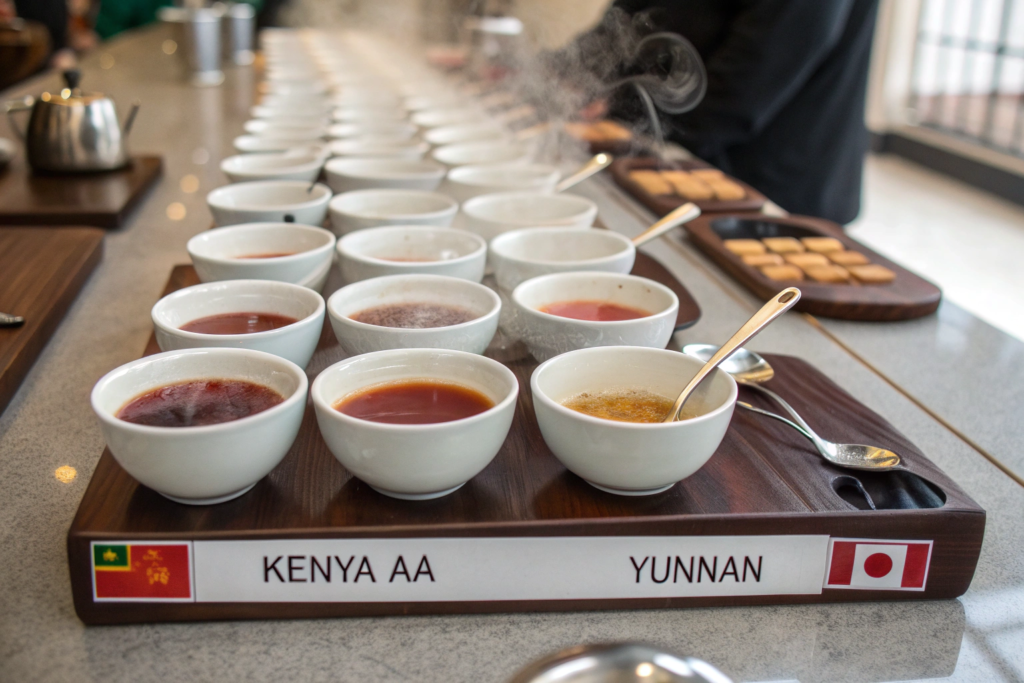
What Flavor Notes Define Premium Baoshan Arabica vs. Nyeri AA?
Let's get specific. Let's compare two hypothetical but realistic lots.
Nyeri AA, Kenya (Washed):
- Fragrance/Aroma: Intense blackcurrant jam, fresh red berries, hint of grapefruit zest.
- Flavor: Explosive acidity. Juicy. Notes of cranberry, blackberry, and a distinct savory-sweet tomato broth note. Winey.
- Aftertaste: Long, clean, slightly drying (tannic).
- Body: Light to medium. Silky, not syrupy.
Baoshan Grade 1, Yunnan, China (Washed):
- Fragrance/Aroma: Sweet black tea, toasted almond, a touch of dried apricot.
- Flavor: Balanced. Gentle lemon acidity upfront that fades quickly into a rich, brown sugar sweetness. Notes of oolong tea, honey, and a hint of cocoa in the finish.
- Aftertaste: Smooth, clean, sweet.
- Body: Medium to heavy. Syrupy, coating mouthfeel.
See the difference? The Kenyan is a soloist. It demands attention. The Yunnan is a harmonizer. It makes everything around it better. This is why Yunnan works so well in espresso blends. It adds body and sweetness without clashing with the other origins. It is the glue that holds a blend together. I have had roasters tell me that adding 20% Yunnan to their blend allowed them to reduce the amount of expensive Brazilian pulped natural they were using without losing any mouthfeel. That is a direct cost saving that does not compromise quality.
How Does Processing Method Influence the Flavor Gap?
This is a nuance that most buyers miss. Kenya is famous for its double washed or fully washed process. They ferment the coffee, wash it, ferment it again, wash it again. It is meticulous. It produces an incredibly clean, bright, almost surgical cup. That is why the acidity is so transparent.
Yunnan has traditionally used a simpler washed process. But that is changing fast. On our estate, we are experimenting with anaerobic fermentation, honey process, and natural process. And the results are closing the gap in complexity.
A natural processed Yunnan Arabica can develop intense fermented berry notes that rival a fruity Ethiopian natural. A honey processed Yunnan can have the syrupy body and stone fruit sweetness of a Costa Rican honey. The terroir of Yunnan is still revealing itself. We are just scratching the surface of what processing can do here. The potential is enormous. And because labor costs in Yunnan are more stable than in some other origins, we can afford to do these labor-intensive processing methods at a price point that is still attractive for wholesale. You can explore different processing methods through case studies on the Perfect Daily Grind website.
What Are the Price and Supply Chain Stability Differences?
Taste is one thing. Business is another. You can love the taste of Kenyan AA. But if you cannot get it at a consistent price, or if the container is delayed by a port strike in Mombasa, your love does not pay the bills. The supply chain reality is often the deciding factor for a wholesale buyer like you, Ron.
The price of Kenyan AA is highly volatile, driven by the auction system in Nairobi and global C-market speculation, whereas Yunnan Arabica pricing is more stable due to direct negotiation with large estate owners and a less speculative domestic market, while supply chain logistics from Shanghai offer more reliable transit times to the US West Coast compared to East Africa.
How Does the Nairobi Coffee Exchange Auction Impact Price vs. Yunnan Direct Trade?
Kenyan coffee is sold through a unique system. Most of the top lots go through the Nairobi Coffee Exchange. It is an open-outcry auction. Buyers bid against each other. When global demand for high-acidity coffee spikes, the prices for AA lots go through the roof. It is a free market in its purest form. It is exciting. It is also a nightmare for budgeting.
You might cup a beautiful Kenyan AA in October and get a price of $4.20 per pound FOB. You plan your menu. You design your packaging. You go to buy it in November, and because of a drought rumor in Brazil, the auction price has jumped to $5.10 per pound. Your margin is gone.
Yunnan coffee is different. It is a direct trade model. I own the land. I set the price based on my cost of production plus a reasonable margin. The price does not swing wildly week to week based on a trader in New York or an auctioneer in Nairobi. At Shanghai Fumao, we typically set our export prices on a quarterly basis. We can lock in a price for a full container contract for 60 to 90 days. That is stability. That allows you to plan your business. You cannot put a price on that kind of predictability. To track Kenyan auction prices, you can follow reports from the Nairobi Coffee Exchange directly.
Why Is Shipping From Shanghai More Predictable Than Mombasa?
Geography is destiny in logistics. Look at a map. Coffee from Mombasa, Kenya, to the US West Coast has to go around the Cape of Good Hope or through the Suez Canal. Both routes are long. Both are prone to disruption. Piracy, canal blockages, port congestion in the Mediterranean. The transit time is typically 30 to 45 days, and delays are common.
Coffee from Shanghai to Los Angeles or Oakland? It is a straight shot across the Pacific. Transit time is 14 to 18 days. It is the busiest trade lane in the world. There are more vessels, more container availability, and more competition among carriers. This is a massive advantage for Yunnan coffee. Shorter transit means less time for the coffee to degrade in a hot container. Shorter transit means you can turn your inventory faster. Shorter transit means you are less exposed to the insane demurrage and detention fees that pile up when a ship is stuck off the coast of Long Beach.
I have shipped thousands of containers from Shanghai. The reliability of that lane is one of our biggest selling points. It removes a huge variable from your planning. For real-time port congestion data, you can check the Port of Los Angeles vessel status dashboards.
When Should a Roaster Choose Yunnan Arabica Over Kenyan AA in a Blend?
This is the decision you face every week. You have limited hopper space. You have a blend recipe that your customers love. When do you reach for the Yunnan bag instead of the Kenyan bag? It is not about which is objectively better. It is about the job you need the coffee to do.
A roaster should choose Yunnan Arabica over Kenyan AA when the blend goal is to build body and sweetness without adding aggressive acidity, when cost stability is a priority for the base component of an espresso blend, or when the desired flavor profile calls for chocolate and nut notes rather than bright berry and citrus.
Kenya is a spice. Yunnan is the meat and potatoes. Both are essential in a good kitchen.
Is Yunnan Catimor a Better Base for Espresso Blends Than Bright Kenyans?
Honestly, yes. In most cases. Kenyan AA is a beautiful coffee. But it is a terrible base for a classic espresso blend. Why? Because espresso amplifies acidity. The high, winey acidity of a Kenyan can become harsh and sour under 9 bars of pressure. It can taste like lemon juice and vinegar. It is unbalanced.
A good espresso blend needs a foundation. It needs sweetness to balance the roast. It needs body to carry the crema and the milk. Yunnan Arabica, especially our washed Catimor, provides exactly that. It has the heavy body from the altitude. It has the brown sugar sweetness from the diurnal temperature shift. It has low acidity, so it does not fight the roast profile.
I have many clients who use a base of 60% Yunnan Arabica, add 20% Brazilian Natural for extra chocolate, and then sprinkle in just 20% of a bright Kenyan AA or Ethiopian Yirgacheffe for the top note. That is a world-class espresso blend. And the Yunnan component is the affordable, reliable workhorse that makes the whole thing possible. Without it, they would have to use a more expensive and less predictable Central American bean for the base. At Shanghai Fumao, we specifically grade and process lots for the espresso market—focusing on body and sweetness over delicate acidity.
How Can Yunnan's Chocolate and Tea Notes Complement African Fruit Bombs?
Think of it like cooking. You have a dish that is very acidic—maybe a lemon chicken piccata. You do not serve it with a side of pickles. That is too much acid. You serve it with creamy mashed potatoes or buttered noodles. The richness balances the sharpness.
That is what Yunnan does to a bright African coffee. The black tea and cocoa notes in Yunnan Arabica wrap around the sharp, citrus edges of the Kenyan. They smooth it out. They add depth. They make the coffee more approachable for the average consumer who might find pure Kenya "too sour."
A common trap for new roasters is to blend two bright coffees together. They think "more complexity." What they get is a muddled, sour mess. The best blends have contrast. They have a bright element and a grounding element. Yunnan is the grounding element. It is the bass note in the symphony. It does not get the solo. But without it, the whole piece falls apart. You can learn more about the science of blending from resources like the Roast Magazine archives.
Conclusion
The quality differences between Chinese and Kenyan AA beans are real and significant. They are not competitors fighting for the same spot on the cupping table. They are complementary tools in a roaster's toolbox. Kenyan AA is the razor-sharp knife for slicing through milk in a single-origin pour-over. Yunnan Arabica is the heavy cast-iron skillet for building a rich, comforting espresso blend.
The question for you is not about which origin is superior. The question is about which problem you are trying to solve. Are you trying to wow a judge at a barista competition? Maybe you need that Kenyan fruit bomb. Are you trying to build a reliable, profitable, high-volume wholesale business? You need the stability, body, and cost-effectiveness of Yunnan.
And here is the thing I want you to remember. The Yunnan of today is not the Yunnan of ten years ago. The quality has skyrocketed. The traceability is there. The processing is innovative. The logistics are reliable. We are not just a "cheap alternative" anymore. We are a legitimate, high-quality origin that happens to offer excellent value.
If you want to cup a sample of our Grade 1 Arabica next to your current Kenyan AA and see how they play together in a blend, I would welcome that conversation. Let the coffee speak for itself. Reach out to Cathy Cai. She can send you samples of both our washed and natural processed lots so you can see the range of what Yunnan can do. Email Cathy at: cathy@beanofcoffee.com