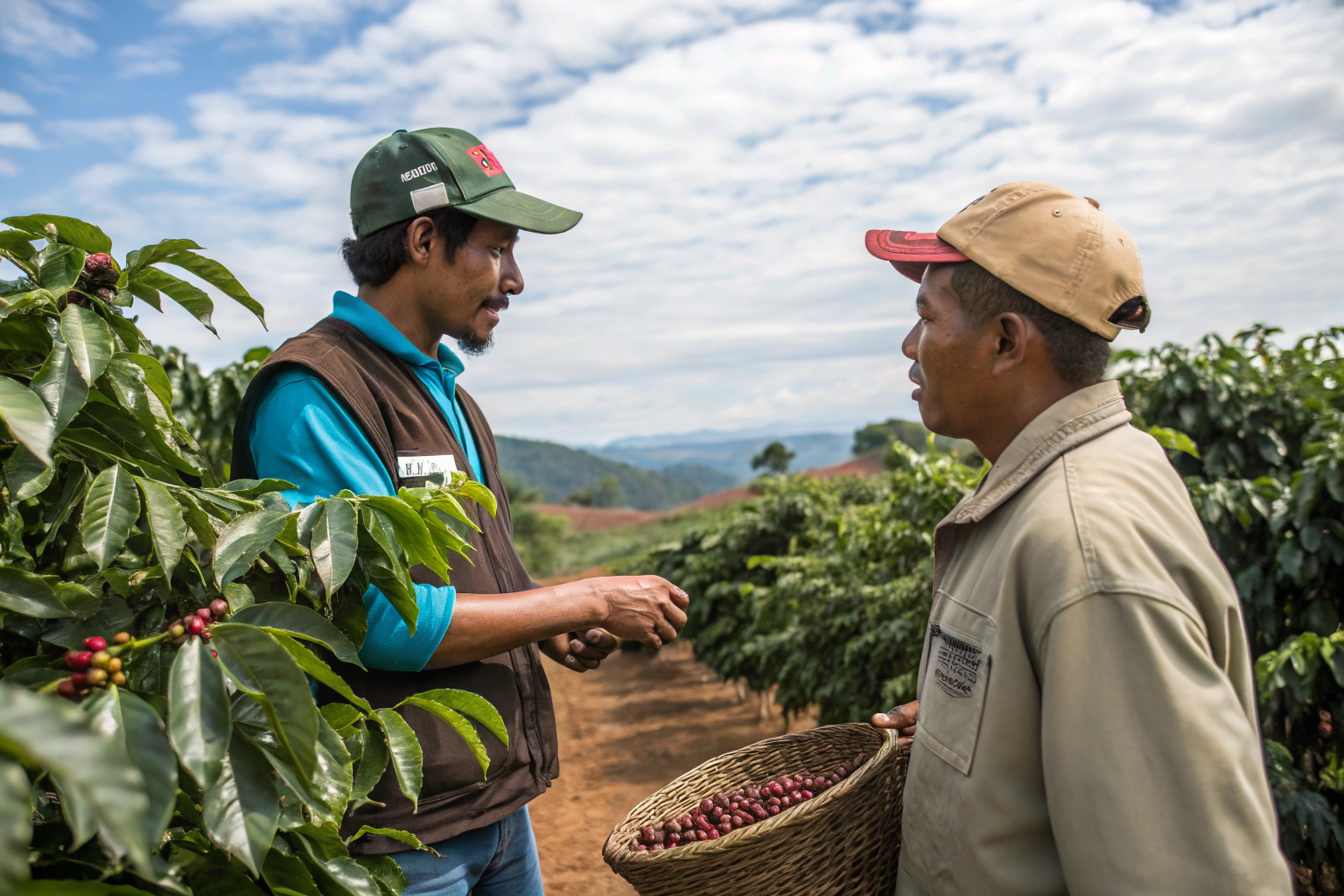
You're building your coffee menu. You want to do the right thing. You want to offer coffees that align with your values and tell a compelling story to your customers. You see two labels, two philosophies: "Fair Trade Certified" and "Direct Trade." One is a formal, third-party certification with a recognizable logo. The other is a looser, more personal claim of a direct relationship. You're a business owner, not an ethicist. You need to cut through the marketing and the ideology and ask the practical question: For my business, for my customers, and for the actual farmer, which model is really better? Or is one just better marketing than the other?
There is no universally "better" model between Direct Trade and Fair Trade; they are different tools designed to address different problems and appeal to different consumer values. Fair Trade is a structured, third-party certified system that guarantees a minimum price and a social premium for community development. It excels at providing a safety net for smallholder cooperatives. Direct Trade is a philosophy of direct, transparent relationships between a roaster and a producer, focused on paying premium prices for exceptional quality. It excels at driving quality improvement and creating compelling, traceable stories. The "best" choice depends on your specific sourcing goals and the story you want to tell.
I live this distinction every day at Shanghai Fumao. We operate as a direct trade partner for many roasters, but we also understand the value and structure of certifications. Let me give you a clear-eyed, practical comparison of the two models, so you can make a strategic choice for your business.
What Exactly Does "Fair Trade Certified" Guarantee for Coffee Farmers?
Fair Trade is a formal, global system with specific, audited standards. It's not just a vague promise; it's a set of enforceable rules designed to protect vulnerable smallholder farmers from the volatility of the global commodity market.
The Fair Trade certification guarantees two primary financial mechanisms for certified producer organizations (typically smallholder cooperatives): (1) The Fair Trade Minimum Price: A floor price for the coffee that acts as a safety net when the C-market price crashes. The buyer must pay at least this minimum. (2) The Fair Trade Premium: An additional sum of money (currently $0.20 per pound) paid directly to the cooperative for investment in community development projects (schools, healthcare, infrastructure) or business improvements. These guarantees are audited by FLOCERT to ensure compliance.
What Are the Strengths of the Fair Trade Minimum Price?
The minimum price is Fair Trade's most powerful and unique feature. It is a form of insurance against market collapse.
When the C-market price for coffee plummets below the cost of production—as it has done historically, devastating farming communities—the Fair Trade Minimum Price provides a critical safety net. It ensures that certified cooperatives receive a price that covers basic costs of living and production, preventing farmers from being forced to sell at a catastrophic loss. For a roaster, buying Fair Trade coffee is a way to support this systemic safety net. It's a statement that you believe in protecting the most vulnerable producers from the market's worst excesses. You can track the current Fair Trade Minimum Price and Premium on the Fairtrade International website.
What Are the Common Critiques of the Fair Trade Model from the Specialty Coffee Industry?
The critiques from the specialty sector are not that Fair Trade is "bad," but that it is a blunt instrument that can be ill-suited to the dynamics of high-quality coffee.
- It Decouples Quality from Price: The minimum price is the same for an 80-point coffee and an 86-point coffee. This provides no financial incentive for farmers to invest in the extra labor and care required to produce exceptional specialty coffee. It can inadvertently reward mediocrity.
- It Is Primarily for Cooperatives: The system is designed for smallholder cooperatives. Large, privately owned estates (which produce a significant portion of the world's specialty coffee) are often ineligible for Fair Trade certification.
- It Can Be Bureaucratic and Costly: The certification process involves paperwork, audits, and fees, which can be a barrier for the smallest and most marginalized producer groups.
- Traceability Is Often Limited: Fair Trade coffee is often aggregated and blended, making it difficult to trace a specific bag back to a specific farm or farmer. The story is about the system, not the individual.
For a specialty roaster seeking a unique, high-scoring, and traceable coffee, Fair Trade alone is rarely the answer.
What Does "Direct Trade" Actually Mean in a Real Business Relationship?
"Direct Trade" is not a certification. There is no logo, no central auditing body, and no single, enforceable standard. It is a sourcing philosophy centered on a direct, transparent, and mutually beneficial relationship between a roaster and a producer.
In practice, a genuine Direct Trade relationship involves: (1) The roaster visiting the farm or maintaining direct, personal communication with the producer. (2) Transparent negotiation of price, with the goal of paying a significant premium well above both the C-market and the Fair Trade Minimum Price, directly linked to cup quality. (3) A long-term commitment to purchasing from that producer, providing financial stability and allowing for joint planning. (4) Complete traceability of the coffee back to a specific farm or even a specific plot. The "guarantee" is the relationship itself, not a piece of paper.
Why Does Direct Trade Often Result in Higher Quality Coffee?
This is the central argument for Direct Trade in the specialty coffee world. It creates a powerful virtuous cycle of quality and price.
A roaster seeking an exceptional 87-point coffee needs a producer who is willing to invest in selective hand-picking, meticulous processing, and careful lot separation. These practices cost more money. Direct Trade allows the roaster to pay a significant premium specifically for that quality. The producer sees a direct financial reward for their extra effort. This incentivizes them to continue improving quality year after year. The roaster gets a better, more unique coffee to offer their customers. The relationship deepens. This cycle simply doesn't exist in the same way within the Fair Trade framework, where the price is decoupled from the cup score.
What Are the Risks and Criticisms of the "Direct Trade" Label?
Because "Direct Trade" has no legal definition, it is vulnerable to marketing abuse and "greenwashing."
- It Is Self-Policing and Unverifiable: Any roaster can put "Direct Trade" on their bag, regardless of the actual nature of their relationship with the producer. There is no third-party audit to verify the claim. A roaster who bought one pallet from an importer and exchanged a single email with a farmer can claim "Direct Trade."
- It Can Be Exclusive: Building genuine direct relationships requires time, travel, and volume. It is often only accessible to larger, well-capitalized roasters.
- It Can Shift Risk to the Producer: In some poorly structured direct deals, a producer might invest heavily in quality based on a handshake agreement, only to have the roaster back out or renegotiate aggressively if the market turns. A formal contract is essential.
For the consumer and the wholesale buyer, the term "Direct Trade" on a bag should be the beginning of a conversation, not the end. You need to ask the roaster: "What does your Direct Trade mean? Can you show me the contract? Can I see a photo of you on the farm?" At Shanghai Fumao, we practice genuine direct trade. Our roasting partners visit our farm, we have transparent pricing, and we build multi-year relationships. We earn the term, we don't just slap it on a bag.
How Do Direct Trade and Fair Trade Impact the Farmer Differently?
The two models were designed for, and tend to benefit, different types of coffee producers. Understanding this distinction is key to understanding their different impacts.
- Fair Trade: Primarily benefits smallholder farmers organized into democratic cooperatives. The model provides a collective safety net and funds for community-wide projects (a new school, a health clinic, a road). The individual farmer may not see a direct per-pound premium for quality, but the community as a whole benefits from the social premium.
- Direct Trade: Primarily benefits individual farms or estates, and select organized groups, that are focused on producing exceptional quality. The benefit is a direct financial premium paid for that quality. This premium can be reinvested in the farm—better equipment, higher wages for pickers, experimental processing—which further improves quality and long-term economic viability.
Neither model is inherently "better" for the farmer. They address different needs. A smallholder in a remote cooperative may desperately need the safety net of the Fair Trade Minimum Price. An established estate producing 86-point Geisha needs the quality incentives of Direct Trade.
Can a Coffee Be Both Fair Trade Certified and Direct Trade?
Absolutely. And this is often the sweet spot for a values-driven roaster.
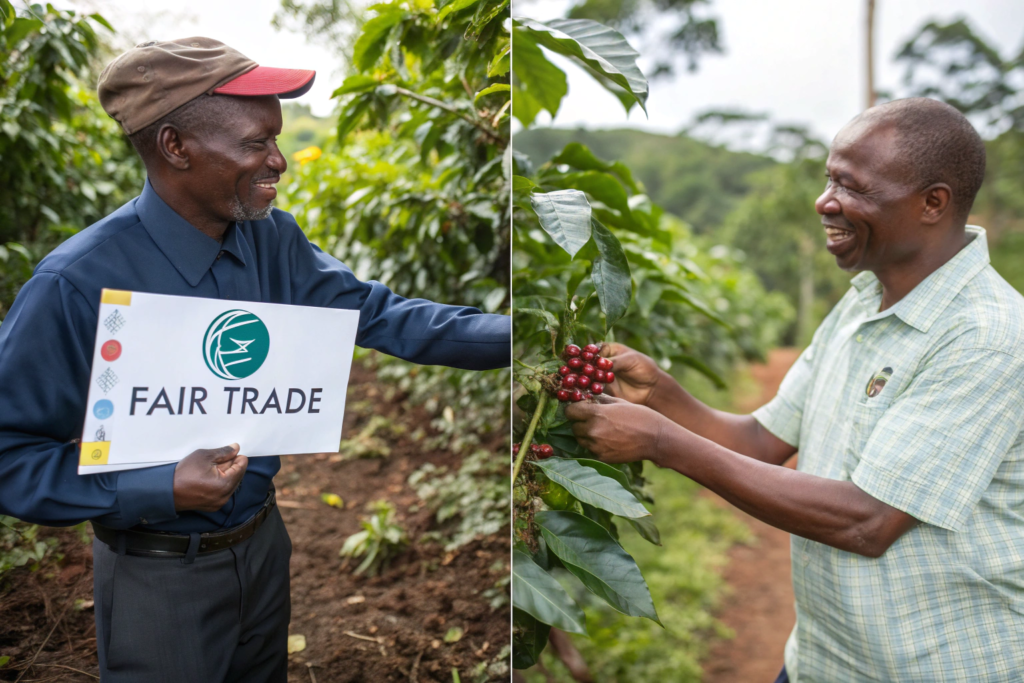
A roaster can source a coffee from a Fair Trade certified cooperative, pay well above the Fair Trade Minimum Price based on its exceptional cup quality, and maintain a direct, transparent relationship with the cooperative's leadership. This coffee would legitimately be both "Fair Trade Certified" and "Direct Trade." It offers the consumer the independent verification of the Fair Trade system and the compelling, personal story of the direct relationship. It's a powerful combination. It demonstrates a commitment to both social safety nets and quality-driven empowerment. This hybrid model is increasingly common in specialty coffee.
How to Identify High-quality Blended Specialty Coffee Beans?
Unveiling the essence of a superior blended specialty coffee bean is an art that engages the senses and demands discernment. Begin by examining the beans themselves, for their appearance speaks volumes. Seek out beans that are uniformly sized, each one a polished gem of deep, rich hues—ranging from velvety browns to warm, chestnut tones, with subtle undertones of caramel or dark chocolate. Avoid any that appear shriveled, discolored, or marred by mold; these are telltale signs of poor storage or aging. A high-quality blend will boast beans that feel smooth and dry to the touch, not damp or brittle. Run your fingers gently over them, and you'll notice a slight, earthy aroma that hints at the complex flavors within.
Next, delve into the aroma. Cupping a sample is essential; take a small amount and gently crush it between your fingers, releasing a symphony of scents. Look for a vibrant, inviting fragrance that dances with notes of ripe fruit—think juicy berries or sweet citrus—intertwined with hints of toasted nuts, dark chocolate, or even a whisper of floral sweetness.
What Is the Better Story for My Customers: Fair Trade or Direct Trade?
Ultimately, for your business, the choice between Fair Trade and Direct Trade is a branding and storytelling decision. Which narrative resonates more deeply with your specific customers?
- The Fair Trade Story: Is a story of global solidarity and collective action. It appeals to a consumer who wants to know their purchase is part of a larger, certified system that protects vulnerable farmers from exploitation and funds community projects. It's a story of justice and stability. The recognizable logo provides instant, easy-to-understand credibility.
- The Direct Trade Story: Is a story of personal connection and exceptional quality. It appeals to a consumer who is curious about the specific origin, the unique flavor, and the individual farmer behind the coffee. It's a story of artisanship, discovery, and premium experience. It requires more explanation from the roaster but can create a deeper, more memorable connection.
There is no right or wrong answer. Some brands build their entire identity around Fair Trade. Others build it around the intimate stories of their direct trade partners. Many smart roasters use both narratives for different coffees in their lineup.
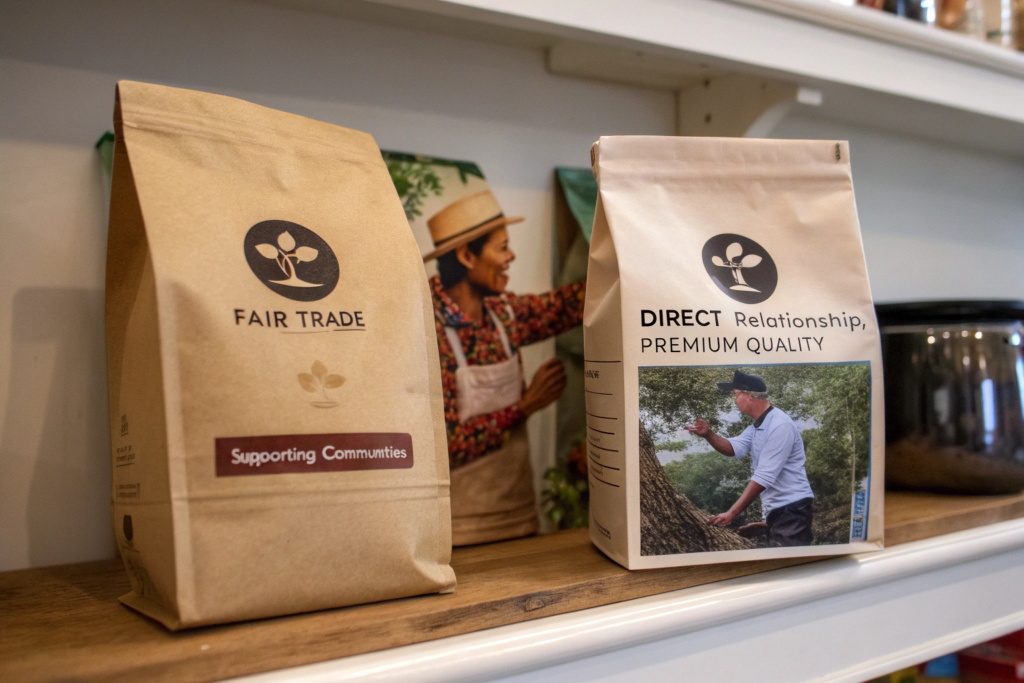
How Do I Verify and Communicate a Direct Trade Story Authentically?
If you choose to market a Direct Trade coffee, the burden of proof is on you. You must move beyond the label and provide genuine transparency.
Authentic Direct Trade Communication Tactics:
- Publish the Price: Be transparent. On your website or blog, state the FOB price you paid for the coffee and compare it to the C-market price and the Fair Trade Minimum Price. This is radical transparency that builds immense trust.
- Share the Story: Use photos and videos provided by your partner. Show the farm. Introduce the farmer by name. Share their challenges and successes. At Shanghai Fumao, we provide our partners with this kind of rich, visual content.
- Use a QR Code: Link directly from the coffee bag to a landing page with the farm's GPS map, photos, and the transparency report.
- Host Virtual or In-Person Events: Invite the producer (or do a live video call) to speak with your customers.
How to transform the transparency of coffee beans?
This level of transparency turns a vague claim into a powerful, verifiable brand asset, a beacon of trust that cuts through the fog of generic marketing. It's the difference between marketing and truth-telling, between empty promises and the rich, earthy reality of a bean's journey from sun-dappled farm to your morning cup. Imagine tracing each bean back to its origin: the mist-kissed slopes of Ethiopian highlands where cherries ripen under a sky brushed with gold, or the volcanic soils of Colombia where rain nurtures deep roots. Transparency reveals the hands that picked them—calloused fingers sorting ripe from unripe, baskets overflowing with ruby-red fruit—and the roasters who slow-roast in small batches, their ovens humming with the sweet scent of caramelization.
It unveils the stories behind fair wages, sustainable practices, and the care taken to preserve flavor profiles unique to each region. This is not just information; it's an invitation to connect, to savor not just the taste of coffee, but the labor, love, and land that made it possible. In this way, transparency transforms a simple commodity into a narrative, a tangible link between producer and consumer, and elevates the humble coffee bean into a symbol of integrity and authenticity.
Conclusion
The question "Is Direct Trade better than Fair Trade?" has no simple answer because they are fundamentally different tools designed for different purposes. Fair Trade is a certified system providing a vital safety net and community investment for smallholder cooperatives. Direct Trade is a relationship-based philosophy focused on paying quality-driven premiums to individual producers and creating traceable, compelling stories.
As a coffee buyer and brand builder, your task is not to choose a side in an ideological debate. It is to understand the distinct value proposition of each model and deploy them strategically. You might offer a Fair Trade certified blend as your comforting, everyday "good" coffee, and a rotating selection of Direct Trade micro-lots as your exciting, premium "adventure" coffees.
The most important thing is to be honest and transparent with your customers about what your sourcing claims actually mean. Whether it's a Fair Trade seal or a Direct Trade story, the authenticity behind it is what builds lasting trust.
If you're interested in exploring a true Direct Trade partnership with a farm that offers complete transparency and exceptional quality, I invite you to learn more about our approach at Shanghai Fumao. My email is cathy@beanofcoffee.com.