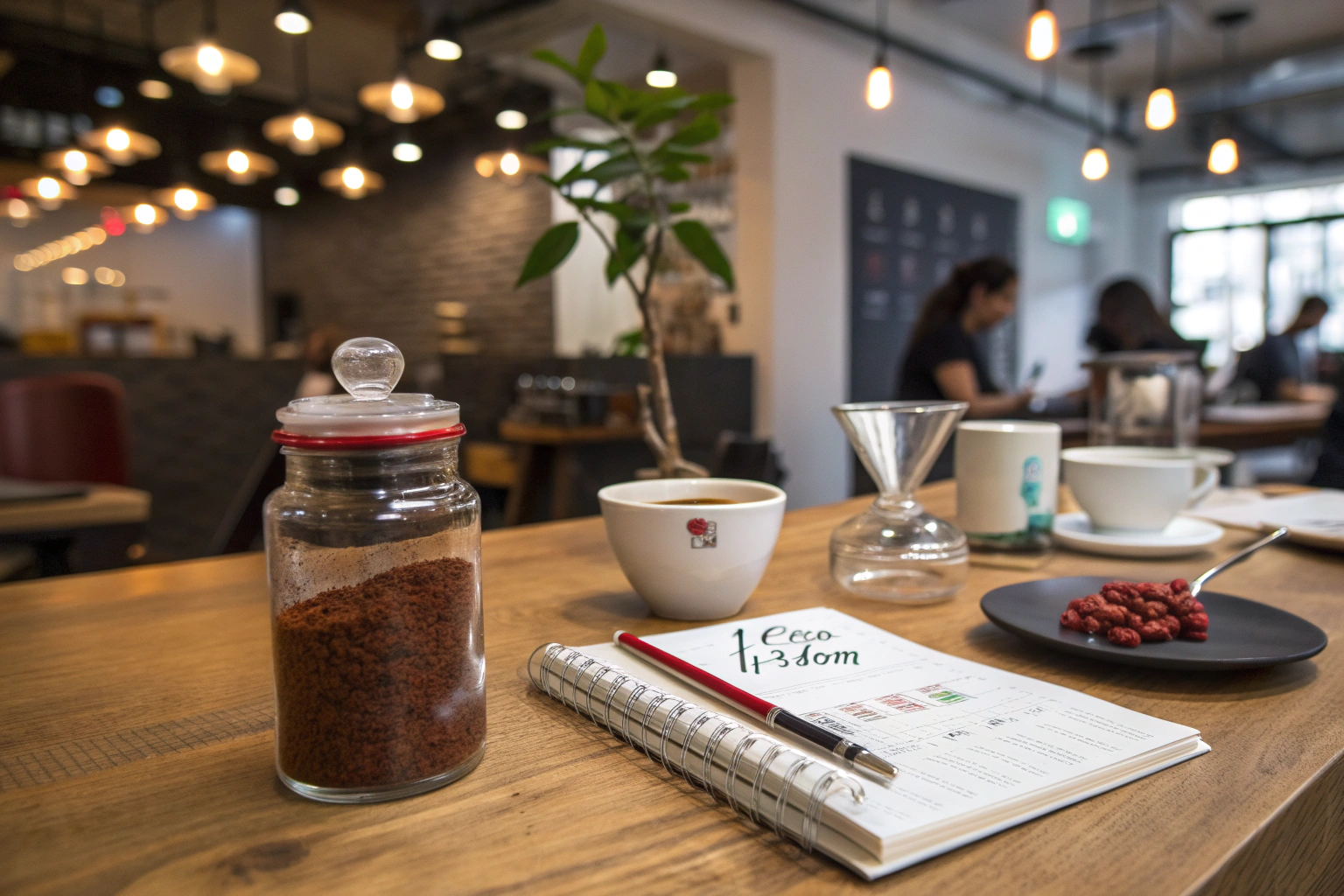
I am often asked, "Why does your Yunnan coffee taste like black tea and chocolate, while my other Asian coffees taste earthy or herbal?" The answer is not one thing. It is everything. It is the dirt under my boots, the chill in the night air, the specific clone of the tree, and the way we wash the beans. Flavor is not a single note. It is a symphony, and the conductor is the terroir of the Gaoligong Mountains.
The flavor of Yunnan Arabica coffee is affected by a complex interplay of factors including the region's unique high-altitude, high-latitude terroir, the specific Catimor and other varietals planted, the meticulous washed, honey, and natural processing methods employed, the volcanic soil composition, and the cool, dry climate of the harvest season.
Each of these elements leaves a fingerprint on the final cup. Let me walk you through the key influences that shape the distinct profile of our Baoshan Arabica.
How Does Yunnan's Unique Terroir Influence the Cup Profile?
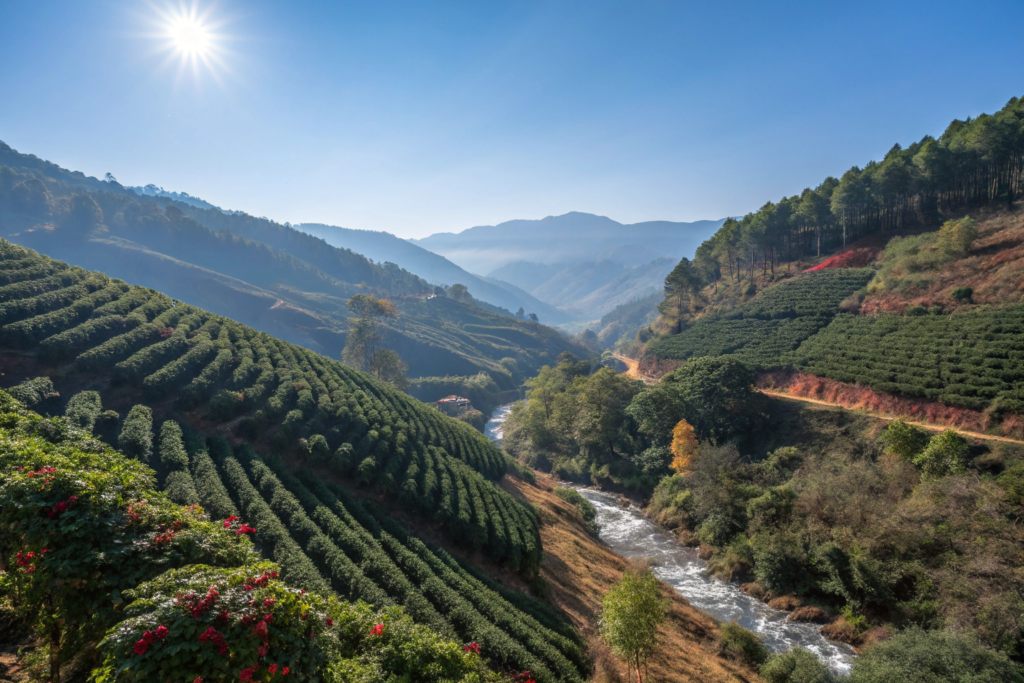
Terroir is the sum of a place. It is the soil, the sun, the rain, the wind, and the slope of the land. Yunnan's terroir is unique in the coffee world because it is at the northern edge of the coffee belt. It is a place of extremes.
Yunnan's unique terroir, defined by its high latitude (25°N), high altitude (1,200-1,650m), and a monsoonal climate with a pronounced dry winter harvest season, profoundly influences the cup profile by slowing cherry maturation, which concentrates sugars and develops a dense bean structure, resulting in a cup characterized by heavy body, low-to-medium acidity, and dominant notes of black tea and brown sugar.
This is not the terroir of bright, citrusy Kenyan coffee. It is the terroir of deep, comforting, sweet coffee.
What Is the Impact of the Pronounced Dry Season During Harvest?
This is arguably the single most important climatic factor for Yunnan coffee quality. In many famous coffee origins, the harvest happens during the rainy season. Farmers are fighting mud, humidity, and the constant threat of unexpected showers ruining their drying coffee.
In Baoshan, the harvest runs from November to March. This is the dry season. Rainfall is minimal. The skies are clear. The humidity is low.
The Impact on Flavor:
- Slow, Even Drying: We can spread the parchment coffee on raised African beds and let the sun and the cool, dry breeze do their work slowly over 10-14 days. This slow, even drying process is critical for developing a clean, sweet cup. It prevents the "ferment" or "earthy" defects that can occur when coffee dries too slowly in humid conditions.
- Concentrated Sugars: The cool nights and sunny days of the dry season create a significant diurnal temperature shift. This stresses the cherry slightly, causing the plant to produce more sugars as a protectant. These sugars translate directly into the brown sugar and caramel sweetness in the cup.
- Clean Fermentation: The cool, dry air also means the ambient yeast and bacteria populations are different. The fermentation in the wet mill is cleaner and more predictable, leading to a cleaner, more transparent flavor profile.
This dry harvest window is Yunnan's secret weapon. It is the reason why our washed coffees are so clean and sweet. It is a natural advantage that we leverage with our processing protocols at Shanghai Fumao. For more on how climate affects coffee flavor, World Coffee Research has excellent resources on sensory impacts.
How Does the Volcanic Loam Soil Contribute to Mouthfeel and Sweetness?
Soil is the coffee tree's pantry. The minerals and organic matter in the soil are the raw ingredients for the flavors that develop in the cherry. The soil in the Gaoligong Mountains is derived from ancient volcanic activity.
The Characteristics of Baoshan Volcanic Loam:
- Rich in Minerals: It contains high levels of potassium, phosphorus, and trace elements like zinc and boron. Potassium is essential for sugar development in the cherry.
- Excellent Drainage: The volcanic soil is porous and well-draining. Coffee roots hate "wet feet." The good drainage prevents root rot and forces the roots to grow deep, seeking nutrients.
- High Organic Matter: The surrounding forest leaf litter decomposes into a rich, dark topsoil. This organic matter feeds a healthy population of soil microbes. These microbes form a symbiotic relationship with the coffee roots (mycorrhizae), helping the plant absorb nutrients more efficiently.
The Impact on Flavor:
The combination of rich minerals, good drainage, and healthy soil biology leads to a coffee bean that is dense, well-nourished, and high in complex carbohydrates. This translates directly into the heavy, syrupy mouthfeel and the deep, lingering sweetness that are the hallmarks of premium Yunnan Arabica.
It is this soil that gives our coffee its "bass notes." It provides the foundation upon which the other flavors are built. When you taste the thick body of our Grade 1 Arabica, you are tasting the volcanic history of the Gaoligong Mountains.
How Do Catimor Varietals and New Selections Shape Yunnan's Flavor?
The genetics of the coffee tree are the blueprint for the flavor. For decades, Yunnan coffee was synonymous with Catimor. This varietal has a reputation—some of it earned, some of it outdated.
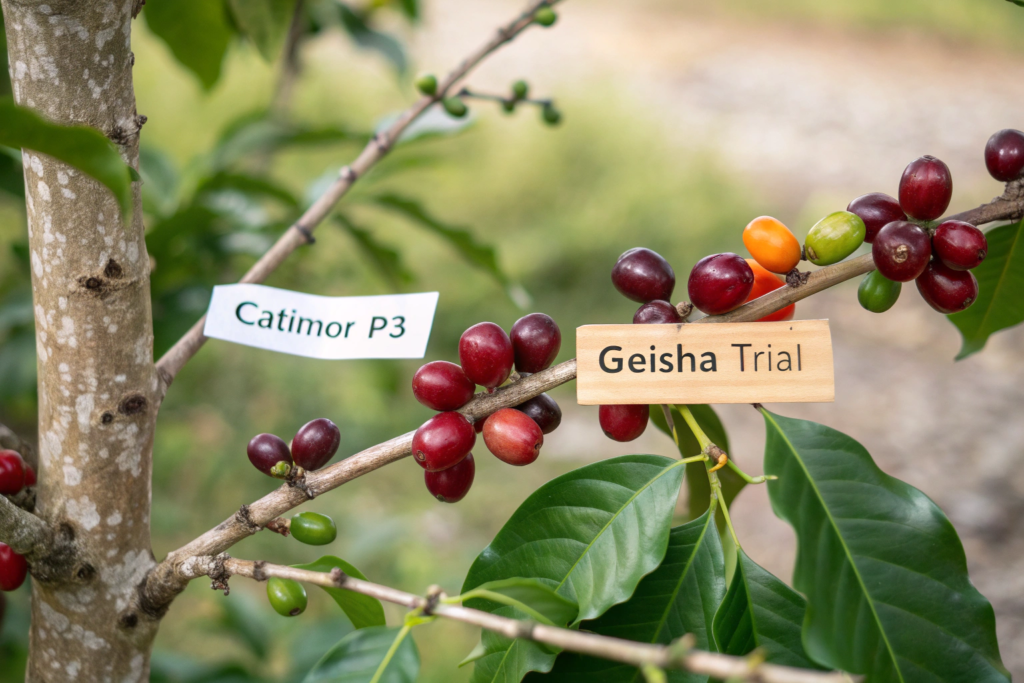
The Catimor varietals that dominate Yunnan production, particularly the newer P3 and P4 selections, have evolved from earlier generations known for harsh, herbal notes into cleaner, sweeter cultivars that, when grown at high altitude and processed with care, produce a cup with distinct black tea, lemon zest, and brown sugar notes, while new plantings of Typica, Bourbon, and Geisha are adding layers of floral and fruity complexity.
The flavor of Yunnan is not static. It is evolving as the genetics in the ground evolve.
What Is the Difference Between Old Catimor and New Catimor Selections?
Catimor is a hybrid of Caturra (a high-quality Arabica) and Timor Hybrid (a Robusta-Arabica cross with disease resistance). Early generations of Catimor were prized for their rust resistance and high yield, but they often carried a distinct herbal, sometimes harsh or "grapey" flavor that specialty buyers rejected.
The Evolution of Catimor in Yunnan:
- Old Catimor (F1, F2 generations): These are the trees planted 20-30 years ago. They can still produce a decent cup, but they are more prone to the herbal, astringent notes if not processed perfectly.
- New Catimor Selections (P3, P4): These are selected sub-varietals of Catimor that have been propagated specifically for their superior cup quality. Through generations of selective breeding, the harsh, herbal notes have been greatly diminished. The cup is cleaner, sweeter, and more expressive of the terroir.
At Shanghai Fumao, we have been aggressively replanting our older Catimor blocks with the new P3 and P4 selections. The difference in the cup is remarkable. The new selections consistently cup 2-3 points higher. They are the reason why Yunnan coffee's reputation is rising so quickly. The "Catimor" of today is not the "Catimor" of your father's cupping table.
How Are Geisha and Typica Changing the Premium Yunnan Flavor Profile?
This is the most exciting development in Yunnan coffee. We are no longer limited to Catimor. Pioneering estates (including ours) have invested heavily in planting premium Arabica varietals like Typica, Bourbon, and Geisha.
The New Wave of Yunnan Flavors:
- Typica: This is one of the oldest and most genetically pure Arabica varietals. When grown in Baoshan, it produces a cup of exceptional sweetness and cleanliness, with notes of stone fruit, honey, and a delicate floral aroma. It is a more "classic" and elegant profile.
- Geisha: The legendary Panamanian varietal. Our first small Geisha lots from Baoshan are cupping at 86-88 points. They are producing intense jasmine, bergamot, and stone fruit flavors. It is a completely different flavor universe from traditional Catimor. It proves that Yunnan's terroir can support world-class, ultra-premium flavor profiles.
The introduction of these varietals is creating a stratification of Yunnan coffee. You have the excellent, large-volume Catimor that provides a sweet, heavy-bodied base for blends. And you have the emerging, small-lot Typica and Geisha that offer a truly unique and exquisite single-origin experience.
This is the future. Yunnan is not just one flavor. It is a canvas. And we are just beginning to paint with a full palette of genetic colors.
How Do Washed, Honey, and Natural Processes Change the Taste?
The bean's genetics and the farm's terroir provide the potential. The processing method is the artist's hand that shapes the final expression. In Yunnan, our dry harvest climate allows us to execute all three major processing methods with precision.
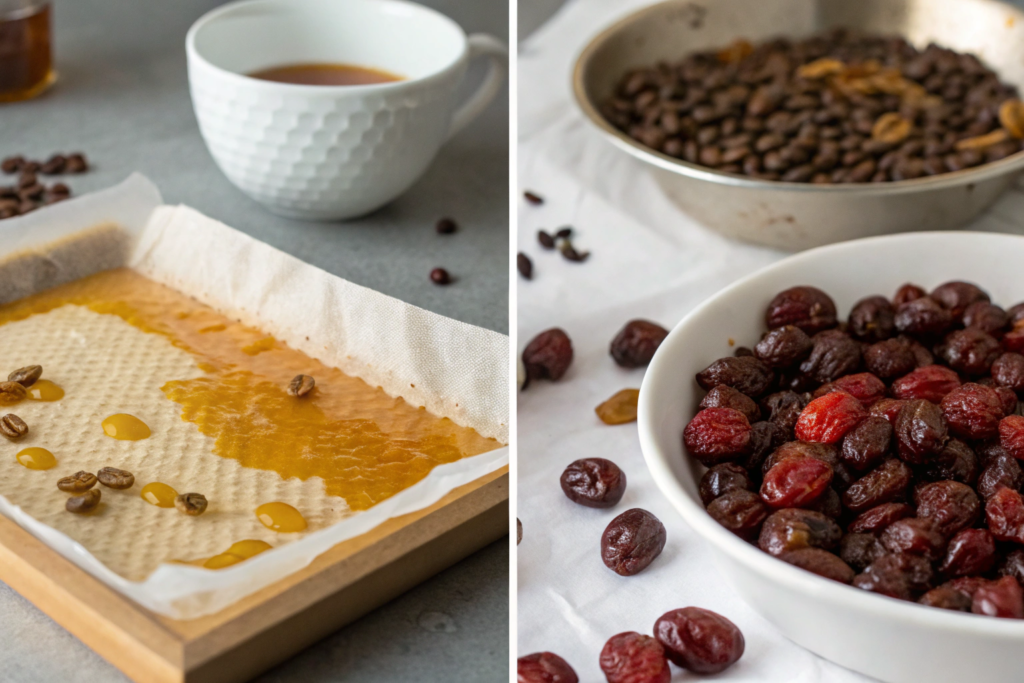
The washed process highlights the inherent terroir of Yunnan, producing a clean, transparent cup with tea-like notes and gentle acidity; the honey process adds layers of syrupy body and stone fruit sweetness; and the natural process, enabled by the dry harvest, creates intensely fruity, fermented berry and wine-like profiles that are unique to the origin. Each method unlocks a different facet of the Yunnan Arabica bean.
Why Does Washed Yunnan Showcase "Black Tea" and "Brown Sugar"?
The washed process is the purest expression of the bean and the land. In this method, the cherry skin and fruit mucilage are completely removed before drying. The bean dries naked.
The Flavor Impact:
- Cleanliness: Removing the fruit eliminates the chance of fruity, fermented flavors. What you taste is the seed itself.
- Clarity of Terroir: The specific mineral notes from the soil and the plant's response to the climate are laid bare.
- The Yunnan Washed Profile: In Baoshan, the washed process consistently reveals a core flavor set of Black Tea (the clean, slightly astringent, floral character), Lemon Zest (the gentle, clean acidity), and Brown Sugar (the deep, caramelized sweetness).
This profile is remarkably consistent across well-processed lots from our estate. It is the "house flavor" of BeanofCoffee washed Arabica. It is a profile that is both distinctive and incredibly versatile. It works beautifully as a clean filter coffee and as a sweet, heavy base for espresso. It is the foundation of our quality reputation.
How Does the Dry Harvest Enable Exceptional Natural Process Yunnan?
This is where Yunnan truly differentiates itself from many other origins. As we discussed, the dry harvest season is a gift for natural processing.
The Challenge of Natural Processing Elsewhere:
In Colombia or Sumatra, trying to dry whole coffee cherries during the rainy season is a constant battle against mold and over-fermentation. The results can be "funky," "boozy," or "dirty."
The Yunnan Advantage:
In Baoshan, we can spread the ripe cherries on our raised African beds in November, under clear skies and low humidity. They dry slowly and evenly over 20-25 days. We can control the fermentation inside the cherry with precision.
The Flavor Impact:
The slow, clean drying allows for a controlled, positive fermentation. The sugars in the cherry mucilage are broken down by yeasts into complex fruity esters. The result is a natural processed coffee that is intensely fruity and clean.
- Flavor Notes: Fermented Strawberry, Dried Mango, Dark Chocolate, Red Wine.
- Body: Massive, syrupy, jammy.
This is a flavor profile that is virtually impossible to achieve in rainy harvest origins. It is a unique expression of Yunnan terroir. Our natural processed lots are some of our most sought-after and highest-scoring coffees. They demonstrate the full potential of the origin. At Shanghai Fumao, our Q-Grader carefully monitors the fermentation of each natural lot, deciding when to move it to the shade to finish drying, in order to capture the perfect balance of fruit and sweetness.
What Role Does Altitude Play in Acidity and Body Development?
We touched on altitude earlier, but it deserves its own focus. Altitude is the engine of bean density. And bean density dictates how the coffee roasts and how the flavors are perceived on your palate.
Altitude in Yunnan directly affects flavor by slowing cherry maturation, which increases bean density and sugar concentration, resulting in a spectrum where lower elevations (1,200m) produce a softer, more chocolate-forward cup, while higher elevations (1,600m+) yield a denser bean with more pronounced acidity, complex black tea notes, and a refined, syrupy body.
This allows us to produce a range of flavor profiles from our single estate, simply by harvesting different blocks.
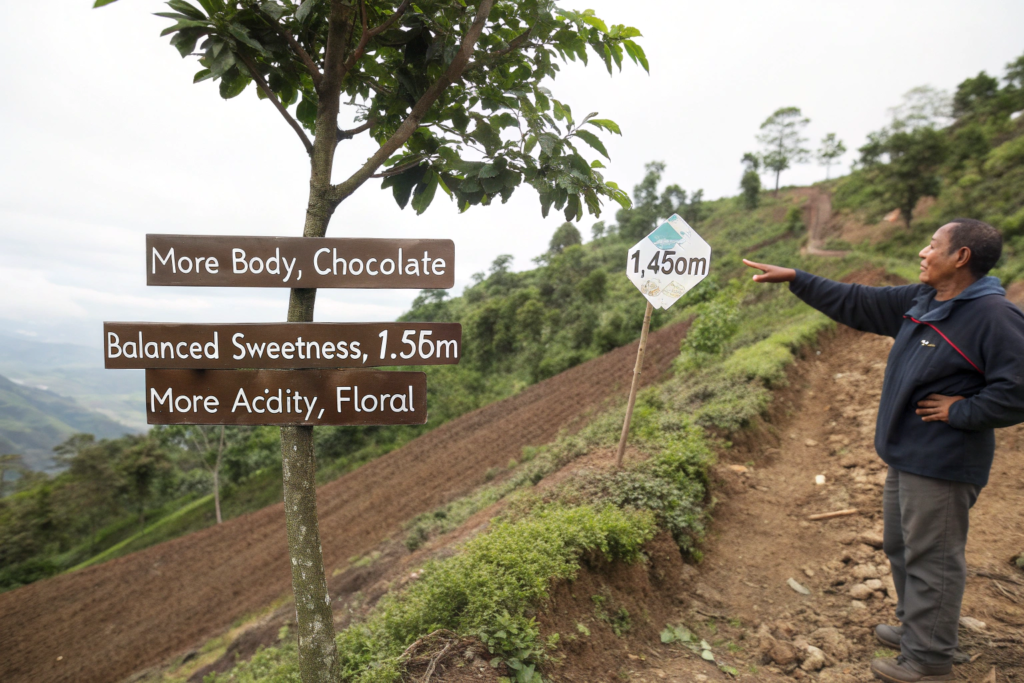
How Does the Cup Profile Differ from 1,200m vs. 1,600m in Baoshan?
Let's compare two lots from our estate, same varietal (Catimor P3), same washed process, but different altitudes.
| Altitude | Bean Density | Acidity | Body | Primary Flavor Notes |
|---|---|---|---|---|
| 1,200m | Medium-High | Low, Soft | Heavy, Creamy | Milk Chocolate, Toasted Nuts, Caramel |
| 1,450m | High | Medium, Malic (Apple) | Heavy, Syrupy | Dark Chocolate, Brown Sugar, Black Tea |
| 1,650m | Very High | Medium-High, Citric (Lemon) | Syrupy, Structured | Black Tea, Lemon Zest, Dried Apricot, Floral hints |
The lower altitude lot is a "comfort coffee." It is all about chocolate and body. It is a perfect base for an espresso blend. The higher altitude lot is more complex and elegant. It has the "sparkle" of acidity and the tea-like florals that specialty roasters crave. It shines as a single-origin filter roast.
This is the advantage of a large, vertically integrated estate. We can segregate our production by altitude and offer you a choice. You can select the specific flavor profile that best fits your blend or your single-origin program. You are not stuck with a generic "Yunnan" flavor. You can choose your elevation. At Shanghai Fumao, our lot cards always include the altitude block.
How Does Altitude Affect the Roaster's Approach to Yunnan Beans?
This is a practical question for you, Ron. You care about how the bean behaves in your roaster. Altitude, because it drives density, dictates your roast curve.
- High-Altitude Yunnan (1,600m+): These beans are dense like pebbles. They absorb heat slowly. You need a higher charge temperature to get heat into the core of the bean. If you use a low charge temp, you will under-develop the center and get grassy, sour notes. These beans are forgiving in the middle phase. They can take the heat.
- Lower-Altitude Yunnan (1,200m): These beans are still dense, but slightly less so. They absorb heat a bit faster. You can use a standard charge temperature, but you need to be careful not to scorch them in the early phase.
If you are blending Yunnan beans of different altitudes, you need to be aware of this density difference. They will roast at different rates. This is why our lot-specific information is so important. It helps you dial in your roast profile faster and with less waste.
Conclusion
The flavor of Yunnan Arabica is not a simple, one-note story. It is the result of a unique convergence of nature and nurture. The high-latitude, high-altitude terroir provides a cool, dry stage. The improved Catimor varietals and emerging Geisha and Typica provide an evolving genetic script. The meticulous washed, honey, and natural processing methods act as the director, shaping the final performance. And the volcanic soil and careful altitude segregation add depth and nuance to every act.
The result is a coffee that is clean, sweet, and heavy-bodied, with a core identity of black tea and brown sugar, but with the potential for extraordinary fruit, floral, and chocolate complexity.
At Shanghai Fumao, our job is to be the careful steward of all these factors. From the nursery to the dry mill, our goal is to preserve and enhance the unique flavor potential of this special place.
If you want to explore the flavor spectrum of our Baoshan estate—from our core washed Grade 1 to our high-altitude Geisha micro-lots—we can curate a sample set for you. Email Cathy Cai. Tell her what flavor profiles you are looking for, and she can select the appropriate samples. Contact Cathy at: cathy@beanofcoffee.com