You're looking at two options. Option one: You buy a few pallets from your local importer. It's easy. The coffee is already in a U.S. warehouse. You can get it next week. But the price per pound makes your margins look thin. Option two: You contract a full container directly from a farm in China. The price per pound is significantly lower. But it's a bigger check. More logistics. More risk. You're a business owner. You're not afraid of work. You just need to know: Is the juice worth the squeeze? What are the real, tangible, bottom-line benefits of going direct and going big?
The benefits of buying coffee beans in bulk direct from origin are threefold and build upon each other: (1) A significantly lower Cost of Goods Sold (COGS) per pound, achieved by eliminating intermediary markups and capturing volume efficiencies. (2) Unmatched Quality Consistency and Traceability, gained through a direct relationship with the farm that controls processing and lot integrity. (3) Long-Term Supply Security and Partnership Leverage, which translates to preferential access to the best lots, more flexible contract terms, and a more resilient supply chain in volatile markets.
I am the "origin" at Shanghai Fumao. I sell bulk containers direct to roasters. I also see what they pay to importers. I know the difference. Let me give you the unvarnished truth about why making the leap to direct, bulk sourcing transforms a coffee business from a fragile shop into a resilient enterprise.
How Much Can I Really Save on Cost Per Pound by Buying a Full Container?
Let's talk hard numbers. This is the primary driver for most businesses making the leap. The difference in your cost basis between buying from a U.S. importer and contracting a full container direct from origin is not marginal. It's transformational.
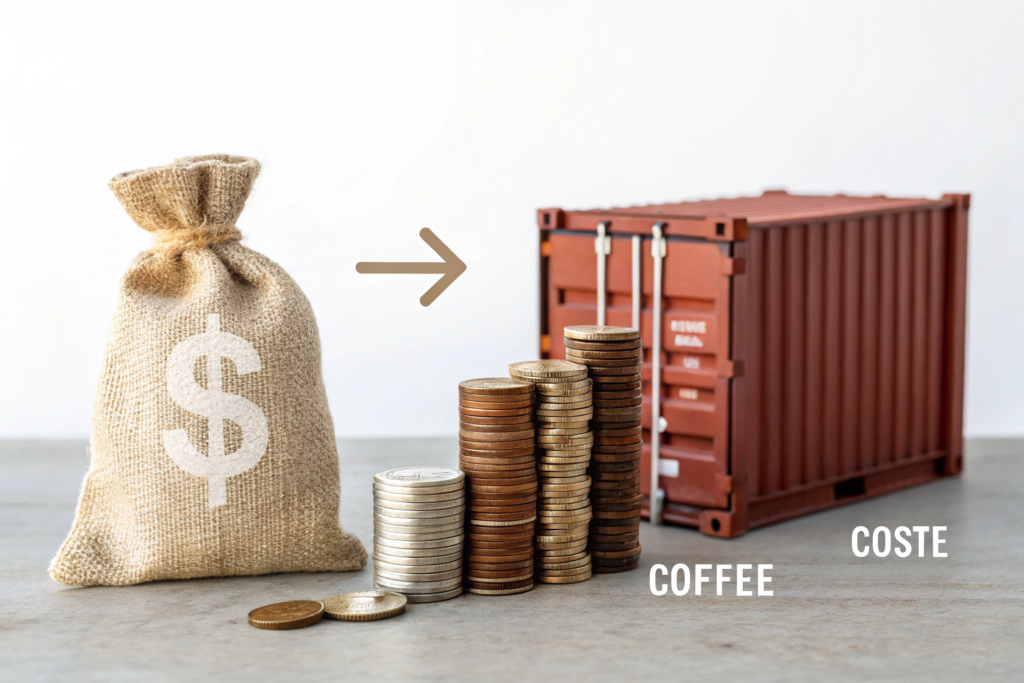
Buying a full container direct from a farm like Shanghai Fumao typically reduces your landed cost per pound by $0.50 to $1.20 compared to buying the same grade of coffee from a domestic importer. This savings is derived from two sources: (1) Eliminating the Importer's Margin. The importer is a business that buys from origin, warehouses the coffee in the U.S., and sells it at a markup—typically 10-20% or more. (2) Capturing Volume Freight Efficiency. The ocean freight cost per pound for a full container is significantly lower than the freight cost embedded in a pallet shipped via LCL (Less than Container Load) or domestic trucking.
What Is the Importer's Markup Costing My Business?
An importer provides a valuable service: they break bulk, they warehouse, they offer credit, they deliver quickly. But that service comes at a cost.
Let's use our example from the previous article. The fully calculated direct landed cost for a container of Yunnan Arabica to Phoenix was $3.03 per pound. That same coffee, of the same grade and quality, purchased from a reputable U.S. importer on a "spot" basis might cost you $3.75 to $4.25 per pound. Why the difference? The importer's price includes:
- Their original cost from the farm (which is lower than your direct FOB price, but they bought it months ago).
- Their ocean freight and logistics to their U.S. warehouse.
- Their warehouse carrying costs (rent, labor, insurance, cost of capital).
- Their profit margin (typically 10-20% or a fixed dollar markup).
- Their risk premium.
For a roaster using 10,000 pounds of this coffee per year, that $0.75 difference represents $7,500 in pure, additional profit that goes to the importer instead of staying in your business. For a larger roaster using a full container (41,000 lbs), that's over $30,000 per year. This is the financial power of direct sourcing.
How Does LCL Freight on Pallets Compare to FCL Ocean Freight?
If you can't commit to a full container, you might buy 4-10 pallets from an importer or even arrange your own LCL shipment from origin. You pay a steep premium for that flexibility.
LCL (Less than Container Load) freight is priced per cubic meter or per 1,000 kg, whichever is greater. The rate per unit is significantly higher than the per-unit cost of a full container. For example, the ocean freight for a full 20-foot container might be $4,200 total, or $0.10/lb. Shipping that same 19,000 kg as four separate 4,750 kg LCL shipments might cost $0.30-$0.40 per pound just in freight, plus higher documentation and handling fees at both ends. The freight cost alone eats up a huge portion of the potential savings. This is why full container buying unlocks the true economies of scale in coffee logistics. At Shanghai Fumao, while we can support smaller trial orders, our core value proposition is built around full container partnerships.
How Does Direct Sourcing Guarantee a More Consistent Roast and Cup?
Saving money is great. But saving money on a coffee that tastes different every time you order it is a false economy. Inconsistency in your core blend is a hidden cost that drives customers away. Direct sourcing provides a structural solution to this problem.
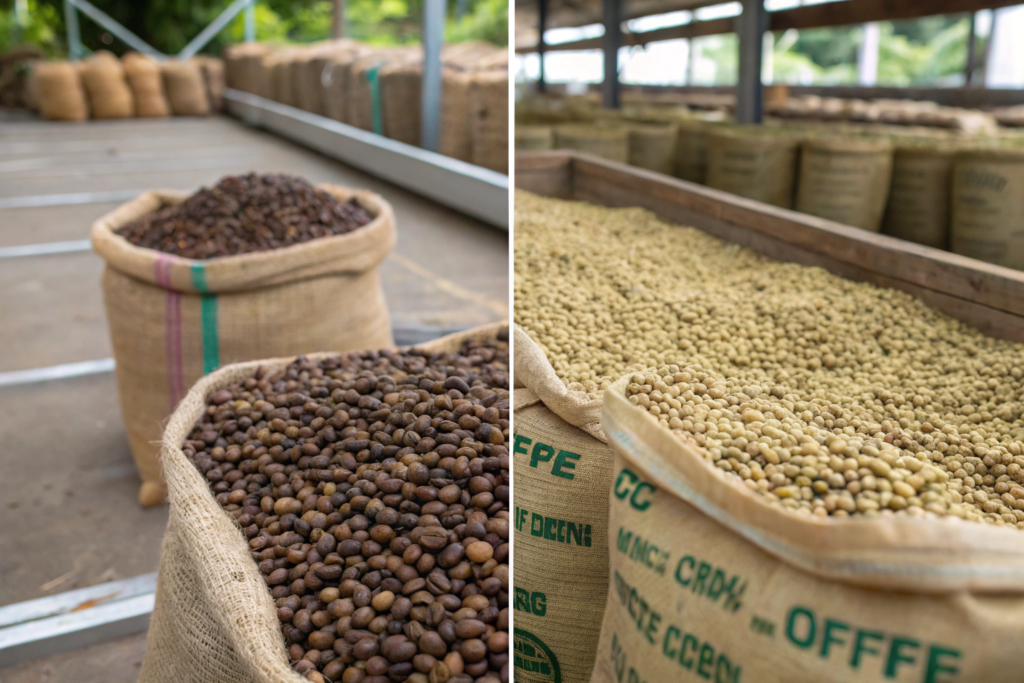
Direct sourcing guarantees a more consistent roast and cup because it eliminates the primary driver of inconsistency: commingling. When you buy from a vertically integrated farm, you are buying a single, homogenous lot of coffee from a single estate, processed under a single, controlled protocol. When you buy from an importer or trader, you are often buying a blend of coffees from multiple farms, processed in multiple ways, that has been aggregated to meet a generic specification. The direct-sourced lot provides a stable, predictable physical platform for your roast profile. The aggregated lot is a moving target.
Why Does a Farm's "Single Lot" Roast Better Than an Importer's Blend?
We discussed density and moisture variation as causes of uneven roasting. An importer's "Yunnan Grade 1" blend is a perfect storm of these variables.
The importer's lot is assembled to hit a price point and a broad flavor profile. It might contain:
- Beans from Farm A (1,600m, dense, 11% moisture).
- Beans from Farm B (1,200m, less dense, 10% moisture).
- Beans from Farm C (properly rested, 11.5% moisture, stable Aw).
- Beans from Farm D (rushed to market, 12% moisture, unstable Aw).
On paper, they all meet the spec for "Screen 18, Grade 1." But in your roaster, they are a chaotic mix of different physical properties. You will never achieve a perfectly even roast on this blend because the raw material is fundamentally uneven. A direct-sourced container from Shanghai Fumao, drawn from a single elevation block and processed as one batch, is physically homogenous. The beans respond to heat in a uniform way. Your roast profile works, batch after batch. This is the invisible quality of direct sourcing.
How Does Direct Communication Improve Quality Outcomes?
When you buy from an importer, your feedback about the coffee goes into a black box. You might tell the sales rep, "This lot is roasting a bit hollow." The rep passes it on, maybe. The information gets diluted and rarely reaches the farmer.
When you buy direct from me at Shanghai Fumao, you email me. You say, "Cathy, this lot is beautiful, but I'm finding the body a touch lighter than the last shipment." I walk out to the cupping lab. I cup the retained sample from that exact lot. I pull the processing data. I can tell you, "You're right. This block received a little more rain just before harvest. The density is slightly lower. Try lowering your charge temperature by 5 degrees." This direct, expert feedback loop is invaluable. It makes you a better roaster. It makes me a better producer. It's a collaborative quality partnership that a multi-layered supply chain simply cannot replicate.
What Are the Strategic Advantages of a Direct Farm Partnership?
Beyond the immediate cost savings and quality consistency, a direct bulk relationship confers long-term strategic advantages that are difficult to quantify but immensely valuable. These are the benefits that protect your business when the market gets rough.
Strategic advantages of a direct farm partnership include: (1) Priority Access: In a tight market, a farm will allocate its best and most limited lots to its long-term, committed container partners first. Spot buyers get what's left. (2) Contract Flexibility: Direct relationships allow for more creative and mutually beneficial contracting, such as multi-year differential agreements, customized processing, or tailored payment schedules. (3) Supply Chain Transparency and Story: You have a direct, verifiable story of origin that commands premium pricing and builds unshakable customer loyalty.
What Happens to Spot Buyers When the Market Spikes?
We saw this in 2022, and we're seeing echoes of it now. When the C Market spikes and global supply tightens, importers and traders pull back. They become more selective. They protect their largest, most reliable accounts.
The spot buyer—the roaster who calls around looking for 10 bags of whatever is cheap and available—is the first to feel the pain. Prices quoted to them are sky-high. The quality available is the "bottom of the barrel"—lots that have been passed over by everyone else. The direct container buyer, with a signed contract and a year-long relationship, is insulated from much of this chaos. Their coffee is already reserved. Their price is already fixed (or at least the differential is). They can continue roasting and selling while the spot buyers scramble. This is the security that direct sourcing provides. It's a buffer against market volatility.
Can a Direct Relationship Unlock Custom Processing or Unique Varietals?
Absolutely. This is one of the most exciting and profitable aspects of a direct partnership.
A spot buyer can only choose from the catalog of what's already been produced. A direct partner can collaborate on what will be produced. As a container partner with Shanghai Fumao, we can have conversations like:
- "For our 2027 contract, we'd love to secure a specific block of your new Geisha planting."
- "We're launching a winter blend. Could we do a custom anaerobic fermentation on one of our containers this harvest?"
- "Can we work together to develop a roast profile on your P4 Catimor that perfectly matches our house espresso?"
These collaborations create proprietary, exclusive, and highly marketable coffees for the roaster. They build a brand that cannot be easily copied by competitors. This level of partnership is only possible through the trust and commitment built through direct, bulk sourcing.
Conclusion
Buying coffee in bulk direct from origin is not just a purchasing decision. It's a strategic transformation of your coffee business. It's the move from being a price-taker in a volatile commodity market to being a value-creating partner in a dedicated supply chain.
The benefits are clear and cumulative: a structurally lower cost basis that flows directly to your bottom line; a physically consistent green coffee that honors your roast profile and delights your customers; and a long-term, resilient partnership that provides security, flexibility, and unique opportunities unavailable to the spot market buyer.
Yes, it requires more capital. Yes, it requires more logistics management. Yes, it requires a commitment to a relationship. But for a roaster serious about building a durable, profitable, and distinctive coffee company, the juice is absolutely worth the squeeze.
If you're ready to explore what a direct container partnership with Shanghai Fumao could mean for your business, I'm ready to have that strategic conversation. My email is cathy@beanofcoffee.com.