A roaster from Vancouver emailed me in April. "I see your new harvest Catimor is available," he wrote. "But I still have 20 bags of last year's crop in my warehouse. It cups okay. Not great, but okay. Is it really worth paying the premium for fresh crop, or should I use up what I have?"
I told him the truth. The past crop coffee in his warehouse was not going to get better. It was going to get worse. Every month, it was losing acidity, losing sweetness, losing the origin character that made it special. The current crop coffee I was offering was vibrant, alive, and at its peak. If he blended the past crop into his production, his customers would taste the difference. They might not complain. They might just quietly stop buying.
Buying current crop coffee ensures maximum cup vibrancy, higher concentrations of volatile aromatics and organic acids, greater roast consistency, and longer usable shelf life, while past crop coffee inevitably suffers from faded acidity, flattened flavor, and accelerated staling that no roast profile can fully compensate for.
This is not to say past crop coffee has no place. It does. But that place is specific, and it comes with a discount that reflects the quality decline. Here is exactly what happens to coffee as it ages, how to evaluate whether the premium for current crop is worth it for your business, and how to make smart buying decisions based on crop freshness.
How Does Aging Affect the Chemical Composition of Green Coffee?
Green coffee is not inert. It is a living seed, and like all living things, it changes over time. Even at the ideal moisture content of 10.5 to 12 percent, the bean is biologically and chemically active. Respiration continues at a slow rate. Enzymes remain functional. Lipids oxidize. Volatile compounds evaporate. The pace of change depends on the storage conditions, but the direction of change is always the same. The coffee is slowly, steadily declining.
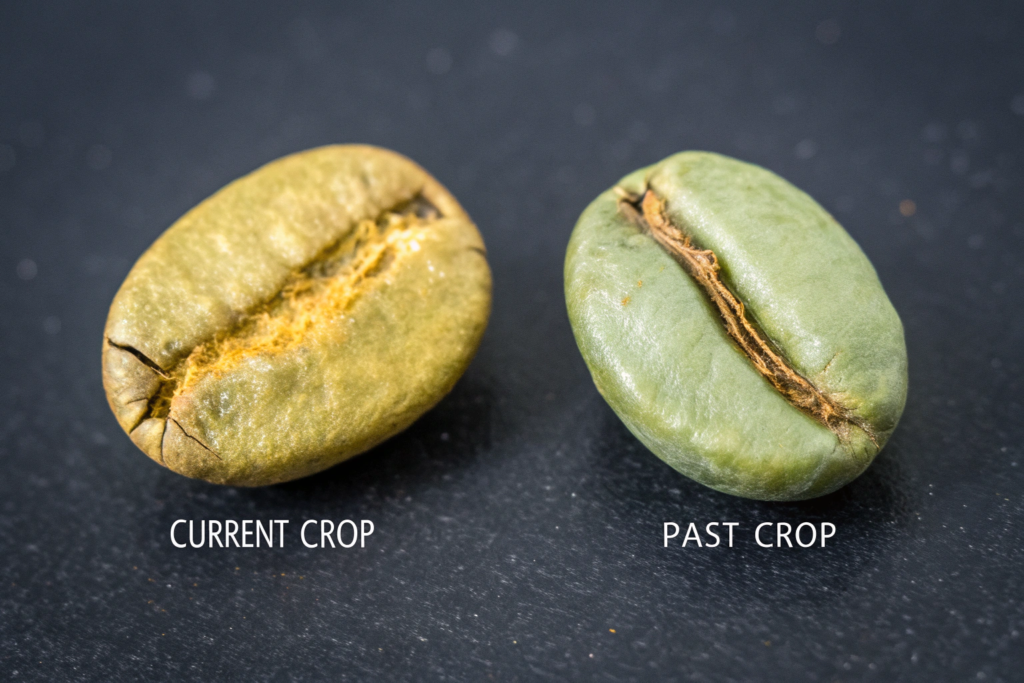
The most significant chemical changes during aging are the degradation of organic acids, the oxidation of lipids, and the loss of volatile aromatic compounds. Organic acids—citric, malic, and chlorogenic—are responsible for the bright, vibrant acidity that makes specialty coffee lively. Over time, these acids break down. The acid concentration drops. The pH rises. The cup loses its brightness and tastes flat, dull, and muted.
Lipids, which contribute to body and mouthfeel, oxidize when exposed to oxygen. The oxidation produces off-flavors—stale, cardboardy, rancid notes. These notes are subtle at first but become more pronounced as the coffee ages. A past crop coffee that is 18 months old will have measurably higher lipid oxidation than the same coffee at 6 months old.
Current crop green coffee retains high concentrations of organic acids, intact lipids, and volatile aromatics, while aging degrades these compounds through acid breakdown, lipid oxidation, and aromatic evaporation, resulting in a measurable decline in cup vibrancy, body, and flavor complexity over 12 to 18 months.
Volatile aromatic compounds are the most fragile. These are the molecules that create the specific flavor notes—jasmine, berry, chocolate, spice. They evaporate slowly over time. The rate of loss depends on the storage temperature and the packaging. A coffee stored in a warm warehouse in jute bags will lose its volatiles much faster than a coffee stored in a cool warehouse in GrainPro. But even under ideal storage, the volatiles decline. The coffee that tasted like blueberry and dark chocolate at 3 months may taste like generic "coffee flavor" at 15 months.
Why Do Organic Acids Degrade During Storage?
Organic acids are not stable molecules. They react over time with other compounds in the bean, with oxygen, and with water. The reactions are slow, but they are relentless.
Citric acid, the primary acid in washed Arabica, degrades through oxidation and through reaction with amino acids. As citric acid concentration drops, the perceived acidity in the cup decreases. The coffee tastes less bright, less lively, less refreshing. Malic acid follows a similar degradation pathway. The combined loss of citric and malic acids is what makes past crop coffee taste flat.
Chlorogenic acids, which contribute to perceived acidity and astringency, also degrade during storage. Their breakdown products can taste bitter and contribute to the dull, heavy sensation that older coffees often have. The degradation of chlorogenic acids is accelerated by heat and moisture. A past crop coffee that was stored in a warm, humid environment will have significantly lower chlorogenic acid content and a noticeably flatter cup.
The degradation rate is temperature-dependent. A coffee stored at a stable 20 degrees Celsius will retain its acids reasonably well for 12 months. The same coffee stored at 30 degrees Celsius will show significant acid loss within 6 to 9 months. The harvest date is only one part of the freshness equation. The storage temperature is equally important.
I monitor the acid profiles of our stored lots through periodic cupping. A lot that cups bright and citrusy at 3 months post-harvest will cup with softer, mellower acidity at 9 months, and noticeably flat at 15 months. The decline is gradual but unmistakable. The cupping scores reflect it—a lot that scored 84 points at 3 months may score 82 points at 12 months and 80 points at 18 months.
How Does Lipid Oxidation Change the Flavor of Past Crop Coffee?
Lipids are the fats and oils in coffee. They contribute to body, mouthfeel, and flavor. Fresh coffee lipids are stable, protected inside intact cell walls. As coffee ages, two things happen. The cell walls become more permeable. And oxygen slowly penetrates the bean. The lipids oxidize.
Oxidized lipids taste different than fresh lipids. The fresh, clean, nutty character of intact lipids gives way to stale, cardboardy, rancid notes. The change is subtle at first—a slight flatness, a loss of sweetness. Over time, the stale notes become more pronounced. The coffee may taste dusty, papery, or slightly sour in an unpleasant way.
Lipid oxidation is accelerated by oxygen exposure, heat, and light. A coffee stored in GrainPro under cool, dark conditions will experience slow lipid oxidation. A coffee stored in jute in a warm, bright warehouse will oxidize much faster. The difference in lipid quality between a well-stored current crop and a poorly stored past crop is dramatic.
I have cupped past crop coffees where the lipid oxidation was so advanced that the coffee tasted like cardboard and old cooking oil. The defect was not subtle. It dominated the cup. No roast profile could hide it. The coffee was not defective in the sense of mold or ferment. It was simply too old. The lipids had gone. The coffee's best days were behind it.
How Does Current Crop Coffee Perform Better in the Roaster?
The freshness of green coffee directly affects how it behaves in the roaster. Current crop coffee roasts more predictably, more evenly, and with better development than past crop coffee. The difference is rooted in the physical and chemical changes that occur during aging.
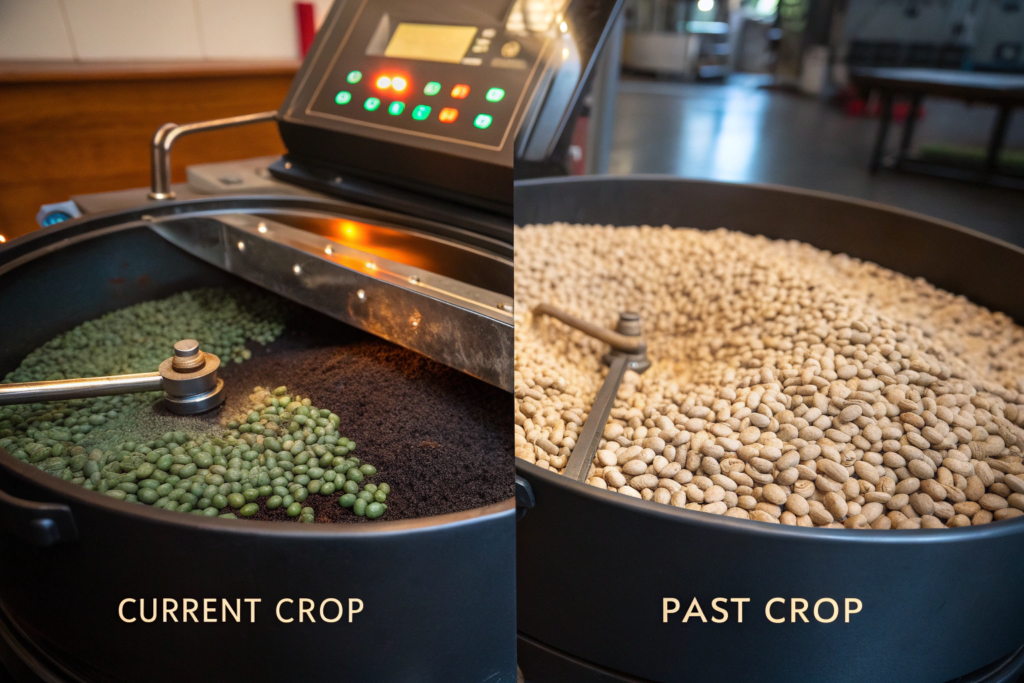
Current crop coffee has higher moisture content within the ideal range, typically 11 to 12 percent. The moisture is evenly distributed throughout the bean. The cell structure is intact. The bean is dense and hard. When this coffee hits the hot drum, it absorbs heat efficiently. The moisture turns to steam. The bean expands. First crack is vigorous and distinct. The development phase is responsive to heat adjustments. The roast curve is smooth and predictable.
Past crop coffee has lower effective moisture, even if the meter reading is within range. The moisture has migrated and bound differently within the aged cell structure. The bean is less dense, softer, and more porous. When this coffee enters the roaster, it absorbs heat more quickly and less evenly. First crack is softer, slower, and less distinct. The bean is less responsive to heat adjustments. The roast can easily race or stall.
Current crop coffee provides roasters with predictable heat absorption, vigorous first crack, and responsive development, while past crop coffee roasts unevenly, cracks sluggishly, and tends to scorch on the surface while remaining underdeveloped at the core.
The result in the cup reflects the roast quality. A well-roasted current crop coffee tastes clean, sweet, and fully developed. A poorly roasted past crop coffee may taste simultaneously roasty and grassy—scorched on the outside, underdeveloped on the inside. Even an experienced roaster will struggle to get a perfect roast from aged beans.
Why Is First Crack Less Vigorous in Aged Beans?
First crack is the moment when the bean's internal water vapor pressure exceeds the strength of the cell walls, causing the bean to fracture with an audible pop. The vigor of first crack depends on the amount of water available to generate steam pressure and the strength of the cell walls.
In a fresh, current crop bean, the moisture content is optimal and the water is held within intact, flexible cell walls. When the bean temperature reaches approximately 195 to 200 degrees Celsius, the water flashes to steam. The pressure builds quickly and evenly. The beans crack loudly and energetically. The sound is sharp and distinct. The crack provides a clear auditory signal to the roaster.
In an aged, past crop bean, the moisture has redistributed. Some moisture has been lost entirely. Some is bound more tightly within degraded cell structures. The cell walls themselves are weaker due to oxidation and enzymatic breakdown. When the bean reaches first crack temperature, the steam pressure is lower and less uniform. The weakened cell walls fracture more easily and less violently. The crack is softer, slower, and may be spread over a longer time period.
The weaker first crack makes it harder for the roaster to identify the exact moment to adjust heat or begin timing development. The auditory cue is less reliable. The roaster must rely more on temperature probes, color, and aroma. The risk of misjudging the roast phase increases. For more on roast dynamics, Cropster provides roast logging tools that help track first crack timing and intensity across different bean ages.
How Does Bean Density Change in Past Crop Coffee?
Bean density is a critical physical parameter that affects heat transfer during roasting. Current crop coffee, properly dried and stored, maintains a high density—typically 700 to 750 grams per liter for high-grown washed Arabica. The dense structure requires more thermal energy to heat through to the core. The roast must be driven with sufficient heat to develop the bean fully.
As coffee ages, the density decreases. The cell walls degrade. The bean becomes more porous. Moisture loss and lipid oxidation create microscopic voids within the bean structure. The density of a past crop coffee, even one that was originally high-grown and dense, can drop to 650 grams per liter or lower after 18 to 24 months.
The lower density means heat penetrates the bean more quickly. The surface can scorch before the core is developed. The roaster must adjust the profile—lower charge temperature, gentler heat application—to avoid burning the outside while cooking the inside. The adjustments are difficult because every past crop lot has aged differently. There is no standard "past crop profile." The roaster must dial in each lot individually.
I measure the density of every lot before shipment and record it on the lot card. Current crop lots consistently measure above 720 grams per liter. Past crop lots from our inventory, if we sell them, measure lower and include a density reading so the roaster can adjust accordingly. The density data helps the roaster anticipate how the beans will behave in the drum.
What Are the Sensory Differences Between Current and Past Crop Cups?
The sensory differences between current crop and past crop coffee are not subtle. They are the difference between a living product and a fading one. The decline affects every attribute on the cupping form.
Acidity is the attribute that fades first and most noticeably. Current crop coffee has bright, vibrant, complex acidity—citrus, stone fruit, berry, depending on the origin and processing. Past crop coffee has muted, flat, or absent acidity. What remains may taste sour rather than bright, a sign of acid degradation rather than fresh organic acids.
Aroma and flavor follow a similar trajectory. Current crop coffee has a rich, complex aroma—floral, fruity, spicy, depending on the lot. The flavor is distinct and layered. Past crop coffee has a flat, generic aroma. The flavor is one-dimensional. The specific origin notes—the blueberry in a natural, the jasmine in a washed Geisha—fade into a generic "coffee" taste. The coffee still tastes like coffee, but it no longer tastes like anything special.
Current crop coffee delivers bright, complex acidity, distinct origin flavors, and a clean, sweet finish, while past crop coffee cups with flat acidity, generic flavor, thinner body, and a papery, dry aftertaste that reflects the loss of volatile aromatics and the oxidation of lipids.
Body and finish decline as well. The body of current crop coffee is full and satisfying, whether it is the syrupy weight of a natural or the silky texture of a washed high-grown lot. Past crop coffee body thins out. The mouthfeel becomes watery and hollow. The finish, which should be clean and sweet, becomes dry, papery, and short.
I cup current and past crop samples of the same lot side by side regularly as a training exercise. The difference is always striking. The past crop lot tastes like a faded photograph of the current crop lot. The structure is still there, but the color and life are gone.
Can Past Crop Coffee Still Be Useful in Blends?
Past crop coffee is not worthless. It simply has a different value proposition and a different appropriate use. A past crop coffee that still cups clean, even if flat, can be a useful blending component for certain applications.
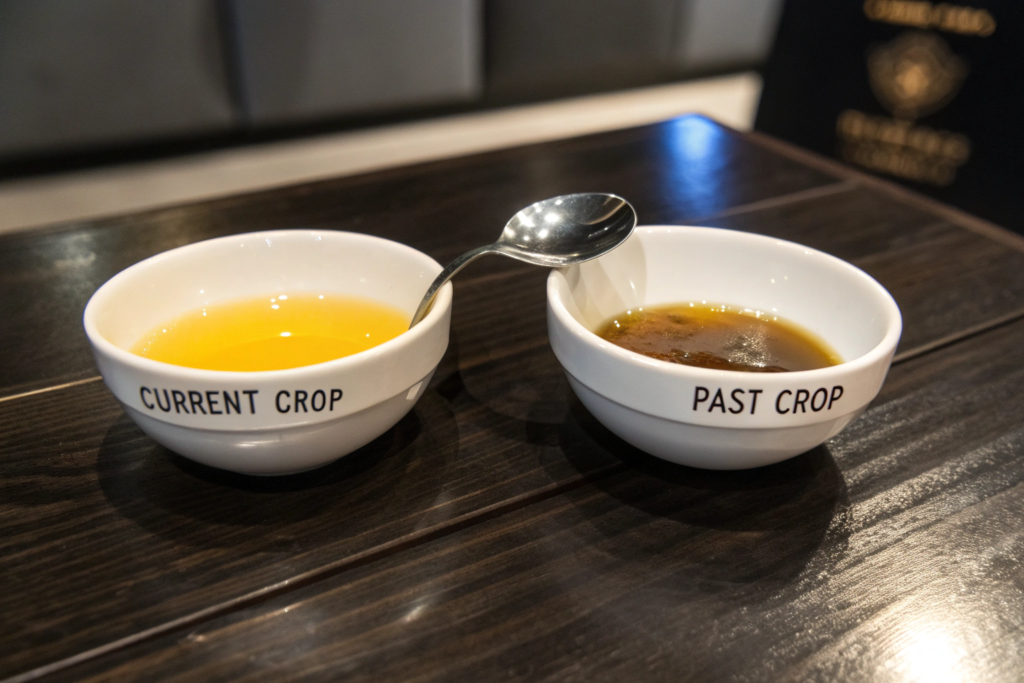
In an espresso blend that is roasted medium-dark to dark, the origin character of the coffee is partially masked by roast character. The chocolate and caramel notes from the roast dominate. The acidity is softened by the darker roast anyway. A past crop coffee used as a small percentage of such a blend—10 to 20 percent—can contribute body and caffeine without introducing noticeable defects. The flatness is hidden by the other, fresher components and the roast profile.
In a cold brew blend, where low acidity is actually desired, a clean past crop coffee can work well. Cold brew drinkers often prefer a smooth, chocolatey, low-acid cup. A past crop coffee that has lost its acidity can fit this profile naturally. The key is that the coffee must be clean—no mold, no ferment, no rancid lipid notes. A clean but faded past crop coffee is usable. A defective past crop coffee is not.
I sell past crop lots at a discount to roasters who understand what they are buying and have a specific use for them. The discount reflects the quality decline. The lot card clearly states the harvest date and the cupping score. The buyer knows they are buying an aged product. The transaction is transparent.
What Is the Maximum Shelf Life for Specialty Grade Arabica?
There is no single answer to the maximum shelf life question. The shelf life depends on the storage conditions, the packaging, and the quality expectations of the end user. But some general guidelines are widely accepted in the specialty industry.
Under ideal storage conditions—cool, stable temperature below 22 degrees Celsius, low humidity, darkness, and GrainPro hermetic packaging—specialty grade washed Arabica can maintain 90 percent or more of its original cup quality for 12 to 14 months post-harvest. Between 14 and 18 months, the quality decline accelerates. By 18 to 24 months, the coffee is noticeably past crop, with significant loss of acidity, aroma, and complexity.
Under typical commercial storage conditions—ambient warehouse temperature, jute bags, moderate humidity—the decline is faster. Noticeable quality loss can occur within 6 to 9 months. By 12 months, the coffee is clearly past crop.
Natural processed coffees tend to age slightly faster than washed coffees because the lipids are more exposed and more prone to oxidation. High-density, high-altitude coffees tend to age slightly slower than low-density coffees because the dense structure provides more protection.
I guarantee our current crop Catimor for 12 months from the harvest date when stored properly. Beyond 12 months, I recommend buyers evaluate the lot carefully before use. The coffee may still be good. It may not be. The only way to know is to cup it. For more on shelf life standards, the Green Coffee Association provides guidance on green coffee storage and quality maintenance.
How Should You Evaluate Whether to Buy Current or Past Crop?
The decision to buy current crop or past crop is a business decision. It should be based on the intended use of the coffee, the quality expectations of the customer, and the price difference between the two options.
For a single-origin offering, a limited release, or any coffee where the origin character is the selling point, current crop is the only sensible choice. The customer pays a premium for distinctive flavor. That flavor depends on freshness. A past crop single origin will disappoint the customer and damage the roaster's reputation.
For a core espresso blend, a cold brew program, or a dark roast offering, past crop coffee may be an acceptable option if the quality is still clean and the price discount is significant. The darker roast and the blending mask some of the freshness decline. The customer is not expecting bright, distinctive origin character. The price savings can improve the blend margin.
The decision to buy current or past crop should be based on product application—current crop for single origins and premium offerings where origin character is paramount, past crop only for dark roasts and blends where the freshness decline can be masked and the price discount justifies the quality compromise.
The price discount for past crop should be meaningful. A 10 percent discount for a 12-month-old past crop lot is not sufficient. The quality decline is greater than 10 percent. A 20 to 30 percent discount is more typical for clean past crop lots that are still usable. The exact discount depends on the cupping score, the age, and the storage history.
What Questions Should You Ask a Supplier About Crop Freshness?
When buying green coffee, the buyer should ask specific questions to determine the crop freshness and make an informed decision.
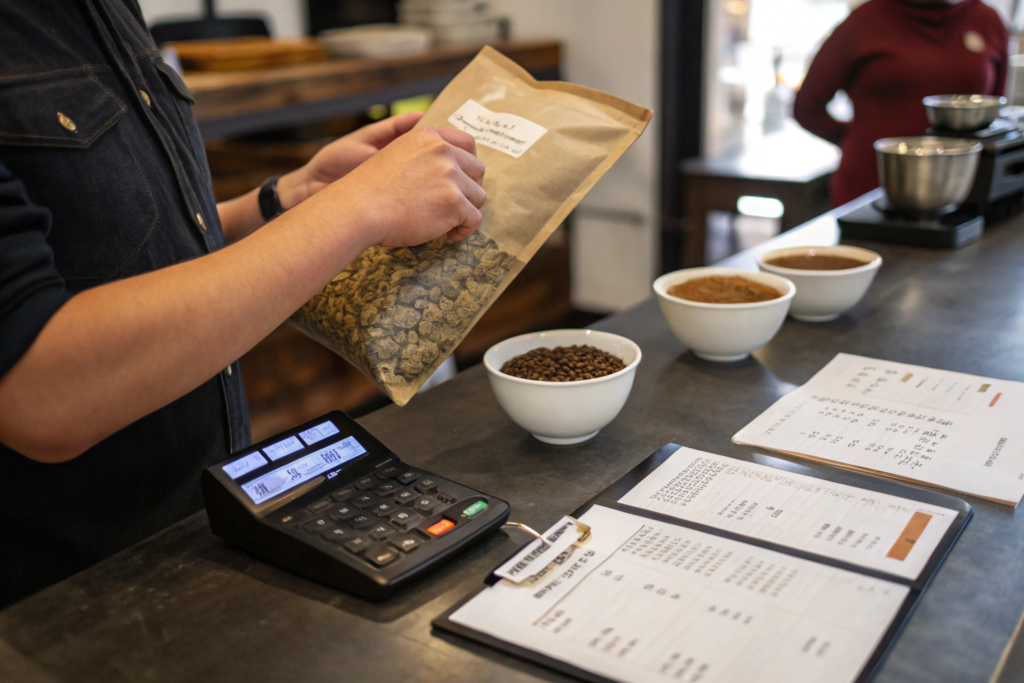
First: "What is the exact harvest date for this lot?" The answer should be a specific month and year, not a vague "current crop." "Harvested January 2025" is a real answer. "This season's crop" is not.
Second: "How has this coffee been stored since harvest and milling?" The answer should describe the storage conditions—temperature, humidity, type of bags. "Stored at 20 degrees Celsius in GrainPro in a dark warehouse" is the ideal answer.
Third: "What is the current moisture content and water activity?" The readings should be within the fresh range—moisture 10.5 to 12 percent, water activity below 0.60. If the moisture is low and the water activity is high, the coffee has been poorly stored.
Fourth: "What is the current cupping score, and how does it compare to the score at the time of harvest?" The current score reveals the quality decline. A lot that scored 84 at harvest and 82 now has held up well. A lot that scored 84 at harvest and 79 now has not.
Fifth: "Is there a price adjustment for this lot relative to current crop pricing?" The answer reveals whether the supplier is pricing the lot appropriately for its age and quality.
At Shanghai Fumao, we provide all of this information with every offer. The harvest date, storage history, current moisture and water activity, current cupping score, and pricing are transparent. The buyer has the information needed to make an informed decision.
How Do You Cup a Past Crop Sample Objectively?
Cupping a past crop sample requires a shift in expectations. The cupper should not compare it to the memory of the same coffee when it was fresh. That comparison will always be disappointing. The cupper should evaluate the past crop lot on its own terms: Is it clean? Is it free of defects? Does it have any remaining positive character? Is it usable for the intended application?
The cupping protocol is the same as for any coffee. Use the SCA cupping form. Score each attribute honestly. The past crop lot will score lower in acidity, flavor, and aftertaste. That is expected. The question is whether the scores are still within the acceptable range for the intended use.
For a dark roast espresso blend, a past crop lot that scores 80 points, with no defects and a clean finish, may be perfectly acceptable. The darker roast will add body and roast character that compensate for the flatness. For a light roast single origin, the same 80-point past crop lot is not acceptable. The light roast will expose the flatness and the customer will be disappointed.
The cupping should also include an aging test. Cup the roasted sample at 24 hours post-roast. Cup it again at 7 days post-roast. A past crop coffee that cups okay on day one but collapses by day seven is not stable enough for retail sale. The customer who buys the bag and brews it over two weeks will have a poor experience. I encourage buyers to cup past crop samples with their intended application in mind. A coffee that cups poorly as a light roast filter may cup acceptably as a medium-dark roast blender. The cupping evaluation should be contextual, not absolute.
Conclusion
The difference between current crop and past crop coffee is measurable, noticeable, and commercially significant. Current crop coffee has higher acidity, more complex flavor, better body, and more predictable roasting behavior. Past crop coffee has faded acidity, flatter flavor, thinner body, and trickier roast dynamics. The decline is driven by the degradation of organic acids, the oxidation of lipids, and the loss of volatile aromatic compounds over time.
The decision to buy current or past crop depends on the product application and the price difference. Current crop is the right choice for single origins, premium offerings, and any coffee where origin character is the value proposition. Past crop may be acceptable for dark roasts, cold brew, and blends where the freshness decline can be masked and the price discount justifies the quality compromise.
Transparency is essential. The supplier should provide the harvest date, storage history, current cupping score, and appropriate pricing for the age. The buyer should cup the lot objectively, with the intended application in mind. A good decision is based on data, not on assumptions.
If you want to taste the difference between our current crop and past crop Yunnan lots, contact Cathy Cai at BeanofCoffee. She can send you samples of both, along with the harvest dates, cupping scores, and pricing for each. You can cup them side by side and make your own evaluation. Her email is cathy@beanofcoffee.com. She responds quickly and can answer any questions about crop freshness, storage, and pricing.