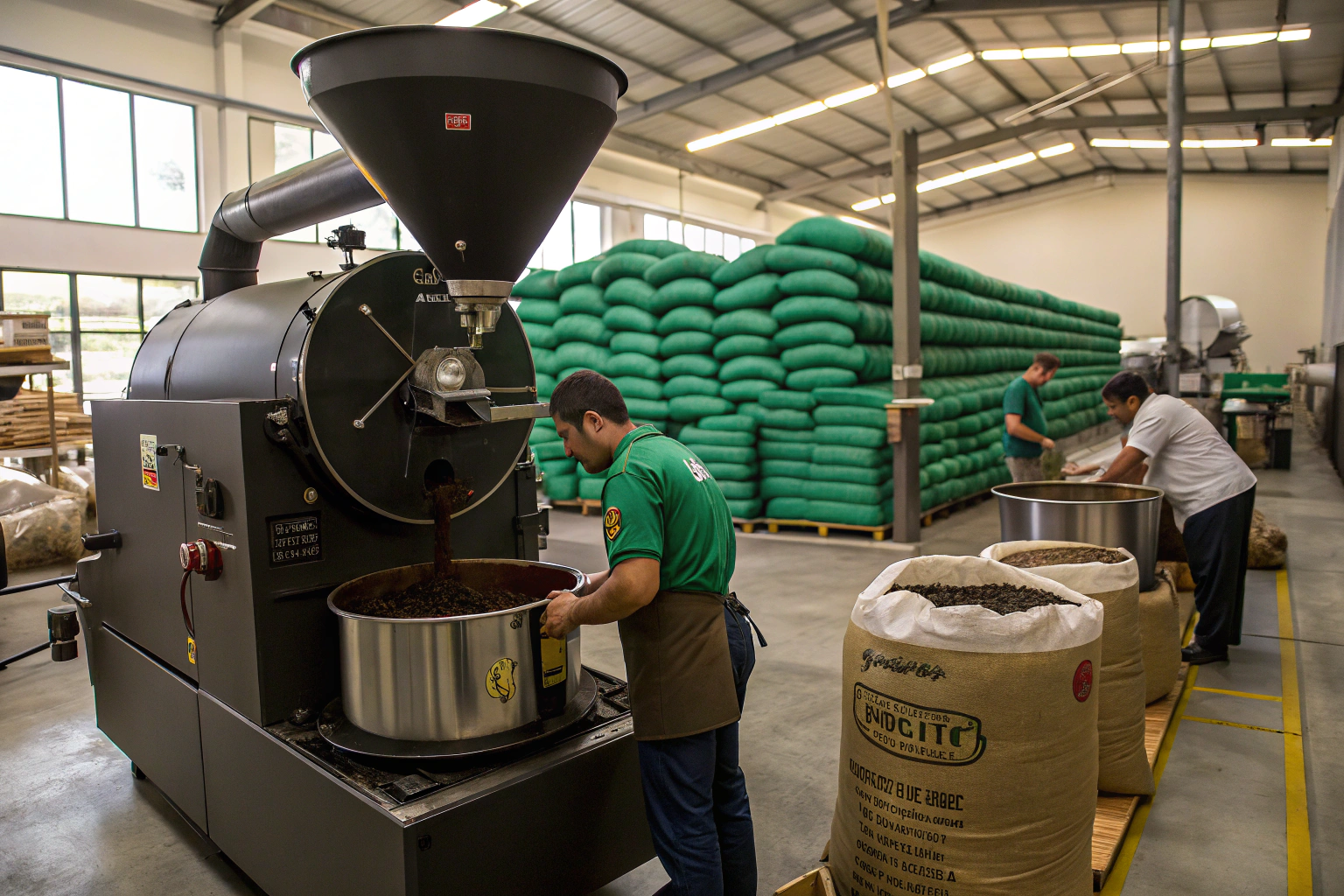
I remember the exact moment I realized we had a scaling problem. It was a Tuesday morning in October, and I was standing in our roasting facility watching two of my best team members argue. One was trying to fulfill a last-minute order for a cafe chain that had just expanded to three new locations. The other was trying to roast the weekly batch for a grocery order that was already two days behind schedule. We had one roaster. One packaging line. One shift. And suddenly, demand from two different channels was pulling our production in opposite directions. We had spent years chasing growth. Now growth was chasing us, and we were not ready.
Scaling a coffee roasting business is not simply a matter of buying a bigger roaster. It is a simultaneous challenge across five interconnected dimensions: production capacity and equipment, green coffee supply chain consistency, quality control across larger batch sizes, team structure and specialized roles, and cash flow to finance inventory growth. A failure in any one of these dimensions creates a bottleneck that limits the entire operation. A roaster that upgrades equipment without securing a larger green coffee supply simply runs out of beans. A roaster that secures supply but cannot maintain cupping consistency across larger batches loses the quality reputation that fueled the growth in the first place. Scaling is a system problem, not a machine problem.
What I learned in the years since that chaotic Tuesday morning is that scaling is not an event. It is a series of deliberate, often uncomfortable, transitions. You transition from being a roaster who runs a business to being a business leader who happens to roast coffee. You transition from making every decision yourself to trusting a team. You transition from buying spot lots of green coffee to contracting full containers months in advance. Each transition is a challenge. Here is what those challenges look like in practice, and how to navigate them without losing your quality, your team, or your mind.
When Is the Right Time to Upgrade Your Coffee Roasting Equipment Without Overextending?
This is the question that keeps roastery owners up at night. You are running at near capacity. Your lead times are stretching. Your production team is working overtime. The logical answer is to buy a bigger roaster. But a bigger roaster is expensive. Not just the machine itself—the installation, the ventilation upgrades, the additional green coffee inventory you need to feed it, the additional staff to operate it. The all-in cost is three to five times the price tag on the equipment brochure.
The right time to upgrade roasting equipment is when your current machine is running at 80% capacity or more for at least three consecutive months, and you have confirmed sales contracts or predictable repeat orders that will immediately fill at least 50% of the new machine's capacity. Upgrading on speculation—buying a bigger roaster because you hope the growth will come—is the single most common and costly mistake in scaling a roastery. The machine arrives, the payments begin, and the expected orders do not materialize. Now you have a debt payment and an underutilized asset eating into your margins. The upgrade must be pulled by confirmed demand, not pushed by ambition.
I broke this rule once. I bought a second packaging line because I was sure a big retail contract was closing. The contract fell through at the last minute. For six months, that packaging line sat idle, and the depreciation and financing costs were a drag on the entire business. I learned to wait for the signed contract before signing my own. When I finally did upgrade our primary roaster, it was because we had three months of backlog and written commitments from our top five clients that their volumes were increasing. The new roaster paid for itself within its first year of operation. The timing was right because the demand was real, not projected.
What is the real capacity utilization rate that signals a need for new equipment?
Eighty percent is the magic number for a roastery running a single shift. When your roaster is running at 80% of its theoretical maximum output—accounting for warm-up time, cool-down between batches, cleaning, and maintenance—you have essentially no room for growth or for error. A machine breakdown, a sudden large order, or a seasonal spike will push you past capacity and force you to delay orders, disappoint clients, and damage your reputation. At 80%, you should begin the equipment planning process. At 90%, you are in crisis mode. The lead time for a new commercial roaster can be three to six months, and installation can take weeks. Start the process before you are desperate.
How do you calculate the total cost of a roaster upgrade beyond the equipment price?
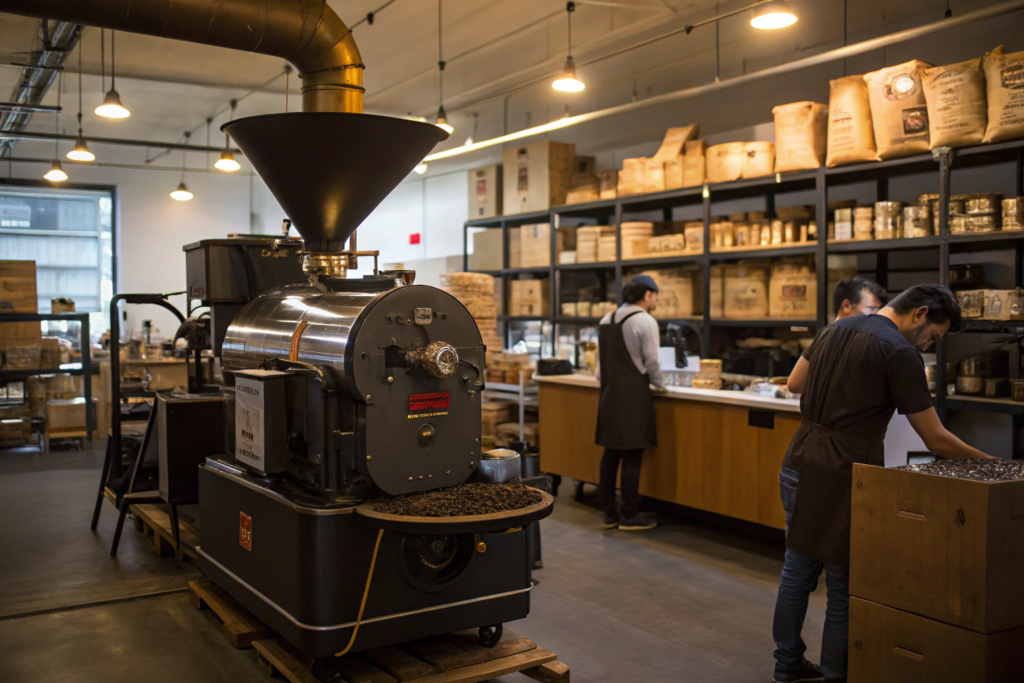
The equipment price is the starting point. Add installation: electrical upgrades, gas line modifications, ventilation and afterburner requirements, and structural reinforcement if the new machine is significantly heavier. Add facility modifications: does the new machine fit through the door, or do you need to widen an opening? Add auxiliary equipment: a larger destoner, a larger grinder, more packaging capacity to match the new roasting output. Add increased working capital: a larger roaster requires a larger green coffee inventory, which ties up cash. Add training and labor: you may need to hire an additional roast operator or pay for training on the new equipment. A $100,000 roaster can easily be a $250,000 project by the time it is operational. Budget for the project, not the purchase.
How Do You Secure a Consistent Green Coffee Supply Chain as Your Volume Triples?
When you are a small roaster buying 10 bags of green coffee at a time, the supply chain is simple. You buy from an importer's spot list. You pay a little more per pound, but you get flexibility. When you scale to buying full containers of 300 bags at a time, the supply chain changes completely. You are no longer buying what is available. You are contracting what will be harvested, processed, and shipped months in the future. The risk profile shifts dramatically.
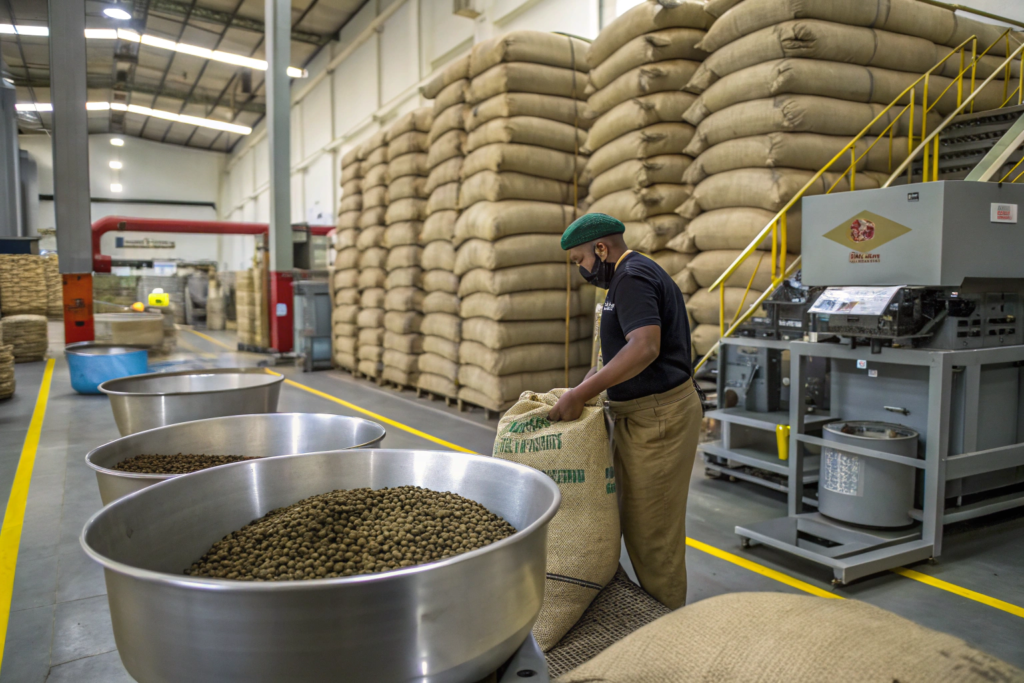
Securing a consistent green coffee supply at scale requires moving from spot buying to forward contracting, and from single-supplier relationships to a diversified, multi-origin, multi-supplier sourcing strategy. A roaster who triples their volume cannot rely on one farm or one importer. A drought, a crop failure, a shipping disruption, or a quality issue at that single source will halt production. The scaled roaster needs direct relationships with producers or exporters at origin for their core coffees, backup relationships with importers for flexibility, and a safety stock buffer of at least 30 to 60 days of green coffee inventory for every SKU. This buffer is an insurance policy. It costs money in warehousing and tied-up capital. It is also the only thing that keeps you roasting when a container is delayed by three weeks.
We work with several roastery clients who have scaled from small to mid-sized, and the ones who do it smoothly are the ones who start building supplier relationships before they need the volume. They visit origin. They cup with us. They contract their core lots a year in advance. By the time their new roaster arrives, the green coffee pipeline is already full. The ones who struggle are the ones who try to scale the equipment first and the supply chain second. They have a beautiful new roaster and no beans to put in it.
Why does forward contracting become essential at higher roasting volumes?
When you buy 10 bags, you can afford to be picky and opportunistic. When you buy 300 bags of a single lot for a year-round blend, you cannot afford to discover in June that the lot is sold out. Forward contracting locks in the specific lot, the specific volume, the specific quality parameters, and the specific price for a future delivery window. It gives the roaster supply certainty and price predictability. It gives the producer a guaranteed buyer, which allows them to invest in the crop. It is the foundation of a stable, scalable supply chain. The International Coffee Organization's trade statistics provide the macroeconomic context for forward contracting trends, and the Specialty Coffee Transaction Guide offers benchmarking data for fair contract pricing.
How much green coffee inventory buffer is appropriate for a growing roastery?
The buffer depends on your lead time, your demand variability, and your risk tolerance. At a minimum, maintain 30 days of green coffee inventory for every active SKU, based on your average weekly usage. If your lead time from order to delivery is 60 days, maintain 60 days. If you source from origins with longer or less reliable shipping, add a safety margin of 15 to 30 additional days. This buffer is not wasted inventory. It is continuity insurance. Calculate the cost of running out of your flagship blend for two weeks—lost sales, lost accounts, lost reputation—and compare it to the cost of holding an extra 30 days of green coffee. The insurance is almost always cheaper.
How Do You Maintain Cupping Quality and Consistency Across Larger Roast Batches?
This is the challenge that separates great scaling from mediocre scaling. A coffee that scores 86 points on a 15-kilo sample roast does not automatically score 86 points on a 120-kilo production roast. The heat transfer dynamics change. The development time changes. The airflow changes. The roaster operator who could manage the smaller machine by feel and experience now has to manage a much more complex thermal system with less intuitive feedback.
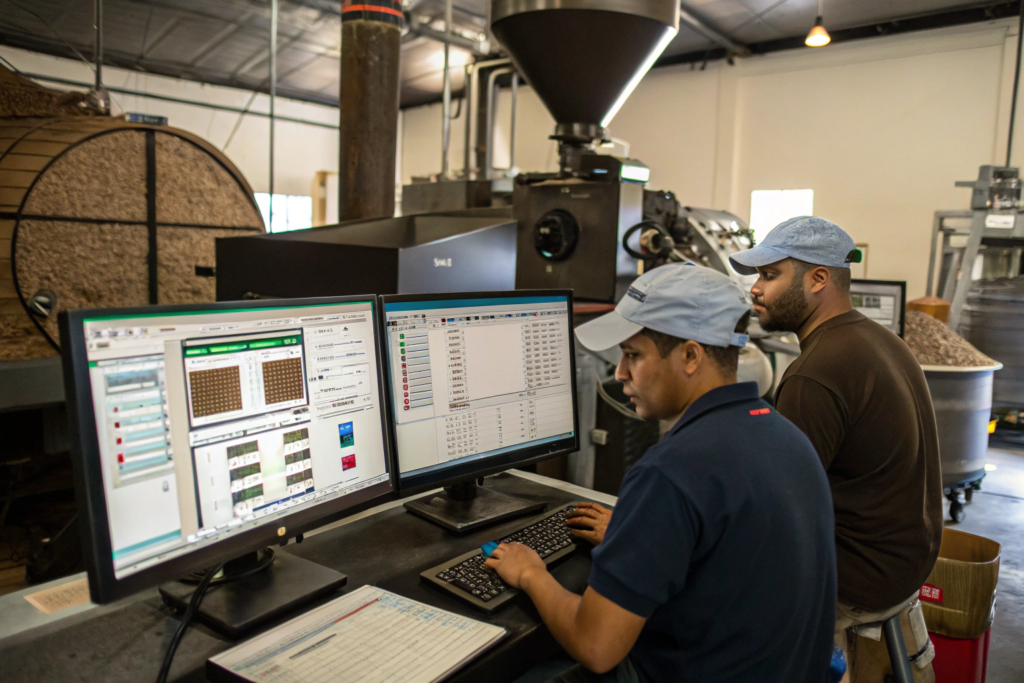
Maintaining quality across larger batches requires formalizing the roast profiling process that was previously intuitive. Every production batch must be logged with roast curve data: charge temperature, turning point, rate of rise, development time ratio, and drop temperature. This data, captured by software like Cropster or Artisan, must be reviewed regularly, not just when a problem arises. A cupping protocol must be established that tests every production batch, not just the sample roast. And the head roaster must transition from being the sole quality arbiter to being the leader of a quality team, training others to cup and make decisions to a consistent standard. Quality at scale is a system, not a person.
The hardest personal transition for me was accepting that I could not cup every batch anymore. When we were small, I cupped everything. It was my signature on every bag. When we scaled, I physically could not keep up. I had to train two Q-graders on my team to cup to my standards, calibrate with me weekly, and make decisions I used to make alone. It felt like a loss of control. It was actually the only way to maintain control at scale. The SCA's roasting and cupping standards provide the objective framework that makes this delegation possible.
What roast profiling data must be tracked to ensure batch-to-batch consistency?
The essential data points are charge temperature, turning point time and temperature, rate of rise at each minute of the roast, first crack time and temperature, development time as a percentage of total roast time, and drop temperature. This data, overlaid on previous successful batches of the same coffee, provides a template that any trained roaster can follow. Deviations are immediately visible. If the rate of rise stalls too early, the batch will taste baked. If the development time is too short, the batch will taste grassy. The data does not replace the roaster's skill. It amplifies it and makes it transferable across team members and shifts.
Why does a formal cupping protocol become non-negotiable at higher volumes?
At low volumes, a single bad batch can be caught, discarded, and absorbed as a small loss. At high volumes, a single bad batch can be hundreds or thousands of pounds of coffee that has already been packaged, shipped, and paid for. The financial and reputational cost of a quality failure scales with volume. A formal cupping protocol—where every production batch is cupped, scored, and compared to a reference sample before it is released for packaging—is the quality control gate that prevents a bad batch from ever leaving the roastery. It takes time and discipline. It is far cheaper than a recall or a lost account.
What Team Structure and Role Specialization Are Required to Scale Beyond a One-Person Operation?
The founder-roaster is the bottleneck in every growing coffee business. In the early days, the founder does everything: sources green coffee, roasts, packages, sells, handles customer service, manages the books. This works until it does not. The breaking point usually arrives when the founder is so busy with production that sales stop growing, or so busy with sales that production quality starts slipping.
Scaling beyond a one-person operation requires the founder to systematically extract themselves from every role except the ones that truly require their unique expertise. The first hire is usually production support: someone who can roast, package, and ship. The second is often sales and customer relationships. The third is operations and logistics. As the team grows, specialized roles emerge: a dedicated green coffee buyer, a quality control lead, a production manager, a sales representative for each channel. The founder's role shifts from doing the work to building the system, training the team, and maintaining the external relationships and brand vision. This is a painful transition for many founders. It is also the only path to a business that can run without the founder being present every minute.
My own transition was messy. I held onto roasting for too long. I held onto client communication for too long. The business suffered because I was the bottleneck. Clients waited days for responses because only I could approve a quote. Production stalled because only I could make a roast profile adjustment. The day I hired a head roaster and truly handed over the controls was terrifying. It was also the day the business started growing again. The Specialty Coffee Association's business resources offer excellent guidance on building production teams, and for broader organizational thinking, the Harvard Business Review's scaling resources provide frameworks that apply to any growing business.

What is the first role a founder-roaster should hire to free themselves for growth?
The first hire should be the role that consumes the most founder time and generates the least unique value. For most roasters, that is production: roasting and packaging. A skilled production roaster, once trained, can execute roast profiles and manage the packaging line as well as the founder. This frees the founder to focus on sales, sourcing, and client relationships—activities that directly drive revenue growth. Hiring a salesperson first, while the founder stays stuck in production, is a common mistake. The salesperson generates demand that the founder cannot fulfill, creating frustration for everyone.
How do you transition from "the founder cups everything" to a quality team culture?
Start by hiring or training someone with cupping skills and calibrating them to your palate. Cup together every day for at least a month. Score the same coffees blind, compare scores, and discuss differences. Over time, the calibrations can move to weekly. Document your cupping standards in writing: what defines a 7.0 body, what defects are disqualifying, what flavor notes are acceptable for each blend. This documentation allows new team members to learn the standards and existing team members to maintain consistency. The founder's role shifts from being the sole cupper to being the final arbiter in disputes and the guardian of the quality standards.
Conclusion
Scaling a coffee roasting business is a series of letting-go moments. Letting go of the small roaster for a larger one. Letting go of spot buying for forward contracts. Letting go of cupping every batch personally. Letting go of being the only person who can talk to a key client. Each letting-go feels like a loss of control. But each one, done at the right time and in the right way, is actually an investment in control at a larger scale. The systems, the team, the supply relationships, and the quality protocols replace the founder's hands. They allow the business to grow beyond what any one person can do alone.
If you are a roaster navigating this transition, or if you are sourcing green coffee and need a supply partner who understands the demands of scale, we work with roasteries at every stage of growth. From small-batch sample lots to multi-container annual contracts, we can help you build a green coffee pipeline that supports your scaling ambitions. Contact Cathy Cai at cathy@beanofcoffee.com. She can discuss your volume projections, your quality requirements, and how we can structure a supply agreement that grows with you. Scaling is hard enough. Your green coffee supply should not be the hardest part.