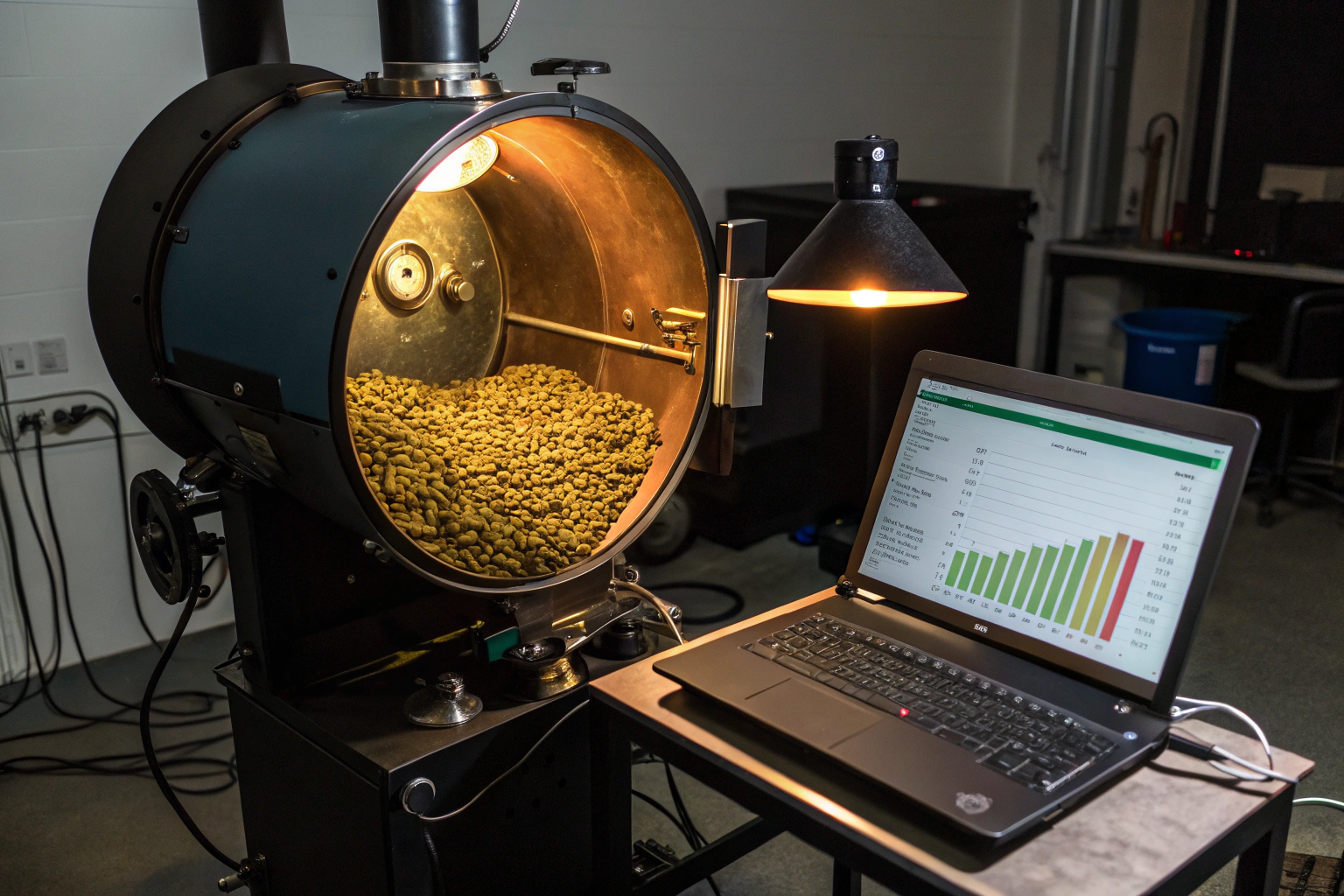
A roaster from Chicago emailed me a confession last year. "I love your Catimor," he wrote. "But I keep messing up the roast. First batch tasted like grass. Second batch tasted like ash. I have wasted ten pounds of good coffee. What am I doing wrong?"
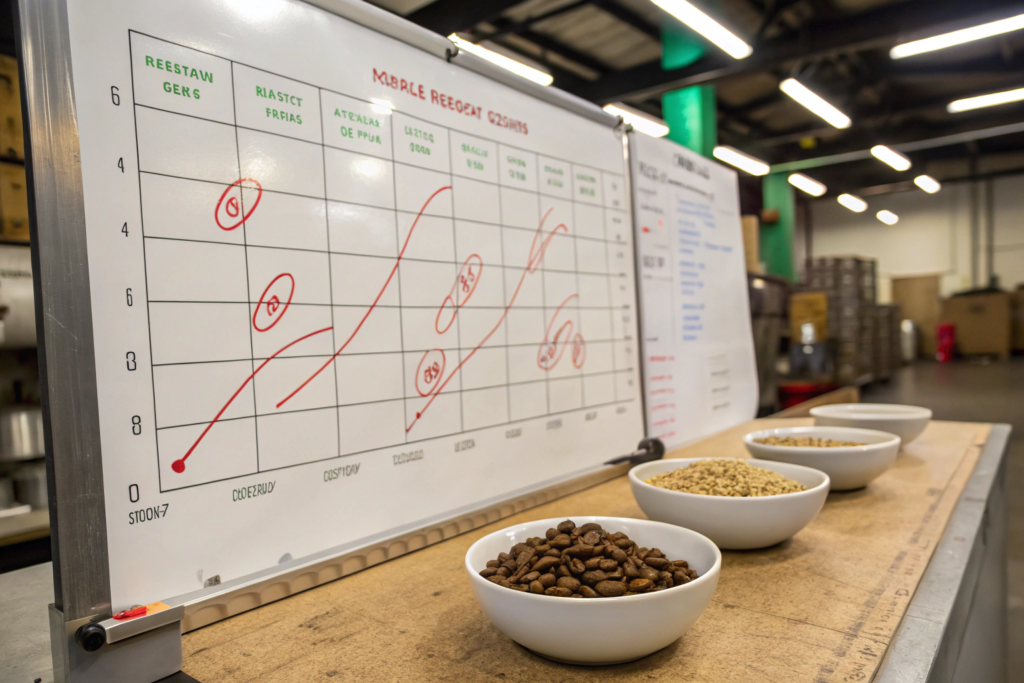
I asked him to send me his roast curves. The first curve showed a charge temperature that was too low and a development time that was too short. The beans never fully developed. The grassy, vegetal notes were the result. The second curve showed a charge temperature that was too high and a development time that was too long. The beans scorched on the outside and carbonized. The ashy, bitter notes were the result. He was roasting our Catimor like a soft Brazilian natural. Our beans are dense, high-grown, and washed. They need a different approach entirely.
The ideal roast profile for Chinese washed Arabica uses a moderately high charge temperature, a gentle but steady heat application through the drying and Maillard phases, and a development time ratio of 14 to 17 percent after first crack, targeting a medium to medium-light finish that fully develops the bean's chocolate and nut sweetness without incinerating the delicate citric acidity.
The beans grown on our Baoshan mountains are not forgiving of lazy roasting. But when you dial in the right profile, they reward you with a cup that is balanced, sweet, and unmistakably clean. Let me walk you through exactly how to build that profile from start to finish.
How Does Bean Density Affect Roasting Chinese Washed Arabica?
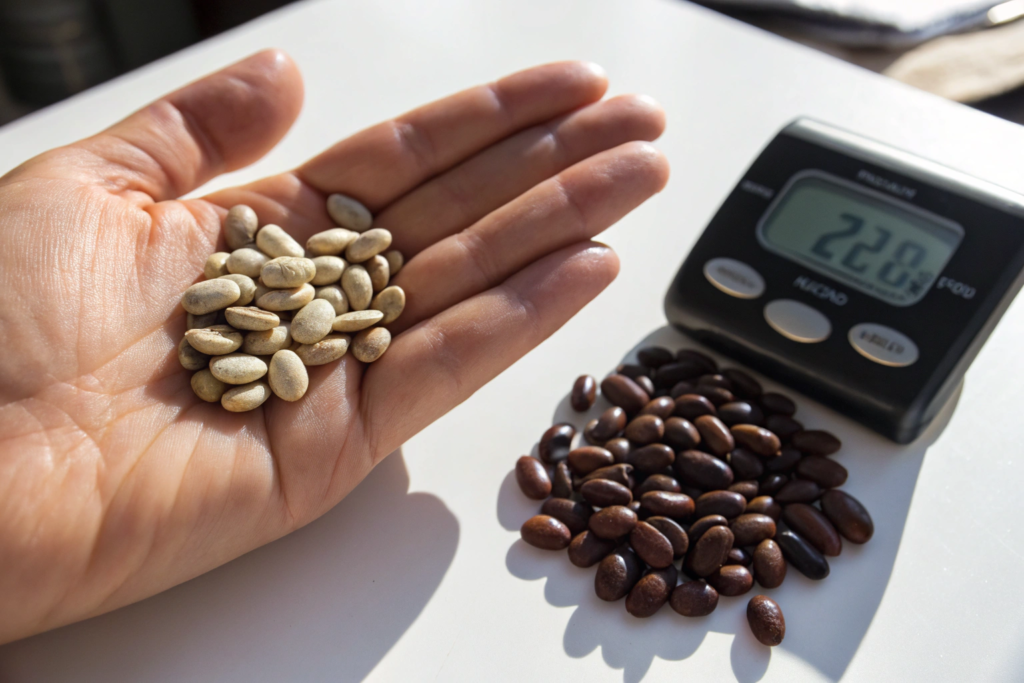
The first thing a roaster must understand about Chinese washed Arabica from Yunnan is that these beans are dense. Not moderately dense. Significantly dense. This density is a direct result of the altitude and the washed processing method.
Our Catimor grows at 1,500 to 1,600 meters in Baoshan. At that altitude, the cooler temperatures slow cherry maturation. The beans develop more compact cell structures. The washed processing, which removes the fruit mucilage cleanly before drying, produces a parchment coffee that dries slowly and evenly, preserving that compact structure. The final green bean has a bulk density typically between 720 and 750 grams per liter. For comparison, a soft Brazilian natural might measure 650 to 680 grams per liter.
High-grown Chinese washed Arabica beans, with densities often exceeding 720 grams per liter, require more thermal energy to heat through to the core, demanding a higher charge temperature and a more aggressive initial heat application than softer, lower-density origins.
This density difference changes everything about how the bean behaves in the drum. A dense bean is harder for heat to penetrate. The thermal energy must travel further into the bean structure to reach the core. If you apply heat too gently, the outside of the bean roasts while the inside remains underdeveloped. You get a cup that tastes simultaneously roasty and grassy—scorched on the outside, raw in the middle. This is the most common mistake roasters make with our coffee.
The solution is not to blast the beans with heat. It is to apply sufficient thermal energy early in the roast, during the drying phase, to drive moisture out and heat into the core. This requires a higher charge temperature than you would use for a softer bean, and a steady, confident heat application through the turnaround point. The goal is to build thermal momentum that carries the beans evenly through the Maillard phase and into first crack.
What Charge Temperature Works Best for Dense Yunnan Beans?
The charge temperature is the temperature of the roasting drum when the green beans are dropped in. It is the first and most critical decision in building a roast profile. Get it wrong, and the entire roast is compromised.
For our dense washed Catimor, I recommend a charge temperature between 200 and 210 degrees Celsius. This is higher than the 180 to 190 degrees Celsius typical for a soft Brazilian or a low-grown Central American. The higher charge temperature provides the initial burst of thermal energy that the dense bean structure needs to start absorbing heat immediately.
The turnaround point—the lowest bean temperature after the charge, before the temperature starts rising—is a key indicator of whether the charge temperature was correct. For our Catimor, the turnaround should occur around 75 to 85 degrees Celsius, roughly 60 to 90 seconds after charging. If the turnaround is too low—below 70 degrees Celsius—the charge temperature was insufficient. The beans will struggle to build momentum. The drying phase will drag. The development will suffer. If the turnaround is too high—above 90 degrees Celsius—the charge temperature was excessive. The beans may scorch, especially the smaller beans in the batch.
The gas setting after charging should be high enough to recover from the turnaround quickly but not so high that the rate of rise spikes. I target a rate of rise of 10 to 12 degrees Celsius per minute during the drying phase. The bean temperature should climb steadily from turnaround through 150 degrees Celsius without stalling and without racing. For more on roast profile fundamentals, Cropster provides software and educational resources that many specialty roasters use to develop and refine their profiles.
How Does the Rate of Rise Differ from Low-Density Arabica?
The rate of rise—the speed at which the bean temperature increases—is the heartbeat of the roast. It tells you whether the beans are absorbing heat efficiently or struggling to keep up.
Dense beans like our washed Catimor can tolerate and need a faster rate of rise during the drying phase than softer beans. The dense structure absorbs heat without overheating the surface. A rate of rise of 10 to 12 degrees Celsius per minute through the drying phase, from turnaround to around 150 degrees Celsius, is appropriate. This is faster than the 7 to 9 degrees Celsius per minute typical for a soft natural.
As the roast progresses, the rate of rise must decline. This is a universal principle of coffee roasting. If the rate of rise stays high through first crack, the beans will race into development and likely scorch. The art is in managing the decline. For our Catimor, I target a gradual, steady decline in the rate of rise from the peak during drying down to around 3 to 5 degrees Celsius per minute at the start of first crack.
The declining rate of rise ensures that the bean surface and the bean core reach a similar temperature by the time first crack begins. If the rate of rise is still high at first crack, the surface is much hotter than the core. The outside over-develops while the inside under-develops. If the rate of rise crashes to zero before first crack, the roast stalls. The beans bake. The cup tastes flat and papery.
Monitoring the rate of rise requires a reliable bean temperature probe and software that calculates the derivative. I watch the rate of rise curve as closely as the temperature curve. It tells me more about what is happening inside the bean than the temperature alone.
What Happens During First Crack for Washed Yunnan Arabica?
First crack is the moment every roaster waits for. It is the audible signal that the bean has absorbed enough energy to vaporize its internal water, build pressure, and fracture its cellulose structure. For washed Yunnan Arabica, first crack is not just an event. It is a phase that requires careful management.
Our dense, high-grown beans produce a vigorous, distinct first crack. Because the beans are hard and compact, the pressure buildup is significant. When the beans crack, they crack loudly and energetically. The sound is like popcorn—sharp, distinct pops, not the soft rustling of a lower-density bean. First crack typically begins at a bean temperature between 195 and 200 degrees Celsius for our Catimor, depending on the roast profile and the batch size.
The duration of first crack—from the first pop to the last pop—varies with the heat application. If the heat is too high, first crack will be short and intense, with beans cracking rapidly over 30 to 45 seconds. The risk is that the outside of the beans scorches while the inside is still catching up. If the heat is too low, first crack will be prolonged and sluggish, with beans cracking sporadically over two minutes or more. The risk is that the roast stalls and the beans bake.
First crack in washed Chinese Arabica is vigorous and distinct due to the high bean density, beginning around 195 to 200 degrees Celsius, and the heat application during this phase should be gently declining to allow the endothermic crack to proceed evenly without scorching or stalling.
I target a first crack duration of 60 to 90 seconds for our Catimor. The heat application entering first crack should be slightly reduced—enough to prevent the roast from racing, but not so much that the crack loses momentum. The rate of rise should be 3 to 5 degrees Celsius per minute as first crack begins, and should decline further to 2 to 3 degrees Celsius per minute as first crack ends.
How Long Should Development Time Last After First Crack?
Development time is the period from the end of first crack to the drop. It is the phase where the bean's flavor is finalized. Too short, and the coffee tastes underdeveloped, vegetal, and sour. Too long, and the coffee tastes baked, flat, and roasty.
Development time is typically expressed as a percentage of the total roast time. The industry standard for specialty coffee is a development time ratio between 12 and 18 percent. For washed Yunnan Catimor, I target a development time ratio of 14 to 17 percent.
Here is a practical example. If the total roast time from charge to drop is 10 minutes and 30 seconds, a 15 percent development time ratio means the development phase should last roughly 1 minute and 35 seconds. If the total roast time is 12 minutes, a 15 percent development ratio means 1 minute and 48 seconds.
The exact duration depends on the target roast degree. For a light roast suitable for filter brewing, I aim for the lower end of the range—13 to 15 percent. For a medium roast suitable for espresso or a balanced filter cup, I aim for the middle of the range—15 to 17 percent. I do not recommend exceeding 18 percent for washed Catimor. The bean density means that extended development at high temperatures can easily tip into over-roasting.
The temperature at drop also matters. For a light roast, I drop at a bean temperature of 208 to 212 degrees Celsius. For a medium roast, I drop at 212 to 218 degrees Celsius. The drop temperature and the development time must be consistent with each other. A short development time at a high drop temperature suggests a fast, hot finish that may scorch the beans. A long development time at a low drop temperature suggests a slow, cool finish that may bake the beans.
What Visual and Aromatic Cues Indicate the Roast Is Complete?
Temperature probes and software are essential tools. But they can fail. Probes drift out of calibration. Software crashes. Every roaster should also rely on their senses—sight, smell, and sound—to judge when the roast is done.
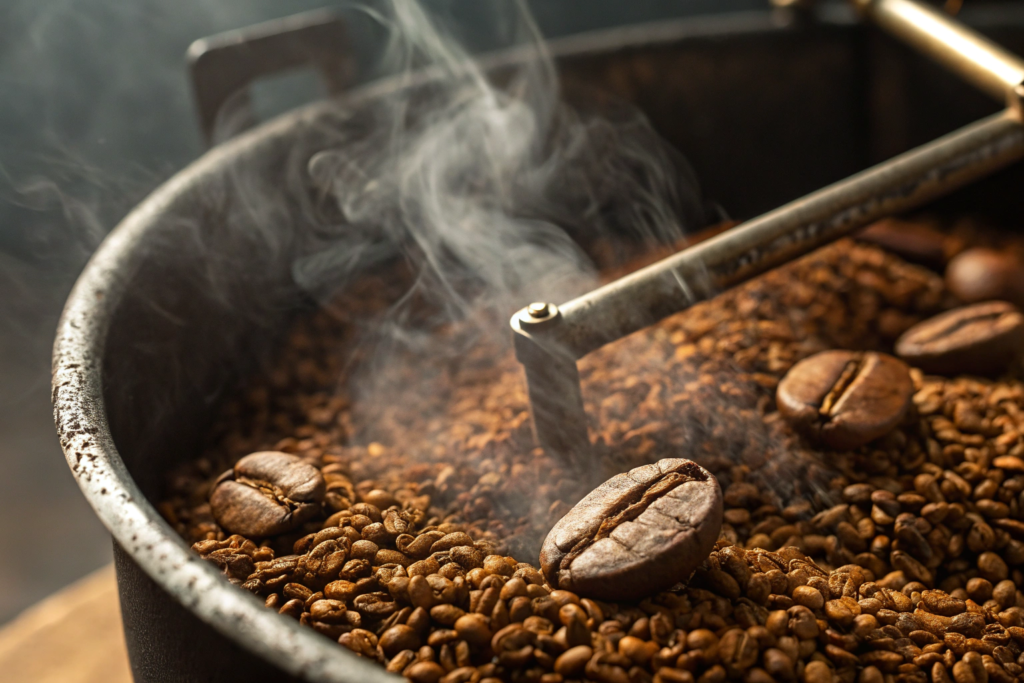
The visual cues for washed Catimor are clear. At the end of first crack, the beans are a light cinnamon brown. The surface is smooth but the center cut is still tight. By the middle of development, the beans have expanded noticeably. The color shifts to a medium milk chocolate brown. The surface remains mostly smooth, with some faint texturing. By the end of development, the beans are a uniform medium brown. The center cut has opened slightly but is not darkened. There are no oils on the surface. If oils appear, the roast has entered second crack territory, which is too dark for this coffee.
The aromatic cues are equally important. During the drying phase, the exhaust smells grassy and vegetal. During the Maillard phase, the aroma shifts to baking bread, then to caramel and toasted grain. At first crack, the aroma becomes sharper, with notes of roasted nuts and chocolate. During development, the chocolate note deepens. The aroma becomes richer and sweeter. If the aroma shifts to sharp, acrid, or smoky, the roast has gone too far.
I train every roaster who buys our coffee to use the trier. The trier is a small scoop that allows you to pull a sample of beans from the drum without stopping the roast. Pull a sample every 15 seconds during development. Look at the color. Smell the beans. Crush one between your fingers and smell the inside. The moment the aroma shifts from "baking bread" to "roasted nuts and chocolate," the roast is entering its final phase. You have roughly 30 to 60 seconds to decide when to drop.
How Do You Adjust Profiles for Filter Versus Espresso Roasts?
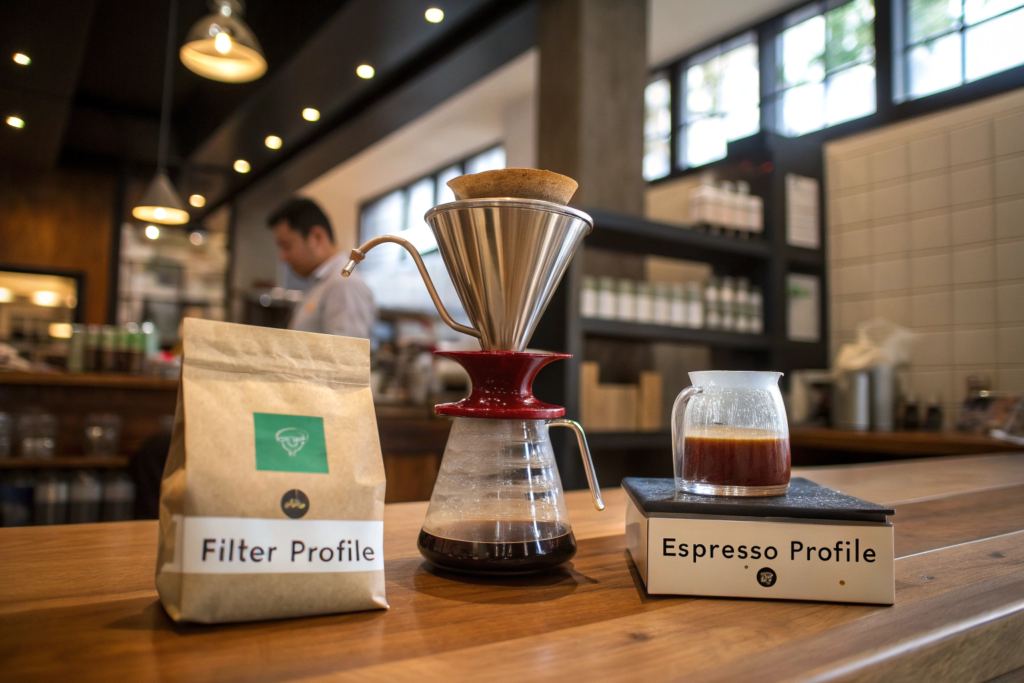
The same washed Yunnan Catimor can produce two very different cups depending on the roast profile. The filter profile emphasizes clarity, acidity, and origin character. The espresso profile emphasizes body, sweetness, and balance. Both are valid. Both are achievable from the same green coffee. But the profiles are different.
The filter profile for washed Catimor is lighter and shorter. The charge temperature is at the lower end of the range—around 200 degrees Celsius. The drying phase is gentle. The Maillard phase is extended slightly to develop sweetness without building too much body. First crack is allowed to proceed with a slightly higher rate of rise to preserve acidity. The development time ratio is 13 to 15 percent. The drop temperature is 208 to 212 degrees Celsius. The Agtron whole-bean color reading is 60 to 70.
The result in the cup is a coffee with bright but balanced citric acidity, a light to medium body, and clear notes of chocolate, almond, and a hint of citrus. It works beautifully in a pour-over or a drip machine. The acidity provides liveliness. The body is light enough to be refreshing. The flavor is clean and transparent.
Filter roasts for Chinese washed Arabica target a lighter Agtron reading of 60 to 70 with a shorter development time of 13 to 15 percent to preserve volatile acidity, while espresso roasts target a slightly darker Agtron of 50 to 60 with a longer development of 15 to 17 percent to build body and sweetness for pressure extraction.
The espresso profile is slightly darker and longer. The charge temperature is at the higher end of the range—around 210 degrees Celsius. The drying phase is similar. The Maillard phase is pushed slightly further to develop more melanoidins, which contribute to body and crema. The heat is reduced more aggressively entering first crack to prolong the development phase without scorching. The development time ratio is 15 to 17 percent. The drop temperature is 212 to 218 degrees Celsius. The Agtron whole-bean color reading is 50 to 60.
The result in the cup is a coffee with softer acidity, a heavier body, and a more pronounced chocolate and roasted nut character. The citric notes are still present but muted. The body coats the tongue. The shot pulls with thick, persistent crema and a balanced, sweet flavor. It works as a single-origin espresso or as the base of an espresso blend.
What Agtron Numbers Define the Sweet Spot for This Origin?
The Agtron scale is the most widely used objective color measurement in specialty coffee. It provides a numerical target that can be replicated across roasters and across roast batches.
For washed Yunnan Catimor, the sweet spot depends on the intended use. Here is a summary of the recommended Agtron ranges:
| Roast Application | Agtron Whole-Bean Range | Agtron Ground Range | Flavor Character |
|---|---|---|---|
| Light Filter | 65 - 70 | 80 - 85 | Bright citric acidity, light body, almond, citrus |
| Medium Filter / Light Espresso | 58 - 65 | 75 - 80 | Balanced acidity, medium body, chocolate, nut |
| Medium Espresso | 50 - 58 | 68 - 75 | Soft acidity, heavy body, dark chocolate, caramel |
The Agtron whole-bean reading is measured on a sample of whole roasted beans. The Agtron ground reading is measured on a sample that has been ground to a specific particle size. The ground reading is typically 10 to 15 points higher than the whole-bean reading because grinding exposes the lighter interior of the bean.
I recommend roasters target a specific Agtron range for each application and cup every batch against that target. If the Agtron reading drifts outside the range, adjust the drop temperature or the development time on the next batch. The Agtron meter removes subjectivity. It tells you exactly what color the beans are. It is an essential tool for consistency. For more on color measurement standards, the Specialty Coffee Association publishes roast color classification guidelines.
How Should Roasters Sample Different Profiles?
Dialing in the perfect profile for washed Yunnan Catimor requires experimentation. Every roaster's machine is different. Every roaster's preferences are different. The best way to find your ideal profile is to roast a systematic sample set and cup the results.
I recommend the following sampling protocol. Start with a baseline profile based on the recommendations above. Roast a batch to a medium Agtron 58 to 65, with a development time ratio of 15 percent. This is your reference batch.
Then roast three variations. Variation one: lighter and shorter. Drop the development time to 13 percent and target Agtron 65 to 70. Variation two: darker and longer. Increase the development time to 17 percent and target Agtron 50 to 58. Variation three: same color, different development. Keep the Agtron at 58 to 65 but extend the development time to 17 percent by reducing heat earlier in the roast.
Label each batch clearly. Let them rest for 24 to 48 hours. Cup them blind. Score them. Note the acidity, body, sweetness, and flavor notes. Also brew them as you would serve them—filter or espresso. Taste the actual product your customer will drink.
The cupping scores and your tasting notes will tell you which profile works best for your equipment and your palate. The baseline profile is often the best. But sometimes the lighter variation reveals a brightness you did not know the coffee had. Sometimes the darker variation creates a body that is perfect for your espresso blend. The sample set gives you the data to decide.
I offer this sampling protocol to every roaster who buys our coffee. If you need guidance, contact Cathy at Shanghai Fumao. She can provide our recommended starting profiles and connect you with roasters who have successfully dialed in our lots.
What Are the Common Roasting Mistakes with Washed Chinese Arabica?
Even experienced roasters make mistakes when they first encounter dense, washed Chinese Arabica. The beans behave differently than what they are used to. Here are the three most common mistakes I see, and how to fix them.
The first mistake is underdevelopment. The roaster charges too low, applies too little heat during drying, and ends the roast too soon after first crack. The beans look pale and wrinkled. The cup tastes grassy, vegetal, and sour. The acidity is sharp and unpleasant, not bright and balanced. The body is thin and watery. This mistake happens because the roaster is used to softer beans that develop more quickly. They apply the same profile to our dense Catimor and the beans never fully develop.
The fix is to increase the charge temperature, apply more heat during the drying phase, and extend the development time. The beans need more thermal energy to develop fully. Give them what they need.
The three most frequent roasting errors with washed Chinese Arabica are underdevelopment from insufficient heat transfer through the dense bean structure, scorching from an excessively high charge temperature or rate of rise, and baking from a stalled rate of rise that prolongs the roast without adding positive development.
The second mistake is scorching. The roaster charges too high, applies too much heat too fast, and pushes the rate of rise too high through first crack. The beans show dark spots or tipping—small burn marks on the ends of the beans. The cup tastes roasty, bitter, and ashy. The origin character is buried under roast character. The acidity is gone.
The fix is to lower the charge temperature slightly, reduce the gas during the Maillard phase, and ensure the rate of rise is declining smoothly into first crack. The dense bean structure can handle more heat than a soft bean, but it still has limits. Exceed those limits and the surface burns before the core is developed.
How Can You Avoid Baking the Coffee During Development?
Baking is the third mistake and perhaps the most insidious. It is harder to detect by sight than underdevelopment or scorching. The beans look normal. But the cup tastes flat, papery, and hollow. The acidity is muted. The sweetness is gone. The finish is dry and short.
Baking happens when the rate of rise crashes during development. The bean temperature stalls or climbs very slowly. The beans spend too long at a moderate temperature without enough energy to drive the positive chemical reactions. The volatile aromatics evaporate. The sugars degrade without caramelizing properly. The result is a coffee that tastes stale even when it is fresh.
The fix is to manage the rate of rise carefully through the end of the roast. Do not cut the gas too aggressively entering first crack. Maintain a gentle but positive rate of rise all the way to drop. The development phase should be a controlled deceleration, not a crash.
A good rule of thumb is that the rate of rise at drop should be at least 1 to 2 degrees Celsius per minute. If it hits zero before drop, the roast has stalled. If it has been below 2 degrees for more than 30 seconds, the roast is baking. Increase the gas slightly or drop the roast earlier.
For further reading on roast defect diagnosis, Perfect Daily Grind has published practical articles on common roasting problems and their solutions that complement the advice here.
What Adjustments Should Be Made for Different Batch Sizes?
Roasting is not a linear scale. A profile that works for a 5-kilogram batch will not work for a 50-kilogram batch without adjustment. The thermal mass, the air flow, and the probe response all change with batch size.
As a general rule, larger batch sizes require a lower charge temperature relative to the bean mass, and more aggressive heat application during the drying phase. The larger thermal mass of the beans absorbs more heat initially, so the charge temperature can be slightly lower to avoid scorching. But the larger mass also takes longer to heat through, so the gas must be higher during drying to maintain the target rate of rise.
Smaller batch sizes are the opposite. The charge temperature should be slightly higher because the smaller bean mass loses heat faster to the drum. The gas during drying should be more moderate because the smaller mass heats through more quickly.
I recommend reducing the batch size to no more than 80 percent of the roaster's rated capacity for dense washed Arabica. A 12-kilogram roaster should roast no more than 10 kilograms of our Catimor per batch. The reduced batch size improves heat transfer, promotes even roasting, and makes the rate of rise easier to control.
Every roaster should cup their production batches regularly. The cupping table reveals whether the adjustments are working. The goal is a consistent cup, batch after batch, regardless of the batch size. Consistency is built on careful observation and incremental adjustment.
Conclusion
Roasting Chinese washed Arabica well is a technical challenge that rewards the roaster who takes the time to understand the bean. The density, the altitude, and the washed processing combine to produce a green coffee that demands a specific thermal approach—higher charge temperatures, a steady rate of rise through drying, a managed decline into first crack, and a development time that fully expresses the bean's chocolate and nut sweetness.
The filter profile and the espresso profile offer two different expressions of the same bean. The filter profile is lighter, brighter, and more acidic. The espresso profile is slightly darker, heavier, and more balanced. Both are achievable. Both are excellent. The choice depends on how you intend to serve the coffee and what your customers prefer.
The common mistakes—underdevelopment, scorching, and baking—are avoidable with careful profile management and regular cupping. The beans tell you what they need. Listen to them. Adjust. Improve. The reward is a cup that is clean, sweet, and unmistakably Yunnan.
If you are working on dialing in your roast profile for our washed Catimor and want personalized guidance, contact Cathy Cai at BeanofCoffee. She can provide detailed roast recommendations, connect you with our recommended starting profiles, and send you green samples so you can experiment yourself. Her email is cathy@beanofcoffee.com. She responds quickly and wants to help you get the best possible cup from our coffee.