I will never forget the morning I received a photograph that made my blood run cold. It came from a freight forwarder in Singapore. The image showed a container that had been stowed on deck during a rough storm in the South China Sea. The container doors were warped. Seawater had breached the gaskets. Inside were 320 bags of our premium Baoshan Arabica, a shipment bound for a major client in Melbourne. The beans were soaked, mold was already setting in, and the entire lot was a total loss. I stood in my office, phone in hand, and felt a wave of nausea wash over me. Then I remembered: I had purchased an all-risk marine cargo policy three days before the vessel departed. That piece of paper—that insurance certificate—turned a potential financial disaster into a recovery process. The insurer paid out the full invoice value within weeks, and I was able to replace the shipment without destroying my cash flow. That day, I stopped treating insurance as a bureaucratic afterthought and started treating it as a non-negotiable pillar of every export deal.
Marine cargo insurance for green coffee shipments must, at minimum, cover the full commercial invoice value plus a 10% markup for incidental costs, be written under Institute Cargo Clauses A or an equivalent all-risk wording, and include coverage for the entire transit from the warehouse in the country of origin to the warehouse of the consignee, with specific attention to moisture and mold exclusions that often catch coffee exporters by surprise.
Coffee is a moisture-sensitive, organic commodity. It absorbs odors. It develops mold if the water activity spikes above a certain threshold. And it travels long distances across multiple climate zones and handling points. A lot can go wrong between the dry mill in Yunnan and the roastery in Portland. Insurance is not just a requirement for letters of credit. It is the safety net that ensures one bad shipment does not erase the profit from the previous nine good ones. In this article, I want to share the insurance framework I have built for our own exports—the clauses I insist on, the valuation method I use, and the common exclusions that every buyer and seller should scrutinize before a container is sealed.
What Types of Marine Cargo Insurance Apply to Green Coffee Shipments?
There is a common misconception among new exporters that simply having a freight forwarder "arrange insurance" solves the problem. I made that mistake once. The forwarder arranged a policy, I paid a small fee, and I filed the certificate away without reading it. It was only after a minor damage claim—a few bags torn during unloading at Rotterdam—that I discovered the policy was what is called "free of particular average." It only covered total losses, like the ship sinking. A few torn bags did not qualify. The claim was denied. From that point on, I educated myself on the actual types of marine cargo coverage available and I chose the level of protection that matched the risk profile of green coffee.
The three primary types of marine cargo insurance applicable to green coffee shipments are Institute Cargo Clauses A (all-risk coverage), Institute Cargo Clauses B (named perils), and Institute Cargo Clauses C (limited named perils), with Clauses A being the only option that adequately protects against the common partial losses—such as water damage, sweat, and hook tears—that frequently affect bagged agricultural commodities in transit.
Institute Cargo Clauses A is the gold standard for our product. It covers "all risks of loss of or damage to the subject-matter insured," except for those specifically excluded. This means if a bag gets caught on a hook during unloading and spills beans across the container floor, the claim is covered. If condensation forms inside the container due to temperature changes and damages the top layer of bags, the claim is covered. If the container is washed overboard in a storm, the claim is covered. Clauses B and C, by contrast, only cover a specific list of named perils—fire, explosion, vessel collision, heavy weather washing overboard—and they generally exclude partial losses. For a commodity like coffee, where partial damage is actually much more common than total loss, Clauses A is the only practical choice. I specify "Institute Cargo Clauses A" in every sales contract now, and I include a copy of the actual policy wording with the shipping documents.
How do Institute Cargo Clauses A differ from standard warehouse-to-warehouse cover?
This is a nuance that took me a while to fully understand. The Institute Cargo Clauses A automatically incorporate a warehouse-to-warehouse clause, which extends coverage from the time the goods leave the named warehouse at the origin until they are delivered to the final warehouse at the destination. So, in a sense, signing up for Clauses A gives you warehouse-to-warehouse geography. But the detail difference lies in the way risks are defined during the inland transit legs. Standard warehouse-to-warehouse cover, if not tied to Clauses A, might only cover named perils during the road transport from the processing mill to the port of departure. Clauses A applies the same all-risk standard to that truck journey as it does to the ocean voyage.
For our operations, this is critical. Our dry mill is in Baoshan, which sits in the mountainous western part of Yunnan. The container travels by truck over winding roads for several hours to reach the port of Shanghai. Landslides, vehicle accidents, or cargo shifting during sharp mountain turns are real possibilities. Under Clauses A, if the truck overturns and the container is damaged, the coffee is covered. Under a more restrictive clause tied to a weaker policy, the coverage might not trigger until the container is actually loaded onto the ocean vessel, leaving a significant exposure gap during the domestic transit leg. When I discuss insurance with a buyer placing an FOB or CIF order, I still recommend they take out their own supplementary policy covering the full transit, because the gaps between different Incoterms and different insurance clauses can create pockets of uninsured risk that only become apparent when a claim is filed. For our own DDP shipments, the full marine cargo insurance policy is directly under our control from mill door to buyer's warehouse.
Why is climate-controlled container coverage sometimes necessary for specialty lots?
A few years back, we shipped a micro-lot of naturally processed Arabica, a tiny 5-bag pallet inside a consolidated container, to a specialty roaster in Copenhagen. The container transited through the Suez Canal in July. The outside temperature on the deck likely exceeded 50 degrees Celsius. When the container reached Denmark, the roaster reported that the beans tasted "flat," with none of the bright fruit notes we had cupped at the dry mill. The moisture content had not changed enough to trigger a standard spoilage claim, but the cup quality had degraded noticeably from heat stress during the voyage. The insurance did not cover this because quality degradation without physical damage is generally not an insurable event under standard cargo policies.
This experience taught me that for extremely high-value specialty lots—the kind that sell for several dollars per pound above the C-market—passive insurance is not enough. You need active risk mitigation. We now offer climate-controlled container options for these shipments. A climate-controlled, or "reefer," container maintains a set temperature and humidity level throughout the voyage, preventing the extreme heat spikes that degrade volatile aromatic compounds in high-quality coffee. The cost is higher, but for a lot worth $8 per pound, the incremental freight investment preserves the value. Insurance does not cover taste. Only physical control of the environment does. However, using a reefer also has an insurance implication: the policy must be endorsed to cover the reefer machinery breakdown risk. If the cooling unit fails midway through the Suez passage and the beans suffer heat damage, a standard Clauses A policy might exclude that under a machinery breakdown clause unless specifically added. I always request a "reefer machinery breakdown" extension when shipping under temperature-controlled conditions, and I verify with my insurance broker that the extension is noted on the certificate.
How Is the Insured Value Calculated for an International Coffee Consignment?
The insured value is not just a random number you throw onto a form. It determines what you will actually receive if the worst happens. Underinsure, and you recover only a fraction of your loss and your buyer is left holding the shortfall. Overinsure by too much, and the premium costs become an unnecessary drain on your margin. There is actually a widely accepted formula for getting the value right, and I learned it from a claims adjuster who visited our office after the Singapore storm incident. He walked me through the math with patience. The standard approach in international trade is to insure for the CIF value—the cost of the goods, plus the freight, plus the insurance premium itself—and then add an uplift of 10%, sometimes 20%, to cover incidental costs and the inconvenience of a total loss.
The correct insured value for a shipment of green coffee is calculated as the Commercial Invoice Value plus the Freight Cost plus an uplift of at least 10% to cover the buyer's lost profit opportunity and administrative costs, with the sum expressed in the settlement currency—nearly always U.S. dollars for coffee—and clearly declared on the insurance certificate so there is no dispute at the time of adjustment.
I will give you a practical example from one of our recent shipments to California. The 20-foot container held 19.2 metric tons of washed Arabica at a contracted price of $3.10 per pound FOB Shanghai. The ocean freight to Oakland cost $2,800. The CIF value, therefore, was the total FOB value plus freight. On top of that, I added a 10% uplift. The insured value declared on the policy was the rounded-up dollar amount of that total. This was not an inflated number. It was the exact commercial reality of what it would cost to replace those beans if the container vanished. The premium, calculated as a percentage of this insured value, was a few hundred dollars. That premium bought peace of mind worth tens of thousands of dollars. Underinsuring by using only the FOB value and forgetting the freight and the uplift would have saved me maybe $80 in premium but would have left a $3,000 gap at claim time. That is a trade I never accept.

What is the standard coffee trade formula for CIP or CIF valuation?
The formula is straightforward and is actually taught in Incoterms training. For CIF, the insured amount should be the contract price plus 10%. But what is included in the "contract price" is where many exporters undercount. The contract price under CIF includes the cost of the goods, the cost of freight to the named port, and the cost of the insurance itself. So, the full formula is: Insured Value equals (Goods Value plus Ocean Freight) multiplied by 1.10. If you are shipping on CIP terms, the geography extends further inland, and so do the freight costs, but the 110% rule remains the standard.
Some buyers, particularly large corporate buyers with their own risk management departments, contractually require a 20% uplift. Their reasoning is that a total loss means a gap on the retail shelf, lost margin on the roasted product, and internal administrative costs to handle the claim and source a replacement. If a buyer requests a 20% uplift, I comply and adjust the DDP or CIF price accordingly to absorb the extra premium. The key is that the insured value listed on the certificate must exactly match the value stated in the letter of credit or the sales contract. Any discrepancy between the contract value and the insured value can cause a letter of credit to be rejected by the issuing bank. For a coffee exporter, an LC rejection means the cargo is sitting at the destination port with no payment released, and the demurrage clock is ticking. This is why I triple-check the insured value field on the insurance certificate against the sales contract before the document package goes to the bank. A single digit error on the insured value line item has cost me a three-day payment delay in the past, and I do not repeat that mistake.
Should the insurance policy also cover inspection and sorting costs after a claim?
This is an excellent and often overlooked question. Standard marine cargo policies cover the physical loss of or damage to the insured coffee. They do not automatically cover the cost of sorting through a partially damaged shipment to salvage what remains usable. Let me paint a real scenario. A container arrives with water damage affecting the top layer of bags. About 15% of the beans are moldy and must be destroyed. The remaining 85% are physically intact but mixed with small debris or have absorbed a musty odor. The roaster cannot simply dump the whole container into their production line. They must hire a sorting crew to separate the damaged bags, open the borderline bags, and visually inspect the beans.
The cost of this salvage operation—labor, supervision, waste disposal—can run into thousands of dollars. Under a basic policy, that cost might be considered the buyer's responsibility, not the insurer's. However, a well-drafted policy can include a "sue and labor" clause or a specific "sorting and reconditioning" extension. The sue and labor clause is actually part of the Institute Cargo Clauses and it covers reasonable expenses incurred by the insured to avert or minimize a covered loss. I make sure our policy explicitly references sue and labor coverage and that our claims history demonstrates its accepted use. Additionally, some policies offer a "brand and label" clause for consumer-packaged goods, but for bulk green coffee, the relevant extension is "salvage and reconditioning." I ask my broker to confirm in writing that reasonable sorting and inspection costs following a covered partial loss will be reimbursed. This confirmation has proven its value once already, when a shipment to Hamburg suffered condensation damage and the local surveyor estimated a 12% loss. The insurer covered not only the 12% lost value but also the fee for the independent surveyor and the labor cost for the re-bagging operation. Without that extension, we would have absorbed those additional costs ourselves.
What Common Exclusions in Coffee Cargo Policies Surprise First-Time Shippers?
The moment of truth in an insurance policy is not the coverage section. It is the exclusions section. I have been in this business long enough to have read the fine print more times than I care to count, and I still occasionally catch a new exclusion that I had not noticed before. The exclusions are where insurers define the boundaries of their obligation. And for a natural, moisture-sensitive product like green coffee, some of the standard exclusions can be deal-breakers if you do not negotiate them upfront.
The most dangerous exclusions for green coffee shipments include the inherent vice exclusion—which insurers may invoke if beans mold due to their natural moisture content rather than an external accident—the insufficient packing exclusion, the delay exclusion, and the unseaworthiness exclusion, all of which can be mitigated by providing documented drying records, using new GrainPro bags, and vetting the vessel's condition before loading.
Inherent vice is the big one. It refers to the natural tendency of a product to deteriorate from its own internal characteristics. Coffee beans have an internal moisture content. If that moisture content is too high at the time of packing, the beans can develop mold during transit even without an external water source. The insurer may argue that the damage was caused by the product's own inherent quality, not by an insured peril, and deny the claim. I have seen this happen to another exporter who shipped beans at 13.5% moisture to save weight. He lost the entire claim because the surveyor's report pinned the mold on excessive pre-shipment moisture. To defeat this exclusion, I provide the insurer with a pre-shipment moisture certificate from an independent surveyor, showing the beans were dried to between 10.5% and 12.0%—the safe range for ocean transit. This certificate, along with the loading photos, creates a baseline that shifts the responsibility back to the insurer if mold develops during the voyage. The packing exclusion is another trap. If beans are shipped in used or torn bags and water enters through the damaged packaging, the insurer can claim the loss resulted from insufficient packing. We use only new, food-grade GrainPro bags inside new jute sacks. The bag cost is higher, but the insurance claim security is absolute.
How does the inherent vice exclusion specifically threaten coffee claims?
Let me go deeper into inherent vice, because it is the most subjective and therefore the most litigated exclusion in coffee cargo insurance. Inherent vice is defined in insurance law as the "loss or damage resulting from the natural behavior or qualities of the insured goods." For coffee, the argument typically goes like this: the beans were loaded with a water activity level above the safe threshold, and the mold that developed during the voyage was simply the natural consequence of that internal moisture, not the result of a fortuitous external event like a container roof leak. The insurer's surveyor will sample the damaged beans, test the moisture content, and if it reads high, the claim goes into dispute.
I contest this by maintaining a rigorous pre-shipment quality control dossier. Every export lot is sampled at three stages: at the dry mill bagging line, after container stuffing, and a retained sample stored in our office. The retained sample is key. If a claim arises, I have a sealed, untouched sample from the exact same production run that I can send to an independent lab. If the retained sample tests clean and dry, but the shipment arrived moldy, the cause is external, not inherent. This shifts the burden back to the insurer to prove an exclusion applies. I also require the freight forwarder to provide a container inspection report confirming the container was clean, dry, and free of holes before stuffing. This container inspection report, combined with the pre-shipment moisture certificate and the retained sample, forms a three-legged defense against any inherent vice denial. For exporters who do not keep these records, the inherent vice exclusion is a silent killer of claims. For us, it is a manageable risk. I encourage every buyer reading this to ask their supplier one question before a shipment: "Do you retain a pre-shipment sample and can you provide a container inspection report?" The answer tells you a lot about how seriously they treat your cargo.
Are war and strikes risks relevant to modern coffee shipping routes?
War and strikes risks might sound like relics from an older era of shipping, but the modern reality is that they remain highly relevant. The standard Institute Cargo Clauses A policy explicitly excludes loss or damage caused by war, civil war, revolution, or any hostile act by a belligerent power. It also excludes loss caused by strikers, locked-out workmen, or persons taking part in labor disturbances. These excluded risks are covered separately under the Institute War Clauses and the Institute Strikes Clauses, which can be added to the policy by endorsement for a minimal extra premium.
The relevance to coffee shipping routes is real. A significant percentage of global coffee from Asia to Europe transits the Red Sea and the Suez Canal. In recent years, this route has experienced security incidents that have prompted many shipping lines to reroute around the Cape of Good Hope, adding thousands of miles and weeks of transit time. While the long route itself is not a war risk, the threat in the Red Sea zone is. If a vessel is attacked and cargo is lost, a policy without war risk cover would not respond. Similarly, port strikes can paralyze key coffee entry points. I remember the U.S. West Coast port labor disruptions a few years ago that stranded thousands of containers. Cargo that was stuck in the port and suffered deterioration while waiting for the strike to end fell into a grey area. The strikes exclusion meant that if the delay caused the loss, the claim might be denied. For these reasons, I always add the Institute War Clauses and Institute Strikes Clauses to our standard cargo policy. The cost is minimal, often 0.025% to 0.05% of the insured value, and the protection against these specific catastrophic events is well worth it. In the current geopolitical environment, skipping war and strikes coverage is a risk I would not advise any coffee exporter or importer to take.
What Role Does a Cargo Surveyor Play in Validating Coffee Insurance Claims?
When the Melbourne storm-damaged container arrived at the port, I did not rush to open it myself. The first call I made was to the insurer's claims hotline. The second call was to an independent marine cargo surveyor listed on the adjuster's approved panel. I had learned from a previous, much smaller claim—a torn bag dispute at Felixstowe—that without a third-party surveyor's report, the claim process turns into a he-said-she-said argument between the exporter, the buyer, the shipping line, and the insurer. A surveyor's report breaks that deadlock with professional evidence that all parties accept.
A certified marine cargo surveyor validates an insurance claim by independently documenting the extent of physical damage, identifying the proximate cause of loss, sampling the affected cargo for laboratory testing if mold or moisture is suspected, and recommending the salvage value of the damaged goods, with the survey report serving as the primary evidence relied upon by underwriters to settle or dispute a claim.
The surveyor we engaged in Melbourne was methodical. He arrived at the container depot with a high-resolution camera, a moisture meter, a temperature probe, and a stack of report templates. He photographed the container exterior, noting the seal number and any visible damage to the doors. He then supervised the opening of the container and documented the internal condition. He identified the point of water ingress—a failed door gasket on the left side. He unloaded the top layer of bags and separated them into three categories: sound, water-damaged beyond salvage, and potentially salvageable after re-drying. He took samples of the moldy beans and the sound beans for lab testing back in his office. His final report, which ran to 12 pages, included photographs, moisture readings, a proximate cause analysis, and a quantified loss recommendation. I forwarded this report to the insurer, and the claim was approved within three weeks. Without that surveyor's detailed, independent findings, I would have been negotiating from a position of weakness, relying only on the buyer's photographs and my own factory records.
What immediate steps should an exporter take at the first sign of cargo damage?
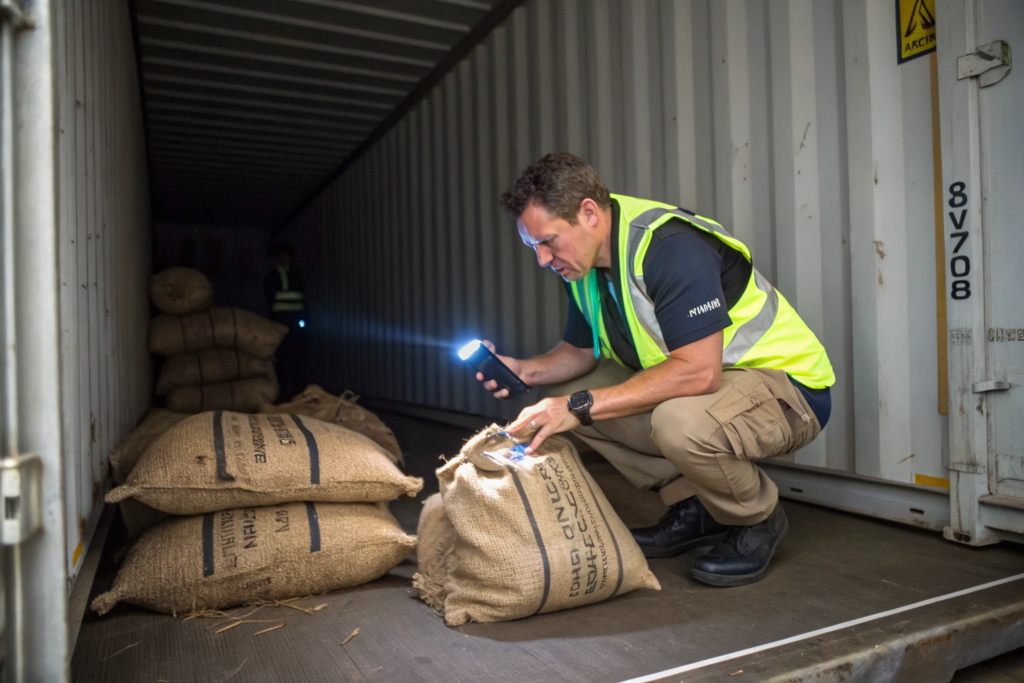
The clock starts ticking the moment you receive notice of damage. The cardinal rule is: do not disturb the evidence. I immediately instruct the consignee, or their receiving warehouse, to leave the container sealed if the damage is discovered on delivery. If the damage is discovered during unloading, stop unloading immediately. Take wide-angle photographs showing the container in its position, the container number, and the seal. Then take close-up photographs of the damaged bags, the area around the damage, and any visible cause, such as a wet floor or a punctured container wall. Do not dispose of any damaged goods.
The next call is to the insurer or their appointed claims agent at the destination, notifying them of the potential claim and requesting a survey. Most policies require this notification within a specific timeframe, often within three days of delivery. I also notify the shipping line in writing, holding them responsible for the damage pending investigation. At this stage, I collect the full document set: the bill of lading, the packing list, the commercial invoice, the insurance certificate, the pre-shipment survey report, and the container inspection report. These documents support the surveyor's investigation and speed up the adjustment. The final immediate step is to cooperate fully with the surveyor and avoid any admission of liability. I let the surveyor determine the cause. I provide the factual records. The separation of evidence-gathering from liability-admission protects the insured position while allowing the claims process to move forward on solid factual ground.
How can a buyer and seller share the survey cost under CFR or FOB terms?
This is a practical question that I have had to negotiate in real time with buyers on several occasions. Under CFR or FOB terms, the marine cargo insurance is typically arranged by the buyer. The seller's insurable interest technically ends when the goods pass the ship's rail at the port of loading. However, in reality, a damage claim often requires investigation at the destination, and the exporter may be asked to contribute information or evidence from the origin side. The survey cost at destination is generally borne by the party who holds the insurance policy—the buyer under CFR or FOB. But what if the survey determines that the damage occurred before loading, due to a defect in the bagging or the pre-carriage trucking? In those cases, the financial burden of the survey and the loss may shift to the seller.
To avoid a dispute over survey costs, I include a clause in our CFR and FOB contracts that states: "In the event of cargo damage discovered at destination, the buyer shall appoint a surveyor and provide the seller with a copy of the survey report within 14 days. If the survey determines that the damage originated prior to loading, the seller shall reimburse the buyer for the reasonable cost of the survey." This clause protects the buyer's right to recover survey costs from me if the fault is genuinely mine, while also incentivizing a prompt survey and transparency. If the survey finds the cause was an ocean transit peril, the buyer's insurer bears the survey cost as part of the claim expenses. This shared understanding, documented in the contract, prevents the awkward post-claim conversation that otherwise starts with "who is going to pay for the surveyor?" and ends with strained commercial relationships.
Conclusion
Insurance for a green coffee shipment is not a generic procurement checkbox. It is a tailored financial instrument that protects against the specific physical and environmental risks that coffee faces during long-haul ocean and inland transport. We have walked through the coverage standard that works—Institute Cargo Clauses A with warehouse-to-warehouse scope. We have looked at the insured value calculation that prevents underinsurance. We have examined the exclusions, especially inherent vice and insufficient packing, that can torpedo a claim if not actively managed with pre-shipment documentation. And we have discussed the role of the independent surveyor in turning a chaotic loss into an orderly financial recovery.
The core message I want any coffee buyer or fellow exporter to take away from this article is that insurance is a partnership between the insured and the information they provide. The more rigorously you document your beans' condition at the point of loading, the stronger your position at the point of claim. The more carefully you read the exclusions before the policy is bound, the fewer surprises you face when the surveyor's bill arrives.
If you are a roaster or importer looking for a coffee supply partner who treats cargo insurance with the seriousness it deserves—maintaining full documentation, offering Clause A all-risk policies as standard on our DDP shipments, and standing behind every bag from our Yunnan plantation to your warehouse—please connect with us at BeanofCoffee. Our export logistics lead, Cathy Cai, can walk you through our insurance certificate package, our claims history, and our specific policy endorsements for your shipment type. Reach Cathy directly at cathy@beanofcoffee.com. Let us make sure your next container of Baoshan Arabica is protected from port to roastery, without a single gap in coverage.