You pop the lid on the sample. The roaster has done their job. You grind the beans, pour the hot water, break the crust. And then it hits you. Not the sweet, clean aroma you expected. Something else. A whiff of wet cardboard. A sour, vinegary tang. A flat, ashy finish. You look at the green beans in the bag. They look mostly fine. A little uneven, maybe. A few dark spots. You're not a Q-Grader. You're a business owner trying to figure out why this lot tastes off and, more importantly, how to avoid buying a container full of this disappointment. You're asking: What are the hidden flaws in this bean that are ruining my cup?
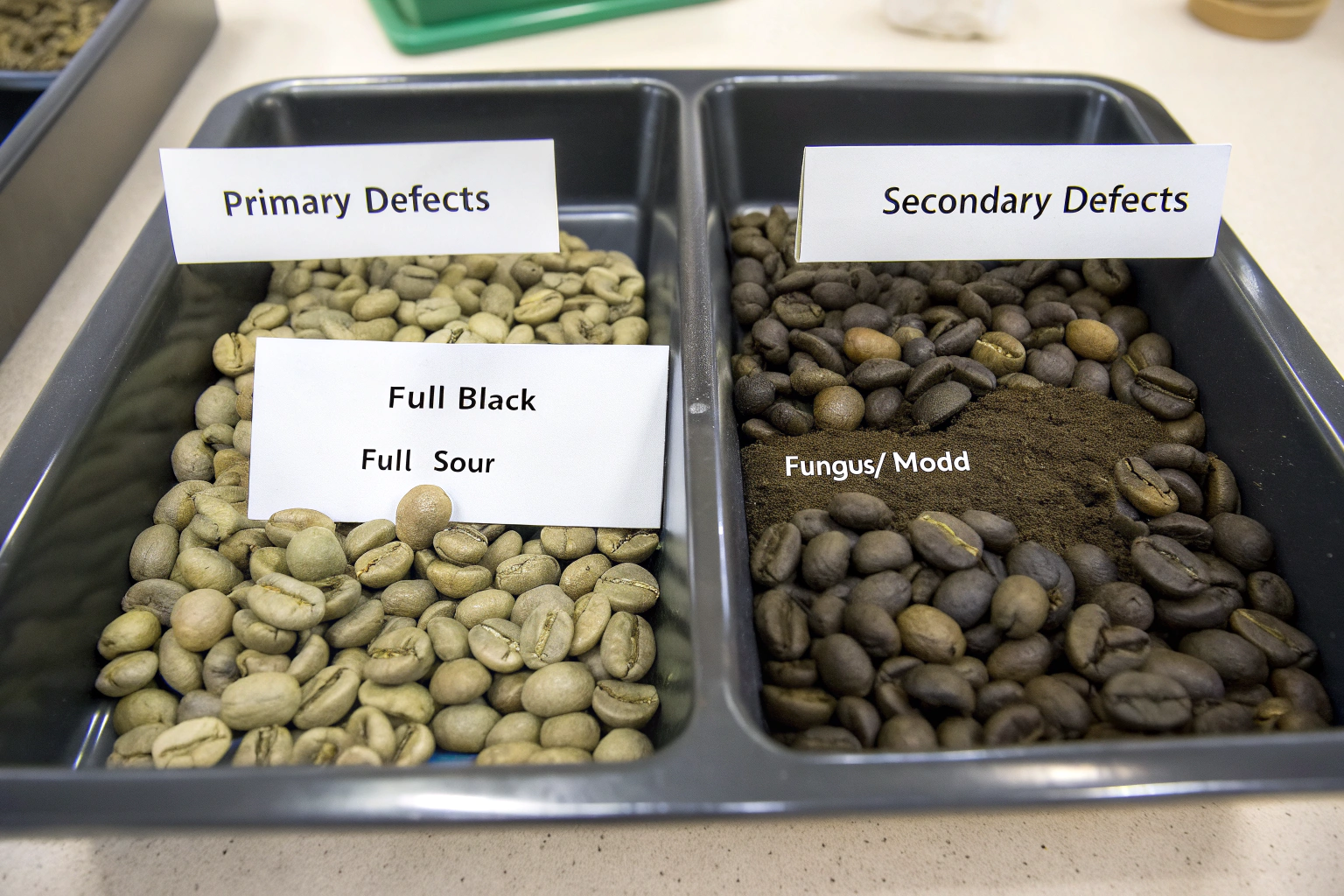
The most common coffee bean defects that buyers should know fall into two categories: Primary Defects, which are severe and cause distinct, unpleasant off-flavors, and Secondary Defects, which are less severe but degrade overall cup quality and consistency. Primary Defects include Full Black, Full Sour, and Fungus/Mold damage. Secondary Defects include Partial Black, Partial Sour, Broken/Chipped beans, and Insect Damage. Understanding how to visually identify these defects in a green sample is the single most important skill for protecting your investment and ensuring your coffee tastes the way it should.
I inspect thousands of pounds of green coffee every week at Shanghai Fumao. My team and I are trained to spot these defects before they ever leave our dry mill. Let me walk you through the most common culprits—what they look like, how they happen, and, most importantly, what they taste like in your cup. This is your field guide to green coffee quality.
What Are Primary Defects and Why Are They Dealbreakers?
In the SCA Green Coffee Classification system, Primary Defects are the unforgivable sins. They represent a severe flaw in the bean that will almost certainly produce a distinct, unpleasant, and often overpowering off-flavor in the cup.
Primary Defects are considered dealbreakers because their impact is so significant that even a single occurrence in a 350-gram sample can ruin the cup quality of the entire lot. The SCA standard allows for ZERO Primary Defects in a Specialty Grade sample. The presence of even one Full Black, one Full Sour, one large stone, or significant fungus damage disqualifies the coffee from being called "Specialty.
What Is a Full Black Bean and What Does It Taste Like?
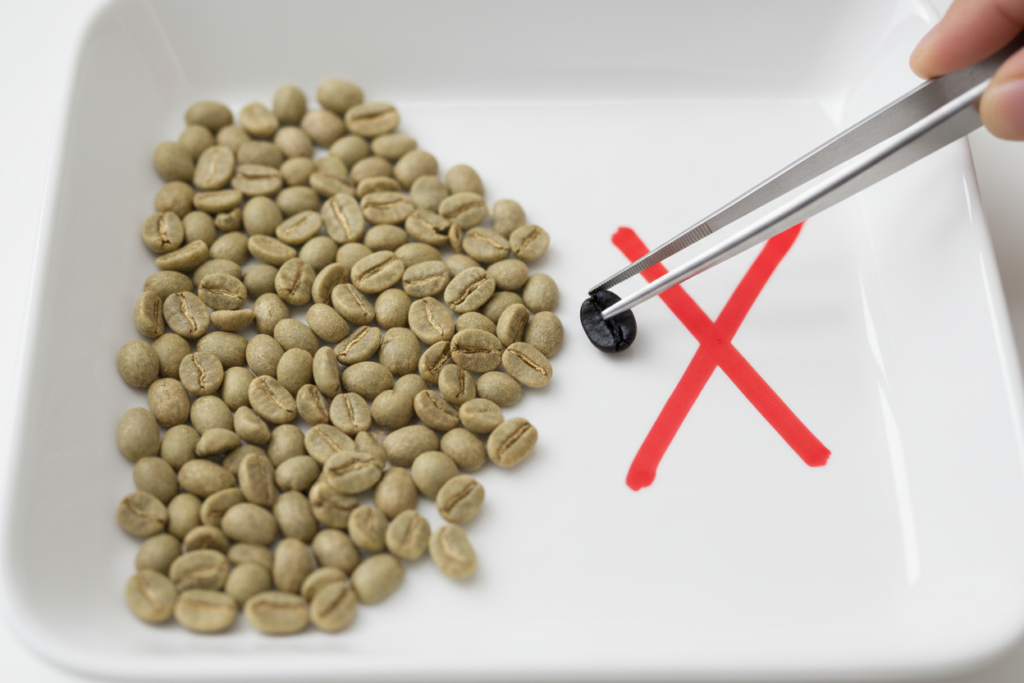
Appearance: A Full Black bean is exactly what it sounds like. It is opaque, shriveled, and entirely black or very dark brown. It is often smaller and lighter than a healthy green bean. It looks like a small lump of charcoal.
Cause: This defect originates on the tree. It's typically a cherry that fell to the ground naturally (over-ripe) or was knocked off by wind/rain. It lay on the soil, began to ferment and rot, and was later swept up during harvest and mixed with the good cherries.
Cup Impact: Catastrophic. A single Full Black bean, when roasted and ground, imparts a powerful, pungent, and unpleasant flavor. It tastes ashy, sooty, phenolic (like Band-Aids or disinfectant), and dirty. It completely overwhelms the delicate flavors of the coffee. It is the single most damaging defect. At Shanghai Fumao, our optical sorters are programmed to detect and eject every single Full Black bean.
What Is a Full Sour Bean and How Does It Differ from a Black Bean?
Appearance: A Full Sour bean is a yellowish-brown, amber, or "foxy" red color. It often has a slightly wrinkled, leathery surface. It is also lighter in density than a healthy green bean.
Cause: This defect is typically caused by over-fermentation or by using dirty water during processing. It can also result from cherries that were picked under-ripe or that sat too long in the fermentation tank. It is a processing defect, not a tree defect.
Cup Impact: Distinct and unpleasant. A Full Sour bean tastes vinegary, sour, fermented, or like rotting fruit. It's the taste of a fermentation process gone wrong. While not as overwhelmingly ashy as a Full Black, it's a very recognizable and off-putting flavor that ruins the cup's cleanliness. Like Full Blacks, the SCA standard is zero tolerance for Specialty Grade.
What Are the Most Common Secondary Defects and Their Impact?
Secondary Defects are the more common, less individually catastrophic flaws. They are still undesirable, and their cumulative effect can drag a coffee's quality down significantly.
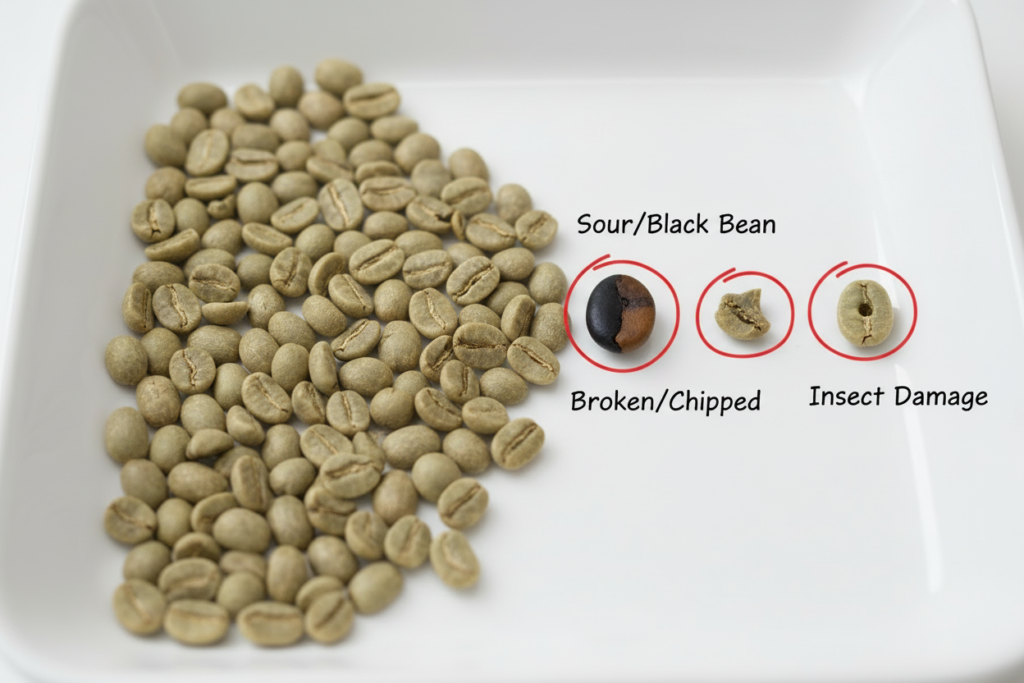
Secondary Defects are flaws that, while not as devastating as Primary Defects, still degrade the coffee's quality, consistency, and appearance. The SCA standard allows for a limited number of Secondary Defect "equivalents" (typically 5 or fewer) in a 350-gram Specialty Grade sample. These include Partial Black, Partial Sour, Broken/Chipped beans, Insect Damage, and immature "Quakers."
Why Are Broken and Chipped Beans a Problem for Roasters?
Appearance: Fragments of beans, or beans with significant pieces missing.
Cause: Mechanical damage during dry milling or aggressive handling.
Cup Impact: Broken beans are a consistency nightmare for roasters. Because they are smaller and have more surface area, they roast much faster than whole beans. In a batch with a high percentage of broken beans, the fragments will scorch and burn while the whole beans are still developing. This leads to an uneven roast, with some beans burnt and others underdeveloped. The result is a cup with ashy bitterness mixed with sour, grassy notes. It's impossible to achieve a consistent, balanced roast. You can learn more about the impact of bean size uniformity from the Roasters Guild.
What Does Insect Damage Look Like and Does It Affect Flavor?
Appearance: A small, neat, round hole bored into the bean. Sometimes you can see a dark tunnel or the remains of the insect inside if you break the bean open.
Cause: The Coffee Berry Borer (La Broca) , a small beetle that burrows into the coffee cherry and lays its eggs inside the developing bean.
Cup Impact: Controversial, but generally negative. Some argue that a low level of insect damage (1-2%) does not significantly impact cup flavor. Others, and the SCA classification, consider it a defect because the insect activity introduces bacteria and fungi into the bean, which can lead to musty, earthy, or sour off-flavors. It is also visually unappealing and indicates a lack of pest control on the farm. At Shanghai Fumao, our strict pest management and optical sorting keep insect damage to a minimum.
How Do Processing Defects Differ from On-Farm Defects?
Understanding where a defect originates is key to understanding the supplier's quality control systems. It tells you whether the problem is in the field or in the mill.
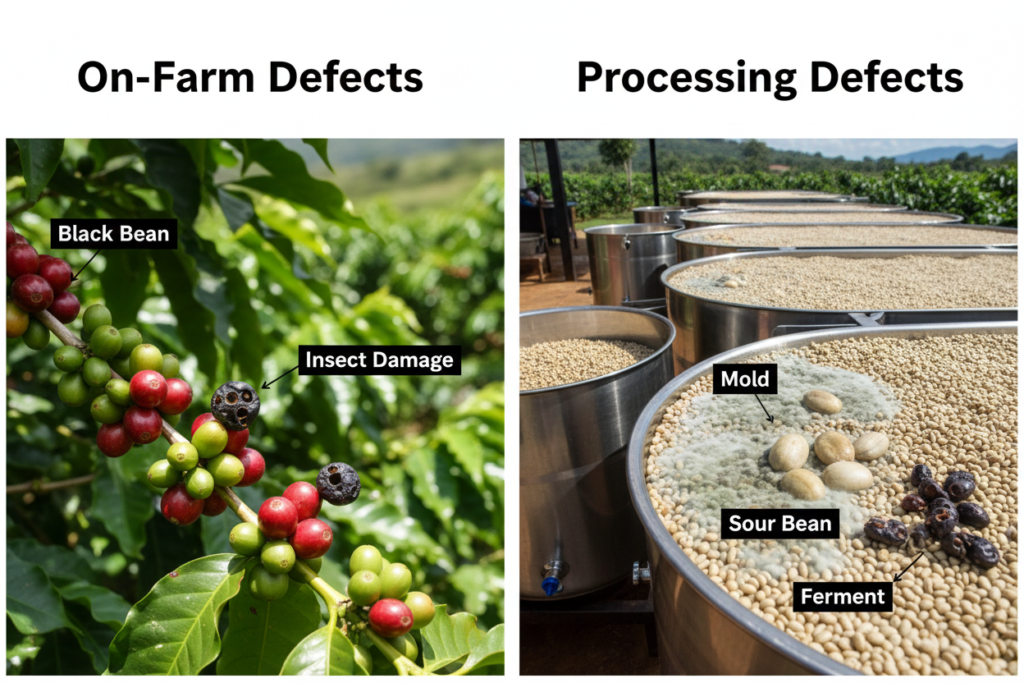
On-Farm Defects originate on the tree and are related to cherry selection and plant health. They include Full Black (from dropped cherries), Insect Damage (from pests), and Immature Beans (from strip-picking). Preventing these requires disciplined selective harvesting and good agricultural practices.
Processing Defects originate after the cherry is picked, during the wet mill and drying phases. They include Full Sour and Partial Sour (from over-fermentation), Fungus/Mold (from improper drying or storage), and Stinker beans (from severe over-fermentation). Preventing these requires clean equipment, controlled fermentation protocols, and careful, even drying.
What Is a "Stinker" Bean and How Does It Form?
This is the notorious "Rio" defect, named after the port in Brazil where it was first identified. It's one of the most feared defects in coffee.
Appearance: A Stinker bean often looks surprisingly normal in the green state. It may have a slightly darker, duller color, but it's not as obvious as a Full Black.
Cause: Severe, localized over-fermentation. A cherry gets stuck in a corner of the tank or in a piece of equipment and ferments for days or weeks, creating a pocket of intense microbial activity. This single bean becomes a concentrated bomb of foul-smelling compounds.
Cup Impact: Unmistakable and repulsive. A single Stinker bean can taint an entire pot of coffee. It smells and tastes medicinal, like iodine, or intensely phenolic (like harsh chemicals). It's a sharp, piercing, and lingering off-flavor. Catching these requires meticulous cleaning of all processing equipment.
How Does Mold or Fungus Damage Appear on Green Beans?
Appearance: Visible mold growth on the surface of the bean. It can appear as white, grey, green, or black powdery or fuzzy spots. In severe cases, the beans may be clumped together by the fungal mycelium.
Cause: Improper drying or storage in conditions of high humidity and poor airflow. The moisture content of the bean was too high, allowing ambient mold spores to germinate and grow.
Cup Impact: Musty, earthy, damp, moldy. It tastes like a damp basement smells. This is a serious food safety concern, as certain molds can produce Ochratoxin A (OTA), a regulated mycotoxin. Coffee with visible mold should be rejected. This is why moisture control is so critical. You can read more about OTA risks from the European Food Safety Authority.
How Can a Buyer Learn to Visually Identify These Defects?
You don't need to be a Q-Grader to perform a basic visual inspection. This is a skill any coffee buyer can and should develop. It's your first line of defense before you even roast the sample.
Learning to visually identify defects requires two things: the right tools and deliberate practice. The essential tools are: a good light source (daylight or a bright desk lamp), a clean white cupping tray (or a sheet of white paper), a pair of tweezers, and a reference guide (the SCA Defect Handbook or high-quality images online). Practice by spreading a 350-gram sample and slowly, systematically scanning for anything that deviates from the ideal pale green, uniform color.
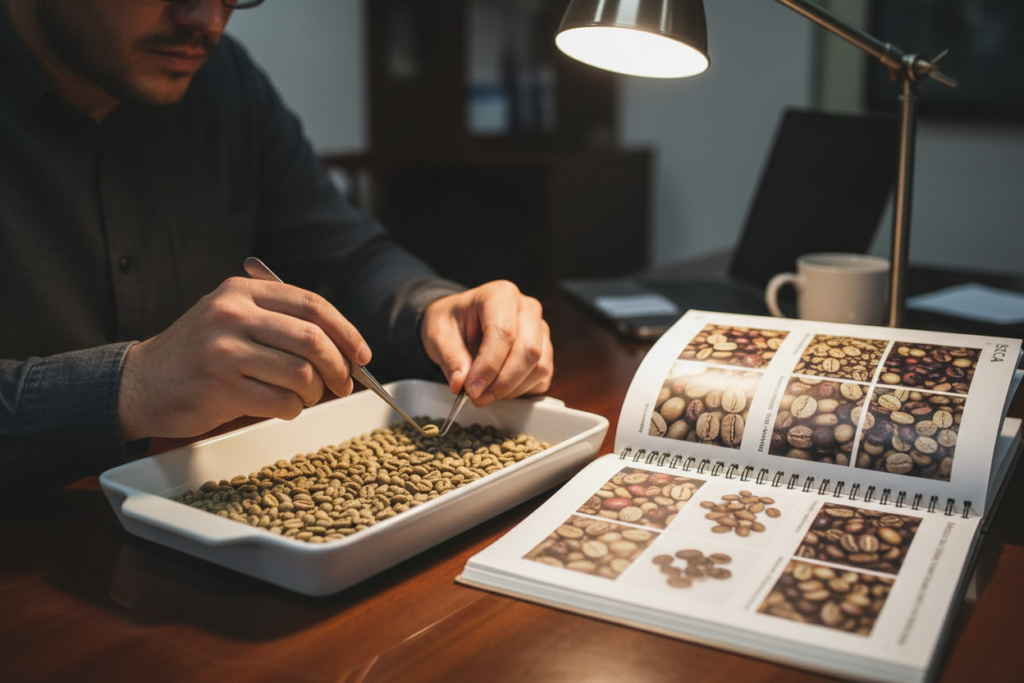
What Is the Best Way to Set Up a "Defect Hunt" on My Desk?
This is a simple, repeatable process you can do in 15 minutes for any new sample.
- Weigh Your Sample: Use a scale to weigh out exactly 350 grams (about 12.3 oz) of green coffee.
- Spread It Out: Pour the sample onto a clean, white surface. A cupping tray is ideal, but a sheet of bright white printer paper works perfectly. Spread the beans into a single layer.
- Get the Light Right: Position a bright desk lamp directly over the tray. Shadows are your enemy. You want even, bright illumination.
- Scan Systematically: Start at one corner of the tray and slowly scan across, row by row. Don't just look at the "pile." Look at each individual bean. Use the tweezers to pick out and isolate anything that looks suspicious.
- Categorize: Place the defects you find into piles: Full Blacks, Partial Blacks, Sours, Brokens, Insect Damage, etc.
- Count and Evaluate: Count the defects in each category. Refer to the SCA Green Coffee Defect Handbook to calculate "full defect equivalents." A Specialty Grade sample should have 0 Primary Defects and 5 or fewer Secondary Defect equivalents.
At Shanghai Fumao, this is a daily ritual for our quality control team. It's how we ensure every lot meets our export standards.
Where Can I Find Reliable Reference Images of Coffee Defects?
You need a good visual guide. The gold standard is the official SCA Green Coffee Defect Handbook . It's available for purchase and is an essential investment for any serious buyer.
There are also excellent free resources online. Coffee Quality Institute (CQI) offers educational materials. Many coffee laboratories and importers have published high-quality photo guides on their websites. A simple Google Image search for "SCA coffee defect poster" will yield useful visual references. The key is to practice. The more samples you visually inspect, the faster and more accurate you will become at spotting the flaws.
Conclusion
Knowing the most common coffee bean defects is not about being a coffee snob. It's about being a smart, responsible buyer. It's about understanding the direct link between what you see in the green bean and what you taste in the cup. A Full Black bean is an ashy, ruined cup. A handful of broken beans is an uneven roast. A musty smell is a potential food safety issue.
By learning to identify these defects visually, you take control of your quality. You move from hoping the coffee is good to verifying it with your own eyes. You become a harder target for suppliers cutting corners.
If you're looking for a partner who obsesses over defect prevention at every stage—from selective hand-picking in Baoshan to optical sorting in our dry mill—I invite you to review our green grading reports and sample our coffee. My email is cathy@beanofcoffee.com.