You've cupped a fantastic sample. The flavor notes are perfect. But then, months later, the shipped beans arrive dull, musty, or worse—molded. What happened? Often, the culprit is hiding in plain sight: moisture. It's the invisible variable that can make or break your coffee investment. As an exporter who manages drying and storage for thousands of tons, I can tell you that strict moisture control is non-negotiable for safe, high-quality export.
The standard moisture content limit for export-ready green coffee beans is generally between 10% and 12%, with 12% being the widely accepted maximum for safe storage and transport. This range is enforced by both international trade rules and the practical need to prevent mold growth, preserve flavor, and avoid weight loss during transit. However, the "sweet spot" for quality is often tighter, around 10.5% to 11.5%. For specific markets or certifications, the limit can be even stricter, such as 10.5% for some specialty contracts. It's a simple number with complex implications for your coffee's shelf life, quality, and ultimately, your profit.
That number—12%—seems straightforward, right? But here's the catch: a single, static measurement isn't enough. Coffee is hygroscopic; it absorbs and releases moisture from the air. So, the real challenge isn't just hitting 11% at the mill, but ensuring it stays safe through bagging, shipping, and storage in a different climate. Let's dive into why these limits exist, how to verify them, and what happens when you get it wrong.
Why Is Moisture Content Critical for Coffee Export?
Think of moisture as coffee's silent partner. Too little, and the beans become brittle, lose their aromatic oils, and roast too quickly. Too much, and you're paying to ship water instead of coffee. More critically, high moisture creates the perfect environment for chemical degradation and microbial growth—primarily Ochratoxin A (OTA) producing molds. This isn't just about quality; it's about safety and compliance. For an exporter, failing to control moisture means rejected shipments, financial loss, and damaged reputation. For you, the buyer, it means receiving an unstable, risky product.
Moisture is critical because it directly dictates the stability and safety of your coffee. During the long sea voyage from China to the U.S. or Europe, beans sit in a metal container. Temperature swings cause "container sweat"—condensation forms inside. If the beans are at a high moisture content, this added humidity can push them over the edge into the "danger zone" (above 13-14% moisture) where mold spores activate. Furthermore, moisture content is directly linked to water activity (Aw), a more precise measure of microbiological risk. Even at 12% moisture, if the water activity is too high, mold can still grow. Controlling moisture is the first and most important step in quality control, ensuring the beans you paid for arrive in the same condition they were sampled in. It's a cornerstone of being a reliable supplier.
How Does Moisture Affect Coffee Quality and Shelf Life?
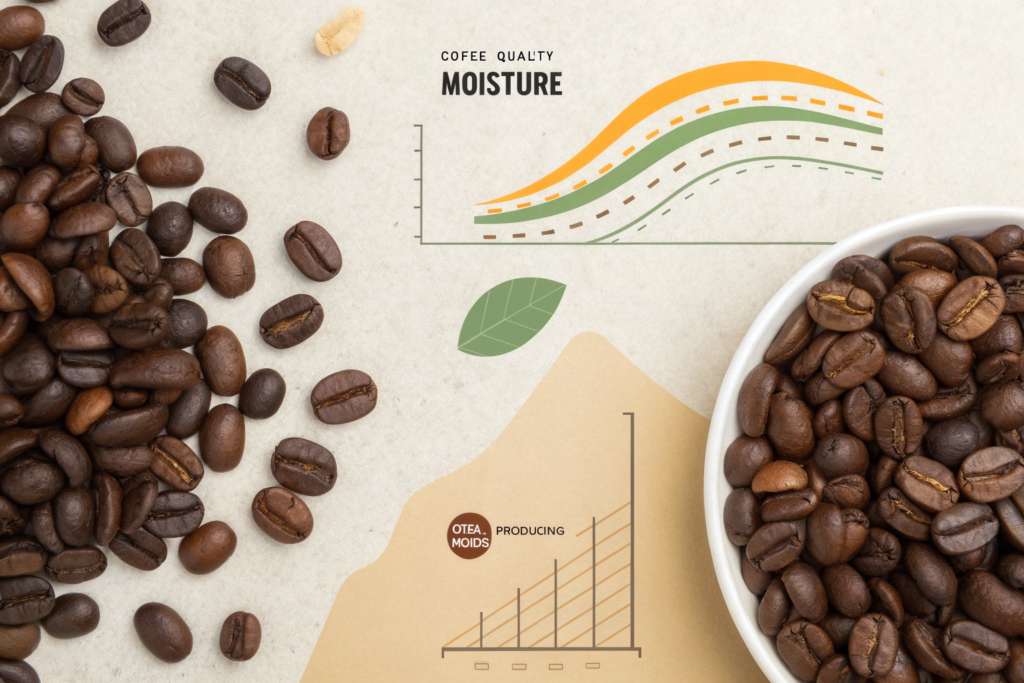
High moisture accelerates staling. It fuels enzymatic and oxidative reactions that break down sugars and acids, leading to flat, papery, or sour flavors. It also promotes the growth of spoilage organisms. Simply put, wet coffee ages fast. Conversely, coffee dried too low (below 9-10%) can lose its volatile aromatics, tasting baked or hollow. The ideal range preserves the cellular structure and flavor compounds. For shelf life, the rule is simple: every 1% increase in moisture roughly halves the safe storage time. Coffee at 10% can be stored for a year or more in good conditions. Coffee at 13% might develop problems in a matter of weeks. For you as a buyer, this means a lot. It affects your roasting schedule, your inventory risk, and the freshness window for your final product.
What Are the Risks of Shipping Coffee with High Moisture?
The risks are financial, legal, and reputational. Financially, you face weight loss. As over-dried coffee absorbs moisture from the air, it gains weight (causing you to overpay). As over-wet coffee loses moisture, it loses weight—you pay for coffee you don't receive. Legally, coffee exceeding maximum moisture limits can be rejected at the port of entry. Contamination with mycotoxins like Ochratoxin A can lead to entire shipments being destroyed, as it violates food safety regulations in North America and Europe. Reputationally, it's a disaster. One moldy shipment can end a buyer relationship built over years. For an exporter, maintaining strict moisture limits is the bare minimum for being considered safe and trustworthy.
How Is Moisture Content Measured and Tested?
You can't manage what you don't measure. Relying on visual or tactile feel—the "bite test"—is hopelessly inaccurate for export standards. Professional measurement requires the right tools and a consistent protocol. The goal is to get a representative, accurate reading that reflects the entire lot.
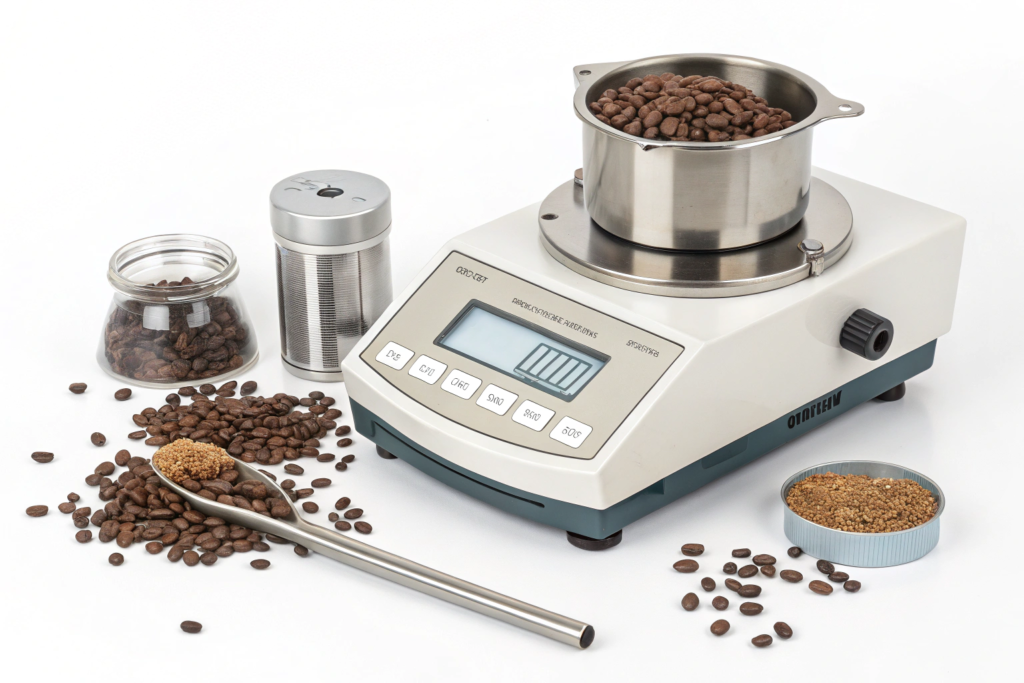
The industry standard for measuring moisture content in green coffee is using a calibrated moisture meter, specifically designed for grains or seeds. These devices use electrical resistance or capacitance to estimate moisture. The most common and reliable method involves grinding a 100-gram sample of beans to a consistent particle size and then using a calibrated meter like a Dickey-John or a similar model. For high-value specialty contracts, some use the oven-drying method (also called the loss-on-drying method) as a reference, but it's too slow for daily QC. The key is sampling: you must take small samples from multiple bags throughout a lot (e.g., from the top, middle, and bottom of a container load) and test them individually. The average and the range (the highest and lowest readings) are both critical. A high range indicates uneven drying, which is a major red flag.
What Tools Do Professional Exporters Use for Moisture Testing?
Professional exporters invest in dedicated coffee moisture meters. Brands like GAC, DICKEY-john, or Kett are common in mill labs. These are not cheap agricultural meters; they are precise instruments calibrated for the specific density and electrical properties of coffee. At Shanghai Fumao, we use calibrated digital meters with ground sample chambers. We test multiple samples from every single drying batch before it is approved for bagging. The process is documented, and readings are logged against each lot number. This data is part of the quality control packet we can provide to buyers. It's a tangible piece of evidence that we take our specifications seriously. Before shipment, we often conduct a final pre-shipment test to ensure no moisture migration has occurred during storage.
Can Buyers Verify Moisture Levels Independently?
Absolutely, and they should. This is a key checkpoint in your sourcing security. There are three ways:
- Specify it in the Contract: Your purchase contract should explicitly state the maximum allowable moisture content (e.g., 11.5% max) and the test method (e.g., ISO 6673 standard or equivalent).
- Third-Party Inspection: Hire an independent inspection company like SGS or Bureau Veritas to test moisture at the loading port. They will take samples directly from the export bags, providing an unbiased report.
- Test Upon Arrival: Have your own moisture meter at your roastery. Test samples from multiple bags as soon as they arrive. If the readings are consistently over the contract limit, you have grounds for a claim.
This verification protects you. It ensures that the good quality you sampled is the same quality that was shipped. A transparent exporter will welcome this, as it confirms their own processes.
What International Standards and Buyer Specifications Exist?
The 10-12% rule is a general guideline, but the real world has more specific rules. Different countries, certification bodies, and even individual roasters have their own strict standards. Navigating these is part of an exporter's job.
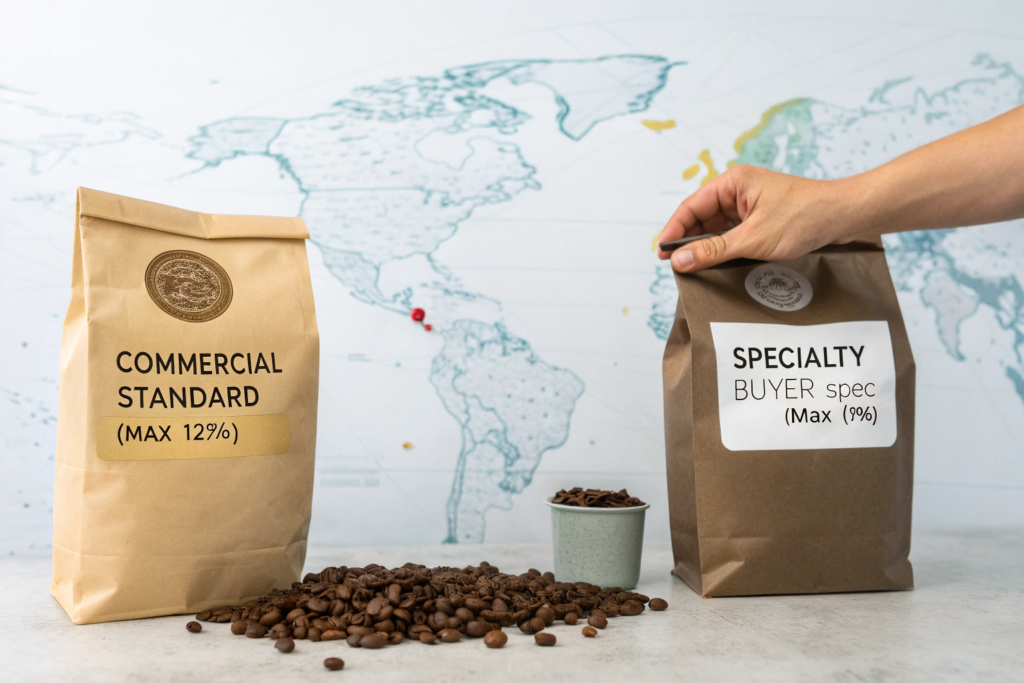
Internationally, the International Coffee Organization (ICO) provides guidelines, but enforcement is national. The Specialty Coffee Association (SCA) recommends a moisture content between 10-12% for green coffee, with the note that 12% should be considered an absolute maximum. However, buyer specifications often tighten this. Many Japanese and European specialty roasters demand a maximum of 11% or even 10.5%. Some organic or fair-trade certifications may have audit requirements for documented moisture control at the processing facility. For large-scale commercial buyers, the limit is usually 12%, but with strict penalties for "swings" (deviations) that cause weight loss. The key is communication: before finalizing a contract, the exporter must confirm and agree to the buyer's specific moisture limits. This avoids costly disputes later.
How Do SCA Guidelines Differ from Commercial Trade Rules?
The SCA guidelines are focused on preserving quality for specialty roasting. They are more conservative. The SCA also emphasizes the importance of stable moisture, not just a single on-point reading. Commercial trade rules, often governed by the rules of associations like the Green Coffee Association (GCA) in the U.S., are designed for efficiency and dispute resolution. They typically set 12% as the maximum allowable for Arabica and 13% for Robusta. However, these rules often include a "allowance" for inherent vice and natural weight loss during transit, which can complicate claims. The specialty market, in contrast, is less forgiving. A reading of 12.1% might be rejected by a specialty roaster but accepted (with a discount) in a commercial trade. This is why knowing your buyer's exact standard is crucial.
Why Do Some Buyers Demand Lower Than 12%?
Experienced buyers demand lower limits for three smart reasons:
- Safety Buffer: They build in a margin of error for moisture migration during transit. If coffee is shipped at 11%, a slight absorption of humidity still keeps it safely below the mold-risk threshold.
- Quality Optimization: Many believe the peak flavor and roastability are best at 10.5%-11.5%. Beans in this range are more stable and produce a more consistent roast.
- Supply Chain Control: It's a test of the exporter's competence. Consistently hitting a tight spec like 10.8% ±0.2% demonstrates advanced drying technology, thorough quality control, and a commitment to precision. It shows the exporter is a stable and trustworthy long-term partner, not just a commodity supplier. At BeanofCoffee, we regularly meet these tight specs for our specialty Arabica and Catimor lots, because we control the entire drying process on our own estates.
How Can Exporters Ensure Stable Moisture During Storage and Transit?
Hitting the right moisture at the mill is only half the battle. The other half is keeping it stable until the coffee reaches the roaster. This is where packaging, storage, and logistics know-how make all the difference.
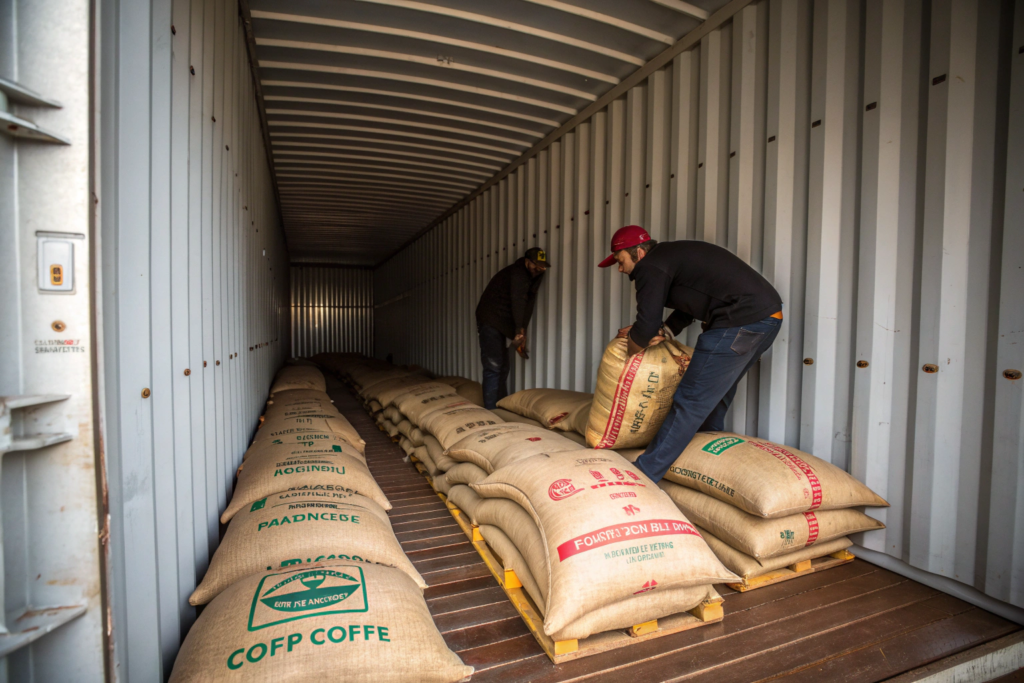
Ensuring stability requires controlling the coffee's micro-environment. The primary tools are proper packaging and conditioned storage. For export, green coffee is almost always packed in multi-layer bags. The standard is the 60kg or 70kg jute bag, but jute is porous and offers little moisture barrier. For higher-value coffee or shipments to very humid destinations, exporters use GrainPro-type bags. These are hermetic, polyethylene liners inserted into a jute or woven poly bag. They create a near-airtight seal, locking in the coffee's moisture content and protecting it from external humidity and odors. After bagging, coffee must be stored in a dry, cool, and well-ventilated warehouse before loading. Crucially, containers must be checked for water damage and proper ventilation. Using desiccants inside containers is also a common practice for extra protection.
What Packaging Best Preserves Moisture Content?
For maximum preservation, hermetic packaging is the gold standard. GrainPro or similar super-grain bags are now expected for high-end specialty shipments. Their effectiveness is proven. They prevent moisture exchange and also protect against insect infestation. The cost is higher than standard jute, but for buyers concerned about quality and security, it's a worthwhile investment. Many direct-trade contracts now specify hermetic bagging as a requirement. At our facility, we offer both options and clearly advise buyers on the best choice for their destination port's climate. For example, coffee shipping to humid Singapore or Miami gets a strong recommendation for hermetic lining. It's a simple step that prevents a major problem.
What Logistics Practices Prevent Moisture Damage?
Smart logistics are defensive logistics. Key practices include:
- Avoiding Condensation: Never loading coffee into a container when the beans are warmer than the external air temperature. This causes "cargo sweat." We schedule loading for cooler times of day and allow bags to acclimate.
- Proper Stowage: Bags should never be stowed directly against the cold container walls. We use dunnage (air pallets or wooden boards) to create an air gap.
- Documentation and Monitoring: Using data loggers inside the container to track temperature and humidity during the voyage. This provides hard evidence of conditions if something goes wrong.
- Insurance: Ensuring the shipment is covered for risks like "fresh water damage" or "mould & mildew."
These practices, while sometimes adding small costs, are essential for delivering on the promise of a safe and reliable shipment. They address the core pain points of timeliness and security by preventing delays and rejections at the destination port.
Conclusion
Moisture limit is more than just a number on a spec sheet. It is the fundamental guardrail for coffee's journey from our warehouse in Yunnan to your roastery. Adhering to the 10-12% standard—and often pushing for the tighter, quality-focused range—is what separates professional, trustworthy exporters from risky suppliers. It protects your investment, ensures your coffee's flavor potential is intact, and minimizes the chance of catastrophic loss due to mold or rejection.
Mastering moisture requires good farming (proper drying), precise measurement, intelligent packaging, and careful logistics. It's a holistic discipline. For you, the buyer, understanding these standards empowers you to ask the right questions, specify the right tests, and choose partners who demonstrate this control.
If consistent, verifiable moisture control is a priority for your sourcing—and it should be—we invite you to connect. At BeanofCoffee, we bake this discipline into every step, from our sun-drying patios to our final pre-shipment inspection. We provide the data because we have nothing to hide.
For detailed information on our moisture control protocols and to request sample quality reports, please contact Cathy Cai. She can walk you through our process and how it ensures the stability of your coffee. Reach her at cathy@beanofcoffee.com. Let's ensure your coffee arrives perfectly stable, every time.