I remember the panic in a new client's voice. He was an online retailer, not a traditional roaster. He had just started importing our beautiful Yunnan coffee, but he was having it roasted and packaged at origin for his private label. His first pallet of finished, branded retail bags was ready to ship. His freight forwarder sent him a checklist. Item number one was "Original Phytosanitary Certificate." He called me, confused. "I thought that was just for raw green beans? Do I really need a Phytosanitary Certificate for roasted coffee?" He was about to pay a consultant $500 to answer a question that has a simple, definitive answer.
A Phytosanitary Certificate is an official government document issued by the National Plant Protection Organization that certifies a plant product has been inspected and is free from quarantine pests, and while it is mandatory for the import of nearly all raw green coffee beans, it is almost universally NOT required for roasted coffee beans, as the roasting process itself is recognized as a mitigating treatment that neutralizes the phytosanitary risk.
This is a critical distinction in international coffee logistics. Let me explain what the document is, why it exists, and when you do and do not need it. At Shanghai Fumao, our export team handles this documentation flawlessly, as detailed on our Logistics & Planning page.
What Exactly Is a Phytosanitary Certificate for Coffee Shipments?
In the complex world of international food trade, a Phytosanitary Certificate (often just called a "Phyto") is a very specific legal instrument. It is not a generic quality certificate or a commercial invoice. It is a government-to-government communication about pest risk. Understanding its legal purpose is key to understanding why roasted coffee gets a pass.
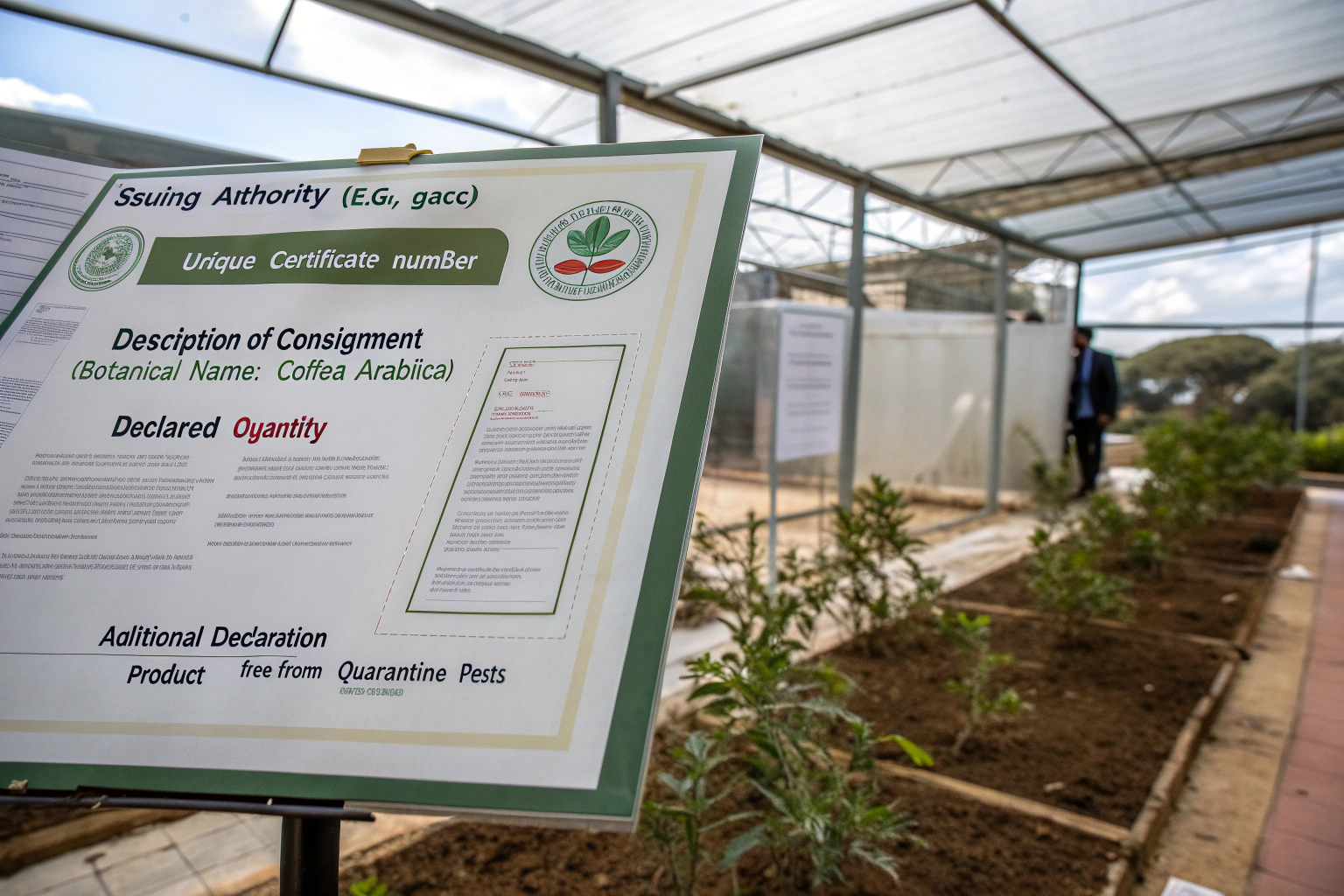
A Phytosanitary Certificate is an official document, conforming to the International Plant Protection Convention (IPPC) model, that is issued by the exporting country's National Plant Protection Organization (NPPO)—in our case, the General Administration of Customs of China (GACC)—to certify that a specific shipment of plants or plant products has been officially inspected and is considered free from harmful quarantine pests and substantially free from other injurious pests, conforming to the importing country's regulations.
It is a legal declaration of plant health, not food safety. Its purpose is exclusively to prevent the introduction and spread of agricultural pests across international borders. It must be the original, signed document, and it travels with the shipment.
Why Is the Phyto Issued by the "National Plant Protection Organization"?
The authority behind the certificate is what gives it its legal power. A Phyto must be issued by a specific government body, not a private company or a third-party lab. This is because it functions as a statement of legal fact for the importing country's own plant health authorities.
In China, the NPPO is the General Administration of Customs of China (GACC). When our coffee is ready for export, a GACC inspector may perform a physical inspection of the beans. The issued Phyto is a sworn statement from the Chinese government to, for example, the USDA's Animal and Plant Health Inspection Service (APHIS), that the coffee in container #XYZ is free from pests like the Coffee Berry Borer. The importing country accepts the document based on its trust in the exporting country's official inspection system. This is a necessary declaration because live insects in a shipment pose a direct threat to a nation's agriculture and natural ecosystems.
What Specific Pests Does the Certificate Declare the Coffee Free From?
The Phyto is not a blanket statement of purity. It is a targeted declaration against a specific list of "quarantine pests"—organisms that could cause significant economic or environmental damage if introduced into a new territory.
For coffee shipments from Asia to the U.S. or Europe, the primary pest of concern is the Coffee Berry Borer (Hypothenemus hampei) , a devastating beetle that bores into the coffee cherry. Other actionable pests can include specific species of ants, mealybugs, and exotic moths. The Phyto certifies that the shipment has been inspected and is free from these specific, listed pests. It is the official documentation that prevents the nightmare scenario we described in What Happens If a Coffee Container Fails USDA Inspection at Port?. It is the document that proves the coffee is biosecure.
Do You Need a Phytosanitary Certificate for Roasted Coffee Beans?
Now we come to the practical answer to my client's question. The entire logic of the phytosanitary system hinges on whether the product is a raw, live agricultural commodity or a processed, inert food product. The coffee plant itself is the pest host. The raw green bean is the potential carrier. The roasted bean is a dead, processed food. This is the legal distinction.
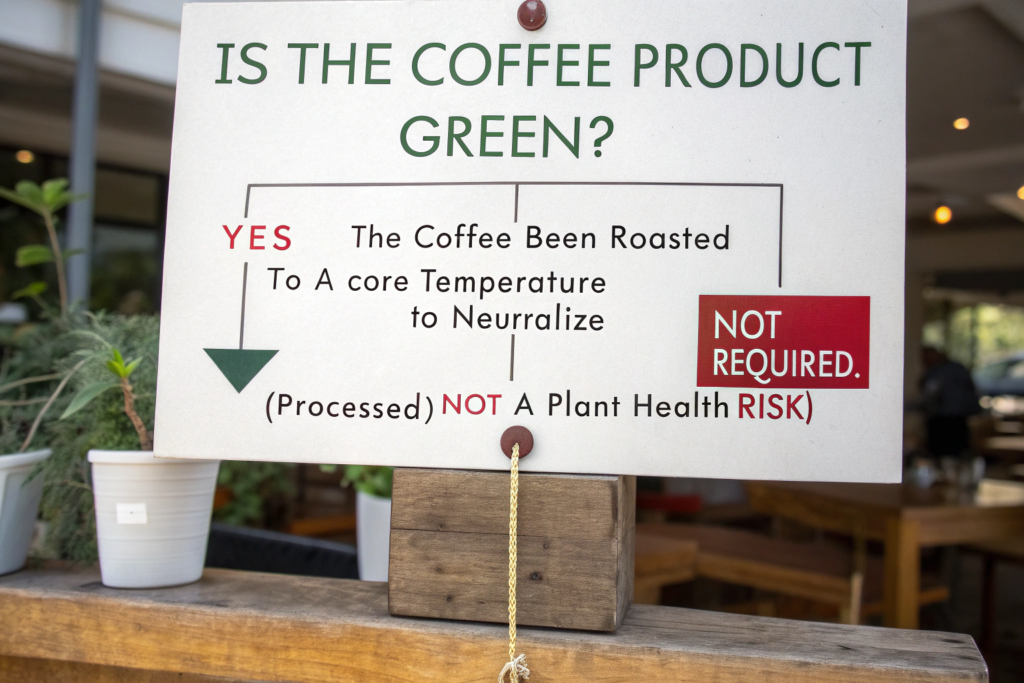
Generally, you do NOT need a Phytosanitary Certificate to import roasted coffee beans. The roasting process is recognized internationally as an effective phytosanitary treatment that eliminates the viability of any potential pest, fundamentally changing the nature of the product from a live plant product requiring a health certificate to a processed food that requires only food safety documentation.
This is not a loophole; it is a core principle of the IPPC. The product is no longer a plant. It is a food. The risk profile has changed completely.
Why Is Roasted Coffee Classified as "Processed," Not "Raw Agricultural"?
This is the simple science behind the legal exemption. A green coffee bean is a living seed. It can germinate. It can harbor live insects. It is a potential vector for introducing a new pest species into a vulnerable environment. It carries inherent phytosanitary risk.
A roasted coffee bean is biologically dead. The high internal temperatures of the roasting process, typically reaching over 200°C (392°F), have neutralized any potential insect, larvae, or egg. The bean's cellular structure is shattered, and it can no longer germinate. It has been fundamentally transformed from a viable agricultural product into a processed, shelf-stable food. Customs authorities worldwide recognize this distinction and classify roasted coffee under a different HS Code (0901.21) with a different, non-agricultural risk profile. For the official formal definitions, you can consult the classification guidelines from the World Customs Organization.
What If Your "Roasted" Beans Are Shipped Warm or in Bulk?
The fact that the coffee is roasted is what provides the exemption, regardless of the packaging. However, there are practical considerations.
If you are importing a specialty lot of roasted coffee beans, whether they are in retail bags or shipped in bulk in a GrainPro liner, the phytosanitary rule is the same: a Phyto is not required. The processing has been completed. The only exception might be for some extremely rare, lightly roasted "cinnamon roasts" that do not reach a high internal bean temperature, but this is a fringe case. The critical factor for your logistics is that while the Phyto is not needed, the Certificate of Origin and the commercial invoice remain absolutely mandatory. The documentation burden shifts entirely to food safety compliance, not plant health.
How Do You Handle a Phyto Certificate for Green, Value-Added, or Private Label Coffee?
The rules are crystal clear for a single product. They become more nuanced when you are running a multi-faceted coffee business. What if you are importing a container of green coffee for your wholesale program and a few pallets of your private label roasted coffee for a direct-to-consumer launch? A single purchase order with different product types requires different documentation.
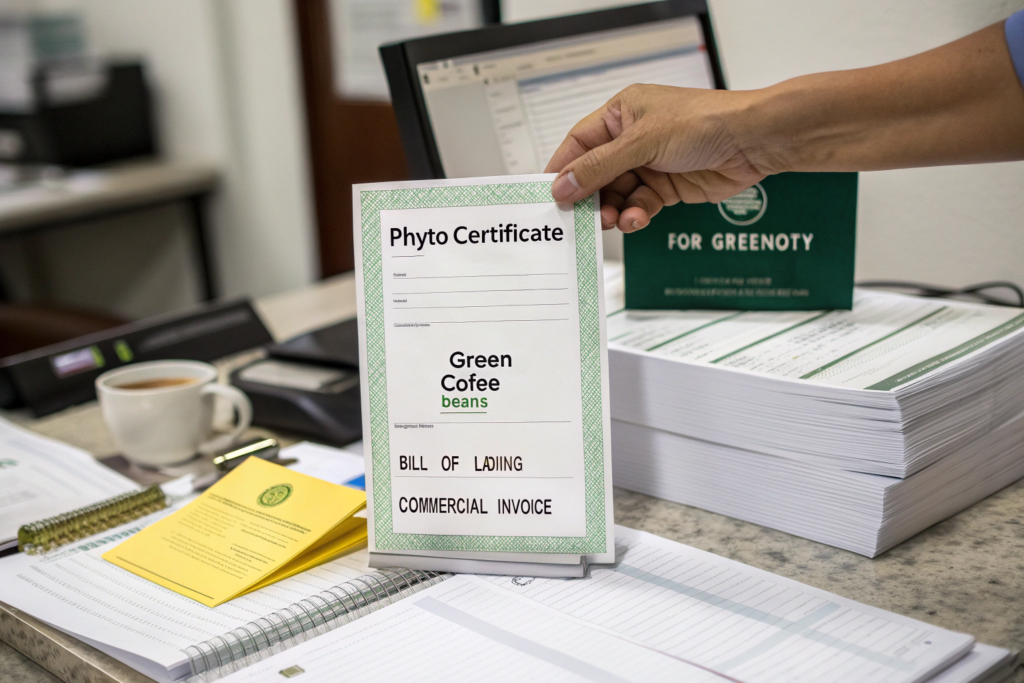
For the portion of your shipment that is green coffee, a Phytosanitary Certificate is absolutely mandatory. For the portion that is finished, retail-ready roasted coffee under your private label, a Phyto is not required. A professional supplier will easily manage this split documentation for a consolidated shipment.
The key is to work with a supplier who understands the regulatory logic and can flawlessly execute the paperwork for each product type.
Does a Private Label Contract Change the Phyto Requirement?
No. The branding on the bag is irrelevant to a pest inspector. The requirement is determined by the physical and chemical state of the bean inside, not your company's logo on the outside of the package.
If your Private Label Program coffee ships green for you to roast locally, you need a Phyto for that green shipment. If you work with us to export your coffee fully roasted and branded at origin, ready for your customer's shelf, then no Phyto is required for that shipment. It is now a processed food product. Your invoice description, however, must be accurate and reflect this exact state to avoid confusion at the port. This is one of the key advantages of a turnkey private label program that manages both products correctly.
Can a Single Supplier Manage All the Paperwork for a Mixed Order?
This is the ultimate value of a professional, full-service export partner. You should not have to become an expert in phytosanitary regulations or manage two separate logistics chains. A competent supplier acts as a single point of accountability for all your documentation.
A partner like Shanghai Fumao has the in-house expertise to handle this seamlessly. You send us one purchase order for both your green coffee and your roasted private label stock. Our logistics team, led by Cathy, will automatically prepare the correct, separate documentation packages, ensuring the green coffee files with a Phyto and the roasted coffee files with the correct Certificate of Origin and commercial invoice. We manage the regulatory complexity so you do not have to. It is a single, integrated service designed to make your life simple.
Conclusion
The Phytosanitary Certificate is a powerful, essential legal document in the green coffee trade, a government-to-government guarantee of plant health that protects a nation's borders. And the need for it hinges entirely on a simple, logical principle: green coffee is a live plant product requiring a Phyto; roasted coffee is a processed food that does not.
For a coffee business importing both raw materials and finished goods, this distinction is operationally critical. The key is not to memorize every international regulation, but to partner with a supplier who understands the science, knows the law, and manages the paperwork with flawless precision for every product type you need.
At Shanghai Fumao, we do exactly that. We ensure your green coffee has the correct Phyto for a rapid customs clearance, and your private label product is documented as a processed food, all managed through a single, accountable point of contact.
If you are planning a mixed order or just want to ensure your paperwork is perfect, let's talk. We can walk you through a sample documentation package. Email Cathy Cai. Ask for a "Sample Green and Roasted Documentation Pack." Contact Cathy at: cathy@beanofcoffee.com