
I run BeanofCoffee, a coffee exporter in Yunnan, China. We own more than 10,000 acres in Baoshan City. We sell Catimor, Arabica, and Robusta. We ship to North America, Europe, and Australia. Buyers like Ron ask me for a CIF price all the time. Ron is 44. He owns a company in America. He cares about price and timeliness. He wants one number that covers everything. That is why CIF is popular. But CIF is not one number. It is a stack of numbers. If you do not see the stack, you cannot compare deals. You cannot find the real cost. You cannot protect your margin.
A CIF coffee deal includes three main parts: the cost of the goods, the insurance, and the freight to the named destination port. The seller pays these three. The buyer pays everything after the port of discharge, including customs duties, port charges, inland trucking, and unloading. A CIF price is not a landed cost. It stops at the destination port. So the buyer must add tariffs, fees, and local delivery. Common extra costs include customs brokerage, terminal handling, demurrage, and FDA or USDA fees. A full CIF breakdown helps you see the real number.
So, what does this mean for you? It means you should not treat a CIF quote as the final price. You should ask for a breakdown. You should ask what is included. You should ask what is not. At BeanofCoffee, we send a simple cost sheet with every CIF quote. We show the goods, the freight, the insurance, and the destination port. We also list the costs the buyer will pay. That honesty saves arguments later. Let me break down a CIF deal piece by piece.
What Does CIF Actually Cover in a Coffee Deal?
CIF stands for Cost, Insurance, and Freight. It is an Incoterm. Incoterms are international rules that define who pays what. The International Chamber of Commerce publishes these rules. CIF means the seller pays for the goods, the insurance, and the ocean freight to a named port. The risk moves to the buyer when the goods are on board the vessel. But the cost stays with the seller until the destination port. That split confuses many buyers. Ron told me once that he thought CIF meant "everything included." It does not. So let me clear it up.
CIF covers the cost of the goods, the marine insurance, and the ocean freight to the named destination port. It does not cover import duties, customs clearance at destination, port charges after discharge, inland trucking, or unloading. The seller arranges and pays for the main carriage and insurance. The buyer handles the import side. This split is why a CIF price is lower than a landed cost. It is also why two CIF quotes can look the same but cost very different amounts after arrival.
Another way to look at this is to compare CIF to a taxi ride to the airport. The driver takes you to the terminal. But you still pay the airline, the baggage fee, and the taxi at the other end. CIF gets the coffee to the port. It does not get the coffee to your warehouse. So plan for the rest. Then you will see the real cost.

What Is Included in the CIF Price?
The CIF price includes three things. First, the cost of the coffee. Second, the marine insurance. Third, the ocean freight. The seller also handles export customs clearance and loading at the origin port. The USITC provides tariff and trade data. The CBP explains U.S. customs entry rules. I use these when I build a quote. A clean CIF quote shows each part. A vague quote hides the parts. So ask for the parts. Then compare.
The cost of the coffee includes the farm price, milling, packing, and inland transport to the Chinese port. The insurance covers the ocean voyage. The freight covers the container space and the sailing. These three make the CIF number. If a supplier cannot explain these three, the quote is not clear. So ask. A clear supplier will answer. A weak supplier will avoid.
What Is Not Included in the CIF Price?
CIF does not include many costs. It does not include import duties. It does not include customs brokerage at destination. It does not include terminal handling charges after discharge. It does not include inland trucking. It does not include warehousing. It does not include FDA prior notice or USDA organic fees. The FDA prior notice page explains the U.S. food import rule. The Trade.gov site offers import and export guidance. I use these when I explain CIF to buyers. These costs can add 10% to 25% to the CIF price. So the landed cost is much higher. Do not forget them.
I tell buyers to make a simple list. List every cost after the port. Then add it to the CIF price. That total is your real cost. A buyer who skips this step may win the deal on paper. But they may lose money in reality. So do the math. Then decide.
How Do You Calculate CIF Costs Step by Step?
Calculating CIF is not hard. But it takes care. You must know the coffee price. You must know the freight rate. You must know the insurance rate. You must know the destination port. Then you add them together. The Freightos index shows freight rate trends. The Drewry shipping research tracks capacity and rates. I use these when I quote buyers. A rate that is right today may be wrong next week. So I confirm before I send the quote. That step protects both sides.
You calculate CIF by adding the goods cost, the insurance cost, and the freight cost to the named destination port. First, calculate the FOB price at the Chinese port. Second, add the ocean freight per container. Third, add the marine insurance, which is usually a small percentage of the CIF value. Fourth, divide by the number of bags or pounds to get the unit CIF price. Then compare that number with other quotes using the same terms. Never compare a CIF price with an FOB price directly.
So, what should you do? Build a simple sheet. Row one: goods cost. Row two: inland freight to port. Row three: export clearance. Row four: ocean freight. Row five: insurance. Row six: total CIF. Then add the destination costs on a second sheet. That two-sheet view keeps you honest. It also helps you compare suppliers fairly.
How Do You Calculate the FOB Base Price?
You calculate the FOB base price by adding the farm price, the milling cost, the packing cost, and the inland transport to the Chinese port. Then you add the export customs clearance. That gives you the FOB price at the port of loading. The International Coffee Organization tracks global coffee prices and trade. The Specialty Coffee Association shares quality and pricing education. I use these to check if our price is fair. A fair FOB price is the base of a fair CIF price. If the base is wrong, the CIF number is wrong. So build the base first. Then add freight and insurance.
I also separate the coffee price from the service cost. The coffee price is what the farmer and mill earn. The service cost is what the logistics chain earns. A buyer should see both. A supplier who hides both is not transparent. Transparency builds trust. Trust builds long-term deals. So show the base. Then show the rest.
How Do You Add Freight and Insurance?
You add freight by checking the current rate for your route and container size. A 20-foot container and a 40-foot container have different rates. A direct route and a transshipment route have different rates. You add insurance by taking a small percentage of the CIF value. The rate depends on the cargo and the route. The Maersk site shares shipping and supply chain information. The MSC site shares service details. I use these to compare options. Then I confirm with our forwarder. A confirmed rate is better than a guess. So confirm before you quote.
| Cost Item | Paid By | Typical Share of CIF |
|---|---|---|
| Green coffee | Seller | 75% to 88% |
| Milling and packing | Seller | 3% to 6% |
| Inland freight to port | Seller | 1% to 3% |
| Export clearance | Seller | under 1% |
| Ocean freight | Seller | 5% to 12% |
| Marine insurance | Seller | under 1% |
This table shows why the coffee itself is the biggest part. It also shows why freight can swing the price. A freight spike can change a CIF quote fast. So watch the rate. Then lock it in when the time is right.
What Hidden Costs Surprise Buyers in CIF Deals?
The surprise is not in the CIF quote. It is after the quote. Ron told me he once budgeted for the CIF price and nothing else. Then the port bill arrived. Then the customs broker bill arrived. Then the trucking bill arrived. He was over budget by thousands. He was not happy. I understand. The system is not always clear. So let me list the common surprises. Then you can plan for them. A plan turns a surprise into a line item. A line item is easy to manage.
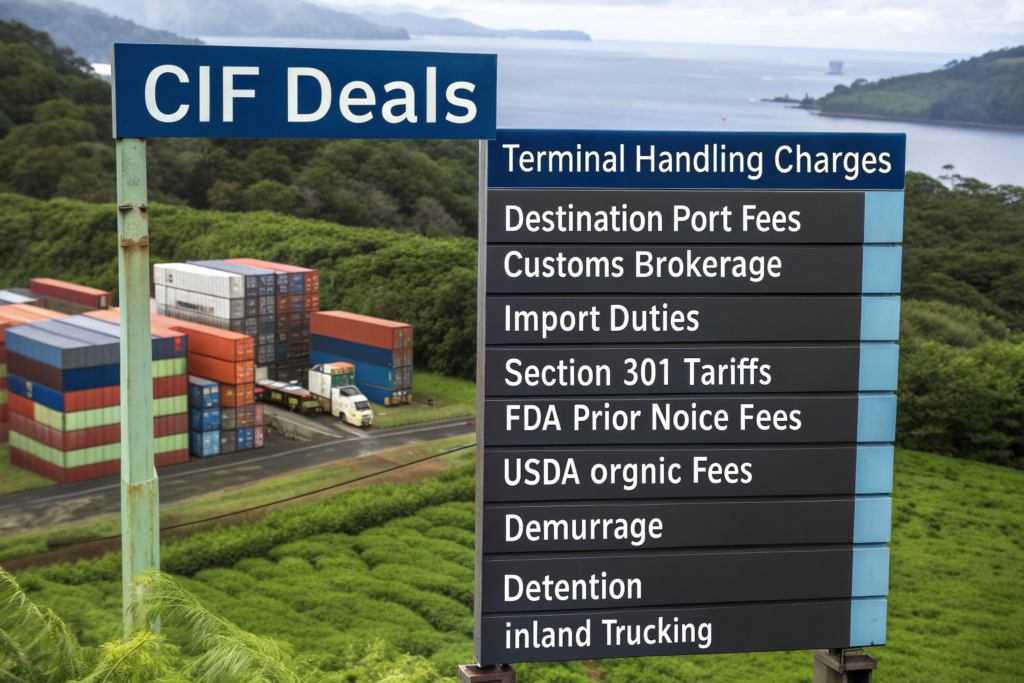
Hidden costs in CIF deals include terminal handling charges, destination port fees, customs brokerage, import duties, Section 301 tariffs, FDA prior notice fees, USDA organic fees, demurrage, detention, inland trucking, and warehousing. These costs are paid by the buyer, not the seller. They can add 10% to 25% to the CIF price. Some costs, like demurrage, appear only when there is a delay. So a smooth shipment may hide them. A delayed shipment reveals them. Plan for both.
So, what should you do? Ask your broker for a full landed cost estimate before you buy. Ask for the terminal fees. Ask for the brokerage fee. Ask for the duty rate. Ask for the tariff code. Ask for the trucking rate. Then add a buffer. A 5% buffer is smart. It covers small surprises. A buffer is not waste. It is protection.
What Are Terminal Handling and Port Charges?
Terminal handling charges are fees for moving the container at the port. Port charges cover wharfage, security, and other services. These fees vary by port. The Port of Los Angeles and the Port of New York may charge different amounts. The Port of Shenzhen shares port information on the origin side. The World Bank logistics data shows logistics performance by country. I use these to explain the range. A buyer should ask for the current terminal fees at the destination port. Then add them to the landed cost. Do not assume they are small. They can be hundreds of dollars per container.
I also tell buyers to check the free time. Free time is the number of days a container can sit at the port without a fee. If the container is cleared quickly, no problem. If there is a delay, demurrage starts. Demurrage is expensive. So clear the container fast. Have your broker ready. Have your truck ready. Have your payment ready. That speed saves money.
How Do Tariffs and Duties Change the Landed Cost?
Tariffs and duties change the landed cost by adding a percentage to the value. For green coffee, the base duty is often Free under HTS 0901.11.00. But additional tariffs may apply. Chapter 99 of the HTS can include Section 301 tariffs or other trade measures. The USTR publishes trade policy information. The Federal Register publishes official notices. I use these when I help buyers check the rules. A wrong code can raise the cost. A missed exemption can lower it. So check the code. Then check Chapter 99. Then check again.
The country of origin matters. Coffee from China may face different treatment than coffee from Brazil. So the same CIF price can have different landed costs. A buyer should compare the full landed cost, not just the CIF price. That is the only fair comparison. So build the landed cost sheet. Then decide.
How Do You Compare CIF with FOB and Other Terms?
CIF is not the only option. FOB is common. DDP is possible. Each term moves the cost and the risk. FOB means the buyer pays the ocean freight and insurance. DDP means the seller pays almost everything, including duties. CIF sits in the middle. Ron asked me which one is best. I told him it depends. It depends on his volume. It depends on his broker. It depends on his risk comfort. So let me compare them. Then you can choose.
CIF is different from FOB and DDP in who pays and who carries risk. FOB means the buyer controls the ocean freight and insurance, which can be cheaper if the buyer has volume. CIF means the seller arranges freight and insurance, which is simpler for the buyer. DDP means the seller pays duties and delivers to the buyer's door, which is the easiest for the buyer but the most expensive and the riskiest for the seller. The right term depends on the buyer's volume, experience, and cash flow.
So, what should you do? Compare the same product under each term. Add the costs each side pays. Then pick the one with the best total cost and the least risk. Do not pick a term because it sounds simple. Pick it because it fits your business. That is the smart way.
When Is FOB Better Than CIF for Coffee?
FOB is better when the buyer has strong freight relationships. A large importer may have a contract rate that is lower than the seller's rate. In that case, FOB saves money. FOB is also better when the buyer wants control of the shipping line and the schedule. The Alibaba platform offers trade tools and supplier listings. The Hapag-Lloyd site shares service information. I use these when buyers ask about FOB. FOB gives control. CIF gives simplicity. So choose based on your strengths.
A small buyer may not have a freight contract. In that case, CIF is easier. The seller handles the booking. The seller handles the insurance. The buyer just waits at the port. That is simpler. But it may cost more. So compare. Then choose.
When Does DDP Make Sense for Coffee?
DDP makes sense when the buyer wants a door delivered price and does not want to manage customs. It is common in small e-commerce orders. It is less common in full container coffee trade. The SGS coffee inspection and Intertek coffee pages show third-party services that support DDP quality checks. I use these when buyers ask for DDP. DDP is easy for the buyer. But it is risky for the seller. The seller must know the destination rules. The seller must pay the duties. The seller must handle the final delivery. If something goes wrong, the seller pays. So DDP prices are usually higher. That is fair. Risk has a cost.
For coffee, DDP can work for small roasted orders. For full container green coffee, FOB or CIF is more common. So match the term to the product. Then match it to your team. If your team knows customs, FOB is fine. If your team does not, CIF is safer. If you want no customs work at all, DDP is possible. But expect a higher price. That is the trade-off.
Conclusion
A CIF coffee deal is not one number. It is a stack of costs. The seller pays the goods, the insurance, and the freight to the destination port. The buyer pays duties, port fees, brokerage, trucking, and more. The CIF price stops at the port. The landed cost continues to your warehouse. So always ask for a breakdown. Ask what is included. Ask what is not. Compare CIF with FOB and DDP. Then choose the term that fits your volume, your team, and your risk. A clear cost sheet protects your margin. A vague quote hides it. So choose clarity. Then choose your supplier.
At BeanofCoffee, we send clear CIF cost sheets with every quote. We own more than 10,000 acres in Baoshan City, Yunnan. We export Catimor, Arabica, and Robusta. We work with large buyers, brand owners, distributors, and trading companies. We can share freight rates, insurance options, and port details. If you want a transparent CIF quote for your next coffee order, please contact Cathy Cai at cathy@beanofcoffee.com. She will help you with samples, pricing, specifications, and shipping terms. You can also visit BeanofCoffee to learn more. Let us build a clear and fair coffee deal together.