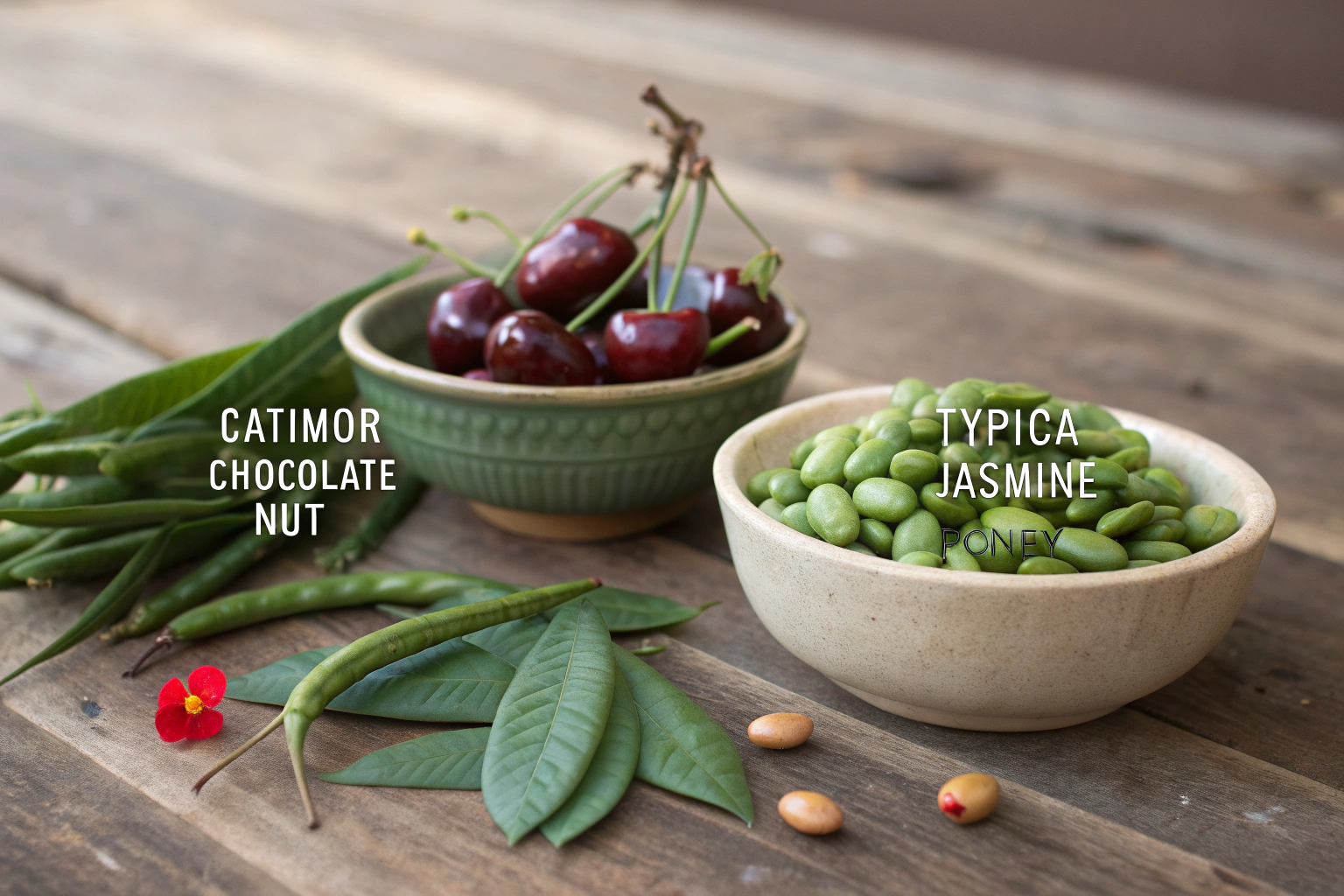
A roaster from a specialty café in Toronto cupped two of my lots side by side last month. Both were washed. Both were grown at 1,550 meters on our Baoshan farm. Both were harvested in January, processed identically, and roasted to the same Agtron level. One was Catimor. One was Typica. He slurped the Catimor. He wrote "dark chocolate, almond, heavy body, mild citrus." He slurped the Typica. He paused. He slurped again. He wrote "jasmine, honey, white peach, silky body." He looked at me. "These are from the same farm?" he asked. "They taste like different countries."
He was right. They taste like different origins because the variety is a powerful driver of flavor. Same soil. Same altitude. Same processing. Same roaster. Different beans. The difference between Catimor and Typica is one of the most dramatic variety contrasts in the coffee world, and understanding it is essential for any buyer sourcing from Yunnan.
Catimor delivers a heavy-bodied, low-acidity cup with dominant notes of dark chocolate, roasted nuts, and mild citrus, while Typica expresses a delicate, tea-like body with bright but refined acidity and complex notes of jasmine, honey, and stone fruit—two fundamentally different flavor experiences from the same origin.
Here is what drives these differences, how they express in the cup, and how to choose the right variety for your roasting program.
What Are the Genetic Origins of Catimor and Typica?
Catimor and Typica represent two fundamentally different chapters in the history of coffee breeding. Typica is the ancient heirloom. Catimor is the modern workhorse. Their genetic origins explain almost everything about their agronomic behavior and their cup profiles.
Typica is the original Arabica variety. All Arabica coffee traces its ancestry back to a small population of wild trees in the forests of Ethiopia and South Sudan. From there, Typica was carried to Yemen, where it was first cultivated. The Dutch took Typica to Java in the 1600s. The French took a single Typica tree to Martinique in the 1700s, and from that one tree, most of the coffee in Central and South America descends. Typica is the grandmother of the coffee world. Its genetic lineage is ancient, pure, and relatively unmodified by human breeding.
Typica trees are tall, elegant, and conical. The branches are widely spaced. The leaves are large and elongated, often with distinctive bronze-colored tips when young. The cherries are large and elongated, with a pronounced point. The tree is low-yielding and susceptible to diseases like coffee leaf rust and coffee berry disease. It requires altitude, shade, and careful management to thrive. It is not an easy tree to grow commercially, which is why farmers have gradually replaced it with more productive varieties.
Catimor is a modern hybrid bred for disease resistance and high yield, while Typica is the ancient heirloom variety from which most Arabica descends, and their genetic differences drive their distinct agronomic traits and cup profiles.
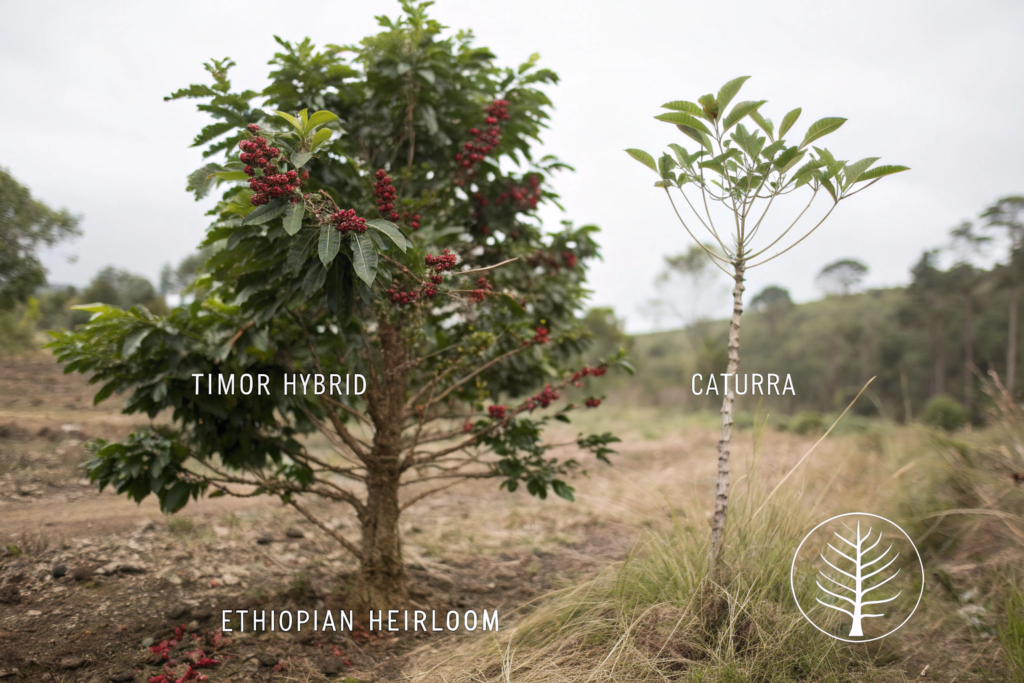
Catimor is a modern creation. It was bred in the mid-20th century by crossing Caturra, a compact, high-yielding natural mutation of Bourbon, with the Timor Hybrid, a natural cross between Arabica and Robusta discovered on the island of Timor. The Timor Hybrid contributed genes for resistance to coffee leaf rust and other diseases. Caturra contributed compact tree size and good cup quality. The result was Catimor—a compact, disease-resistant, high-yielding variety.
Catimor trees are short, dense, and bushy. The branches are short and sturdy. The leaves are smaller and darker green. The cherries are rounder and cluster densely on the branches. The tree is highly productive and relatively easy to manage. It does not need shade. It tolerates a range of altitudes. It resists the major coffee diseases. These agronomic advantages made Catimor the dominant variety in Yunnan and many other origins where disease pressure and yield are critical concerns.
How Does the Timor Hybrid Parentage Affect Catimor Flavor?
The Robusta ancestry in Catimor's genetic background is the single most important factor in its cup profile. The Timor Hybrid parent is a natural cross between Arabica and Robusta. The Robusta genes contribute disease resistance and vigor, but they also influence flavor.
Robusta is known for its heavy body, low acidity, and flavors that range from neutral and grainy to harsh, rubbery, and bitter. The Robusta influence in Catimor is diluted by generations of backcrossing with Arabica, but it is not eliminated. The heavy body and low acidity of Catimor are traits inherited from the Robusta side. The chocolate and nut notes are Arabica traits. The combination produces a cup that is heavy, mild, and pleasant but rarely complex or floral.
In lower-quality Catimor lots, the Robusta influence can express as a slightly harsh, astringent finish, or as a generic "woody" or "earthy" note. These defects are not inevitable. They are the result of poor genetics, low altitude, or poor processing. A well-grown, well-processed Catimor from high altitude expresses the best of its Arabica parentage—clean chocolate and nut flavors with a heavy, satisfying body—while the Robusta influence is barely perceptible.
The Timor Hybrid's Robusta ancestry gives Catimor its characteristic heavy body and low acidity, but also introduces the risk of harsh, astringent notes in lots that are poorly grown or processed, while Typica's pure Arabica lineage produces a cleaner, more delicate, and more florally complex cup.
Typica, by contrast, has no Robusta ancestry. It is pure Arabica. The cup reflects this purity. The acidity is brighter and more complex. The body is lighter and more silky. The flavor notes are more floral and fruit-driven. The finish is cleaner and sweeter. There is no risk of the harsh, rubbery notes that can appear in Catimor. Typica tastes like Arabica in its most classic, unadulterated form.
Why Did Yunnan Farmers Shift from Typica to Catimor?
The shift from Typica to Catimor in Yunnan was an economic decision driven by disease pressure and yield. It was not a choice based on cup quality. It was a choice based on survival.
Typica was introduced to Yunnan in the early 20th century, brought by missionaries and traders along the ancient tea routes. For decades, it was the dominant variety, grown in small plots intercropped with tea bushes. The trees were productive enough for the small-scale farming of the time. The cup quality was excellent.
In the 1990s, the Chinese government, with support from international development programs, began promoting Catimor as a replacement for Typica. The reasons were compelling. Catimor produced two to three times more cherry per tree. Catimor was resistant to coffee leaf rust, which was devastating Typica plots. Catimor could be planted at higher densities and did not require shade, allowing more trees per hectare. The economics were irresistible for farmers who were struggling to make a living from coffee.
The result was a rapid, large-scale replacement. By the early 2000s, most of Yunnan's Typica trees had been ripped out and replaced with Catimor. The Typica population shrank to a few scattered old-growth plots, maintained by farmers who valued tradition or by those who had not yet received Catimor seedlings. Today, true Typica in Yunnan is rare. The trees that remain are old, tall, and low-yielding. They are agricultural heritage.
The shift accomplished its economic goals. Yunnan's coffee production increased dramatically. Farmers had a reliable, disease-resistant crop. But the cup quality of Yunnan coffee became associated with Catimor's chocolate and nut profile. The delicate florals of the old Typica lots became a memory. Only recently, with the rise of specialty coffee, have the remaining Typica plots been rediscovered and valued for their unique cup character.
What Are the Dominant Tasting Notes of Each Variety?
The flavor difference between Catimor and Typica is not subtle. It is the difference between two distinct coffee experiences. A cupper who knows both varieties can identify them blind with high accuracy because the sensory signatures are so different.
Catimor's flavor profile is built around chocolate and nuts. The first note on the cupping table is almost always dark chocolate—bittersweet, rich, and satisfying. Behind the chocolate comes roasted almond or hazelnut. There may be a hint of caramel or brown sugar sweetness. The acidity is low and mild, typically described as citric but soft—more like a whisper of lemon than a burst of citrus. The body is heavy and syrupy, coating the mouth. The finish is clean but relatively short, with the chocolate note lingering briefly.
This profile is consistent across well-processed washed Catimor lots from high altitude. The chocolate and nut notes are the variety's genetic fingerprint. They are present regardless of terroir, though altitude and processing can shift the intensity and balance. A high-altitude washed Catimor from 1,600 meters will have brighter acidity and more pronounced sweetness than a low-altitude lot, but the chocolate and nut foundation remains.
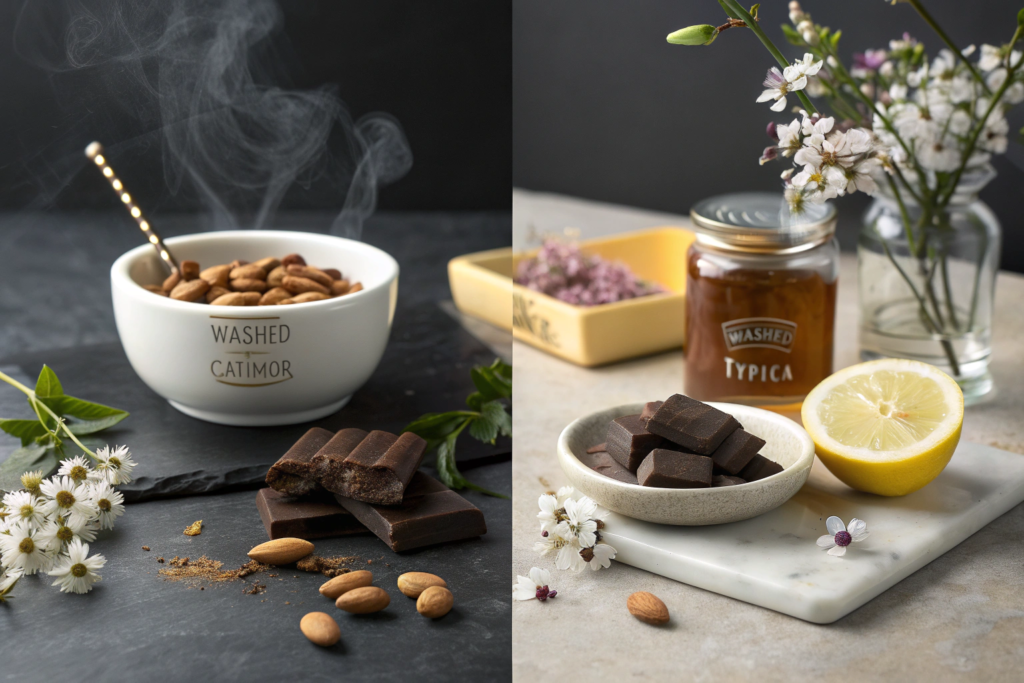
Washed Catimor cups with dominant dark chocolate, roasted almond, and mild citrus, with a heavy body and clean short finish, while washed Typica cups with jasmine, honey, white peach, and a silky tea-like body, with a long, elegant finish.
Typica's flavor profile is built around florals and stone fruit. The first note is often jasmine or orange blossom—delicate, fragrant, and tea-like. Behind the florals comes honey sweetness, not the heavy brown sugar of Catimor but a light, floral honey. The fruit notes are stone fruit—white peach, nectarine, apricot—rather than citrus. The acidity is brighter and more complex than Catimor, but it is refined and balanced, not sharp or sour. The body is light and silky, reminiscent of a high-quality white tea rather than a heavy syrup. The finish is long, clean, and sweet, with the floral notes lingering.
This profile is what makes Typica special. It is not a coffee that shouts. It is a coffee that whispers. The drinker must pay attention. The reward is a cup of exceptional elegance and complexity.
How Does the Body and Mouthfeel Compare?
The body difference between Catimor and Typica is one of the most immediately noticeable sensory contrasts. It is a tactile difference as much as a flavor difference.
Catimor body is heavy, syrupy, and coating. When you slurp a Catimor, the coffee feels thick on the tongue. It has weight. It leaves a sensation of richness that persists after swallowing. This heavy body is a direct inheritance from the Robusta ancestry. Robusta is known for its heavy body, and Catimor retains this trait even after generations of backcrossing with Arabica. The heavy body makes Catimor an excellent base for espresso blends, where body and mouthfeel are critical attributes.
Typica body is light, silky, and tea-like. When you slurp a Typica, the coffee feels delicate and refined. It does not coat the tongue heavily. It glides over the palate and leaves a clean sensation. The body is more like a white tea or a very light oolong than a traditional heavy coffee. This light body is part of Typica's elegance. It allows the delicate floral and fruit notes to express without being weighed down.
The body difference affects how each variety performs in different brew methods. Catimor's heavy body holds up well in espresso and in milk drinks, where the texture can stand up to the milk fat. Typica's light body shines in pour-over and filter brewing, where the clarity and delicacy can be fully appreciated. A Typica espresso can be beautiful but challenging, requiring a careful extraction to avoid thinness.
Can Processing Method Close the Flavor Gap?
Processing method can shift the flavor profile of both varieties, but it cannot close the genetic gap between them. A natural processed Catimor will taste fruitier and heavier than a washed Catimor. A honey processed Typica will taste sweeter and fuller than a washed Typica. But the underlying genetic signature remains.
A natural Catimor, processed with careful cherry selection and slow drying, can develop notes of dried fruit—strawberry, raisin, dried mango—alongside the chocolate and nut foundation. The body becomes even heavier. The acidity softens further. The cup is richer and more complex than a washed Catimor, but it still tastes like Catimor. The chocolate and nut are still there. The heavy body is still there. The Robusta influence is still present.
A washed Typica, processed with meticulous fermentation control, expresses the purest version of the variety's character—jasmine, honey, stone fruit, silky body. A natural Typica pushes the fruit notes toward dried fruit and adds body, but the florals and the tea-like elegance remain. The variety's genetic potential sets the boundaries. Processing can explore the boundaries, but it cannot cross them.
I have experimented with anaerobic fermentation, carbonic maceration, and lactic processing on both Catimor and Typica. The Catimor lots develop intense tropical fruit and creamy notes, but the chocolate undertone and heavy body persist. The Typica lots develop enhanced fruit complexity, but the floral elegance and silky body remain. The processing amplifies and modifies, but the variety's genetic fingerprint is always recognizable.
How Should Roasters Choose Between Catimor and Typica?
The choice between Catimor and Typica is a business decision. It should be based on the roaster's target customer, the intended brew method, the price point, and the volume requirements. Both varieties are excellent. They serve different purposes.
Catimor is the practical choice for volume, consistency, and value. It is available in container loads. The quality is consistent lot to lot, harvest to harvest. The pricing is competitive. The flavor profile—chocolate, nut, mild citrus—is widely appealing and familiar to North American and European consumers. It works as a single-origin filter coffee, but it truly excels as an espresso base, a cold brew component, or a blender. The heavy body and low acidity are assets in these applications.
Typica is the choice for differentiation, prestige, and high-margin limited releases. It is not available in large volumes. The quality can vary more from lot to lot because the trees are old and the plots are small. The pricing is significantly higher. The flavor profile—jasmine, honey, stone fruit, tea-like body—is distinctive and memorable. It appeals to the adventurous specialty consumer who seeks unique flavor experiences. It works beautifully as a single-origin filter coffee, a competition coffee, or a flagship limited release.
Roasters choose Catimor for reliable volume, competitive pricing, and a crowd-pleasing chocolate-nut profile ideal for espresso and cold brew, and Typica for differentiation, prestige, and a unique floral-tea profile that commands premium pricing as a limited release.
The two varieties can also be blended together. A blend of 70 percent Catimor base with 30 percent Typica accent combines the body and chocolate foundation of Catimor with the floral lift and complexity of Typica. The blend has more character than a pure Catimor and more body than a pure Typica. It is an excellent house filter blend or a unique espresso offering.
What Roast Level Maximizes Each Variety's Strengths?
The optimal roast level for each variety reflects its density, sugar content, and flavor profile. The roast should amplify the variety's natural strengths, not fight against them.
Catimor is a dense bean, typically 720 to 750 grams per liter for high-grown lots. The density requires a moderately high charge temperature and sufficient heat during drying to drive thermal energy to the core. The target roast level for Catimor depends on the application. For filter, a medium roast—Agtron 55 to 65—develops the chocolate and nut notes fully while preserving the mild citrus acidity. For espresso, a medium-dark roast—Agtron 50 to 55—builds heavier body and caramelized sweetness, ideal for milk drinks.
Typica beans from old trees are less dense than high-grown Catimor, typically 680 to 720 grams per liter. The lower density requires a gentler roast. A lower charge temperature, a slower drying phase, and careful management of the rate of rise prevent scorching. The target roast level for Typica is light to medium-light—Agtron 60 to 70. This preserves the delicate jasmine and honey notes that make the variety special. A dark roast on Typica is a waste. The florals incinerate, and what remains is a thin, uninteresting cup.
I provide roast recommendations with every lot. For Catimor, the recommendation targets chocolate development and body. For Typica, the recommendation targets floral preservation and clarity. The roaster should cup the lot at different roast levels to find the sweet spot for their equipment and their customers. For more on roast profiling, Cropster allows roasters to track and share profiles for different varieties.
How Do You Market These Flavor Differences to Customers?
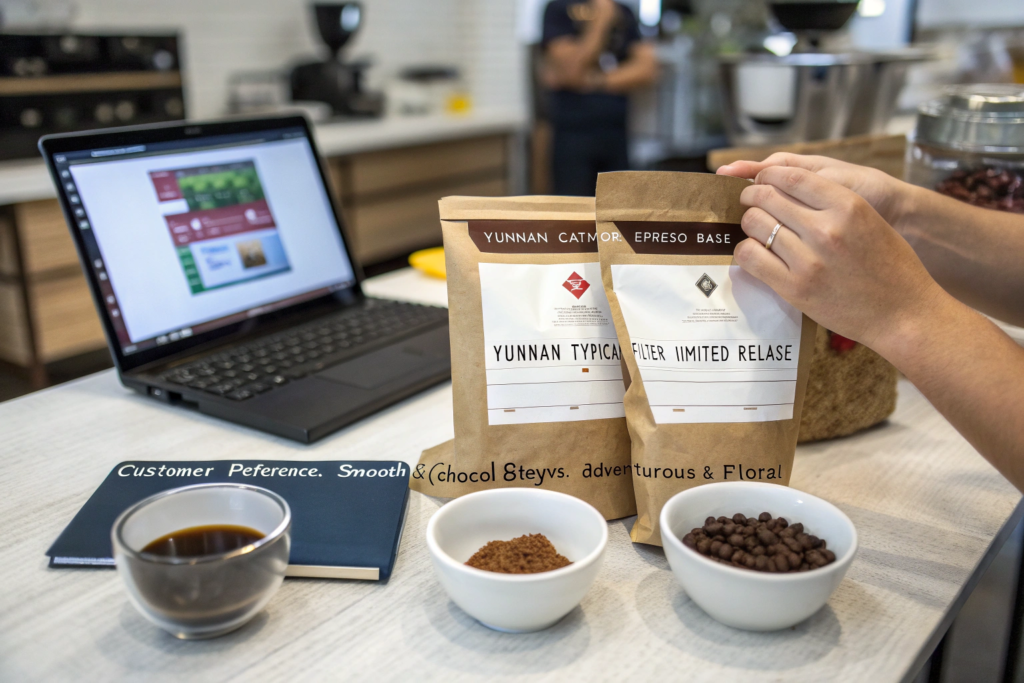
Marketing the difference between Catimor and Typica requires translating the variety names into consumer-friendly flavor promises. "Catimor" and "Typica" mean nothing to most customers. "Chocolate Nut" and "Jasmine Honey" mean everything.
For Catimor, the marketing should emphasize comfort, richness, and familiarity. "Classic Chocolate Espresso" or "Rich & Smooth Breakfast Blend." The flavor descriptors should focus on chocolate, nut, caramel, and smooth body. The customer who buys a Catimor-based coffee is looking for a satisfying, reliable, delicious cup. The marketing should reinforce that expectation.
For Typica, the marketing should emphasize rarity, elegance, and discovery. "Heirloom Typica - Limited Release" or "Floral Honey Single Origin." The flavor descriptors should focus on jasmine, honey, stone fruit, and silky body. The customer who buys a Typica is looking for a unique experience. The marketing should make them feel they are tasting something special and rare.
The story behind each variety can also be told. For Catimor, the story is about modern innovation, disease resistance, and the backbone of Yunnan coffee production. For Typica, the story is about ancient lineage, old trees, and a rediscovered treasure. Both stories are true. Both add value. The right story for the right customer builds engagement and loyalty.
At Shanghai Fumao, we provide marketing-ready variety stories and flavor descriptors with every lot. The roaster can use them on the bag, on the website, and in the café. The goal is to make it easy for the roaster to sell the coffee to their customers.
Conclusion
Catimor and Typica represent two poles of the Yunnan coffee experience. Catimor is the modern workhorse—heavy-bodied, chocolatey, mild, and reliable. It is the foundation of Yunnan specialty coffee, available in volume at competitive prices, ideal for espresso, cold brew, and everyday drinking. Typica is the ancient heirloom—light-bodied, floral, honeyed, and rare. It is a treasure for the specialty market, available in tiny lots at premium prices, ideal for filter, limited releases, and customers who seek the extraordinary.
The genetic difference between the two varieties is the primary driver of their distinct cup profiles. Catimor's Robusta ancestry gives it heavy body and low acidity. Typica's pure Arabica lineage gives it floral elegance and silky body. Processing can modify these profiles, but it cannot erase the genetic signature.
Roasters choose between them based on their business needs. Catimor for volume, consistency, and broad appeal. Typica for differentiation, prestige, and high-margin exclusivity. Both have a place in a well-rounded specialty coffee program. The smart roaster understands what each variety offers and uses it strategically.
If you want to taste the difference between our washed Catimor and our old-growth Typica side by side, contact Cathy Cai at BeanofCoffee. She can send you samples of both from the current harvest, along with cupping scores, roast recommendations, and marketing-ready flavor descriptors. Her email is cathy@beanofcoffee.com. She responds quickly and can help you decide which variety fits your program best.