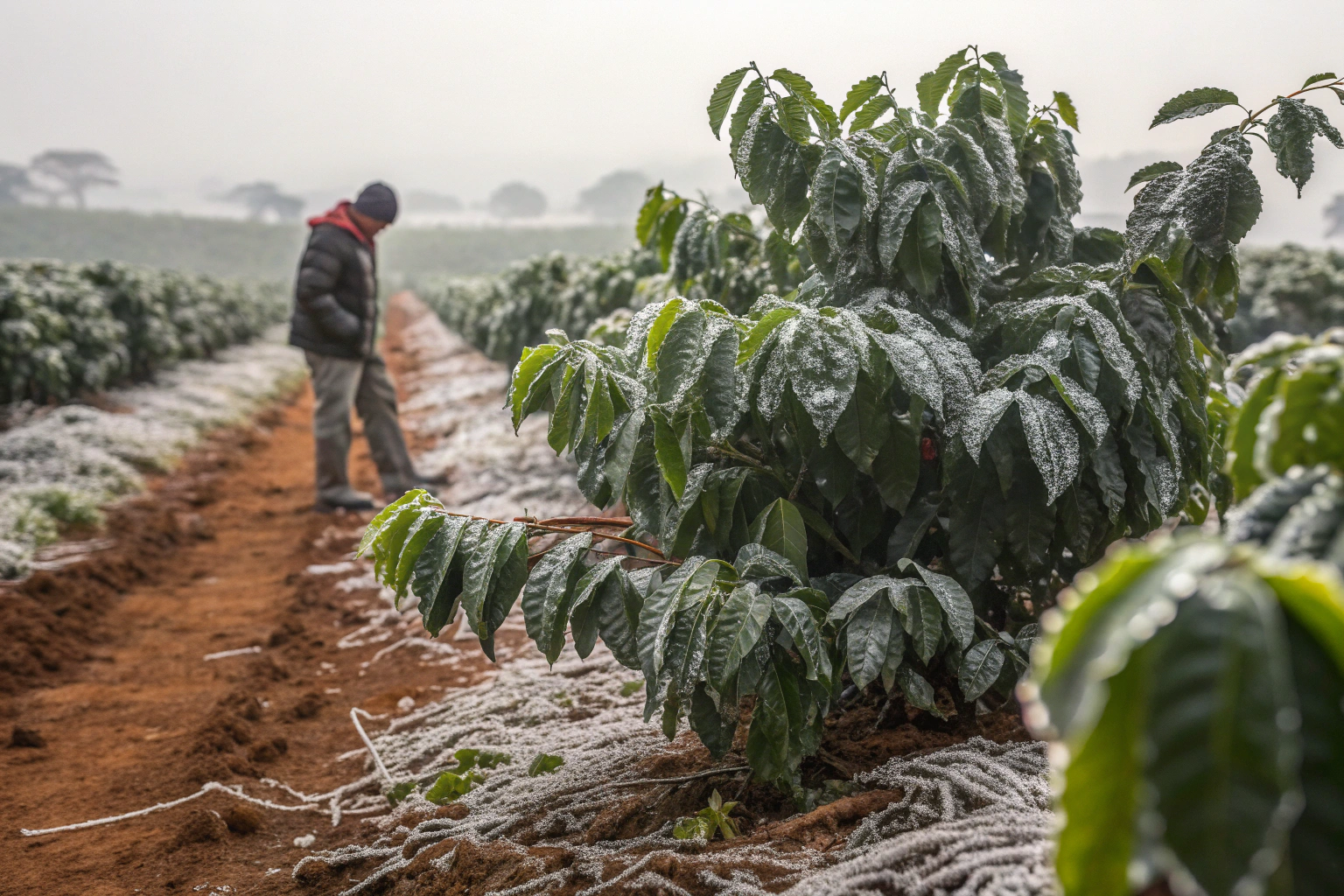
Your coffee sourcing budget is set. Then, news hits: frost in Brazil. The market trembles, and your quotes start to climb. It's a scenario that keeps buyers up at night. You're not just buying beans; you're navigating a market vulnerable to the weather. I've watched frosts reshape entire seasons from our vantage point in Yunnan, and the price shockwaves reach every corner of the globe.
Frost has an immediate and severe impact on coffee bean prices, primarily by destroying crops in key producing regions like Brazil, leading to a sharp reduction in expected global supply. This sudden scarcity triggers speculative trading, driving futures prices up dramatically. For buyers, this means higher, more volatile costs for contracts tied to the commodity market, especially for Arabica varieties. However, the full impact depends on the frost's severity, the region affected, and whether you're locked into a fixed-price contract with a farm-direct supplier.
So, a frost far away can cost you money. But it's not just a simple cause-and-effect. The real story is about market psychology, supply chain buffers, and the critical advantage of sourcing from diverse, stable origins. Let's unpack how a cold snap in one continent can heat up prices everywhere, and what you can do about it.
How Does a Frost in Brazil Affect Global Coffee Prices?
Brazil is the world's largest coffee producer. When frost hits its key growing regions in Minas Gerais or São Paulo, it doesn't just damage leaves—it damages market confidence. The global coffee trade, especially for Arabica, uses the ICE futures exchange in New York as a benchmark. Brazil's projected output is a massive factor in setting that price.
A frost in Brazil acts like a shock to the system. The damage can kill coffee trees, affecting not just the current year's harvest but also the next two to three years of production as trees recover. This isn't a small shortfall; it's a major, multi-year supply cut. Traders and funds on the futures market react instantly to news and damage assessments, bidding prices up in anticipation of scarcity. This surge in the "C price" then lifts the cost of almost all physical Arabica coffee traded globally, even from unaffected countries, because contracts are often priced at a premium or discount to that benchmark. For a U.S. importer, a severe Brazilian frost can mean your cost for Colombian or Guatemalan beans suddenly jumps, simply because the market tide has risen.
Why Is the Brazilian Arabica Crop So Vulnerable?
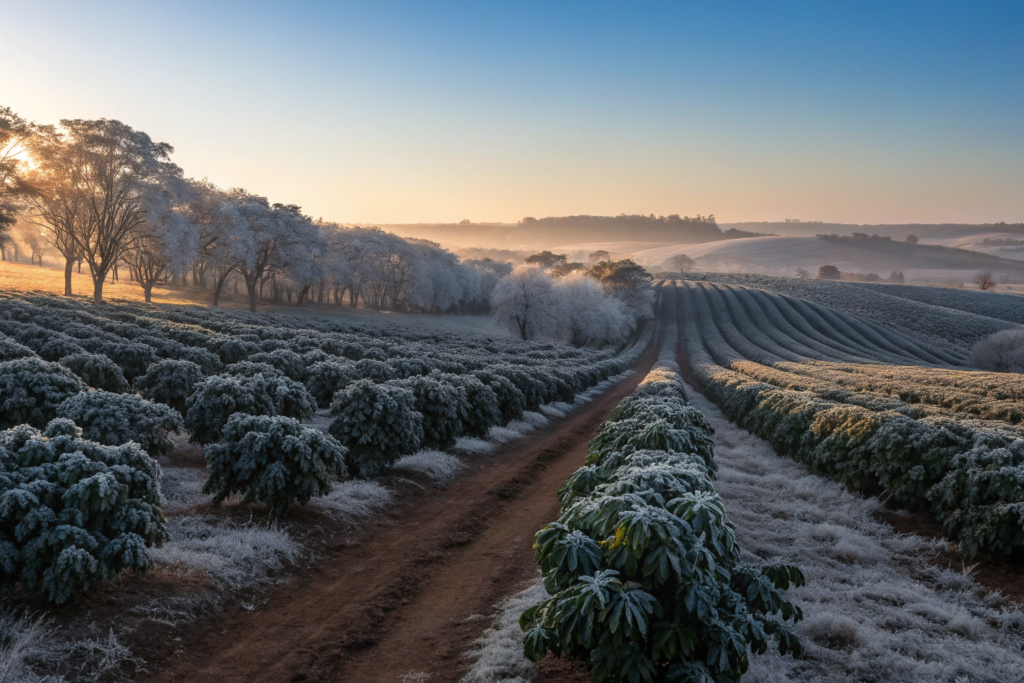
Brazil's Arabica crop is uniquely vulnerable due to geography and farming practice. Much of its Arabica is grown in lower-altitude, non-mountainous regions where frosts are more likely and can be more severe. Furthermore, for efficiency, many farms use dense, unshaded planting. This maximizes sun but also exposes large, contiguous areas of plants to cold air. Without the natural canopy buffer of shade trees, the coffee trees are more exposed. When a cold Antarctic front pushes north, temperatures can plummet below freezing in these open fields, causing ice crystals to form inside plant tissues, literally rupturing them. This scale of modern monoculture farming means when frost hits, the damage is widespread and catastrophic, not localized. The sheer volume of production at risk is what magnifies the global price impact.
What Happens to Futures Prices After a Frost Event?
The reaction is swift and often exaggerated by speculation. The ICE Coffee Futures market is forward-looking. When frost news breaks, trading volume spikes. Algorithmic and speculative traders buy contracts, betting that future prices will be higher. This creates a sharp, upward price spike—sometimes within hours. The market isn't just pricing in the actual lost beans; it's pricing in fear, uncertainty, and worst-case scenarios. This volatility can persist for weeks until accurate damage reports emerge from the fields. For roasters and buyers whose contracts are tied to the futures price plus a premium (the "differential"), their cost basis becomes unpredictable overnight. It's a textbook example of how a physical weather event gets amplified into financial turbulence, hitting your bottom line.
Can Sourcing from Multiple Regions Mitigate Frost Risk?
Putting all your eggs in one basket is risky, especially when that basket is in a frost zone. Diversification is a core principle of risk management in finance, and it's just as critical in coffee sourcing. For a large buyer, reliance on a single origin or price benchmark is a major vulnerability.
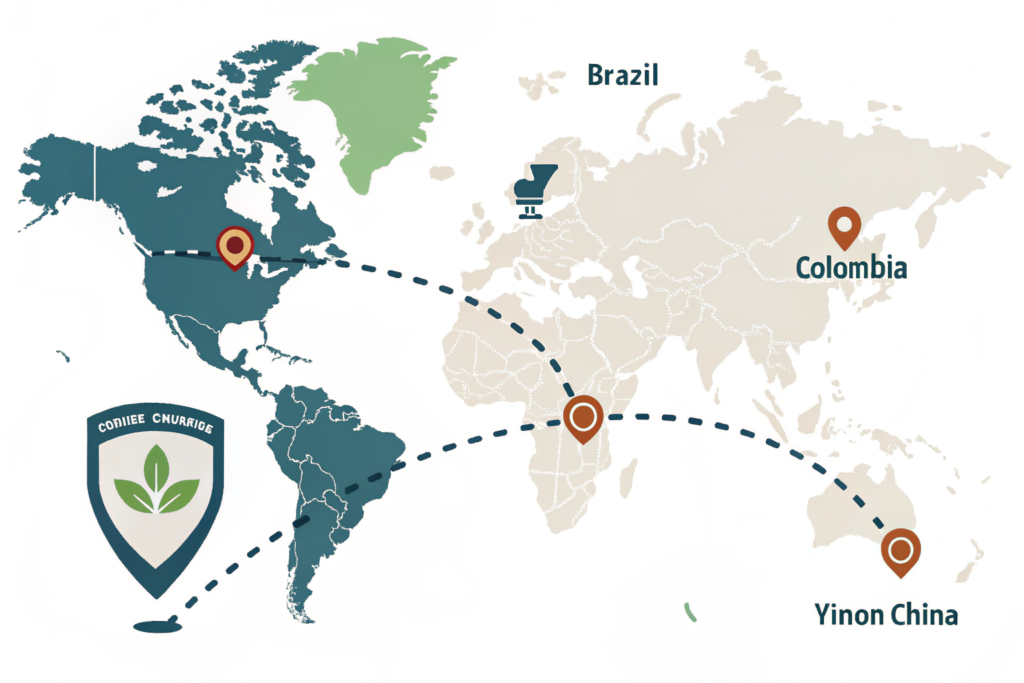
Yes, actively sourcing from multiple, climatically diverse regions is one of the most effective strategies to mitigate frost-driven price risk. When Brazil has a frost, our farms in Yunnan, China, are in a completely different climate and harvest cycle. Similarly, other major origins like Vietnam (dominant in Robusta), Colombia, Ethiopia, and Honduras have their own seasonal patterns and weather risks. By building a supply portfolio that includes beans from Asia, Africa, and Latin America, you are not held hostage to a weather disaster in any one continent. This gives you leverage and options. You can adjust your blend ratios or origin focus based on availability and relative price stability, protecting your business from extreme market shocks.
How Does a China Origin Provide a Price Buffer?
Sourcing from China, specifically from Yunnan province, provides a distinct geographical and systemic buffer. First, the climate: Yunnan's high-altitude subtropical plateau climate is not prone to the frost events that plague Brazil. Our main risks are more about drought or excessive rain. Second, the market link: While global Arabica prices do influence us, a significant portion of Yunnan's premium Arabica and Catimor is traded via direct contracts, not solely pegged to the volatile ICE futures. At Shanghai Fumao, because we control large plantation areas, we can offer fixed-price, seasonal contracts. This means when frost sends the C-market soaring, our agreed-upon price with you remains stable. We become your hedge, your predictable supply pillar amidst market chaos. It's about offering security and reliability when other sources become unpredictable.
What Is a Balanced Coffee Sourcing Strategy?
A balanced strategy mixes origins, coffee types, and contract terms. Don't just buy Brazilian Santos. Blend it with a stable-supply Yunnan Arabica, a Vietnamese Robusta for your espresso base, and maybe an African bean for acidity. On the contract side, balance some futures-linked purchases for flexibility with fixed-price contracts from direct suppliers like us for stability. This approach smooths out the cost curve. When one origin's price spikes, you can temporarily increase the proportion from your more stable sources. This isn't just theory. Many large brand buyers and distributors we work with use this model. They have a core, reliable supply from us for their baseline volume, and they trade in other origins for variety and market opportunities. It makes their business safe and stable.
How Do Frost Scares Influence Trader Behavior and Speculation?
The market often reacts more to fear than to facts. Before the full extent of frost damage is known, the rumor mill and early satellite images can trigger a panic. This environment is where traders and speculators thrive, and their actions can drive prices beyond what the actual supply loss would justify.
Frost scares create a perfect storm for speculative volatility. News agencies report on "potential" damage; weather services issue alerts. Commodity traders, including large funds with no intention of taking physical delivery of coffee, start buying futures contracts en masse, betting the price will go up. This algorithmic and momentum-driven buying pushes prices higher quickly. This action isn't fundamentally about coffee supply and demand anymore; it's about betting on market psychology. This speculation can inflate a price bubble that may later deflate when damage reports are less severe than feared. However, for you, the physical buyer needing to secure beans during that volatile period, you pay the inflated price. It's a tax on uncertainty, paid to the financial markets.

What Is the Difference Between Commercial and Speculative Trading?
Commercial traders are in the physical coffee business—exporters, importers, roasters. They use the futures market primarily to hedge risk, locking in prices to protect their physical operations. A roaster might buy futures to secure a future cost. An exporter might sell futures to lock in a selling price. Speculative traders (like hedge funds, commodity trading advisors) have no interest in physical coffee. They aim to profit from price movements by buying low and selling high. During a frost scare, speculators dominate the buying, amplifying price moves. Their capital can dwarf that of commercial hedgers, causing the market to disconnect temporarily from physical fundamentals. This is why prices can swing wildly even before a single bean is confirmed lost.
How Can Buyers Avoid Paying the "Fear Premium"?
To avoid the fear premium, you need to decouple from the spot futures market at the moment of crisis. The most effective ways are through long-term fixed-price contracts and building relationships with upstream suppliers. If you have an annual fixed-price contract with a direct plantation source, the daily gyrations of the ICE market become background noise. Your cost is locked. Another way is to purchase on a cost-plus basis through a reliable partner who hedges on your behalf, smoothing the cost. At Shanghai Fumao, our model is built on this stability. We absorb the market volatility through our planning and give you a clear, predictable cost. You focus on your roasting and sales, not on betting against weather models in South America. This is what being a trustworthy partner means.
What Long-Term Strategies Protect Against Climate Volatility?
Frost is just one symptom. Climate change means increased volatility—more frequent extreme weather, shifting growing zones, and unpredictable yields. Reacting to each crisis is exhausting. The smart move is to build a resilient supply chain that anticipates these challenges.
Long-term protection requires partnering with suppliers who are actively future-proofing their operations. This includes investing in climate-resilient coffee varieties (like some of the Catimor hybrids we grow in Yunnan, which have good disease resistance), implementing sustainable water and soil management, and diversifying their own farm locations. For you, the buyer, the strategy is to deepen partnerships with such suppliers. Move from transactional purchases to collaborative, multi-year agreements. This gives the supplier the confidence to invest in resilience, and it gives you exclusive access to a more stable supply. Also, consider supporting and sourcing from origins investing in agroforestry (shade-grown coffee), which buffers microclimates against temperature extremes, though yields may be lower.
Are Certain Coffee Varieties More Frost-Resistant?
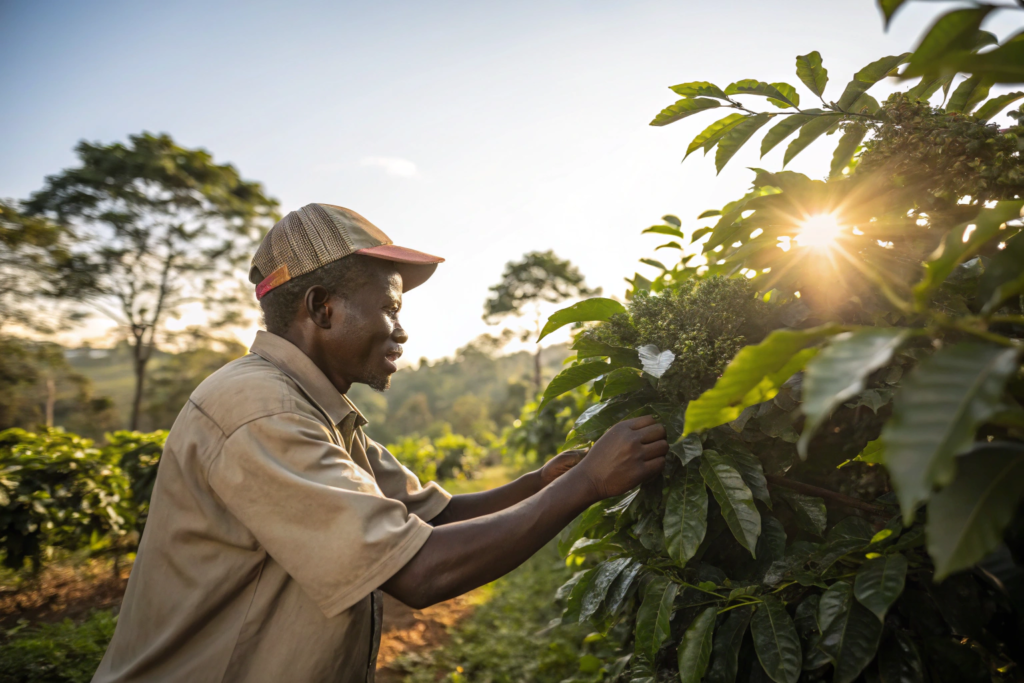
Yes, generally, Robusta coffee is more tolerant of heat and some environmental stress than Arabica. However, within Arabica, certain cultivars bred for hardiness offer better resilience. The Catimor variety, for example, which is a hybrid of Timor (which has Robusta ancestry) and Caturra, is known for its vigor and resistance to leaf rust and, to some degree, variable conditions. While no commercial coffee variety is "frost-proof," cultivating a mix of traditional and hardy hybrids is a key agricultural risk mitigation strategy. In Yunnan, we cultivate both classic Arabica types and Catimor, spreading our own biological risk. This ensures that even in a tough year, we have a harvest, which in turn protects our buyers' supply.
How Does Direct Trade Offer More Stability?
Direct trade, when done right, creates a feedback loop of stability. By working directly with a plantation-owning exporter like Shanghai Fumao, you cut out several speculative middlemen. More of your dollar goes back into the farm, funding better agronomy, processing technology, and sustainability practices that build resilience. In return, you get transparency, traceability, and priority access. You can agree on pricing formulas that are fair but not solely tied to the volatile futures market—perhaps a cost-plus model or a fixed margin. This mutual commitment allows for long-term planning. We know you'll be our partner next year, so we invest in our land. You know we'll be your supplier, so you can build your brand around our consistent quality. It transforms a fragile supply chain into a resilient partnership.
Conclusion
The impact of frost on coffee bean prices is a powerful lesson in global interconnectedness and market vulnerability. It reveals how a local weather event, magnified by speculation, can strain budgets worldwide. But it also highlights a path forward. By understanding these mechanisms—the role of Brazil, the frenzy of futures, the power of diversification—you can move from being a passive price-taker to an active risk manager.
The ultimate strategy isn't to predict the frost, but to build a supply chain that can withstand it. This means diversifying your geographical sources, locking in stability with direct suppliers in less volatile regions, and fostering partnerships that encourage long-term resilience over short-term gains.
If price volatility from climate and market shocks is a recurring pain point for your business, let's discuss a more stable solution. At BeanofCoffee, our foundation in Yunnan provides a reliable alternative. We offer the quality you need, with the price predictability you deserve.
For a detailed discussion on creating a fixed-cost supply line for your coffee needs, please contact our sales lead, Cathy Cai. She can provide samples and a transparent proposal. Reach her at cathy@beanofcoffee.com. Let's build a buffer against the next frost, together.