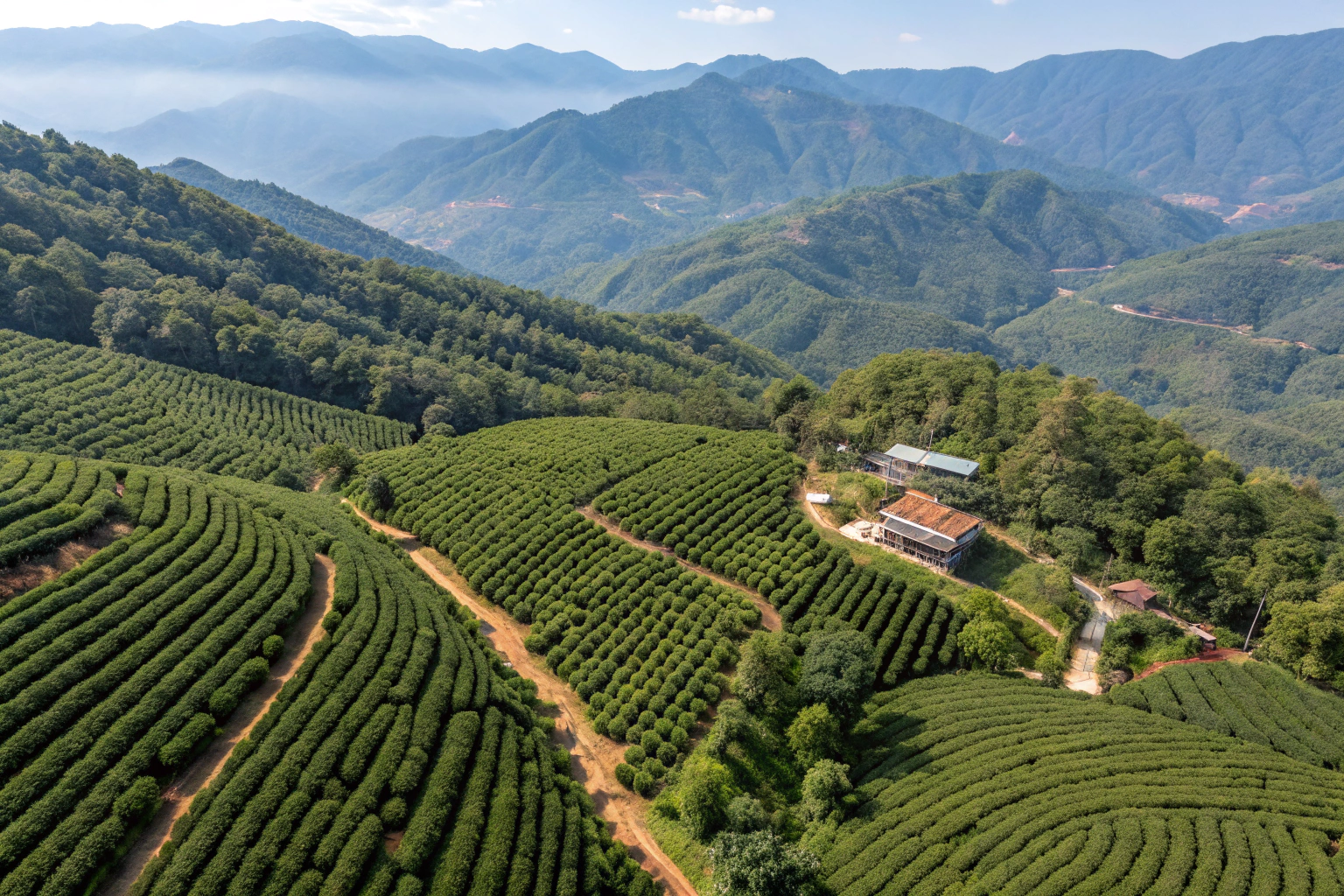
I often get asked by buyers visiting our farm for the first time, "How much coffee can you actually produce here?" They are used to seeing small, 5-hectare family plots in Central America. When they stand on the viewing platform at our Baoshan estate and see the endless waves of coffee trees stretching to the horizon, their sense of scale is reset. They realize Yunnan is different. The production capacity here is not on a village scale. It is on an industrial, estate scale.
The typical production capacity of Yunnan plantations varies dramatically based on size and management, ranging from smallholder plots producing less than 1 metric ton of green coffee per year to large, vertically integrated estates like BeanofCoffee's 10,000-acre plantation, which has a theoretical annual capacity of 12,000 to 15,000 metric tons of green coffee, or roughly 200 to 250 full shipping containers.
This capacity is what makes Yunnan a viable origin for large-scale roasters and distributors. It is not just a source for micro-lots. It is a source for container-loads. Let me explain the range of production scales in Yunnan and where our operation fits into that picture.
How Much Green Coffee Does a Typical Smallholder Farm in Yunnan Produce?
The majority of coffee farmers in Yunnan are smallholders. They own or manage small plots of land, often on steep hillsides. Their production is the backbone of the region's total output, but individually, their capacity is very limited.
A typical smallholder coffee farm in Yunnan manages between 0.5 and 3 hectares of coffee, with average yields ranging from 1,500 to 2,500 kilograms of green coffee per hectare per year, resulting in an annual production capacity of roughly 750 kilograms to 7,500 kilograms (1 to 12 bags) per farm.
This is not a lot of coffee. It is a livelihood, not a commercial export volume. These farmers rely on selling their cherry or parchment to local collectors or cooperatives.
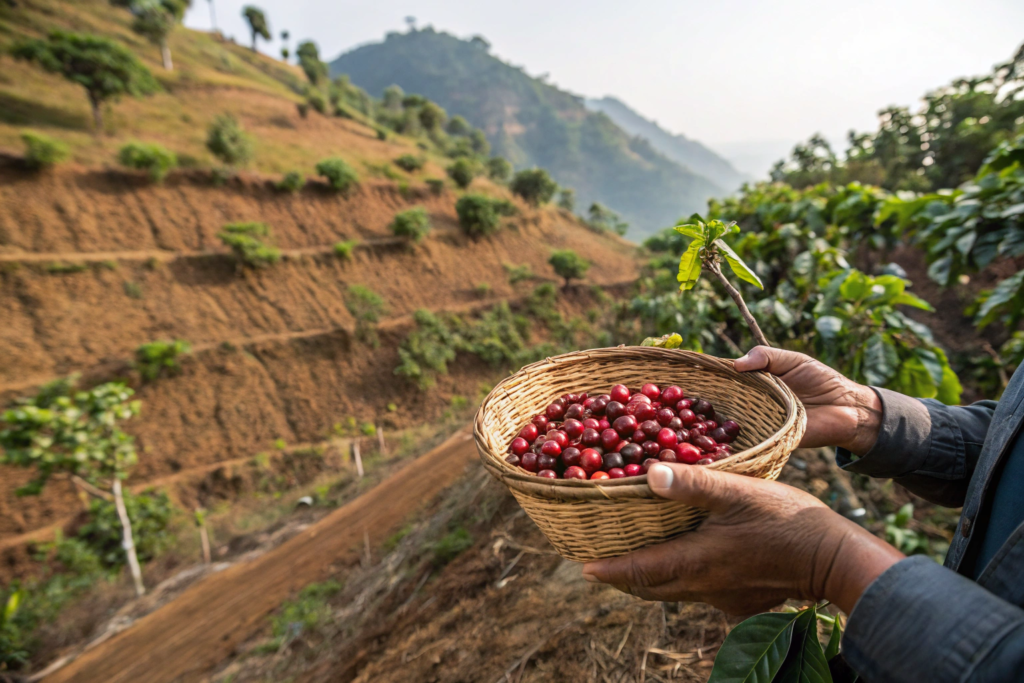
What Factors Limit the Yield on Smallholder Plots?
The capacity of a smallholder farm is constrained by several factors that are different from a large estate.
- Limited Inputs: Smallholders often cannot afford the optimal amount of fertilizer or pest control. Tree health and cherry yield suffer as a result.
- Aging Trees: Many smallholder plots were planted decades ago with older, lower-yielding Catimor varietals. Replanting with new, high-yield trees requires capital and a 3-4 year wait for the first harvest—a luxury many cannot afford.
- Labor Constraints: The harvest is done by the family. During peak harvest, they simply cannot pick all the ripe cherry fast enough. Some over-ripens and falls to the ground. This is a significant yield loss.
- Post-Harvest Losses: Inadequate drying infrastructure (drying on dirt patios) leads to mold and defects. A significant percentage of the harvested cherry is downgraded or lost entirely.
These limitations are real. They are why smallholder coffee, while often having great potential, can be inconsistent in both quality and volume from year to year. At Shanghai Fumao, we work with a network of smallholders in our surrounding area, providing them with agronomy training and a guaranteed market for their cherry. This helps stabilize their production and improves their quality, but their individual capacity remains small.
How Does Cooperative Aggregation Increase Marketable Volume?
This is the solution to the smallholder capacity problem. A single farmer cannot fill a container. But a cooperative of 200 farmers can.
- Aggregation Model: Farmers deliver their dried parchment coffee to a central cooperative warehouse.
- Blending and Grading: The cooperative blends the parchment from many farmers to create a uniform, large lot.
- Scale for Milling: The cooperative has enough volume to justify hiring a toll mill to process the parchment into export-ready green coffee.
Typical Cooperative Capacity: A well-organized cooperative in Yunnan might aggregate 100 to 500 metric tons of green coffee per year. That is 5 to 25 containers.
This is a viable volume for many specialty roasters. The quality can be excellent if the cooperative has strong quality control and traceability standards. However, the roaster is buying a "community blend," not a single-estate lot. The traceability stops at the cooperative level.
This is a key differentiator for large estates like ours. At BeanofCoffee, we do not need to aggregate from hundreds of smallholders to achieve volume. Our volume comes from our own contiguous land, giving us both scale and single-estate traceability. For more on the structure of coffee farming in Yunnan, resources from the International Coffee Organization provide country-level profiles.
What Is the Annual Production Capacity of the BeanofCoffee Estate?
Now let's talk about our scale. This is where the numbers change by an order of magnitude. We are not a smallholder. We are not a cooperative. We are a large, professionally managed agricultural estate. Our production capacity is measured in thousands of tons and hundreds of containers.
The annual production capacity of the BeanofCoffee estate is approximately 12,000 to 15,000 metric tons of export-ready green coffee, derived from over 10,000 acres of planted coffee, with an average estate-wide yield of 2,800 to 3,500 kilograms of green coffee per hectare on our mature, high-density blocks.
This volume makes us one of the single largest coffee producers in China. It is this scale that allows us to serve high-volume buyers like you, Ron, with consistency and reliability.
How Do Our Yields Per Hectare Compare to Global Averages?
Yield is the key metric for agricultural efficiency. How much coffee do we get from a given piece of land? Our yields are significantly higher than the global average, and even higher than many famous specialty origins.
| Region / Farm Type | Average Green Coffee Yield (kg / hectare) | Notes |
|---|---|---|
| Global Average | 800 - 1,200 kg/ha | Includes low-yield, unmanaged farms. |
| Colombia (Smallholder Avg) | 1,500 - 2,000 kg/ha | Intensive hand-labor, but aging trees. |
| Brazil (Mechanized Avg) | 1,800 - 2,500 kg/ha | Flat terrain allows mechanization. |
| Yunnan Smallholder Avg | 1,500 - 2,500 kg/ha | Good climate, limited inputs. |
| BeanofCoffee Estate (Avg) | 2,800 - 3,500 kg/ha | High-density planting, optimal inputs. |
| BeanofCoffee (Premium Blocks) | 4,000+ kg/ha | Best micro-climates, intensive management. |
Why are our yields so high?
- High-Density Planting: We plant more trees per hectare than a traditional smallholder farm.
- Optimal Fertilization: Our in-house agronomy team uses soil analysis and leaf tissue testing to apply precise, targeted nutrition. The trees are healthy and productive.
- Irrigation (Supplemental): While Yunnan has good rainfall, we have invested in drip irrigation in our key blocks to mitigate drought stress during the critical flowering and cherry-fill periods.
- Stumping Cycles: We aggressively manage the pruning cycle (stumping) to rejuvenate the trees and maintain peak productivity.
This is industrial agriculture applied to specialty coffee. It allows us to produce high-quality coffee at a volume and a cost structure that is difficult for traditional origins to match. At Shanghai Fumao, we are constantly trialing new varietals and agronomic techniques to push these yields even higher without compromising cup quality. For global yield benchmarks, World Coffee Research publishes excellent comparative data.
What Is the Breakdown of Our Production by Grade and Screen Size?
High volume is only valuable if it is the right kind of volume. A buyer like you does not just want "a lot of coffee." You want a specific grade and screen size. Understanding the breakdown of our production helps you plan your sourcing.
Approximate Annual Production Breakdown (BeanofCoffee Estate):
| Category | Approx. % of Total | Approx. Metric Tons | Typical Use |
|---|---|---|---|
| Specialty Grade (84+ Score) | 15% - 20% | 1,800 - 3,000 MT | Premium Single-Origin, Micro-lots |
| Grade 1 Commercial (80-83 Score) | 50% - 60% | 6,000 - 9,000 MT | High-End Espresso Blends, Core Offerings |
| Grade 2 / Lower Screens | 20% - 25% | 2,400 - 3,750 MT | Commercial Blends, Instant Coffee |
| Triage / Defects | < 5% | < 750 MT | Domestic Market, Compost |
Screen Size Breakdown (within Grade 1 & Specialty):
- Screen 18+: ~50-60% of the clean cup volume.
- Screen 16/17: ~30-40% of the clean cup volume.
- Screen 14/15: ~5-10% of the clean cup volume.
This breakdown is crucial for your planning. It tells you that if you need a full container of Screen 18+ Specialty Grade, you need to contract it early. It is a limited fraction of our total output. If you are more flexible and can use Screen 16/17 Grade 1, we have much more availability and the price is more favorable.
How Does Our Dry Mill Capacity Align with Our Plantation Output?
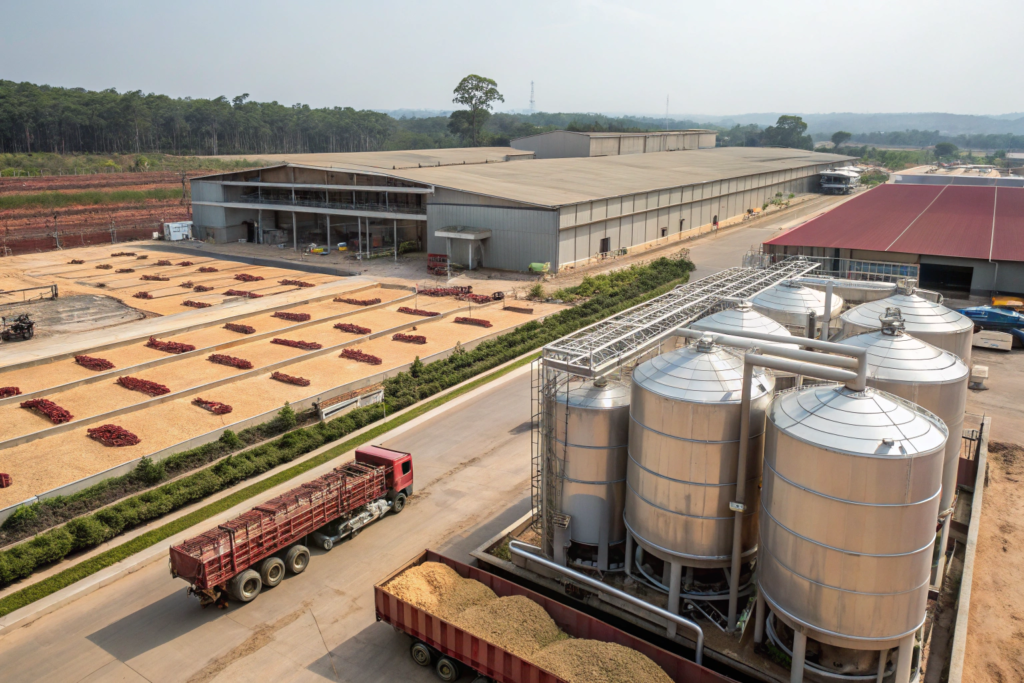
A large plantation is useless without the industrial capacity to process the harvest. You can grow 15,000 tons of cherry, but if your wet mill can only handle 5,000 tons, the rest rots on the tree. This is the bottleneck that plagues many growing regions.
Our dry mill capacity of 10,000 to 12,000 metric tons per year is deliberately aligned with our estate's peak production output, ensuring that every kilo of parchment coffee we produce can be milled, graded, and bagged in a timely manner without creating a backlog that would force us to store coffee in suboptimal conditions or delay client shipments.
We designed the mill to handle our own production, plus a margin for processing coffee from our partner smallholders. It is a balanced, integrated system.
Can Our Mill Handle Custom Processing for Other Yunnan Farms?
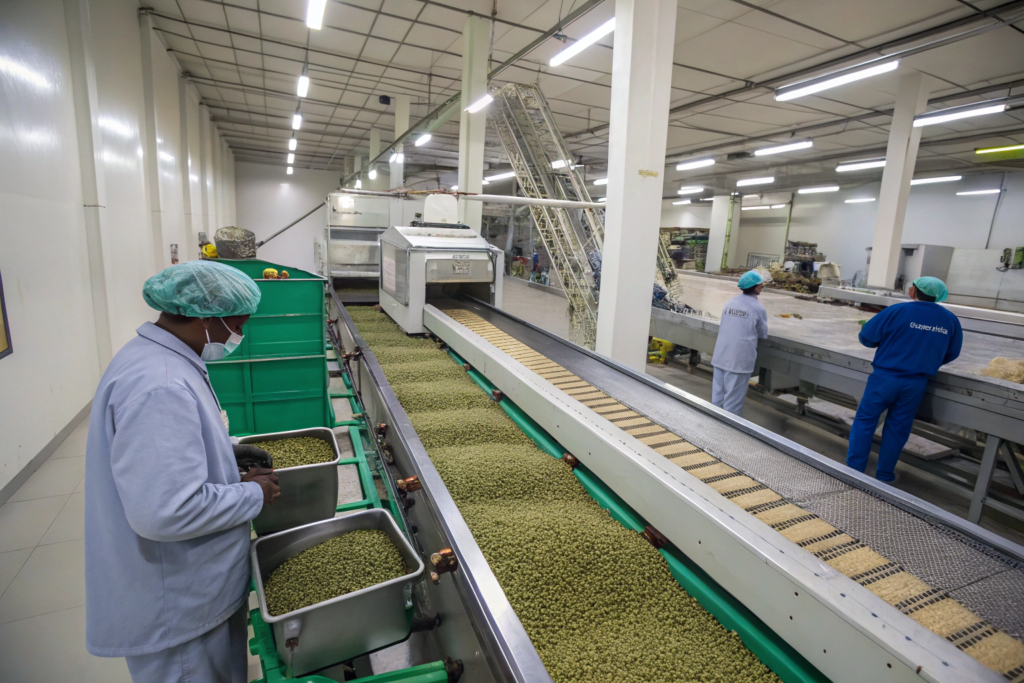
Yes. This is another aspect of our capacity. Because our mill has five independent production lines and a throughput of 3-4 metric tons per hour, we have excess capacity during certain times of the year.
We offer Toll Milling Services to select neighboring farms and cooperatives. They bring us their dried parchment, and we process it through our state-of-the-art equipment.
Benefits for Them:
- Access to gravity separators and destoners they could never afford.
- Professional grading and bagging.
- Access to our ISO 22000 certified facility for export readiness.
Benefit for You (the Buyer): This expands the range of Yunnan coffee we can offer. If you are looking for a specific flavor profile from a specific micro-region near our estate, we can often source the parchment from that neighbor and mill it to our exacting standards. It allows us to be a "one-stop shop" for premium Yunnan coffee, leveraging our milling capacity to upgrade the quality of the entire region.
At Shanghai Fumao, this is part of our mission. We want to elevate the standard of Yunnan coffee as a whole. Sharing our milling technology is one way we do that.
How Do We Manage Inventory and Stock Levels Across the Year?
Harvest is seasonal (November to March). But your roasting business is year-round. You need coffee in July, in October, in January. How do we bridge that gap? This is where our Warehousing Capacity and Inventory Management come into play.
Our Strategy:
- Parchment Storage: After drying, the coffee is stored in its protective parchment shell in our cool, high-altitude warehouses. Parchment is the most stable form for long-term storage.
- Just-In-Time Milling: We do not mill all the coffee at once. We mill it as needed to fulfill export orders. This ensures the green coffee you receive is as fresh as possible.
- Finished Goods Storage: We maintain a buffer stock of our most popular grades (Grade 1 Screen 17/18) in GrainPro bags, ready for immediate shipment. This allows us to respond quickly to spot orders.
Our warehouse capacity is over 5,000 metric tons. This is a critical, often overlooked, component of production capacity. It is our ability to store the harvest safely and release it to the market in a steady, controlled flow throughout the year. This is what provides you with supply security. You do not have to worry about us running out of coffee in August.
Conclusion
The typical production capacity of Yunnan plantations covers a vast spectrum. At one end are the smallholders, producing a few bags a year, forming the cultural and agricultural fabric of the region. At the other end are large estates like BeanofCoffee, producing hundreds of containers a year with industrial efficiency and single-estate traceability.
Understanding this spectrum is key to sourcing from Yunnan. If you want a unique, story-driven micro-lot, a smallholder group might be the answer. But if you want a reliable, high-volume supply of consistent, traceable, and competitively priced specialty coffee, you need the capacity of a large estate.
Our 10,000 acres, our 15,000-ton annual output, and our state-of-the-art dry mill are not just numbers on a brochure. They are the engine that powers our ability to say "yes" to your large orders, to meet your tight shipping windows, and to provide you with a stable, long-term partnership.
If you want to discuss how our production capacity can support your specific volume needs for the coming year, let's look at the numbers together. Email Cathy Cai. She can provide a detailed production forecast and availability report for the upcoming crop year. Contact Cathy at: cathy@beanofcoffee.com