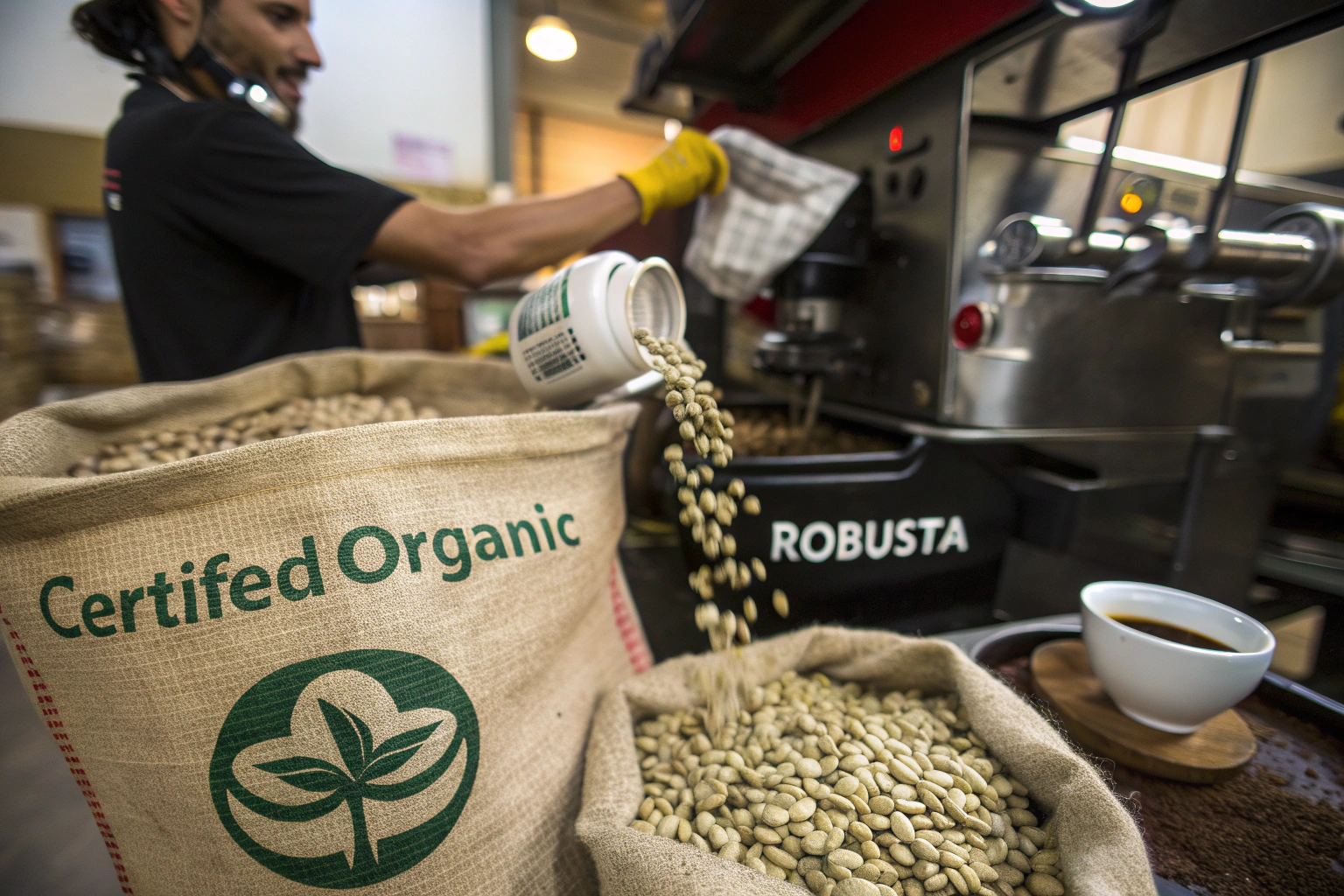
A traditional Italian roaster from Trieste sat across from me at a trade show in Berlin. His family had been roasting espresso for three generations. "My grandfather's blend used fifteen percent Robusta," he told me. "My father's blend used ten percent. My blend uses five percent. I want to push it back up to ten percent, but I cannot find organic Robusta in container volumes that does not taste like burnt rubber. Every sample I get from Vietnam or Uganda cups dirty. Where is the clean organic Robusta?"
I understood his frustration. The organic coffee market is dominated by Arabica. Organic Robusta is rare because the economics are tough. The yield per tree is lower than conventional Robusta. The certification costs are the same whether you grow 10 bags or 10,000 bags. Most Robusta farmers do not bother with organic certification because the premium does not cover the hassle. But the demand is there. Roasters like my Italian friend are searching for it. And a few origins—Yunnan, India, and parts of Latin America—are starting to fill the gap.
Large volumes of certified organic Robusta suitable for espresso crema enhancement are available primarily from Yunnan Province in China, select farms in India, and emerging sources in Ecuador and Mexico, with Chinese organic Robusta currently offering the best combination of volume, cleanliness, and cupping quality at container scale.
If you need 100 bags, 500 bags, or a full container of organic Robusta that cups clean and pulls thick crema, there are specific suppliers and specific origins that can deliver. Let me walk you through the landscape so you can source with confidence.
Why Is Certified Organic Robusta So Hard to Find in Bulk?
Most coffee buyers do not understand why organic Robusta is scarce. They assume that if organic Arabica exists, organic Robusta should exist in similar volumes. The reality is different, and it comes down to agronomy and economics.
Robusta is a hardier plant than Arabica. It tolerates heat, humidity, and pests better. But "better" does not mean "immune." Robusta still gets attacked by coffee berry borer, leaf rust, and various fungal diseases. In conventional production, farmers use synthetic pesticides and fungicides to control these threats. In organic production, those chemicals are prohibited. The farmer must use manual pest control, biological agents, and organic-approved sprays, all of which are more labor-intensive and less effective.
The yield drops. Organic Robusta produces 20 to 30 percent less cherry per tree than conventional Robusta. The labor costs increase because manual weeding and pest control replace chemical applications. The certification costs add a fixed expense that must be amortized over a smaller harvest. The premium price for organic Robusta rarely fully compensates for these added costs. Most farmers do the math and decide it is not worth it.
The scarcity of bulk organic Robusta is driven by the unfavorable economics of organic certification for a low-margin crop, the high labor costs of manual pest and weed control, and the limited number of origins where the climatic conditions allow Robusta to thrive without heavy chemical inputs.
Yunnan is one of the few places where the equation works. Our dry harvest season from November to March naturally suppresses fungal diseases. The berry borer pressure is lower than in the humid lowlands of Vietnam or Indonesia. We can grow organic Robusta with less intervention. The quality is higher. The cup is cleaner. And the organic premium, while modest, is enough to make the business sustainable. For more context on organic coffee economics, the International Coffee Organization occasionally publishes reports on certification trends and price differentials.
What Organic Certifications Matter for Espresso Robusta?
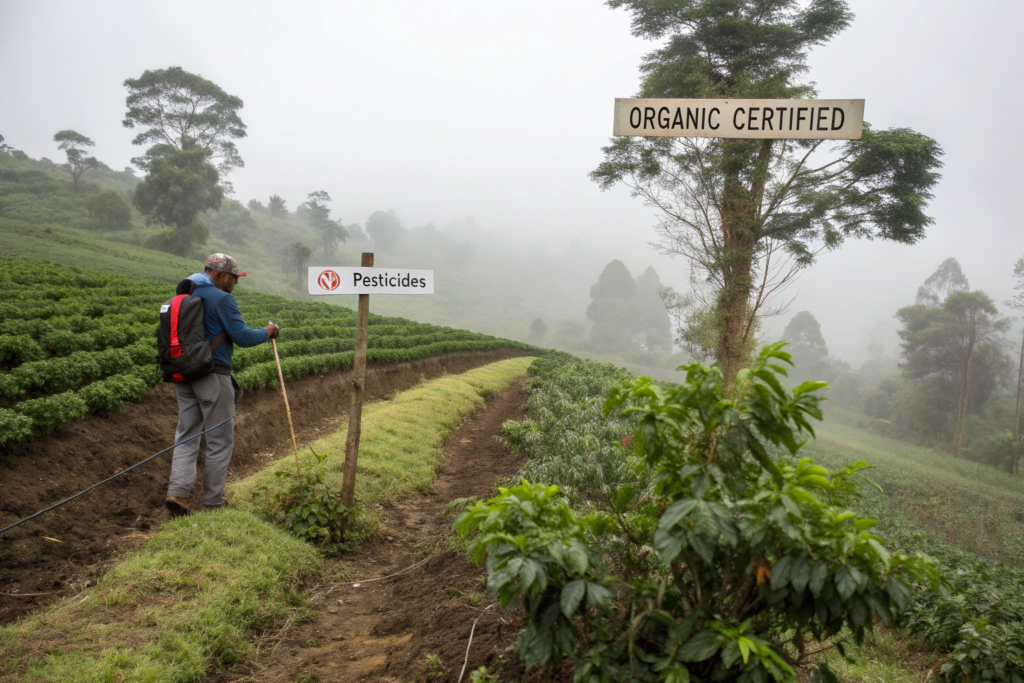
Not all organic certifications are equal. Depending on your market, you need specific logos on your retail bag for your customers to trust the organic claim.
For the US market, USDA Organic is non-negotiable. The certification must be issued by a USDA-accredited certifier. If the Robusta is sold as organic in the United States, the USDA organic seal must be on the documentation. The importer must also handle the coffee through an organic-certified supply chain, from the farm to the warehouse.
For the European Union, the EU Organic logo is required. The standard is similar to USDA but not identical. Coffee certified to one standard does not automatically qualify for the other. However, the EU and US have an equivalence agreement, which simplifies dual certification.
For Japan, JAS Organic is the standard. For Korea, it is the Korean Organic certification. For Canada, the Canada Organic label. If you sell into multiple markets, you need multiple certifications or a certifier who can audit to multiple standards simultaneously.
Our organic Robusta from Shanghai Fumao carries USDA Organic and EU Organic certification. The farm and the processing facility are audited annually. The documentation is available to buyers before shipment. If you need an additional certification like JAS or Canada Organic, we can arrange it through our certifier with advance notice.
Beyond organic, some espresso roasters also want Fair Trade or Rainforest Alliance. These are separate from organic and address labor and environmental standards rather than chemical use. They add cost and complexity. I recommend deciding which certifications your specific customer base actually demands and not over-certifying just for the sake of logos. Every certification adds to the green coffee price. For more on navigating certification requirements, the Specialty Coffee Association has published guides on sustainability certifications and their market value.
How Does Organic Cultivation Affect Robusta Cup Quality?
This is the good news. Organic cultivation, when done well, produces a cleaner-tasting Robusta. The reason is not magic. It is process.
Organic farming prohibits synthetic nitrogen fertilizers. The farmer must use compost, manure, and nitrogen-fixing cover crops. These organic fertilizers release nutrients slowly. The Robusta tree grows at a more moderate pace. The cherries develop over a slightly longer period. The slower growth allows more time for sugar accumulation. The result is a bean with slightly higher sucrose content and a less harsh flavor profile.
The absence of systemic pesticides also matters. Some systemic pesticides are absorbed by the plant and can be present in trace amounts in the green bean. Whether these traces affect cup flavor is debated, but many cuppers report that organic coffees taste cleaner and sweeter. I have cupped organic and conventional Robusta from the same farm, same variety, same processing. The organic lot consistently cups one to two points higher, with less bitterness and a rounder body.
The processing step is equally important. Organic Robusta that is naturally processed—dried in the whole cherry—often tastes harsh and dirty, even if it is organically grown. Organic Robusta that is washed—pulped, fermented, washed clean, and dried in parchment—tastes dramatically better. The washing removes the fruit mucilage before drying, preventing the development of fermented, rotten-fruit notes. Washed organic Robusta is the only type I recommend for specialty espresso blends. For more on processing effects, Perfect Daily Grind has published features on Robusta quality improvement through better processing.
Which Origins Supply the Cleanest Organic Robusta for Crema?
Not all organic Robusta origins are created equal. The flavor, cleanliness, and crema quality vary enormously depending on the altitude, the processing method, and the genetic selection of the Robusta trees.
Vietnam is the world's largest Robusta producer. But finding clean, organic, washed Robusta from Vietnam is extremely difficult. Most Vietnamese Robusta is naturally processed on a massive scale. The focus is volume and low cost, not cup quality. The organic Robusta from Vietnam that I have cupped tends to be earthy, rubbery, and harsh. It works for instant coffee. It does not work for a specialty espresso blend.
India is a better source for quality organic Robusta. The Kaapi Royale and Parchment Robusta grades from Karnataka are often washed and can cup surprisingly clean. The organic certification infrastructure in India is well-established. The volumes are available. The cup quality is generally good—heavy body, mild cocoa notes, low bitterness. The challenge is pricing. Indian organic Robusta is typically more expensive than Chinese, due to higher labor costs and strong domestic demand.
Yunnan, China is currently the leading origin for clean, washed, certified organic Robusta in container volumes, combining high altitude growing conditions that mellow the harsh Robusta flavors, modern washed processing infrastructure, and competitive FOB pricing that makes the organic premium manageable for espresso blenders.
Ecuador and Mexico are emerging origins for organic Robusta. The volumes are small but growing. The cup quality from Ecuadorian washed organic Robusta can be excellent—clean, mild, with a surprising sweetness. The logistics from Latin America to US ports are simpler than from Asia, which can offset a higher FOB price. For roasters on the US East Coast, Latin American Robusta may have a landed cost advantage.
Why Is Yunnan Organic Washed Robusta a Top Choice?
Altitude is the secret. Most Robusta in the world grows below 800 meters. The low elevation and warm temperatures produce a fast-growing, high-yielding tree. The beans are large but harsh. The flavor is aggressive, bitter, and often rubbery. That is classic commodity Robusta.
Our organic Robusta in Baoshan grows at 900 to 1,100 meters. This is considered high for Robusta. The cooler temperatures slow the cherry maturation. The beans develop more sugar and less harsh chlorogenic acid. The cup is mellower, rounder, and cleaner. It still has the heavy body and powerful crema that Robusta is known for, but without the aggressive bite.
Washed processing makes the difference between a Robusta that can be used in specialty blends and one that cannot. Our organic Robusta is pulped, fermented for twelve to eighteen hours, washed in clean mountain water, and dried on raised beds for ten to fourteen days. The mucilage is fully removed. The drying is slow and even. The final bean is clean, uniform, and free of the fermented, earthy notes that plague naturally processed Robusta.
The cup profile of our organic washed Robusta is mild and neutral—toasted grain, a hint of unsweetened cocoa, no rubber, no earth, no harsh bitterness. The body is extremely heavy and syrupy. The crema production is exceptional. For the roaster blending at 10 to 15 percent into an Arabica base, this Robusta adds texture, crema, and caffeine without adding off-flavors. That is the entire value proposition. You can explore more about how Yunnan is positioning itself in the coffee world at the International Coffee Organization.
How Do Indian and Ecuadorian Organic Robustas Compare?
Indian organic Robusta, particularly the Kaapi Royale grade, has a different character. The beans are often larger. The processing is washed and polished, giving the beans a clean, almost shiny appearance. The cup profile tends toward darker, more intense notes—dark chocolate, roasted nuts, sometimes a hint of spice. The body is heavy. The crema is thick but sometimes slightly paler than Chinese Robusta.
The challenge with Indian organic Robusta is consistency. The quality can vary lot to lot depending on the curing works and the specific region. Some lots cup very clean. Others show a slight earthy or baggy note that only becomes apparent after roasting. Working with a trusted Indian exporter who cups every lot before shipment is essential.
Ecuadorian organic Robusta is the newcomer. The volumes are small—maybe a few containers per year. But the quality is intriguing. Grown at moderate altitudes in the coastal highlands, Ecuadorian washed Robusta cups with a surprising sweetness. The body is heavy. The crema is thick and dark. The flavor is milder than Indian Robusta, with notes of milk chocolate and caramel rather than dark chocolate and spice.
The landed cost for Ecuadorian Robusta into US Gulf or East Coast ports is competitive because of shorter shipping distances. For a US-based roaster, the logistics advantage may offset a slightly higher FOB price. The volumes are still too small for large-scale blending programs, but for smaller specialty roasters, Ecuadorian organic Robusta is an option worth cupping.
How to Evaluate Organic Robusta Samples for Espresso Blending?
Cupping Robusta requires a different mindset than cupping Arabica. If you apply the same sensory expectations, you will reject every Robusta sample. The goal is not to find a Robusta that tastes like Arabica. The goal is to find a Robusta that tastes clean for Robusta and contributes the desired attributes to your blend.
The first evaluation is visual. The green beans should be uniform in size and color. Avoid lots with many broken beans, insect-damaged beans, or beans with black or sour-looking discoloration. The beans should be screen size 16 or larger for good crema production. Smaller beans produce less crema and tend to roast unevenly.
The second evaluation is the dry fragrance. Grind a sample and smell it. Clean organic Robusta should smell neutral to slightly grainy. It should not smell rubbery, earthy, moldy, or fermented. Any harsh or unpleasant aroma in the dry fragrance will be amplified in the cup.
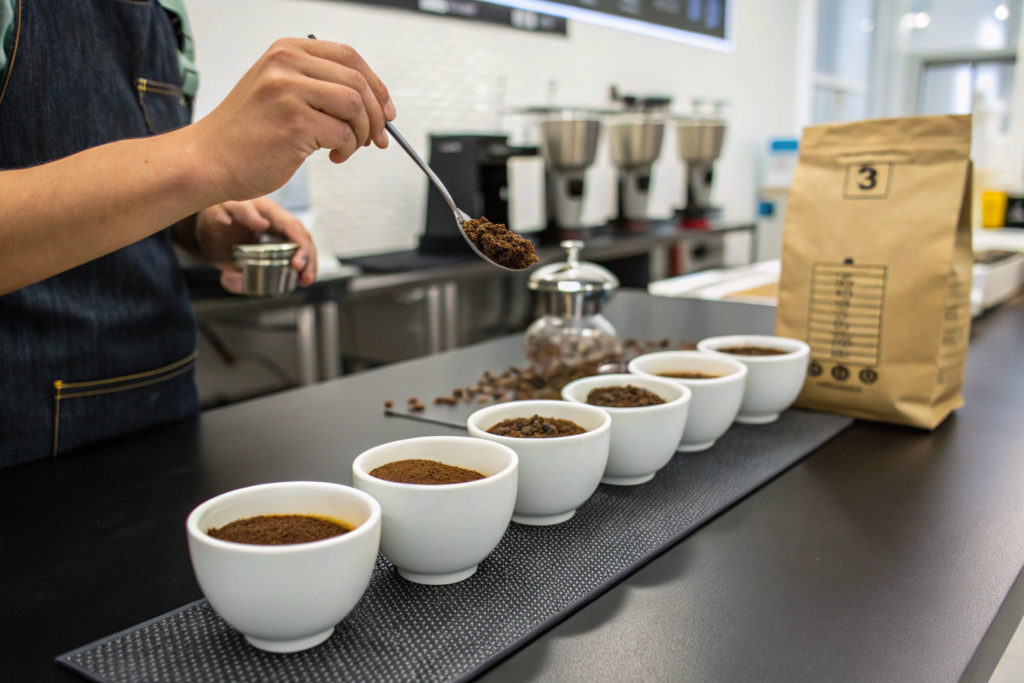
To properly evaluate organic Robusta for blending, cup it at 100 percent strength first to detect any defects, then cup it blended at your target ratio—usually 10 to 15 percent—with your Arabica base to evaluate crema quality, body enhancement, and overall balance rather than tasting the Robusta in isolation.
The third evaluation is the cupping at 100 percent. Slurp the Robusta straight. It will be intense. That is okay. You are looking for defects, not flavor complexity. The cup should taste clean—grain, cocoa, maybe a hint of nuts. It should not taste rubbery, ashy, or chemically bitter. The body should be heavy and coating. The aftertaste should be neutral, not harsh or lingering in an unpleasant way.
What Crema Tests Should You Perform Before Buying?
Crema is the functional reason you are buying Robusta. You should test it objectively, not just observe it casually.
Pull a shot of your 100 percent Arabica espresso blend. Photograph the crema immediately after the shot finishes. Photograph it again after 30 seconds. Photograph it again after 60 seconds. Note the color, the thickness, and the persistence. This is your baseline.
Now prepare a test blend. Add 10 percent of the Robusta sample to your Arabica base. Pull a shot. Photograph the crema on the same timeline. Compare the photos side by side. The Robusta blend should show noticeably darker color, thicker texture, and longer persistence. The tiger-stripe pattern should be more pronounced. After 60 seconds, the Arabica-only crema will be mostly dissipated. The Robusta blend crema should still be present as a thin, even layer.
If the 10 percent Robusta addition does not visibly improve crema, the Robusta is either low quality or stale. Fresh, high-quality Robusta has an immediate and obvious crema effect.
Also taste the shots. The Robusta blend should taste fuller, heavier, and more intense. The Arabica flavors should still be present. The Robusta should not dominate or introduce off-notes. If the blend tastes worse than the Arabica alone, the Robusta is not right for your program. For more on espresso evaluation protocols, the Specialty Coffee Association provides cupping forms and brewing standards that can be adapted for blend assessment.
What Are the Common Defects in Organic Robusta Lots?
Organic Robusta is susceptible to specific defects, some of which are processing-related and some of which are storage-related.
The most common defect is mold. Organic farming prohibits synthetic fungicides. If the drying is not fast and even, mold can develop on the cherries or the parchment. Moldy Robusta tastes musty, earthy, and unclean. It is not the pleasant earthy-spice note of a wet hulled Sumatra. It is a flat, stale, unpleasant flavor that ruins a blend. Check every sample for moldy notes.
The second common defect is insect damage. Coffee berry borer is a major pest in Robusta. Organic farms use biological controls, but they are not always fully effective. Borer-damaged beans have small holes and dark spots. They taste sour and harsh. A high percentage of borer damage makes a lot unusable.
The third defect is age. Organic Robusta is produced in small volumes. Some lots sit in warehouses for months or years before being sold. Aged Robusta tastes flat, papery, and stale. The crema production drops. The body thins. Check the harvest date. Ask how the coffee has been stored. Freshness matters for Robusta just as it does for Arabica.
The fourth defect is uneven processing. Some organic Robusta lots are a mix of washed and natural beans, or a mix of different screen sizes. The unevenness causes uneven roasting, which creates a mix of scorched and underdeveloped beans in the finished blend. The green should be uniform. For defect identification guides, the Green Coffee Association provides detailed visual and sensory defect references.
How Much Organic Robusta Should You Order for Your Espresso Program?
Ordering the right volume of organic Robusta requires calculating backward from your espresso sales and your target blend ratio. Do not guess. The math is simple and the consequences of over-ordering are significant because Robusta fades faster than Arabica.
First, determine your annual espresso bean usage. If you roast 50,000 pounds of coffee per year and espresso is 60 percent of your production, your annual espresso volume is 30,000 pounds. If your target Robusta percentage in the blend is 10 percent, you need 3,000 pounds of organic Robusta per year.
Second, decide your shipment frequency. Organic Robusta, like all Robusta, has a shorter shelf life than washed Arabica. I recommend ordering enough for three to six months of use. For 3,000 pounds per year, a six-month supply is 1,500 pounds. That is roughly 11 bags of 60-kilogram bags, or about 11 bags.
Calculate your annual organic Robusta requirement by multiplying your total espresso green coffee volume by your target Robusta blend percentage, then divide by your preferred shipment frequency per year—most roasters order three to six months of supply at a time to ensure freshness and manage cash flow.
Third, build in a buffer. If your usage is 1,500 pounds per six months, order 1,800 pounds. Usage fluctuates. A shipment delay could leave you short. A small buffer prevents running out of a critical blend component.

How Do You Calculate the Ideal Ratio for Your Blend?
Start with 10 percent as your baseline. Pull shots. Cup the blend. Taste with milk. Evaluate the crema. Assess customer feedback.
If the crema improvement is noticeable but the Robusta flavor is not detectable, your ratio is in the right zone. Increase to 12 or 15 percent if you want more crema and body. Decrease to 5 to 8 percent if the Robusta character starts to peek through the Arabica flavors.
The optimal ratio depends on your Arabica base. A dark-roasted Brazilian natural base can absorb more Robusta without the Robusta flavor showing. A light-roasted washed Ethiopian base will reveal the Robusta much more quickly. Test with your specific base coffee, not a generic formula.
Also test over time. The Robusta character in a blend can become more noticeable as the roasted coffee ages. A blend that tastes balanced one week after roast might taste Robusta-forward three weeks after roast. Test your blend at multiple age points before finalizing the ratio. For more on blend development, the Coffee Quality Institute provides sensory training that covers blend design and component interaction over time.
What Is the Minimum Order Quantity for Organic Robusta?
Minimum order quantities for organic Robusta vary by supplier, but they are generally larger than for specialty Arabica micro-lots because Robusta is a lower-margin product.
Most suppliers will ship a single pallet—roughly 10 to 15 bags of 60 kilograms, or 600 to 900 kilograms total—as a minimum trial order. The per-pound cost will be higher at this volume because the fixed shipping costs are amortized over fewer bags. But it allows you to test the Robusta in your blend before committing to a larger volume.
For ongoing supply, the minimum practical order is typically 50 to 100 bags, or roughly one-third to one-half of a 20-foot container. A full 20-foot container holds approximately 300 bags of 60 kilograms, or about 18 metric tons. If your annual Robusta usage is less than a full container, you can either pay a premium for less-than-container-load shipping or partner with another roaster to split a container.
The Shanghai Fumao team offers flexible order volumes for organic Robusta. We ship single pallets for trial orders and full container loads for established blending programs. Cathy Cai can provide current FOB pricing for different volume tiers and help you determine the most cost-effective shipment size for your usage rate.
Conclusion
Organic Robusta in bulk for espresso crema is available, but it requires sourcing from the right origins and verifying quality through rigorous cupping and crema testing. Yunnan, China is currently the most reliable source for clean, washed, certified organic Robusta in container volumes, with India and Ecuador offering smaller but respectable alternatives.
The key is to find a Robusta that cups clean at 100 percent, performs visibly in a crema test at 10 to 15 percent blend ratio, and is backed by the organic certifications your market requires. The volume you order should match your annual espresso usage, calculated with a simple formula, and ordered in three-to-six-month increments to maintain freshness.
If you are ready to cup a sample of organic washed Robusta from Yunnan and test it in your espresso blend, contact Cathy Cai at BeanofCoffee. She can send a green sample with current cupping scores, USDA and EU organic certification documentation, and FOB pricing for your target volume. She can also advise on blend ratios and roast profiles based on your specific Arabica base. Her email is cathy@beanofcoffee.com. She responds quickly and ships samples within a week. The crema test will tell you everything you need to know.