You see it on bags all the time now. "Anaerobic 72-hour fermentation." "Extended ferment." "Wild yeast process." It sounds exotic. It sounds expensive. And sometimes, it tastes like rotten fruit and vinegar. You buy a pallet of this experimental stuff, and your roastery smells like a dumpster behind a winery. Your customers complain. You lose money. So, what went wrong? The fermentation time pushed too far. That's the monster hiding under the fancy marketing. Long fermentation is a high-stakes gamble. And for a commercial buyer like you, the house usually loses.
Extended fermentation times—anything beyond the standard 12 to 36 hours for washed coffee—multiply the risk of over-fermentation defects. We are talking acetic acid build-up, mold onset, and the total collapse of the bean's cellular structure. The official Specialty Coffee Association defects list calls these "stinker" beans, "sour" beans, and "moldy" beans. When you push past 48 hours, you stop developing pleasant fruit notes and start flirting with rotting. The bean absorbs the metabolic waste of bacteria. It soaks in its own decomposition juice. The clean, crisp acidity turns sharp and vinegary. The body turns thin. The finish turns dirty. You cannot roast this away. You cannot blend it out. The defect is molecular. It is glued to the seed.
But here is the nuance. Not all long ferments are disasters. There is a difference between controlled extended fermentation in a sealed, chilled tank and a farmer just leaving cherries in a plastic bag under the sun for three days. The temperature, the pH, the yeast strain—every variable matters. When we process specialty lots at Shanghai Fumao, we cap our ferment times conservatively. Why? Because we prioritize a clean, stable, export-grade product. We know your cupping room in Portland is waiting to pass or fail this container. A funky, risky profile might win a competition for one roaster. But it can also ruin a 10,000-kilo contract for another. Let's look at the science of why longer almost never means safer.
What Chemically Happens When Coffee Ferments Too Long?
Fermentation in coffee is basically controlled digestion. Yeast and bacteria eat the sugars in the mucilage—the sticky fruit layer stuck to the parchment. They produce alcohol, carbon dioxide, and organic acids. In a normal, 24-hour wash, you get a clean lactic acid profile. Think yogurt, not vinegar. The pH drops slowly. The environment stays stable. But when you stretch this to 72 hours, the microbial party goes through phases. The first 24 hours are yeast-dominant. Sweet, fruity. By hour 48, the yeast is dying from its own alcohol. Bacteria take over.
The bacterial shift is where the risk explodes. Acetic acid bacteria convert ethanol into acetic acid. Vinegar. A tiny bit adds complexity. A lot adds a sharp, nasal sting. At the same time, if oxygen sneaks in, clostridium bacteria can grow. These are the butyric acid producers. Butyric acid smells like vomit. Rancid parmesan. It is incredibly potent. A few stinker beans can contaminate an entire batch. They are impossible to sort electronically because the density might still look normal. Only a human nose catches them. And by then, the coffee is already bagged and on the boat.
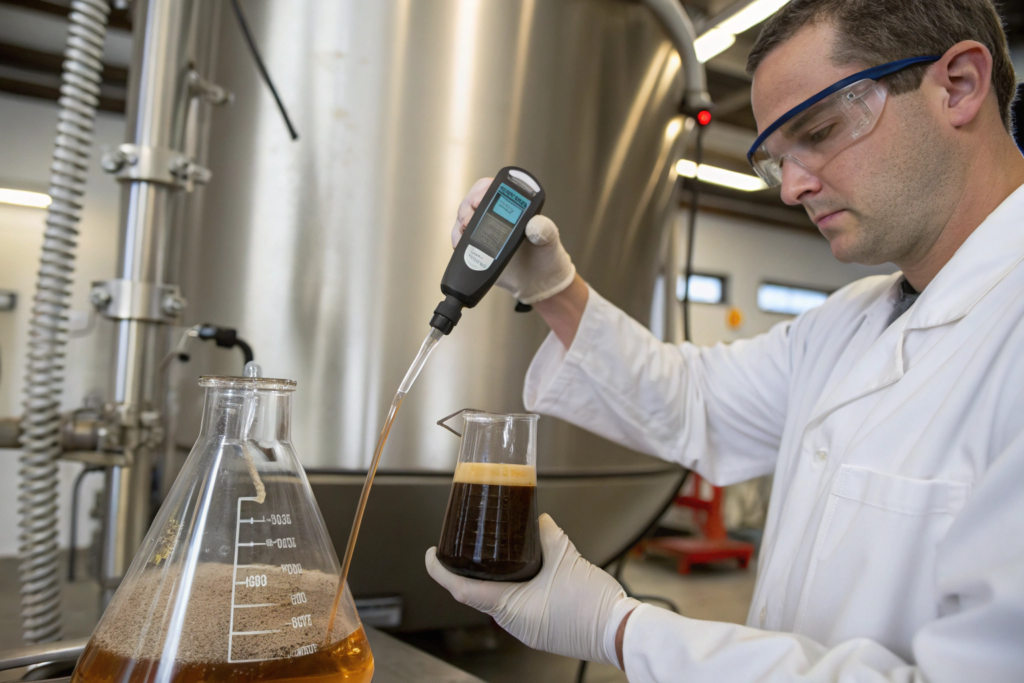
Another chemical reaction gets ignored: lipid oxidation. Coffee has oils. When the bean sits in a wet, warm, acidic bath for too long, the cell walls degrade. The oils migrate to the surface and oxidize. Oxidized oils taste like old peanuts. They smell like cardboard. This defect doesn't show up in the green bean visually, but it kills the cup's sweetness. It makes the coffee taste flat and aged, even if it's fresh crop. This is why our protocol at Shanghai Fumao monitors pH every two hours during fermentation. When the curve starts to bend toward acetic acid, we stop. We wash. We don't chase a trend. We chase a clean cup.
How Does Over-Fermentation Specifically Impact the Roasting Process?
You put a bean with over-ferment defects into a hot drum. It does not behave. The first thing you notice is the smell. The steam that comes off during the drying phase smells sour. Not bready. Not sweet grass. Sour and slightly cheesy. That's the volatile acetic acid flashing off. Then, at first crack, the beans don't pop evenly. Their structure is compromised. The cell walls are weakened from the extended acid bath.
Think of it like a sponge. A healthy bean is a firm sponge. It absorbs heat and expands uniformly. An over-fermented bean is a soggy sponge. It has micro-fractures. When you apply heat, these weak spots scorch. The outside chars before the inside is developed. You get a bean that is black on the tip and green in the crease. The roast color is mottled. No profile can fix this. If you drop it early, it's grassy. If you drop it late, it's ashy. There is no sweet spot.
And then there is the carry-over. The sour aroma from the roast exhaust sticks to the walls of your roaster. It contaminates the next batch. You have to purge the system. You waste time and energy. For a production roaster running 200-kilo batches, running a load of over-fermented beans can screw up your whole day's schedule. It's a business disruption, not just a quality one. The SCA Roasting Handbook highlights the importance of green bean integrity for even heat transfer. A bean with structural damage is already a roasting defect waiting to happen.
Can You Visually Identify a Long-Ferment Defect in Green Beans?
Sometimes. But not always. That's the trap. A really badly over-fermented bean will have a brownish color. The parchment might be stained red or purple. The silverskin might be dark and loose. If you rub the beans in your hands, they might smell faintly of vinegar or stale wine. But a moderately over-fermented bean looks almost normal. Maybe slightly dull. Maybe a bit paler. But under normal warehouse lighting, it can pass a visual check.
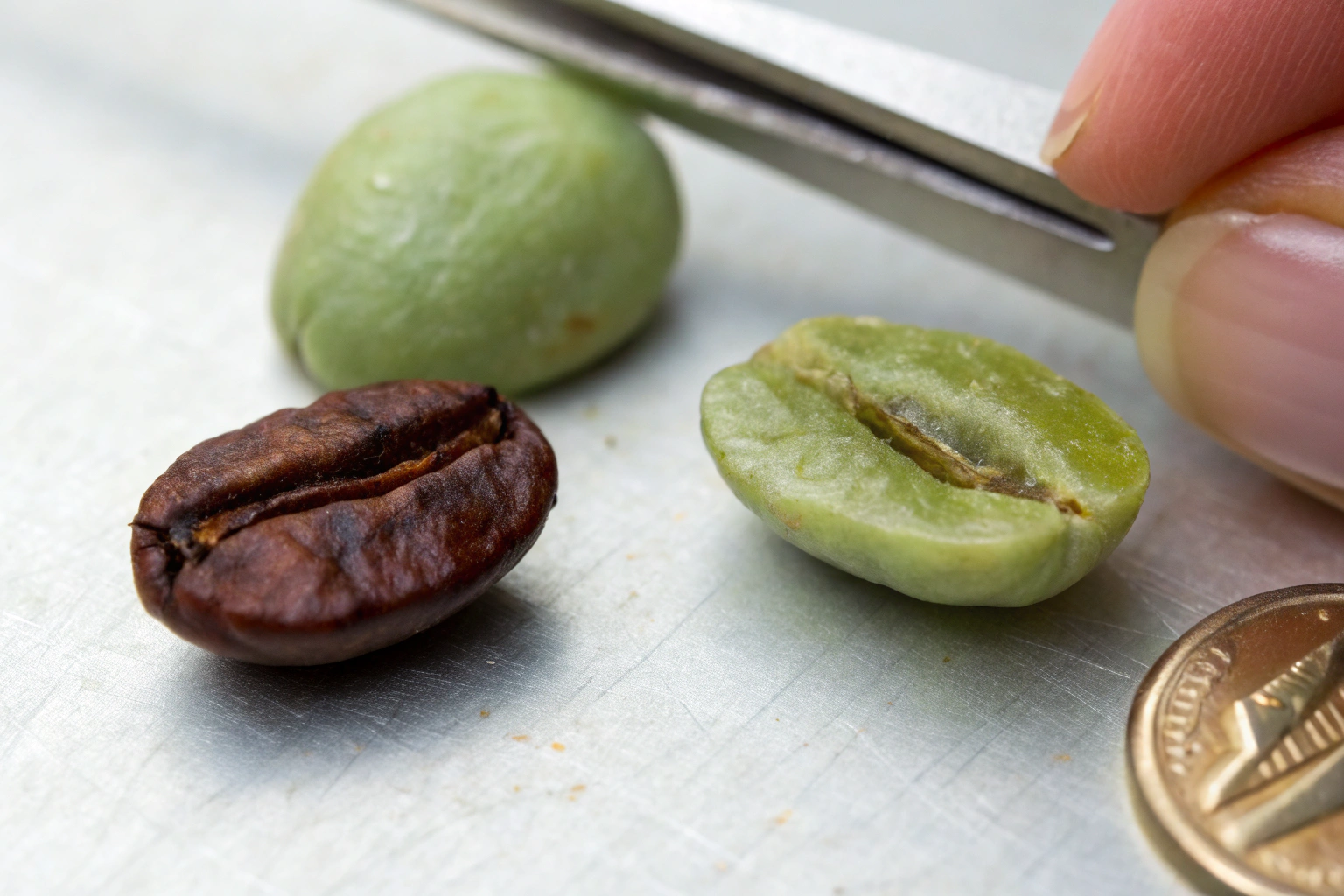
The most reliable visual cue is the embryo. Cut the bean in half. Look at the tiny rootlet in the center. In a healthy bean, it is white or pale yellow. In an over-fermented bean, it turns dark brown or black. The embryo is the most sensitive tissue. It dies first when the fermentation acids attack. If you see a black embryo, that bean is a stinker. Guaranteed. It will taste like rotten onion and ash.
This is why we cross-cut samples from every lot before shipment. We don't just do a green grading for screen size and defects. We take a blade and cut 50 beans. We check the embryos. If more than one is dark, the lot goes into commercial grade, not specialty. It's a brutal test, but it protects you. Most specialty buyers rely on this simple, physical check. It's faster than waiting for mold cultures to grow. For more on green grading standards, the Arabica Green Coffee Defect Handbook is a solid reference. It shows you exactly what to look for.
Is There a Safe Way to Produce an Extended Ferment for Export?
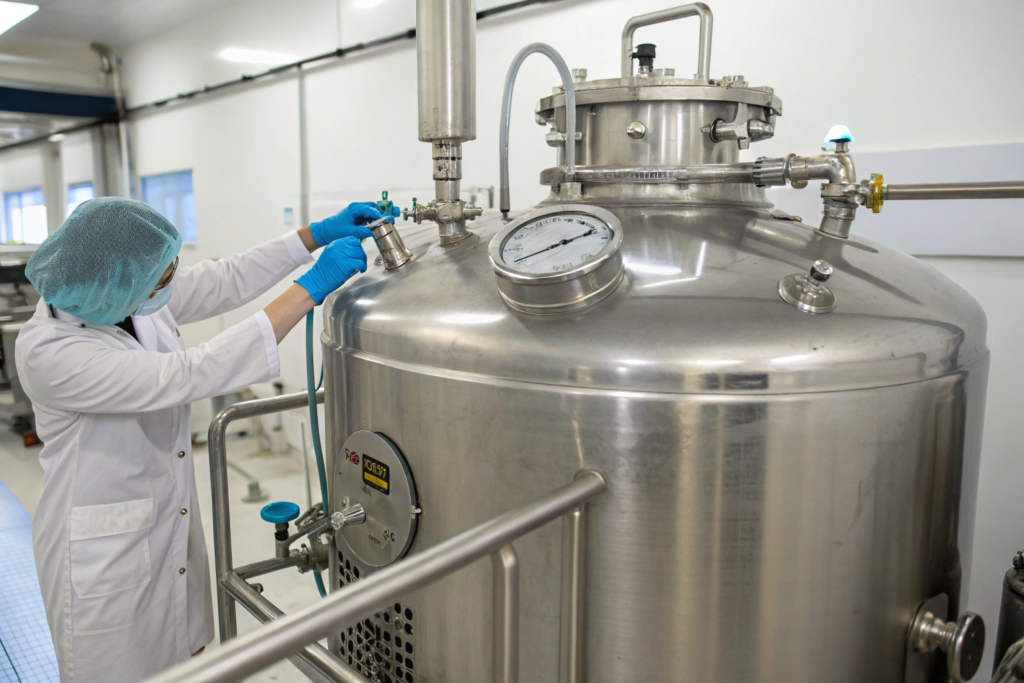
Yes. But it is expensive, and it requires lab-level control. You cannot just leave a pile of depulped coffee under a tarp and call it "extended honey anaerobic." That is a recipe for waste. To safely extend fermentation, you need a sealed, oxygen-free tank. Stainless steel. You need to inject an inert gas like nitrogen or carbon dioxide to push out the oxygen. You need to chill the tank to slow down bacterial activity while letting specific yeasts work. And you need a starter culture. A known, lab-grown yeast. Saccharomyces cerevisiae, for example. Not wild, random microbes from the farm's ambient air.
This controlled environment allows you to push to 72 or even 96 hours without runaway acidity. The yeast you selected produces the esters you want—pineapple, mango, tropical notes—without producing the acetic acid you don't want. But here's the catch. This process raises the cost per kilo significantly. The tank is expensive. The gas is expensive. The lab work is expensive. It only makes sense for a micro-lot that scores above 88 points and sells for $10 or more per pound FOB. It is not a process for a container of Office Coffee Service base blend. It is a niche product. A high-risk, high-reward experiment.
For our core export business, we avoid this tightrope. We focus on a classic washed process with a clean, crisp profile. We can do a controlled maceration for 24 to 36 hours in clean water. That develops a bright, malic acidity without any risk of rot. It is safe. It is repeatable. It is the backbone of a reliable supply chain. Unless a buyer specifically wants a high-octane, funky ferment and is willing to pay the premium and accept the natural batch variation, we steer them to our standard washed. It's the honest choice. The Specialty Coffee Association's processing standards acknowledge that extended fermentation requires strict monitoring. If you don't have the sensors, don't do it.
What Role Does Water Temperature Play in Fermentation Speed?
Water is the accelerator. Warm water speeds up fermentation. Cold water slows it down. This is the simplest, most powerful lever you have. If you process coffee in a hot climate—like Yunnan in the summer—your fermentation tanks can heat up to 30 degrees Celsius. At that temperature, bacteria breed like crazy. A 24-hour ferment in warm water can taste like a 60-hour ferment in cool water. It can get away from you fast.
So we do something simple. We use cold mountain water. Our water source in Baoshan comes from mountain springs. It is naturally cool, even in summer. We aim to keep the fermentation tank between 18 and 22 degrees Celsius. This temperature range favors yeast activity over bacterial activity. It stretches the window of safety. You can ferment for 36 hours at 20 degrees and get a clean, sweet profile. If you do 36 hours at 30 degrees, you are likely drinking vinegar. It is not just about the time on the clock. It is the time multiplied by the temperature. That's the real equation. Cold water is a quality insurance policy. We use it generously.
How Does Humidity During Drying Compound Fermentation Defects?
The coffee is fermented. It's washed. Now it has to dry. If the fermentation was perfect, but the drying is too slow and too humid, you still get defects. High humidity drying creates a breeding ground for surface mold. The beans are damp. They sit in a thick layer on the patio. The air doesn't move. The outer surface of the bean stays wet for days. This reactivates any residual bacteria from the fermentation phase. It's like a second fermentation, but uncontrolled, on the surface of the bean.
This process can produce phenol defects. Phenols taste like medicine. Band-aids. Chlorine. They are potent. They cover up any nice fruit notes. You might cup a coffee that was fermented nicely but dried poorly, and you will taste a mix of fruit and antiseptic. It's confusing. It is also a defect. To prevent this, we use raised African beds with excellent airflow. We cover the coffee during the hottest part of the day to prevent cracking. We rake it frequently. We use mechanical dryers as a backup only, and always at low temperatures. The goal is to get the moisture down to 12% within a reasonable window—about 8 to 12 days for washed coffee. If it drags past two weeks, the risk of phenol taint skyrockets. For more on drying mechanics, the CQI processing course has great modules on moisture management during post-harvest.
How to Write a Coffee Contract That Protects Against Fermentation Defects
You do not want to pay for a container of vinegar beans. So your contract must be a fortress. The standard FOB contract says "Arabica, Grade 1." That is not enough. Grade 1 covers screen size and physical defects. It does not cover taste. It does not cover fermentation defects. You need a specific sensory clause. You need to define rejection criteria based on cup quality, not just green appearance.
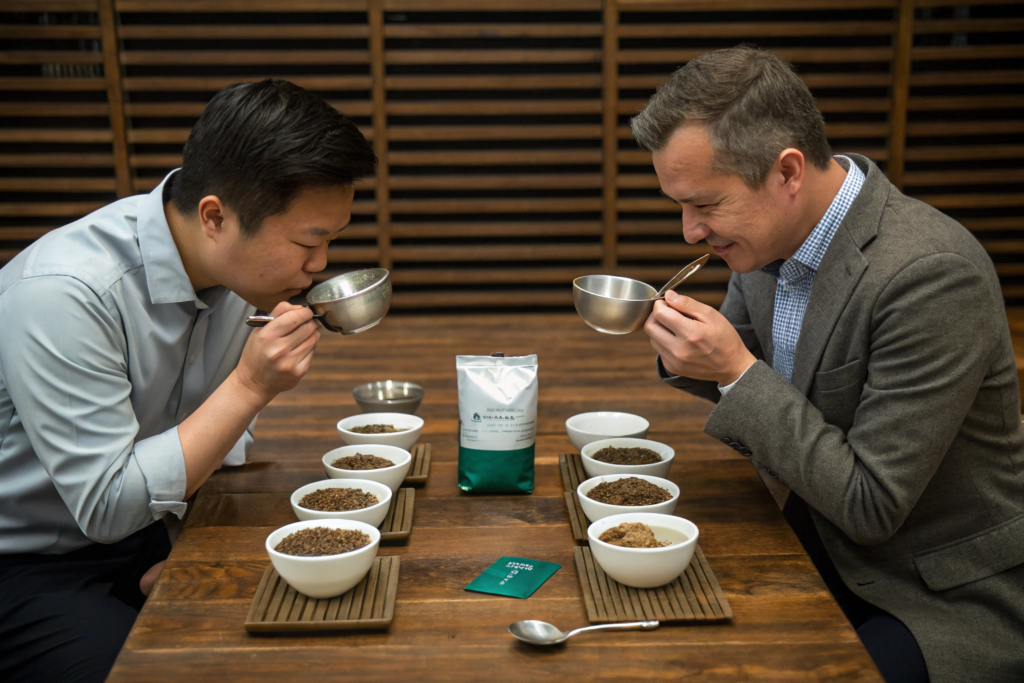
The contract must state the acceptable cup profile. "Coffee shall exhibit a clean cup, free from ferment, phenol, and stinker defects." It must also specify the testing method. "Evaluation based on a pre-shipment sample, roasted to Agtron 55, cupped per SCA protocols." This gives you a legal leg to stand on. If the pre-shipment sample tastes clean, but the arrival sample tastes like fermented garbage, something happened in transit. But if the pre-shipment sample already has a hint of vinegar, you reject it before it ever leaves the port. You do not pay.
We welcome these clauses. We insist on them. A buyer who has a tight contract is a buyer who understands coffee. It protects both of us. It sets clear expectations. There is no argument. There is just the spoon. We cup the sample together—either physically at the warehouse or via express sample—and we sign off. That sample is sealed and kept as a reference. If the container is ever challenged, we open the reference sample and cup again. It resolves disputes fast. For standard contract language, the Green Coffee Association contracts provide templates. Modify them to include your sensory requirements. Don't rely on a handshake.
What Pre-Shipment Lab Tests Should You Request from a Chinese Exporter?
When the coffee is ready to ship, you need proof. Not just a promise. Request a water activity test. Aw below 0.65 ensures no mold growth. Request a moisture content test. 10% to 12% is the target. Request an Ochratoxin A and Aflatoxin panel. ND (non-detect) is the only acceptable result. These three tests cover the safety basics. They prove the coffee is stable and clean.
But for fermentation risks, you also need a sensory report from a certified Q-grader. The report should have a score and, more importantly, a description of the acidity and cleanliness. Look for words like "clean," "balanced," "bright." Alarm bells go off for words like "fermenty," "vinegary," "over-ripe," "medicinal." A Q-grader's nose is your first line of defense. They can detect a single stinker bean in a 350-gram sample. We provide these reports for every lot as standard practice at Shanghai Fumao. We also keep a retention sample in a temperature-controlled room for 12 months. If you ever have a question, we can pull that sample and re-test. It is traceability. It is accountability.
How Does Packaging Interact with Residual Ferment Activity?
This is a sneaky one. You have coffee that is technically dry. 11% moisture. But there is still a tiny amount of residual microbial activity on the surface of the bean. Spores. Dormant bacteria. You seal it in a GrainPro bag. The bag heats up in the container. The dormant bugs wake up. They start metabolizing again. They produce gas. The bag inflates. Not like a balloon about to pop, but you feel the pressure. That gas is often carbon dioxide mixed with volatile off-gasses from the microbial activity.
When you open that bag three months later, you get a whiff of a weird, stale, funky note. It dissipates, but the seed has absorbed some of it. The coffee doesn't taste fresh. It tastes tired. This is a low-grade fermentation defect that happens after the fact. To prevent it, we ensure the coffee is not just dry, but stable. We let it rest in parchment for at least 30 days after drying. This resting period allows the internal moisture and microbial activity to reach a true, dead equilibrium. Then we mill and bag. This patience eliminates the post-bagging inflation issue. It is a hidden step that many suppliers skip because they want to ship fast. Speed is the enemy of stability. A stable bean in a hermetic GrainPro bag is inert. It stays exactly as it was the day it was sealed.
Conclusion
Chasing the myth of the "extended fermentation" for a commercial coffee contract is like playing with fire. You might get a beautiful, tropical fruit bomb. But you are more likely to get a container full of vinegary, structurally damaged beans that no roaster wants and no office worker will drink. The risks—acetic acid development, stinker beans, structural collapse during roasting, and post-packing spoilage—are real, chemical, and largely irreversible. They cannot be fixed by a clever roast profile or a dark roast disguise. They are baked into the seed.
We have walked through the chemistry of what happens when fermentation runs wild, how to spot the visual and sensory defects, and how to build a contract that protects your investment. The message is not that fermentation is bad. Fermentation is essential. It is what separates a high-quality washed Arabica from a dirty, cheap commodity bean. But controlled, conservative fermentation is a craft. Extended, experimental fermentation is a gamble. For a steady, reliable supply chain that your customers depend on, you want the craft. You want the clean, sweet, chocolatey consistency of a well-managed wash.
If you want to source coffee that is fermented for flavor, not for risk, let's talk. We can send you samples of our standard washed process, and if you are truly curious, a small sample of a controlled extended ferment so you can taste the difference yourself. But I will warn you: the clean, classic profile will probably win your daily drinking cup. Contact our export director, Cathy Cai, at cathy@beanofcoffee.com. She will set up a cupping kit shipment immediately.