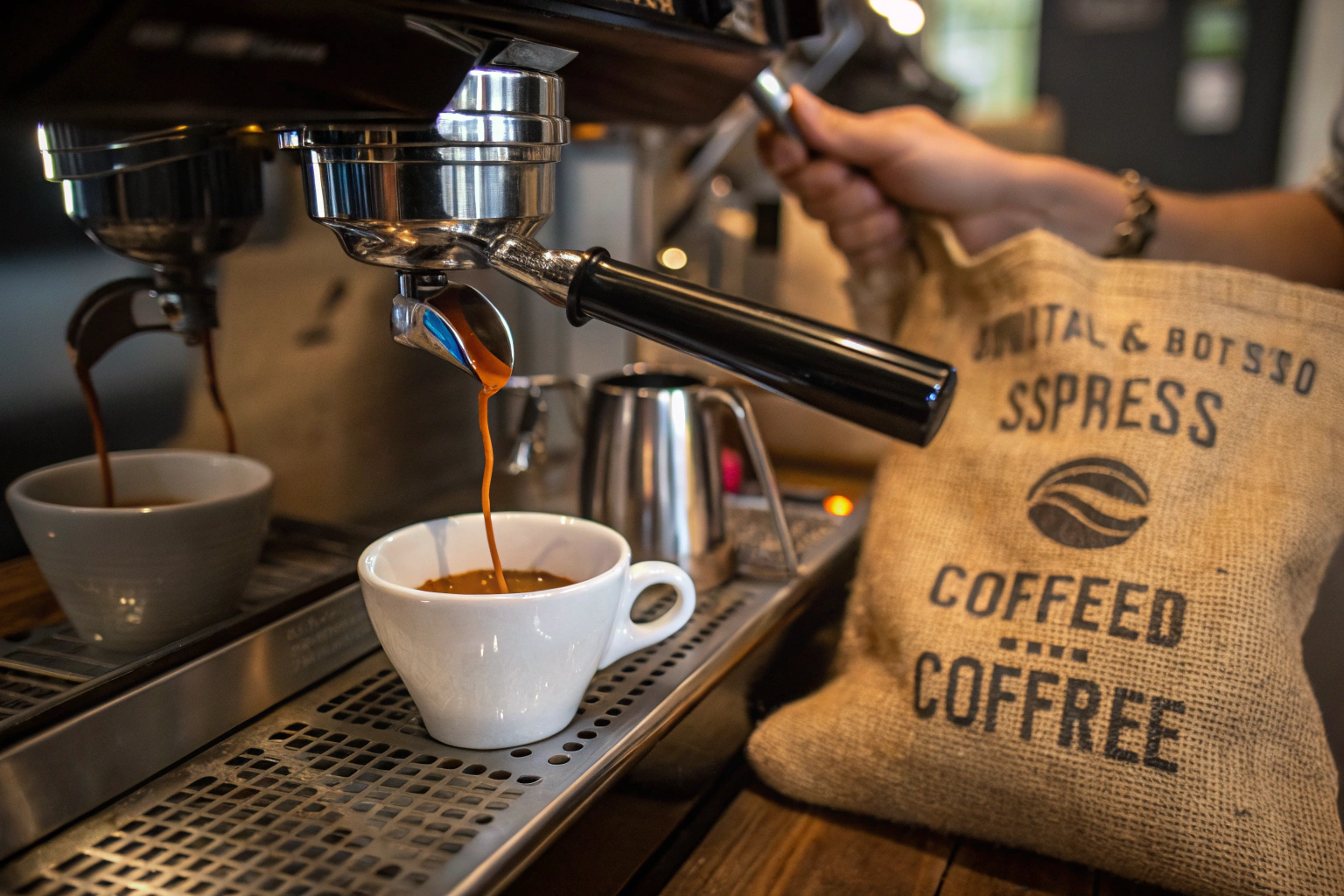
A roaster from a well-established Italian-style espresso company in Chicago sat at my cupping table last year. He had been blending the same 60 percent Brazil natural, 40 percent Colombia washed formula for over a decade. "It is consistent," he said. "My customers trust it. But I am losing shelf space to younger roasters. Their espresso bags say 'fruit bomb' and 'jammy body.' Mine says 'smooth and balanced.' I need to evolve without alienating my base. What can a natural process base really do for my blend?"
I poured him a shot of our natural processed Catimor. He watched the crema develop. He tasted it. He set the cup down. "This is 100 percent Arabica natural?" he asked. "It has the body of a blend with Robusta. And the sweetness is... different. Not chocolate. More like dried berries and caramel." He took notes. He ordered samples. Three months later, his new "Heritage Red" espresso blend launched with 30 percent Yunnan natural. His customers loved it. His shelf space expanded.
Roasters are switching to natural process coffees for espresso blends because naturals deliver a heavier, syrupy body, enhanced perceived sweetness, and complex fruit notes that add depth and differentiation to the shot, all while producing a thicker, more persistent crema that visually signals quality to the customer.
This is not a rejection of washed coffee. It is an expansion of the espresso blending toolkit. Naturals offer attributes that washed coffees, even excellent ones, cannot easily replicate. Here is exactly what those attributes are, how they improve the espresso shot, and how to integrate naturals into your own blend program.
What Does Natural Process Add to Espresso Body and Mouthfeel?
Body is the tactile sensation of weight and texture on the tongue. In espresso, body is one of the most important sensory attributes because it determines whether the shot feels satisfying or thin, rich or watery. Natural processed coffees consistently produce heavier body than washed coffees from the same origin and variety. This is not a matter of opinion. It is a measurable physical difference driven by the processing method.
During natural processing, the whole cherry is dried with the fruit mucilage intact. The mucilage is rich in polysaccharides—complex carbohydrates that contribute to body—and lipids. Over the 15 to 25 days of drying, these compounds migrate from the mucilage into the bean. The bean absorbs polysaccharides and lipids that would have been washed away in a washed process. The result is a green bean with a higher concentration of body-building compounds.
When this bean is roasted and extracted under pressure, those polysaccharides and lipids dissolve into the espresso. They create a thicker, more viscous liquid. The mouthfeel is heavier, creamier, and more coating. The sensation lingers on the palate longer. The body of a natural processed espresso can rival that of a blend that includes Robusta, but without the rubbery or bitter notes that commodity Robusta often brings.
Natural process adds body to espresso by allowing polysaccharides and lipids from the cherry mucilage to migrate into the bean during extended drying, creating a heavier, creamier mouthfeel that persists in milk drinks and provides the tactile richness that espresso drinkers associate with quality.
For an espresso blender, this body enhancement is transformative. A blend that previously relied on a percentage of Robusta or a heavy-bodied Indonesian bean for texture can now achieve similar or better body using a natural Arabica. The flavor is cleaner. The crema is still thick. The body is still satisfying. The blend becomes 100 percent Arabica, which carries marketing advantages in the specialty market. For more on the chemistry of coffee body, the Specialty Coffee Association has published sensory science resources that explain the role of polysaccharides and lipids in mouthfeel.
How Does Natural Process Affect Crema Persistence and Texture?
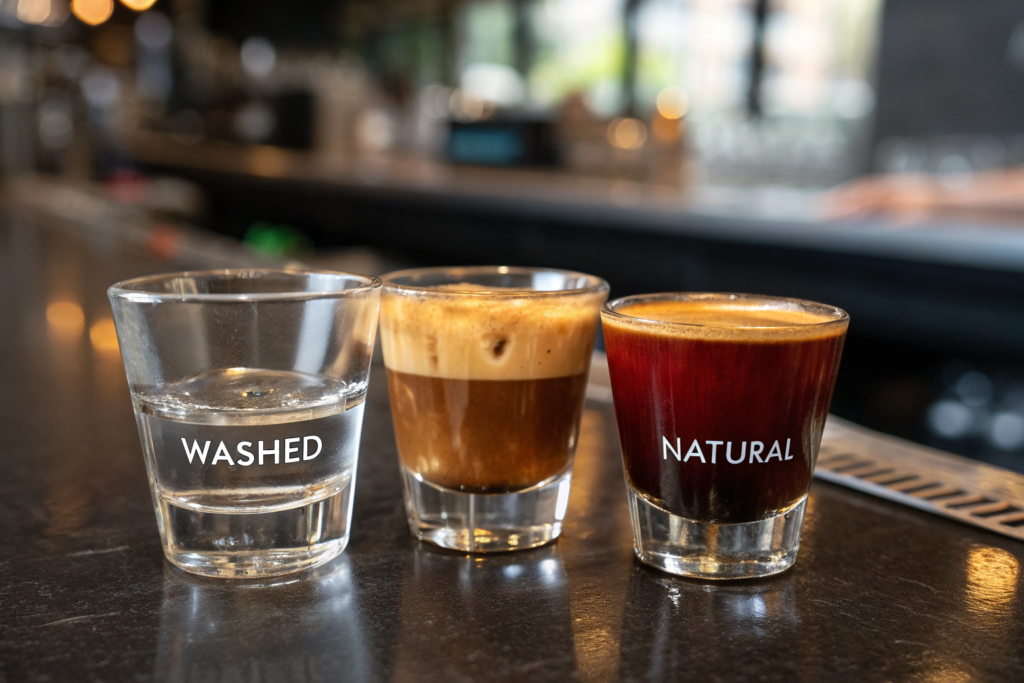
Crema is the emulsion of coffee oils, sugars, and carbon dioxide that forms on top of an espresso shot. It is the first thing the customer sees. A thick, persistent crema signals freshness and quality. A thin, quickly dissipating crema signals the opposite. Natural processed coffees tend to produce more crema, with better persistence, than washed coffees.
The reason traces back to the lipids and polysaccharides absorbed during drying. These compounds act as emulsifiers and stabilizers. They help the gas bubbles in the crema maintain their structure. The bubbles are smaller, more uniform, and more stable. The crema layer is thicker and lasts longer in the cup.
The color of the crema also changes. Natural processed coffees typically produce a darker, more reddish-brown crema compared to the lighter, more tan crema of washed coffees. The darker crema is visually striking. It photographs well. It looks like the crema that traditional espresso drinkers expect from a high-quality shot.
I have pulled side-by-side shots of our washed and natural Catimor from the same harvest, same roast level, same grinder setting. The washed shot produces decent crema—maybe half an inch, lasting 45 seconds. The natural shot produces a thicker crema—three-quarters of an inch, lasting over a minute. The tiger-stripe pattern is more pronounced. The visual difference is immediately obvious. In a café setting, where the customer watches the shot being pulled, that visual difference influences perception of quality and value.
Why Does Natural Process Sweetness Complement Milk Better?
Milk changes coffee. The fat and lactose in milk coat the tongue and mute certain flavors while amplifying others. High acidity, which can taste bright and pleasant in a black espresso, can taste sour and curdled when milk is added. Bitterness, which can provide structure in a black shot, can become harsh and unpleasant in milk.
Natural processed coffees have a different sweetness profile than washed coffees. The sweetness is heavier, more fruit-driven, and more caramel-like. This type of sweetness complements milk beautifully. The fruit notes—dried berry, stone fruit, honey—cut through the milk fat without clashing. The heavy body of the natural coffee stands up to the creamy texture of the milk. The reduced acidity of the natural prevents the sour-milk interaction that plagues high-acid washed espressos in milk drinks.
A flat white or cappuccino made with a natural-based espresso blend tastes richer, sweeter, and more decadent than the same drink made with a washed-based blend. The customer may not be able to articulate the difference, but they perceive the drink as smoother and more satisfying. They are more likely to order it again.
I have watched this play out in cafés that use our natural Catimor in their espresso blend. The baristas report that customers who previously added sugar to their lattes stop adding sugar. The natural sweetness of the coffee is enough. The drink tastes complete without modification. For a café, this means fewer customer requests for sugar, simpler service, and a cleaner flavor experience.
Which Natural Process Coffees Work Best for Espresso Blends?
Not every natural processed coffee works well as an espresso blend component. Some naturals are too wild, too fermented, or too acidic to integrate smoothly into a blend. The best natural espresso components share certain characteristics.
The natural should be clean. This is non-negotiable. A natural with ferment defects, mold, or excessive acetic acid will ruin a blend. The ferment notes, which might be subtle in a filter brew, become aggressive and unpleasant under the intense extraction of espresso. The natural should cup clean at 82 points or above, with no off-flavors.
The natural should have heavy body and moderate to low acidity. High acidity naturals can taste sour and unbalanced in espresso. Low acidity naturals with heavy body provide the texture and sweetness that improve the blend without introducing harshness.
The natural should have a flavor profile that complements the other components of the blend. A natural with intense blueberry notes may dominate a blend. A natural with dried fruit, caramel, and chocolate notes integrates more smoothly and adds complexity without taking over.
The best natural process coffees for espresso blends are clean, heavy-bodied, and moderate in acidity, with flavor profiles of dried fruit, caramel, and chocolate that integrate smoothly with washed base components rather than dominating the blend.
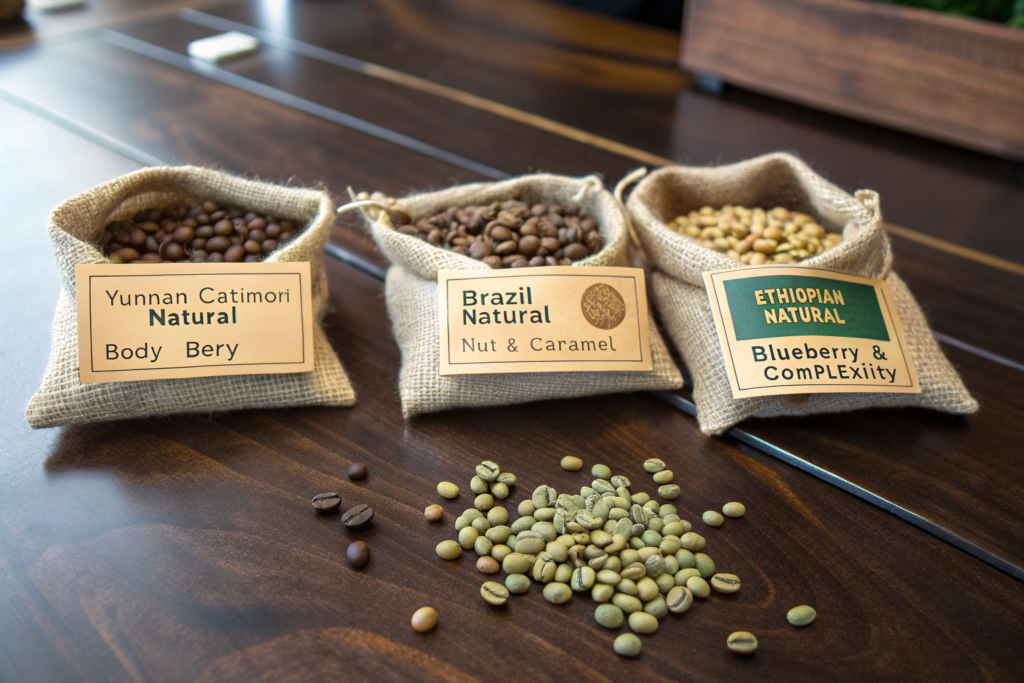
Brazilian naturals are the traditional choice for espresso blends. They have low acidity, heavy body, and notes of chocolate, nut, and caramel. They are reliable, available in large volumes, and reasonably priced. A Brazilian natural at 40 to 60 percent of a blend provides a solid, sweet foundation.
Why Is Yunnan Natural Catimor a Rising Star for Espresso?
Our natural processed Catimor from Baoshan is gaining traction among espresso blenders for several reasons. The cup profile is ideally suited to espresso. The pricing is competitive. The traceability is direct.
The flavor profile of Yunnan natural Catimor sits somewhere between a Brazilian natural and an Ethiopian natural. It has the heavy body and chocolate undertone of a Brazilian, but with more fruit character—dried strawberry, mango, honey. The fruit notes add complexity without the wild, fermented character that can make Ethiopian naturals challenging in espresso. The acidity is present but soft, providing structure without sourness.
The body is exceptional. Our high-altitude Catimor, grown at 1,500 to 1,600 meters, has naturally dense beans. The natural processing adds polysaccharides and lipids. The result is a coffee with a syrupy, coating body that rivals a wet-hulled Sumatra but with a cleaner, fruitier flavor.
The crema production is outstanding. Shots pulled with our natural Catimor produce thick, dark, persistent crema with pronounced tiger striping. The crema enhances the visual appeal of the shot and contributes to the smooth mouthfeel.
For a roaster currently using a Brazil base with a washed Central American accent, replacing the Brazil with Yunnan natural can shift the blend toward more fruit complexity and heavier body without losing the chocolate and nut foundation. For more on espresso blend design, Perfect Daily Grind has published articles on modern approaches to espresso blending.
Can You Use 100 Percent Natural Coffee for Espresso?
A 100 percent natural espresso is a specific product for a specific customer. It is not for everyone. But for the right roaster and the right audience, it can be a signature offering.
A 100 percent natural espresso has intense body, pronounced fruit sweetness, and a complex, sometimes wild flavor profile. The crema is thick and dark. The shot tastes like a concentrated version of the coffee's natural fruit character. It is a sensory experience that is distinctly different from a traditional espresso.
The challenge is balance. A natural that tastes balanced as a filter coffee may taste overwhelmingly fruity or fermenty as an espresso. The pressure extraction amplifies certain flavor compounds. A natural with even a hint of ferment can taste aggressively funky in the cup.
For a successful 100 percent natural espresso, the natural must be exceptionally clean and balanced. It should have enough body to carry the fruit notes. It should have low enough acidity to avoid sourness. It should be roasted to a level that develops the sugars fully without burning off the fruit character.
I recommend that roasters test their natural lots as 100 percent espressos before committing to a blend. If the natural tastes great as a pure espresso, it will shine in a blend. If the natural tastes harsh or unbalanced as a pure espresso, it needs to be blended with washed components to smooth the edges. The pure espresso test reveals the true character of the natural.
How Do You Adjust Roast Profiles for Natural Espresso Components?
Natural processed beans roast differently than washed beans. The differences in density, sugar content, and bean structure require adjustments to the roast profile. A roaster who applies the same profile to a natural and a washed lot will get different results—and not necessarily good ones.
Natural beans are typically less dense than washed beans from the same origin and altitude. The extended fruit contact during drying alters the bean's cell structure. The bean becomes slightly more porous. Heat penetrates more quickly. The roast can race if the profile is not adjusted.
The higher sugar content of natural beans also affects the roast. The sugars caramelize more readily. The Maillard reaction may proceed faster. The risk of scorching the sugars is higher if the heat is too aggressive. The roast must be managed carefully to develop the sugars into caramel and chocolate notes without burning them into carbon.
Roasting natural processed coffee for espresso requires a lower charge temperature, a gentler heat application during the drying phase, and careful management of the Maillard phase to fully develop the sugars into caramel and chocolate without scorching, with a target medium to medium-dark Agtron reading of 50 to 60.
I recommend a charge temperature 5 to 10 degrees Celsius lower for natural beans than for washed beans of the same origin. The drying phase should be extended slightly to ensure even moisture removal from the more porous structure. The rate of rise should be moderate and declining, avoiding any spikes that could scorch the sugars.
The target roast level for espresso is medium to medium-dark. Agtron whole-bean reading of 50 to 60. This is slightly darker than a filter roast. The additional development caramelizes the sugars fully, building the chocolate and caramel notes that provide the foundation of an espresso blend. The roast should not enter second crack territory, where oils migrate to the surface and the fruit character is lost.

Should You Roast Blend Components Separately or Together?
This is one of the most debated questions in espresso blending. The answer depends on the specific components and the roaster's quality goals.
Pre-blending—mixing the green beans and roasting them together—is simpler and faster. One roast batch. One set of adjustments. One lot to track. But pre-blending requires compromise. The natural and washed beans in the blend have different densities, different moisture contents, and different optimal roast profiles. Roasting them together forces the roaster to choose a profile that is not optimal for either component. The result is acceptable but rarely exceptional.
Post-blending—roasting each component separately to its ideal profile and then blending the roasted beans—is more work but produces a better cup. The natural component can be roasted to the medium-dark level that maximizes its body and sweetness. The washed component can be roasted to a slightly lighter level that preserves its acidity and origin character. The Robusta component, if used, can be roasted to its own optimal profile. The roasted beans are then blended at the target ratio.
I recommend post-blending for premium espresso blends. The additional labor is justified by the superior cup quality. The natural component is roasted perfectly for what it is. The washed component is roasted perfectly for what it is. The blend expresses the best of both.
For high-volume production blends, pre-blending may be the practical choice. The roaster should cup the pre-blended result against the post-blended result and decide whether the quality difference justifies the additional labor. The answer depends on the specific coffees, the target price point, and the customer's quality expectations. For more on blending strategies, Cropster allows roasters to track different profiles for blend components.
What Development Time Maximizes Body and Sweetness in Naturals?
Development time—the period after first crack—is where body and sweetness are built. For natural processed espresso components, the development time should be longer than for a filter roast but carefully managed to avoid baking.
I recommend a development time ratio of 16 to 20 percent for natural espresso components. This is longer than the 14 to 16 percent typical for washed espresso components. The extended development allows the polysaccharides to break down into body-building compounds. It allows the sugars to caramelize fully into the chocolate and caramel notes that define a great espresso.
The development must be active, not passive. The rate of rise must remain positive throughout development. The bean temperature should continue to climb, but at a declining rate. If the rate of rise crashes to zero, the roast stalls. The beans bake. The body becomes thin and the sweetness becomes flat.
I target a final rate of rise of 2 to 4 degrees Celsius per minute at the drop. The drop temperature for a natural espresso component is typically 215 to 220 degrees Celsius, depending on the specific bean and the target flavor profile. The Agtron whole-bean reading should be 50 to 55.
The development phase should be monitored closely. Pull a sample with the trier every 15 seconds after first crack ends. Smell the beans. Look at the color. The aroma should shift from bready to caramel to chocolate. The moment the chocolate note peaks and before any sharp or acrid note appears is the moment to drop.
How to Market a Natural Process Espresso Blend to Customers?
Marketing a natural process espresso blend requires a different approach than marketing a traditional espresso. The customer expectation for "espresso" is often dark, bitter, and intense. A natural espresso is sweeter, fruitier, and more complex. The marketing must bridge the gap between expectation and reality.
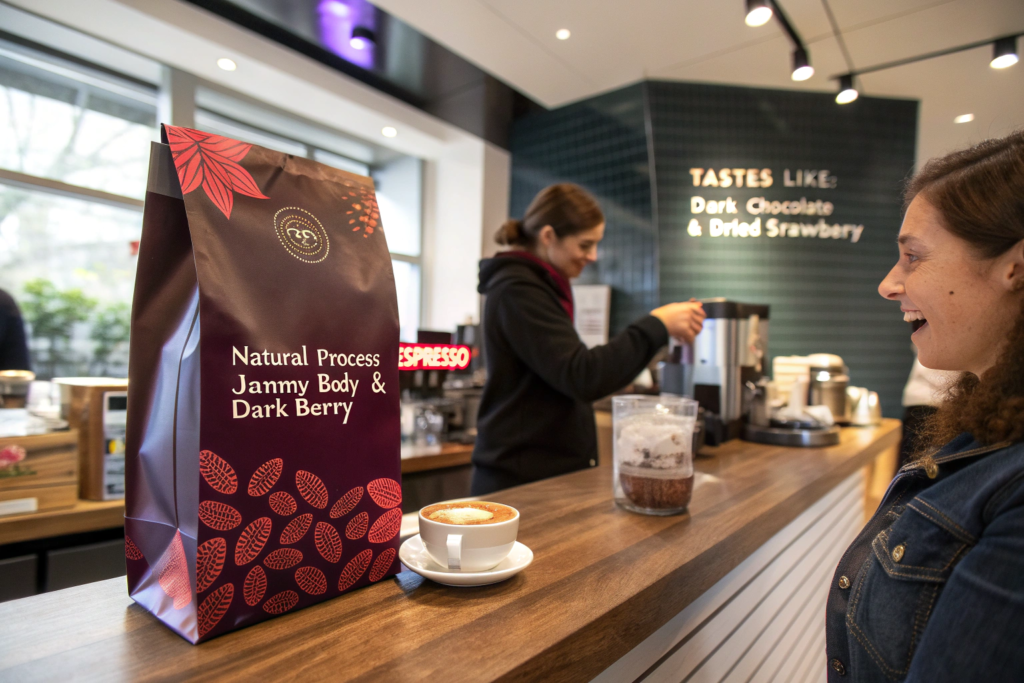
The bag label should lead with flavor, not process. "Natural Process" is a technical term that means nothing to most consumers. "Dark Berry & Dark Chocolate Espresso" means something. The flavor descriptor sets the expectation. The customer anticipates a unique experience. When the shot delivers the berry and chocolate notes, the customer is satisfied.
The story on the back of the bag should explain, in simple terms, why this espresso tastes different. "We use coffee dried inside the whole cherry, like a raisin. This ancient method builds intense sweetness, heavy body, and notes of dried fruit that shine in milk and taste incredible on their own." Three sentences. No jargon. The customer understands the value proposition.
Effective marketing of natural espresso blends replaces process jargon with indulgent flavor descriptors, tells the natural drying story in simple, food-friendly terms, and offers brewing guidance that helps the customer replicate the café experience at home.
The bag should also include serving suggestions. "Try this espresso as a straight shot to taste the berry sweetness, or in a cappuccino to experience the rich, chocolatey body." The customer who buys the bag has a roadmap for enjoying it. They are more likely to have a positive experience and become a repeat buyer.
In the café, the barista should offer a small sample of the natural espresso to customers who order a traditional espresso drink. "We just switched to a new espresso blend. It is a little different—sweeter, with berry notes. Want to try a sip?" The sample converts the skeptical customer. The taste is the proof.
What Flavor Descriptors Sell Natural Espresso Without Sounding Weird?
The language used to describe natural espresso to consumers should be familiar, appetizing, and specific. Abstract or technical descriptors confuse and alienate. Familiar food references invite and reassure.
Instead of "fermented fruit notes," say "dried strawberry" or "raspberry jam." Everyone knows what strawberry jam tastes like. It is a positive, delicious association.
Instead of "winey acidity," say "juicy" or "bright." Winey suggests alcohol, which some customers do not want in their coffee. Juicy suggests fresh fruit, which is universally appealing.
Instead of "heavy body," say "creamy" or "velvety." Heavy body sounds technical. Creamy and velvety sound indulgent. They describe a texture the customer wants to experience.
Instead of "low acidity," say "smooth" or "mellow." Low acidity sounds like a deficiency. Smooth sounds like a benefit.
The descriptor list for a Yunnan natural espresso might read: "Dark chocolate, dried strawberry, and honey sweetness. Creamy body. Smooth, long finish." Every word is familiar. Every word is positive. The customer can imagine the taste before buying the bag. That is the goal. For more on consumer coffee language, the National Coffee Association publishes annual reports on what flavor descriptors resonate with specialty coffee consumers.
How Do You Explain the Natural Process in a Single Sentence?
The explanation of natural processing should be brief, visual, and focused on the benefit to the consumer. The customer does not need a microbiology lesson. They need a reason to care.
My recommended one-sentence explanation: "We dry this coffee inside the whole cherry, like a raisin, which gives it a naturally sweeter, fruitier taste and a richer body."
That is it. Four concepts in one sentence. The coffee is dried inside the fruit. The process is natural—it uses the sun and the cherry itself, not chemicals or additives. The benefit is sweeter, fruitier taste and richer body. The analogy is raisins, which everyone understands.
If the customer wants more detail, a second sentence can add: "It is the oldest way of processing coffee, and when done carefully, it creates flavors that no other method can."
The explanation is simple, honest, and benefit-focused. It does not talk down to the customer. It does not confuse them. It answers the question "Why does this coffee taste different?" in a way that makes the difference sound desirable.
Conclusion
The shift toward natural process coffees in espresso blends is not a fad. It is a logical evolution driven by the sensory advantages that naturals bring to the cup. Heavier body. More persistent crema. Sweeter, fruitier flavor that complements milk. Greater differentiation in a crowded market. These are real, measurable benefits that improve the customer experience and strengthen the roaster's brand.
Yunnan natural Catimor is emerging as a particularly valuable tool for espresso blenders. It delivers the body and crema of a traditional base component with the fruit complexity of a premium accent coffee. It is clean, consistent, and available at a competitive price with direct traceability.
Integrating naturals into an espresso program requires adjustments to sourcing, roasting, and marketing. The right naturals must be selected—clean, heavy-bodied, moderate acidity. The roast profiles must be adapted to the lower density and higher sugar content. The marketing must translate the processing story into consumer-friendly language that focuses on flavor and benefit.
If you are curious about how our natural processed Yunnan Catimor performs as an espresso component, contact Cathy Cai at BeanofCoffee. She can send you a sample of our current natural lot, along with roast recommendations and cupping notes focused on espresso attributes. She can also discuss blend ratios, pricing for volume orders, and forward booking for your ongoing program. Her email is cathy@beanofcoffee.com. She responds quickly and can help you explore whether natural espresso is right for your lineup.