I was in a meeting with a large European distributor a few years ago. He was buying containers of coffee from all over the world. He was not a specialty micro-roaster. He was a volume player, supplying supermarkets and office coffee services. He told me, "I cannot afford to buy only Fair Trade or Organic. My customers will not pay that premium. But I also cannot afford to be linked to deforestation or child labor. I need a baseline. I need to know that every container I buy is not going to blow up my reputation." That was the moment I fully understood the power of the 4C certification. It was not about charging a premium. It was about eliminating catastrophic risk at scale.
The 4C (Common Code for the Coffee Community) certification is critically important for mainstream coffee distributors because it provides a globally recognized, independently audited baseline of sustainability that eliminates the worst practices from the supply chain—deforestation, forced labor, and banned pesticides—at a low cost and high volume, allowing distributors to de-risk their entire portfolio and meet the minimum sustainability requirements of major retailers and regulators without paying a specialty-level premium.
It is the entry-level sustainability standard that makes responsible sourcing possible at the scale of mainstream coffee. Let me explain exactly what it is, what it verifies, and why it is a smart business decision for a volume distributor. At Shanghai Fumao, we hold 4C certification because we understand the needs of this market, and you can learn more about our commitment on our Sustainability page.
What Is the 4C "Baseline Standard" and What Does It Verify?
In the hierarchy of coffee certifications, the 4C standard is not the penthouse. It is the solid, safe, and non-negotiable foundation of the building. It is deliberately designed as a baseline—a clear, verifiable set of minimum requirements that any responsible coffee farmer should be able to meet. It is not about being "elite." It is about being decent.
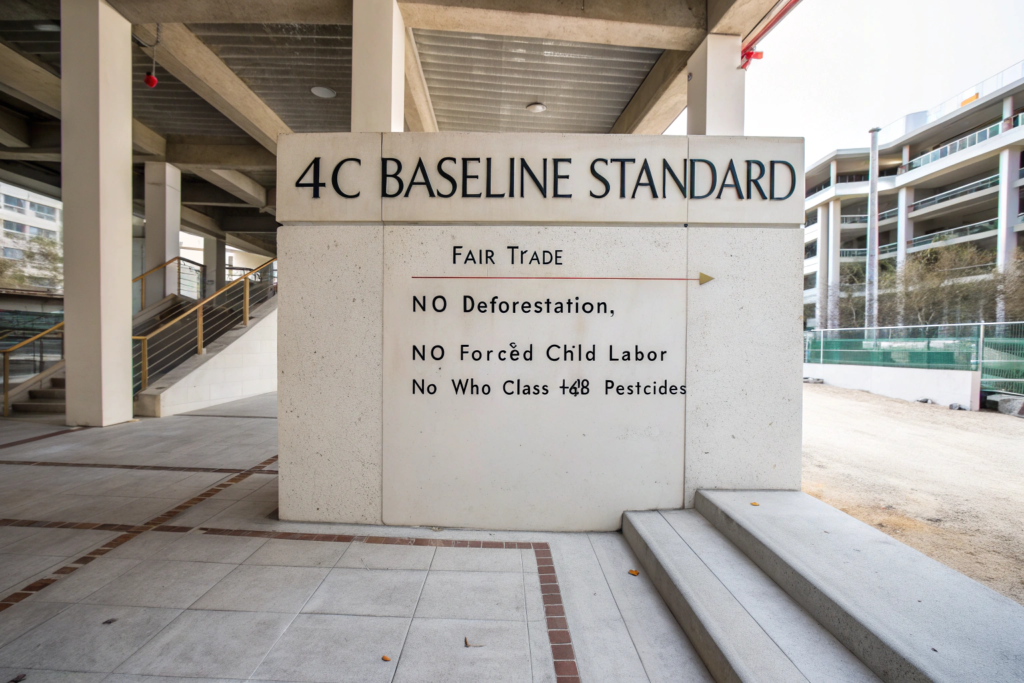
The 4C "Baseline Standard" verifies that coffee has been produced according to a core set of 27 principles that prohibit destructive and unethical practices, focusing on three key pillars: environmental responsibility (specifically banning deforestation and protecting primary forests), social responsibility (eliminating child and forced labor and ensuring basic worker safety), and economic responsibility (promoting transparency and farm management).
It is a "thou shalt not" standard. It draws a clear red line that participating farms and distributors agree not to cross. It eliminates the worst outcomes, creating a safe, defensible supply chain.
How Does 4C's "Zero Deforestation" Principle Protect a Distributor's Supply Chain?
This is arguably the single most important principle for a large distributor in the current regulatory and market climate. Deforestation is the greatest reputational and regulatory risk in the coffee supply chain. The 4C standard makes a clear, audited commitment against it.
- The Clear Principle: The 4C standard strictly prohibits any deforestation or conversion of natural forests for coffee production after a 2014 cut-off date. This is a black-and-white rule, not a vague suggestion. You can read more about these regulations on the European Commission's Deforestation page.
- The Audit Verification: On a 4C certified farm like ours, this is not just a promise. During the annual, third-party audit conducted by an independent certification body, our farm is physically inspected. The auditor checks our land-use records and verifies them with satellite imagery and GPS data. They confirm that our coffee production area has not expanded into any native forest.
- The Benefit for the Distributor: When you buy a container of 4C certified coffee from Shanghai Fumao, you are buying a product with a verified, independently audited guarantee that it is not contributing to deforestation. As the EU's Deforestation Regulation (EUDR) comes into full effect, requiring this exact data for every shipment entering the European market, a 4C certified supply chain acts as a powerful, pre-validated compliance tool. It transforms a potential supply chain liability into a documented, compliant asset.
How Does the Standard's Ban on Forced Labor and Unsafe Practices Mitigate Brand Risk?
For a mainstream distributor supplying major supermarket chains, a single exposé about child labor or unsafe working conditions on a source farm can destroy a brand and result in lost contracts. The 4C standard provides a robust, audited defense against this existential threat.
- Prohibited Practices: The 4C standard explicitly bans the use of child labor and any form of forced or compulsory labor, in accordance with core International Labour Organization (ILO) conventions. It also mandates that workers have the right to freedom of association and collective bargaining.
- Mandated Health & Safety: Beyond just ethical treatment, the standard requires that all farm workers receive formal health and safety training and are provided with, at minimum, access to clean drinking water and sanitary facilities. The use of the most hazardous WHO Class 1A and 1B pesticides is strictly banned.
- The Auditor's Verification Process: These are not just paper policies. During the annual audit, the independent inspector conducts private, confidential interviews with a random selection of our farm workers, away from management. They ask direct questions about their pay, working conditions, and any potential safety hazards. This is the true power of a third-party certification. It gives you, the buyer, credible assurance that the social standards are being met, not because the farmer says so, but because an independent investigator has verified it. This is a critical element of our Quality Control philosophy, which extends beyond just the physical bean.
How Does 4C Provide a Cost-Effective, High-Volume Sustainability Solution?
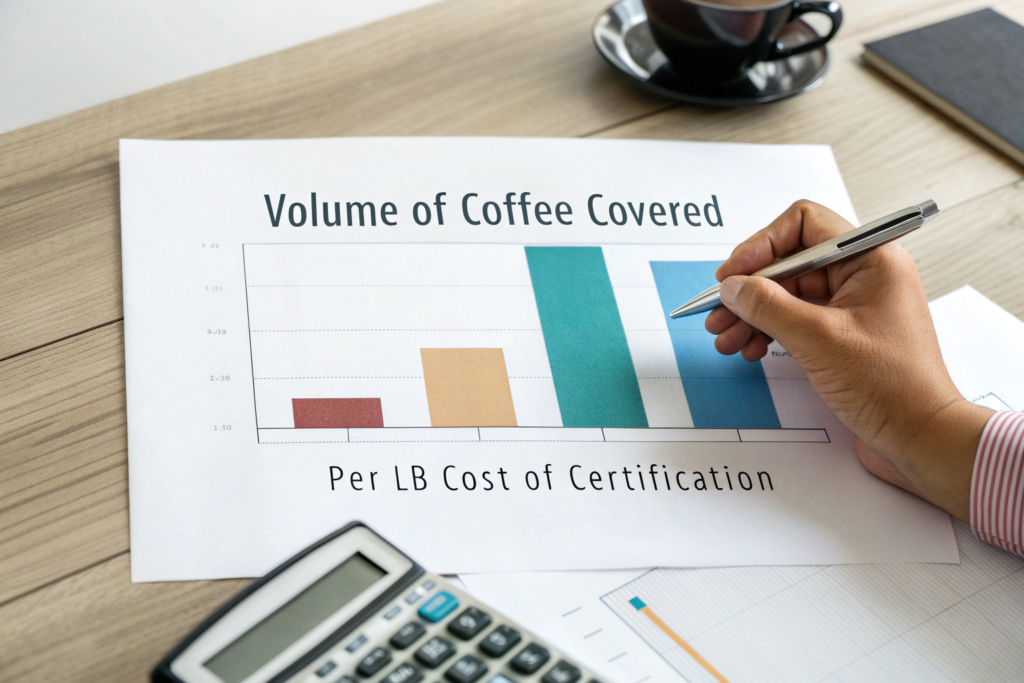
For a mainstream distributor, sustainability cannot be a niche, expensive add-on. It must be scalable across their entire volume. This is the economic genius of the 4C system. It was intentionally designed to be affordable and accessible, enabling the mass adoption of good practices that premium certifications, with their higher costs and lower yields, cannot achieve.
The 4C standard provides a cost-effective, high-volume sustainability solution because its "baseline" nature and efficient group certification model result in a negligible per-pound premium, allowing distributors to procure vast quantities of verified, responsibly sourced coffee without the significant price increase associated with organic or Fair Trade certifications, thereby making sustainability accessible to the mainstream market.
This is about making the entire coffee industry safer and more responsible, not just a privileged slice of it. It is sustainability at the scale of the problem.
Why Is the "Group Certification" Model Efficient for Large-Scale Sourcing?
Many coffee farms in a region like Yunnan could not afford the individual cost of a 4C audit. The standard's "Group Certification" model solves this brilliantly, making it scalable for both farmers and distributors.
- How It Works: An entity like Shanghai Fumao acts as the "Management Unit" for a group of smaller farmers. We take on the responsibility of establishing an Internal Management System (IMS). Our trained staff educates the farmers on the 4C principles, provides technical assistance, and conducts rigorous internal inspections to ensure compliance. We manage the administrative burden.
- The Efficiency for the Auditor: The third-party auditor then does not need to visit every single small farm. They audit our central IMS, our internal inspection records, and then take a statistically significant random sample of the group members to physically verify everything in the field.
- The Benefit for the Distributor: This model allows a distributor to buy 4C certified coffee that originates not just from my large estate, but from a verified network of surrounding smallholders, all managed under our compliant system. It dramatically opens up the available volume of certified coffee without a corresponding increase in cost. It enables a reliable, scalable, and ethically sound supply at a mainstream price point. You can learn more about global group certification models from the ISEAL Alliance.
How Does 4C "Mass Balance" Traceability Work for Large Blended Shipments?
This is the second key to its scalability. A distributor selling a mainstream "Breakfast Blend" is not making a single-origin claim. They do not need to trace every bean back to a single plot. 4C uses an audited "Mass Balance" system, which is perfectly suited for the realities of large-scale commodity blending.
- The Concept: Mass balance is a transparent, audited accounting system. If a distributor buys 1,000 metric tons of 4C certified coffee and 1,000 metric tons of non-certified coffee, and mixes them logistically, they can sell a maximum of 1,000 metric tons as "4C Certified." The system, managed through a digital platform, ensures they never sell more certified volume than they purchased. It works like a bank account for certified coffee.
- Why It Is Necessary: This allows certified coffee to travel efficiently through the standard commodity supply chain, sharing mills, containers, and warehouse space with non-certified coffee. This avoids the astronomical cost of a completely segregated, Identity Preserved supply chain.
- The Honest Claim: The final product label does not claim that every bean is certified. It states the product "supports 4C certified farmers." This is an accurate and honest reflection of the mass balance system. The financial support is real, and the volume tracking prevents fraud. This system allows a supermarket blend to make a legitimate sustainability claim without the final product cost being prohibitive. It brings sustainability to the masses.
How Can 4C Certification Help Distributors Comply with New EU Regulations?
For any distributor selling coffee into the European market, the new reality is legal compliance. The European Union Deforestation Regulation (EUDR) is not a voluntary sustainability program. It is the law. Starting December 30, 2024, importers must be able to prove their coffee is deforestation-free. This is a data-heavy requirement. A 4C certification provides a significant head start.
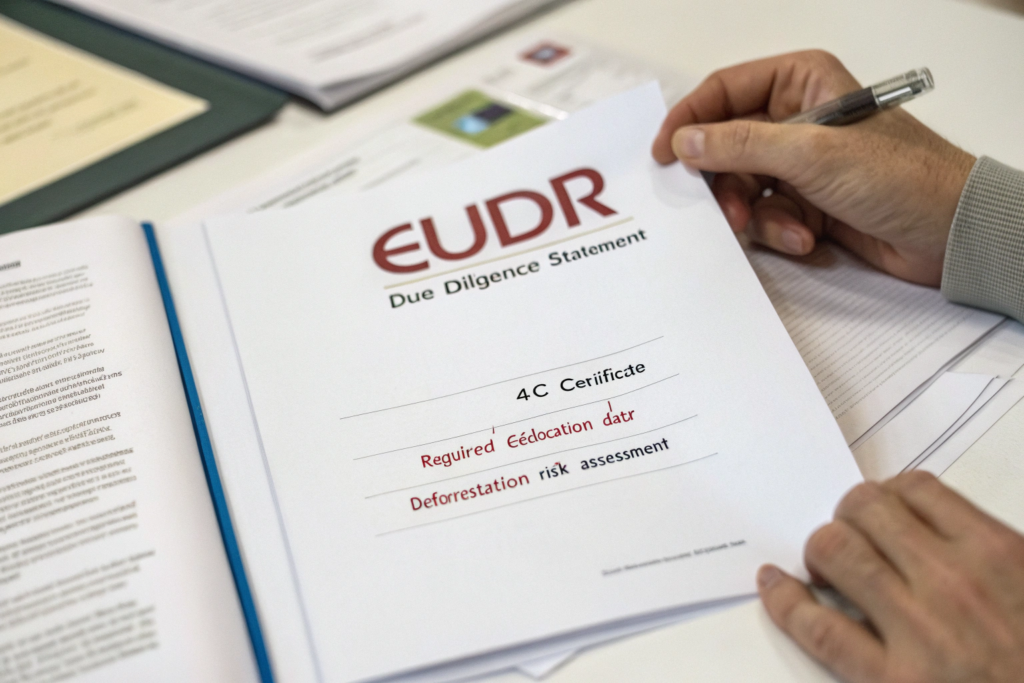
4C certification helps distributors comply with new EU regulations like the EUDR by providing a pre-validated framework of geolocation data and deforestation risk assessment that directly feeds into the mandatory Due Diligence Statement required for every single coffee shipment entering the European Union.
It turns a potential regulatory nightmare into a manageable process backed by audited data. It pre-answers the government's questions.
Does 4C Provide the Geolocation Data Required by the EUDR?
Yes, this is one of the most valuable technical functions of the 4C standard in the current regulatory environment. The EUDR requires importers to collect the geolocation coordinates of all plots of land where the coffee was produced. This is a massive data collection challenge.
- The 4C Requirement: As part of the 4C audit, every certified farm, including every member of our group certification, must be mapped with GPS coordinates. The polygon for each plot of land is recorded.
- The Ready-Made Data File: When you buy 4C certified coffee from a Management Unit like Shanghai Fumao, we are already legally required by our 4C certification to maintain this precise geolocation data in a digital format. We can provide this data directly to you as part of the export documentation package. You do not need to embark on a separate, expensive project to map thousands of smallholders. The certification system has already done the hard work for you. This is a direct, tangible business benefit. For the official text of the regulation, visit the European Commission's Environment page.
How Does a 4C "Due Diligence" System Pre-Fill Your Legal Obligations?
The EUDR requires importers to not just gather data, but to conduct a formal "Risk Assessment" and file a "Due Diligence Statement" with the government for every shipment. A 4C certified supply chain drastically simplifies this.
- The Low-Risk Flag: When a government system sees that the coffee is sourced from a 4C certified supply chain, with its audited Zero Deforestation commitment and verified geolocation data, it is immediately flagged as a lower risk. This increases the likelihood of a smooth, rapid customs clearance.
- The Pre-Built Diligence File: The documentation package we provide—which includes the 4C certificate, the GPS data, and our audited land-use records—effectively pre-fills your Due Diligence Statement. You are not conducting the risk assessment from scratch. You are leveraging the work of an independent, EU-recognized third-party standard to satisfy a major component of your legal obligation. This saves you immense time, money, and legal risk. It makes a 4C certified supply chain not just an ethical choice, but a smart legal and financial strategy.
Conclusion
For mainstream coffee distributors, the 4C certification is not a luxury. It is a critical piece of business infrastructure. It provides the most cost-effective, scalable, and credible baseline for sustainability in the coffee industry. It verifiably eliminates the worst practices—deforestation, forced labor, and hazardous pesticides—from the supply chain, protecting your brand from catastrophic reputational risk.
More than ever, it is a practical tool for regulatory compliance, providing the exact geolocation data and audited risk assessment required by new laws like the EUDR. It allows a volume distributor to buy responsibly, safely, and legally without paying a premium that would make their product unsellable. It is sustainability for the real world, at the scale of the real market.
At Shanghai Fumao, we hold 4C certification because we believe that good practices should not be reserved for only the highest-priced lots. We are proud to offer high-quality, 4C verified Yunnan coffee that meets the ethical, legal, and business needs of our mainstream partners.
If you are a volume buyer and want to learn how our 4C certified coffee can de-risk your supply chain and simplify your EUDR compliance, let's have a practical conversation. Email Cathy Cai. Ask for our "4C Compliance Information Pack." Contact Cathy at: cathy@beanofcoffee.com