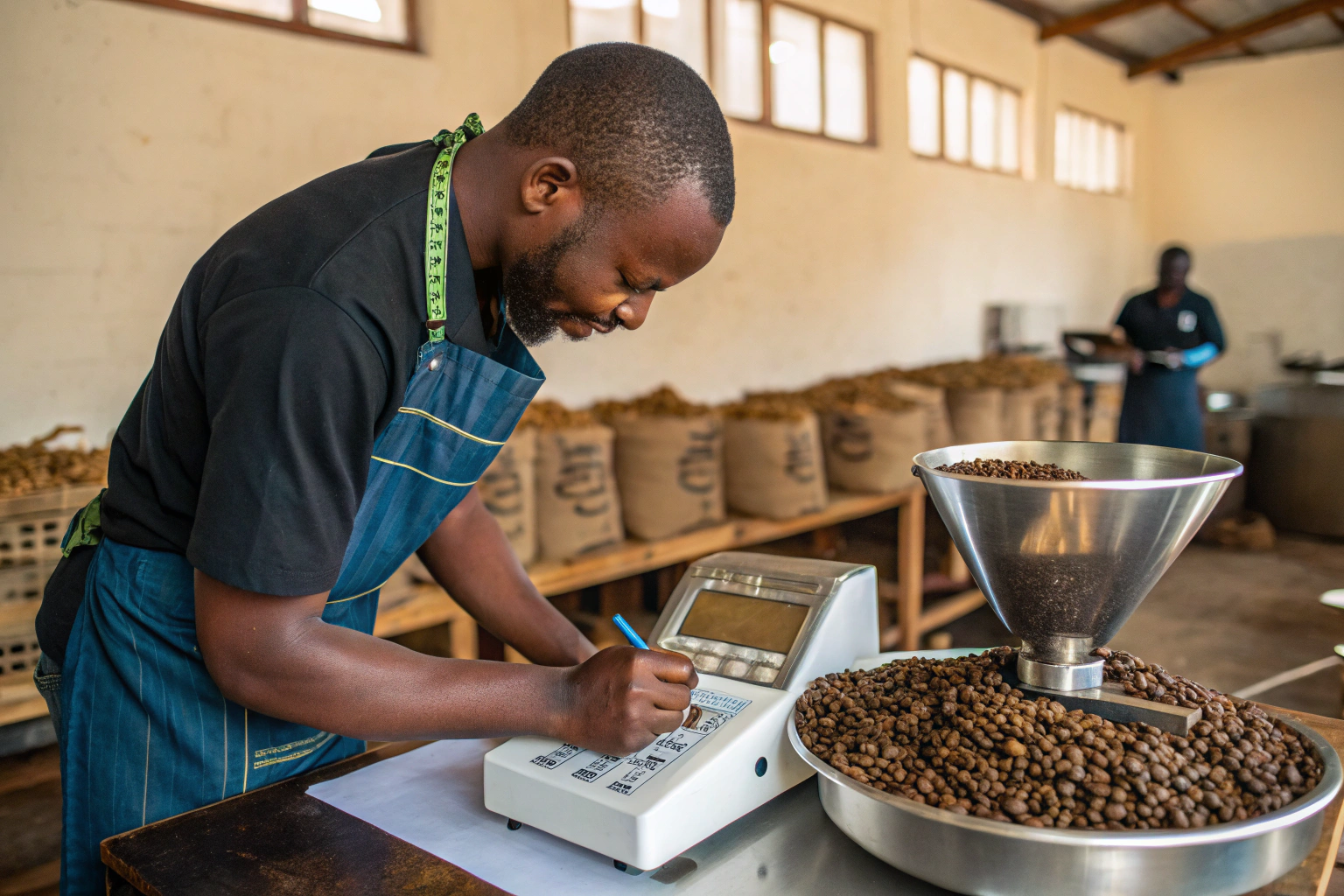
You see it on every high-end coffee bag: "Grown at 1,600 meters above sea level." But for a commercial buyer, is this just marketing fluff, or does it actually affect the beans you're paying for? From our Yunnan plantations, which span different elevations, I can tell you this: altitude is not just a number—it's a direct proxy for coffee's chemical composition, which dictates its market grade, price, and ultimately, its destiny in your supply chain.
Altitude measurement is critically important for coffee grading because it serves as a reliable, standardized indicator of bean density, flavor potential, and overall quality. Higher altitude generally correlates with slower bean development, resulting in a denser, harder bean with higher sugar and acid concentration. These physical and chemical traits are the foundation of quality grading systems used worldwide, allowing buyers to quickly assess a coffee's potential cup score, roast behavior, and appropriate price tier before even tasting it.
That's the straightforward answer. But the relationship between altitude and quality is a story of stress, time, and chemistry. It's not that high altitude makes good coffee; it's that it creates the conditions that allow the coffee plant to express its best potential. However, this rule has nuances—especially in unique origins like China's Yunnan province. Let's unpack why this metric is so embedded in the trade and how you, as a buyer, should interpret it.
How Does Altitude Directly Influence Coffee Bean Density and Hardness?
Think of a coffee cherry growing on a mountainside. The higher it is, the cooler the average temperature. Cooler temperatures slow down the cherry's maturation process. The plant has more time to transfer nutrients and develop sugars and organic acids within the seed (the bean). This longer, slower growth period results in a bean with more concentrated cellular structure.
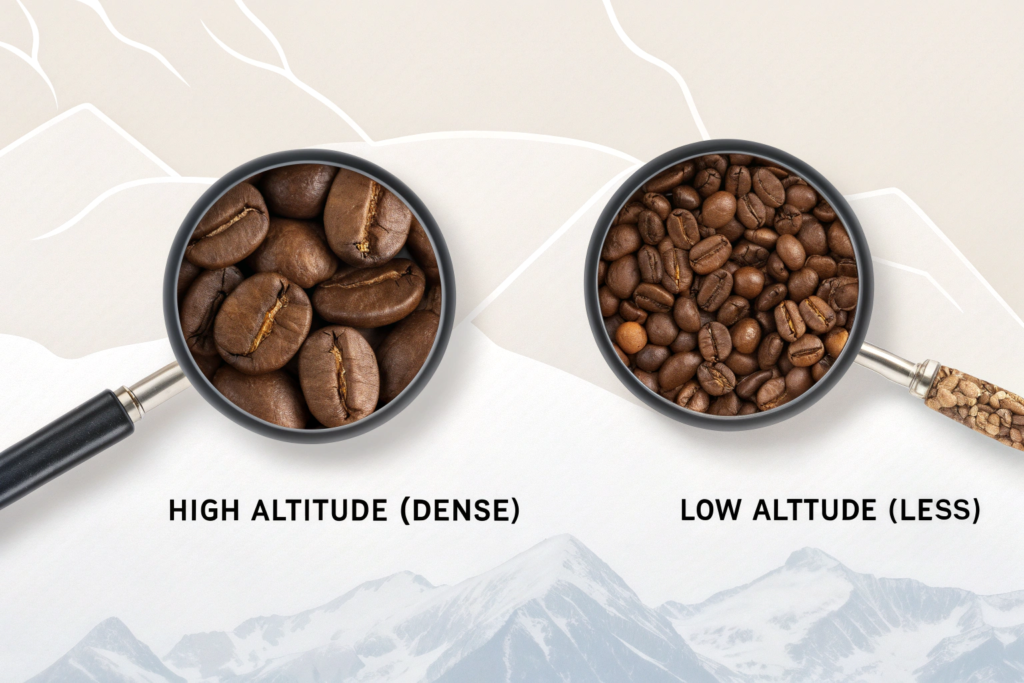
The direct result is increased density and hardness. A bean from 1,800 meters will be significantly denser and harder than a bean of the same variety from 800 meters. You can feel this difference. The higher-altitude bean will feel heavier for its size and make a sharp "click" when bitten, while the lower-altitude bean may feel lighter and crumble more easily. This physical property is not just an academic point; it is the first and most objective checkpoint in quality control. Dense beans roast more evenly, withstand shipping and handling better, and contain the building blocks for complex flavors. At our Shanghai Fumao export facility, we use density sorters as a primary mechanical grading step—separating the denser, higher-value beans from the lighter ones. This directly contributes to a reliable and consistent product for our buyers.
Why Do Denser Beans Command a Higher Grade?
In formal grading protocols, like those used in Central America or by the SCA, bean density (often categorized as "hardness") is a primary grading factor. Coffees are labeled as "Strictly Hard Bean" (SHB), "Hard Bean" (HB), etc., based on their growing altitude. Denser beans are assumed—and often proven—to be of higher intrinsic quality. They have:
- Better Sugar-Acid Balance: More fuel for the Maillard reaction during roasting, leading to developed sweetness and acidity.
- Superior Structural Integrity: They are less likely to fracture during milling and roasting, producing a more uniform roast.
- Longer Shelf Life: Their compact structure is less prone to rapid staling.
For a grader or a buyer, altitude/density is a quick, non-destructive way to triage large volumes of coffee. It’s a stable and trustworthy initial filter.
Can You Have High Quality at Lower Altitudes?
Yes, but it's the exception that proves the rule. In some regions, like Yemen or parts of Brazil, unique microclimates, soil conditions, or specific varieties can produce exceptional coffee at moderate altitudes. However, in the global market, these are outliers. The altitude-density-quality correlation is so strong that it remains the default language of trade. For a buyer, a coffee marketed as "High Grown" or "SHB" from a reputable exporter like us at Shanghai Fumao sets a clear expectation of a certain physical standard, which is the first step toward flavor potential. It addresses the pain point of unpredictable quality.
What Is the Chemical Link Between Altitude and Flavor Development?
Altitude's magic happens at the molecular level. The stressful, cool environment triggers a survival response in the coffee plant, changing its biochemical recipe.
The key chemical link is through sugar and acid accumulation. At higher altitudes, the slower growth allows more time for sugars (sucrose) to develop in the cherry. Simultaneously, the cooler nights and greater temperature differential between day and night promote the formation of desirable organic acids, particularly citric and malic acid. These acids are the precursors to the bright, fruity, and wine-like notes prized in specialty coffee. Conversely, lower altitudes and warmer temperatures lead to faster, less stressed growth, resulting in beans with lower sugar and acid content, often yielding a flatter, more neutral, or grain-like cup. This biochemical profile is what graders are ultimately predicting when they see a high-altitude designation. It’s a promise of complexity.
How Does This Affect Acidity and Sweetness in the Cup?
The relationship is direct. The acids developed at high altitude translate to the perceived brightness, vibrancy, and complexity in the brewed coffee. The higher sucrose content translates to greater potential for sweetness and body after roasting, as those sugars caramelize. A high-altitude Yunnan Arabica will typically present brighter apple or citrus acidity and a clearer brown sugar sweetness compared to a lower-altitude lot from the same region. For a roaster, this means the bean has a higher "ceiling" for flavor development. For a buyer, it justifies a premium price for lots labeled as high-grown.
Are All Acids at High Altitude Desirable?
Not all. While citric and malic acids are desirable, the plant also produces chlorogenic acids, which can taste harsh and astringent. Interestingly, the slower maturation at high altitude also allows for a more balanced breakdown of these less-desirable acids. Furthermore, the stress can increase the concentration of certain volatile aromatic compounds. This complex chemical soup is why high-altitude coffees often have more defined and articulate flavor notes—they simply have more flavor molecules to work with. This is the core of what buyers mean by "good quality" in a specialty context.
How Do Grading Systems Formalize Altitude into Quality Tiers?
The coffee industry loves standards. To move millions of bags efficiently, it transformed the altitude-quality observation into formalized grading tiers. These systems vary by country but share a common logic.
In many Latin American origins, the grading system is explicitly altitude-based:
- Strictly Hard Bean (SHB): Grown above 1,200-1,350 meters. Top tier.
- Hard Bean (HB): Grown between 1,000-1,200 meters.
- Semi-Hard Bean (SH): Grown between 500-1,000 meters.
- Extra Prime, Prime, etc.: Lower altitude designations.
In Africa, grading is often by screen size (e.g., AA, AB), but altitude still heavily influences which screens are filled with dense beans. These grades are not just labels; they are tied to minimum cupping score expectations and directly dictate price in commodity trading. For an exporter, correctly labeling and verifying altitude is a matter of credibility and legal compliance with export contracts. It's a fundamental part of being a trustworthy supplier.
Why Is Altitude a More Objective Measure Than "Flavor" for Grading?
Flavor is subjective and requires skilled cuppers. Altitude (and its proxy, density) is objective, measurable, and verifiable with a GPS device and a density table. In high-volume commercial trade, you cannot cup every bag. Using altitude as a primary filter allows for rapid, scalable sorting of large lots. A buyer in the U.S. can confidently purchase a container of "Guatemala SHB" knowing it meets a specific physical standard that strongly correlates with a known flavor profile range. This system provides security and predictability in a volatile agricultural market.
How Should Buyers Interpret Altitude Claims from Different Origins?
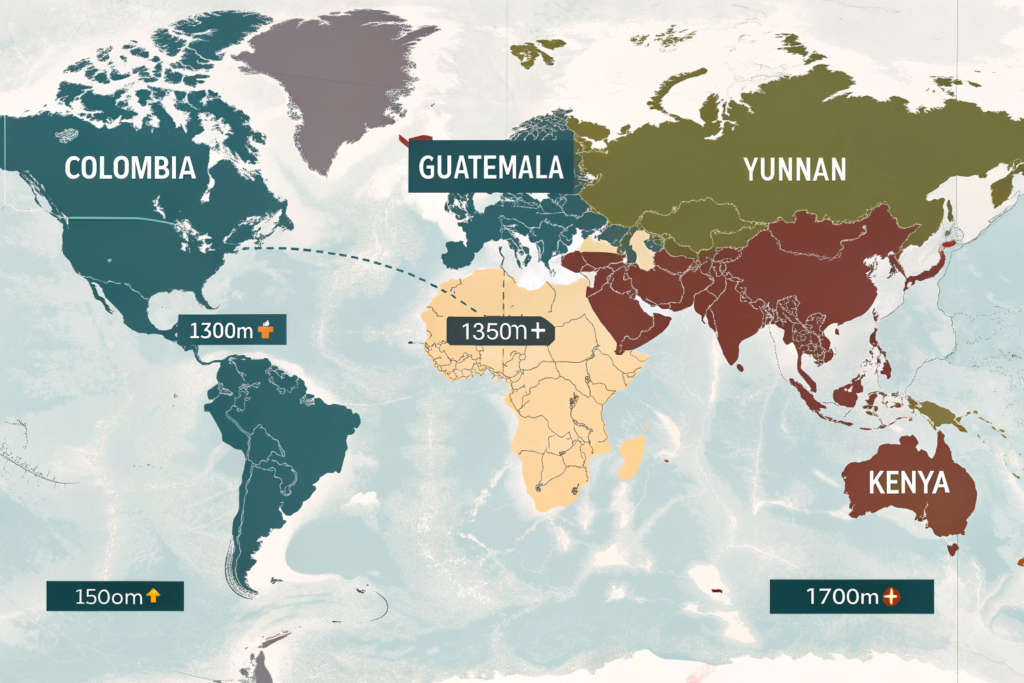
This is crucial. 1,200 meters in Colombia is not the same as 1,200 meters in Ethiopia or Yunnan. The coffee-growing region's proximity to the equator matters greatly. Closer to the equator, the "high altitude" threshold starts lower because the climate is warmer. For example:
- Colombia (near equator): "High altitude" can start at 1,300m.
- Yunnan, China (~22°N latitude): "High altitude" is more significant above 1,500m due to the overall cooler climate.
- Hawaii (~20°N): "High altitude" may be considered above 600m.
A savvy buyer asks not just for the altitude number, but also for the region's typical altitude range and the bean density measurement. We always provide this data for our Yunnan lots, as our farms range from 1,100 to 1,800 meters, allowing us to offer distinct quality tiers.
What Are the Limitations and Exceptions to the Altitude Rule?
Blind faith in altitude alone is a mistake. It is a powerful general rule, but not an absolute law. Several factors can mediate or override its effects.
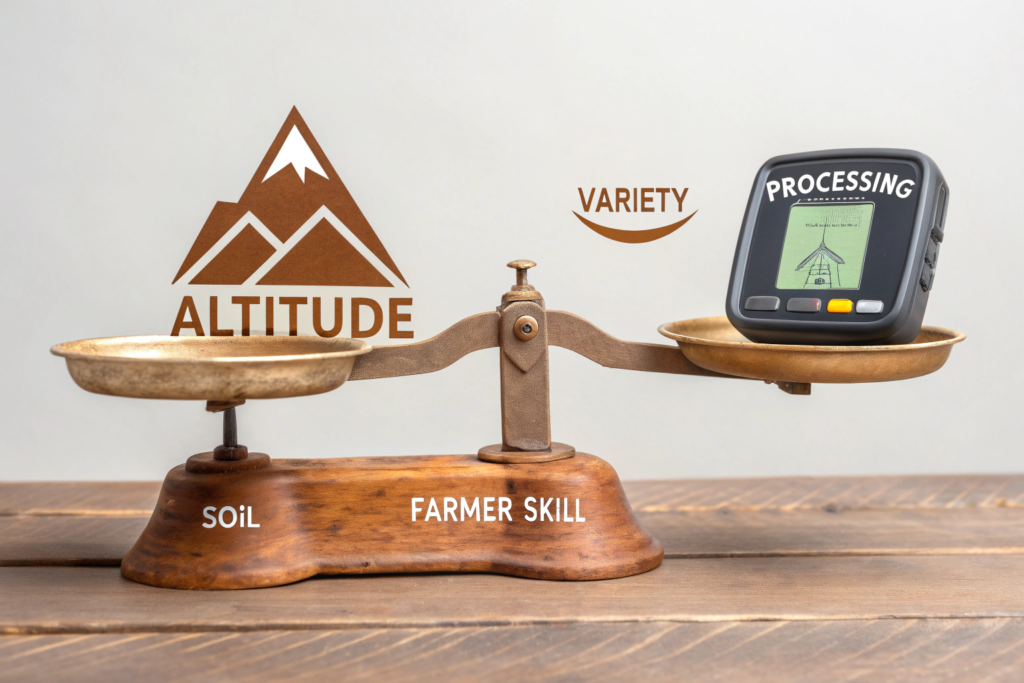
The main limitations are: 1) Microclimate: A perfectly situated lower-altitude farm with ideal shade, soil, and temperature can out-perform a poorly situated high-altitude farm. 2) Variety: Some varieties are naturally predisposed to quality. A well-tended Bourbon or Typica at moderate altitude can beat a high-altitude but less flavorful hybrid. 3) Processing: Poor processing can ruin the potential of the finest high-altitude cherry. A meticulously washed lot from 1,000m may taste cleaner and better than a sloppy natural from 1,600m. 4) Farmer Skill: Agronomic practices are paramount. Altitude gives potential; farming and processing realize it. As an integrated exporter, we control the latter three factors to ensure our altitude claims are backed by real quality.
Can Other Factors Compensate for Lower Altitude?
Yes, through intensive management. Precise fertilization, strict shade management, and ultra-selective harvesting can elevate the quality of a lower-altitude crop. Some renowned Brazilian coffees, grown at moderate altitudes, achieve greatness through such care and through their unique, often chocolate/nutty flavor profile that the market values. However, this compensation has limits—it typically cannot replicate the vibrant acidity of a true high-grown coffee. It creates a different, but still valuable, quality profile. This is why we grow both high-altitude Arabica for complexity and mid-altitude Catimor for disease resistance and stable yield, offering buyers different tools for their needs.
Why Is "Cup of Excellence" Blind to Altitude?
The most prestigious coffee competitions, like Cup of Excellence (CoE), are instructive. They grade coffee blind, based solely on the cupping score. A coffee from 1,000 meters can out-score one from 1,800 meters. This proves that while altitude is an excellent predictor, the ultimate judge is the flavor in the cup. For a buyer, this means: use altitude as a critical first filter for efficiency and risk reduction, but always, always verify with a sample roast and cupping. Your final purchase decision should be based on the taste of the specific lot, not just its passport details. This is the balanced approach of a professional buyer.
Conclusion
Altitude measurement is the cornerstone of coffee grading because it translates a complex set of desirable agricultural conditions into a simple, tradable number. It efficiently signals density, implies flavor potential, and structures the global market. For a commercial buyer, it is an indispensable tool for initial sourcing, risk assessment, and price negotiation.
However, wisdom lies in using altitude as the starting point of inquiry, not the endpoint. It tells you what the bean could be, not what it is. The final grade must always be confirmed by the physical examination of the bean and, most importantly, by the cupping score.
At Shanghai Fumao, we leverage the altitude of our Yunnan highlands to grow dense, complex beans, but we never rely on it alone. We combine it with strict variety selection, modern wet milling, and relentless quality control to ensure the potential is realized in every bag we export.
If you are looking to source coffee where the altitude promise is backed by integrated farming and processing control, we invite you to evaluate our graded lots. We provide the metrics and the proof in the cup.
To explore our altitude-specific offerings and receive graded samples with complete analysis, contact Cathy Cai at cathy@beanofcoffee.com. Let's ensure your quality standards are built on a solid foundation, from the ground up.