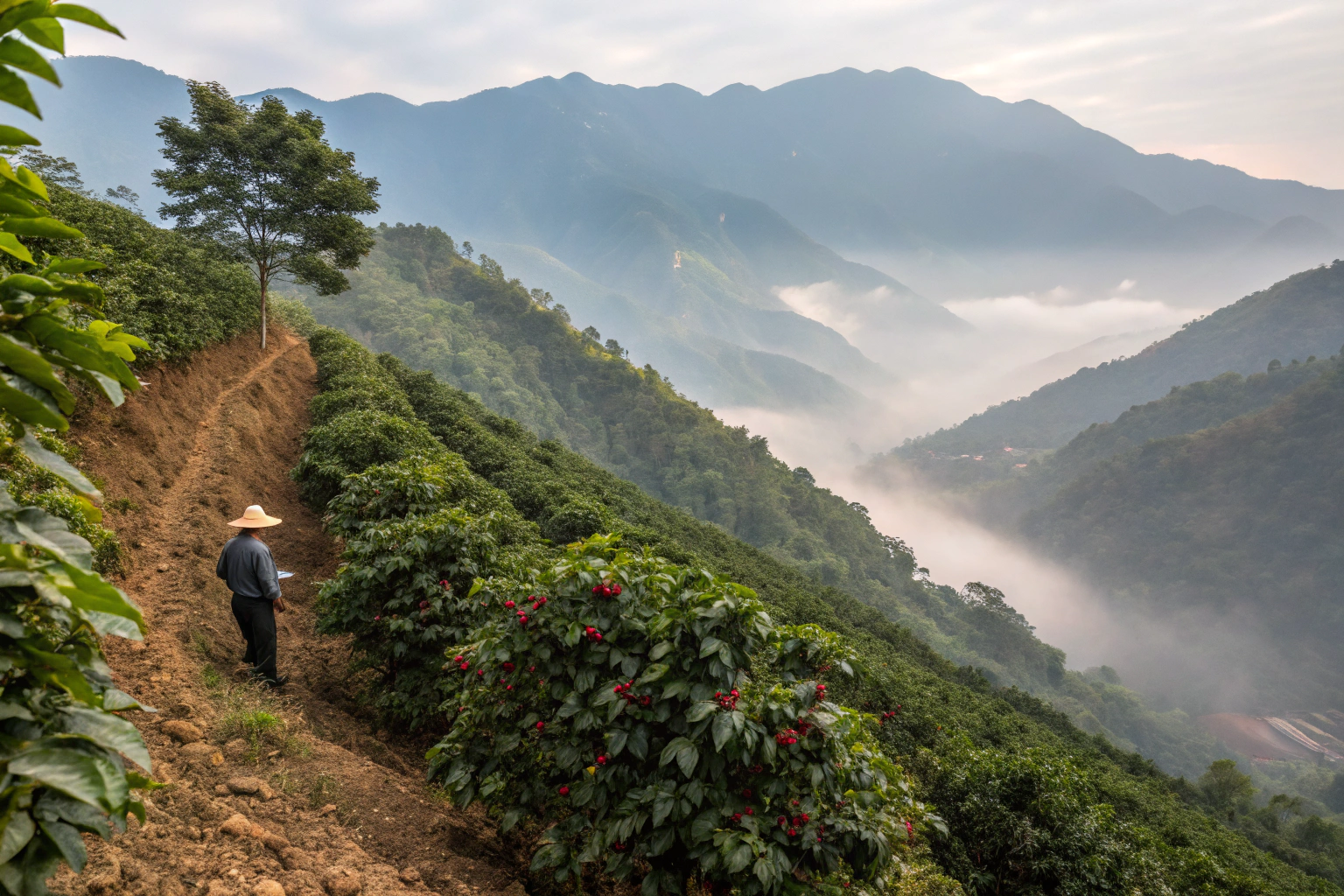
A buyer from San Francisco once asked me, "Why should I pay more for your high-grown lot? Coffee is coffee, right? The plant grows, you pick it. What does the mountain have to do with it?" He was not being difficult. He genuinely did not know. And honestly, many buyers do not. They see "altitude" on a spec sheet. They know it matters. But they cannot explain why to their own customers.
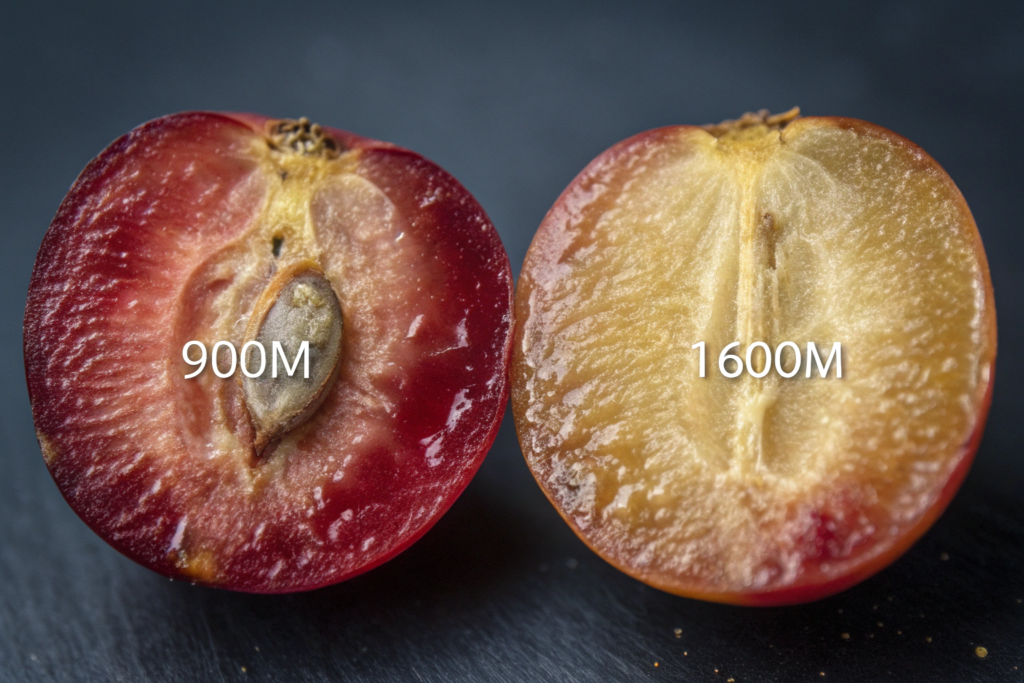
I walked him up a dirt path on our Baoshan farm via video call. I showed him the valley plot at 900 meters. The trees looked healthy. The cherries were plentiful. Then I panned the camera up to the 1,600-meter plot. The air was visibly cooler—you could see my breath. The trees were shorter. The cherries were fewer. "The valley plot produces twice as much coffee," I told him. "But cupping score? The valley scores 80. This mountain plot? 85. Same variety. Same processing. The only difference is the air you are breathing right now." He booked the high-grown lot that afternoon.
Altitude is the single most critical environmental factor for Arabica quality because cooler temperatures at higher elevations slow cherry maturation, allowing more time for complex sugars and aromatic compounds to develop inside the bean, resulting in a denser, harder bean that produces a sweeter, more acidic, and more complex cup.
The relationship between altitude and cup quality is not folklore. It is measurable, biochemical, and consistent across origins. Let me walk you through exactly what happens inside the bean when it grows high on a mountain.
What Happens to a Coffee Cherry at High Elevations?
The coffee plant is not native to high mountains. It evolved in the understory of Ethiopian forests at moderate elevations. But it found a sweet spot on tropical mountainsides where the temperature drops, but frost never hits. The plant had to adapt. The adaptation changed the bean.
At sea level or low altitude, temperatures are warm. Arabica plants grow fast. The cherries ripen quickly—about six to seven months from flowering to harvest. The seed inside fills out, but the fast maturation means less time for complex biochemistry to occur. Sugars are simple. Organic acids are lower. The bean is less dense. The parchment shell is thinner. The resulting cup tastes mild, simple, sometimes earthy or flat.
Move that same variety up to 1,500 meters. The average temperature drops by about 0.6 degrees Celsius for every 100 meters of elevation gain. At 1,500 meters, the ambient temperature is roughly 9 degrees cooler than at sea level. The cherry maturation slows dramatically. It now takes eight to nine months from flower to harvest. Two extra months of slow, cool sugar accumulation.
At high altitudes, the extended maturation period allows the coffee seed to accumulate higher concentrations of sucrose, which acts as a flavor precursor during roasting, while the cooler nights preserve delicate organic acids that would otherwise respire away in warmer conditions.
The bean structure changes. High-grown beans are physically denser. The cell walls are thicker. The center cut is tighter and often more angled. When you hold a handful of high-grown beans, they feel heavier. They are harder to break with your fingers. This density is a visible, tactile indicator of quality. For more on the relationship between growing conditions and bean development, World Coffee Research has agronomy reports detailing how temperature and elevation interact with Arabica physiology.
Why Do Cooler Nights Improve Coffee Acidity?
Acidity in coffee comes from organic acids—citric, malic, chlorogenic, and others—that the plant produces during cherry development. These acids are volatile. They break down over time, especially in warm conditions.
During the day, the coffee plant photosynthesizes. It produces sugars and sends them to the developing cherries. During the night, the plant respires. It consumes some of those sugars and some of the organic acids for its own metabolism. The rate of respiration is temperature-dependent. Warmer nights mean faster respiration. More acid is burned up. The final bean has lower acid content and tastes flatter.
Cool mountain nights slow respiration. The plant consumes less acid. The acids that accumulate during the day are preserved. The final bean has higher acid content. When you roast and brew that bean, the cup tastes brighter, more vibrant, more complex. That citrusy sparkle in a high-grown Yunnan Catimor? That is preserved acidity, a direct result of cold nights on the Baoshan mountainside.
A detail often missed: the diurnal temperature range matters. It is not just the average temperature. It is the swing between warm day and cool night. A location with a 15-degree Celsius swing between day and night produces more complex acid profiles than a location with the same average temperature but a narrow swing. Our Baoshan slopes typically see daytime highs of 25 degrees and nighttime lows of 10 degrees. That 15-degree swing is ideal for acid preservation and sugar complexity.
How Does Altitude Affect Bean Density and Structure?
Take a green bean from our 900-meter plot and one from our 1,600-meter plot. Hold them side by side. The difference is physical and obvious.
The low-altitude bean is larger, softer, and lighter in color. You can squeeze it between your thumb and forefinger and it gives slightly. The center cut is open and wide. The density might measure 680 grams per liter on a density meter.
The high-altitude bean is smaller, harder, and darker blue-green in color. It feels like a pebble. The center cut is tight and closed, sometimes zigzagged. The density measures 740 grams per liter or higher. It is dramatically harder to crush.
This density difference matters for roasting. A dense, high-grown bean transfers heat more slowly. The roaster must apply more thermal energy to drive heat to the bean core. The roast profile for a dense bean uses a higher charge temperature and a longer development time. If you roast a high-grown bean with a profile designed for a soft low-grown bean, the outside will scorch and the inside will remain underdeveloped. The cupping table will show roasty bitterness alongside grassy underdevelopment.
The density also affects storage. Dense beans are less porous. They absorb moisture from the air more slowly. They retain their quality longer in storage. This is a practical advantage for importers who hold inventory for months. For those interested in the technical side, Cropster offers roast profiling software that accounts for bean density measurements and helps roasters adapt profiles between high-grown and low-grown lots.
What Altitude Range Produces True Specialty Grade Arabica?
Specialty coffee is not an arbitrary designation. It is a cupping score threshold—80 points or above on the SCA scale—and that score is closely correlated with altitude, though not exclusively determined by it.
Here is a rough altitude-to-quality framework based on our Yunnan growing experience:
| Altitude Range | Classification | Typical Cup Profile | Typical Score Range |
|---|---|---|---|
| Below 900m | Low-grown | Earthy, mild, low acidity, simple | Below 80 |
| 900m - 1,200m | Mid-grown | Chocolate, nut, medium body, mild acidity | 80 - 82 |
| 1,200m - 1,500m | High-grown | Citrus, caramel, balanced, clean | 82 - 84 |
| Above 1,500m | Strictly High Grown | Floral, bright acidity, complex, sweet | 84 - 87+ |
For Arabica to reliably achieve specialty grade status of 80 points or above, the elevation should generally exceed 1,200 meters in tropical latitudes like Yunnan, with the highest quality strictly high grown lots coming from elevations above 1,500 meters where the maturation period stretches past eight months.
This framework is a guideline, not a guarantee. I have cupped coffees from 1,400 meters that scored 83 due to poor processing, and a beautifully processed lot from 1,100 meters that scored 82. Altitude creates the potential. Processing realizes it. But the potential ceiling rises with elevation. You simply cannot get the intense floral and citrus notes of an 86-point coffee from a 900-meter farm. The biochemistry does not allow it.
Can Robusta Quality Improve With Higher Elevation?
Robusta is different from Arabica. It is a heartier species. It tolerates heat, humidity, and pests better. It is traditionally grown at lower elevations—sea level to 800 meters. The assumption is that Robusta does not benefit from altitude the way Arabica does.
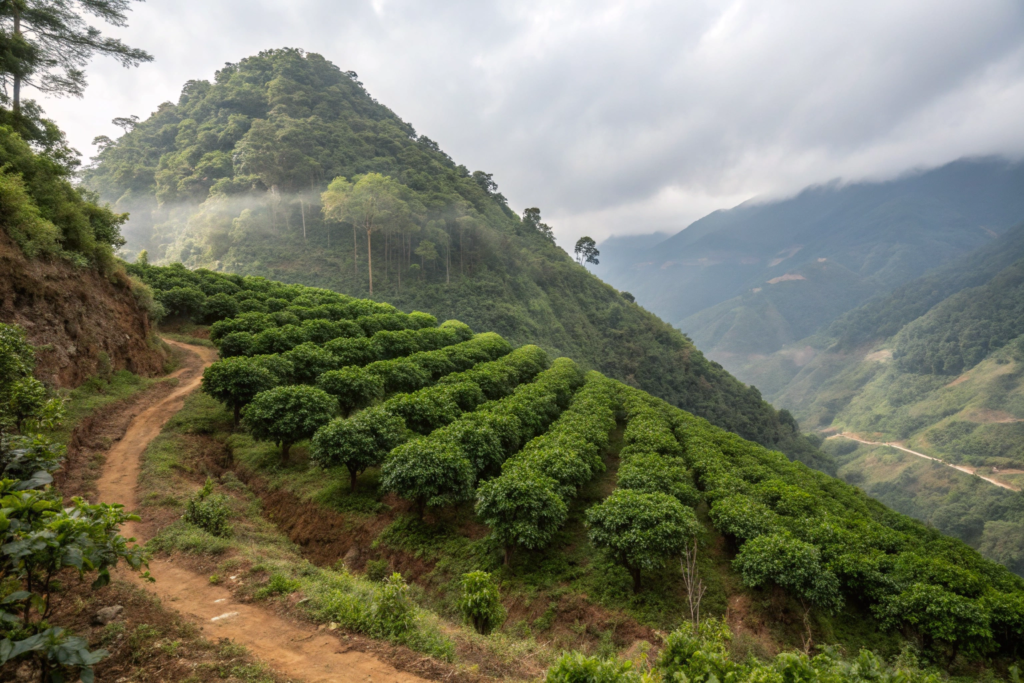
That assumption is not entirely true. We grow some Robusta at 900 to 1,000 meters in Baoshan, which is considered high for Robusta. The cooler temperatures slow the cherry maturation, just as they do for Arabica. The result is a Robusta with less harshness, less rubbery bitterness, and more sweetness than typical lowland Robusta from Vietnam or Indonesia.
The cupping score for our high-grown washed Robusta can reach 80 to 82 points. That is specialty-range for Robusta, which typically caps out in the high 70s. The body remains heavy. The crema is still thick and persistent. But the cup is clean enough to drink black, which is rare for Robusta. This quality allows traditional Italian roasters to use a higher percentage of Robusta in their blends without introducing defect flavors.
The same principle applies: altitude slows maturation and preserves sugars. The plant is still Robusta. It will never taste like Arabica. But high-grown Robusta is a different product than commodity Robusta. It is a specialty ingredient, not a filler. More on this topic can be found through Perfect Daily Grind, which occasionally publishes features on high-altitude Robusta experiments in different origins.
What Happens When Arabica Is Grown Too High?
There is an upper limit. Altitude is not a case of "higher is always better." Beyond a certain point, the conditions become hostile.
Above 1,800 meters in Yunnan, the risk of frost increases. Arabica is sensitive to frost. A single cold snap during flowering can kill the blossoms and wipe out a harvest. The growing season also becomes too short. The cherries may not fully mature before the cold weather returns. Immature cherries produce underdeveloped beans with grassy, astringent flavors.
Photosynthesis also slows down at very high altitudes. The plant simply cannot produce enough energy to support a healthy cherry load. Yields drop to uneconomical levels. The trees become stunted and stressed. The coffee may cup unusually—sometimes interesting, sometimes weird—but the volume is too small and the risk is too high for commercial viability.
The sweet spot in Yunnan is 1,300 to 1,650 meters. That range provides the cool nights and extended maturation for specialty quality without the frost risk and yield collapse of higher elevations. Our Baoshan plots sit comfortably in this zone. The coffee develops fully, the acidity is bright but balanced, and the harvest is reliable year after year.
How Should Importers Verify Altitude Claims?
Altitude claims are easy to fake. A seller can write "1,600 meters" on a spec sheet with no evidence. And some do. I have seen lots labeled "Strictly High Grown" that cupped like lowland coffee and traced back to farms at 1,000 meters.
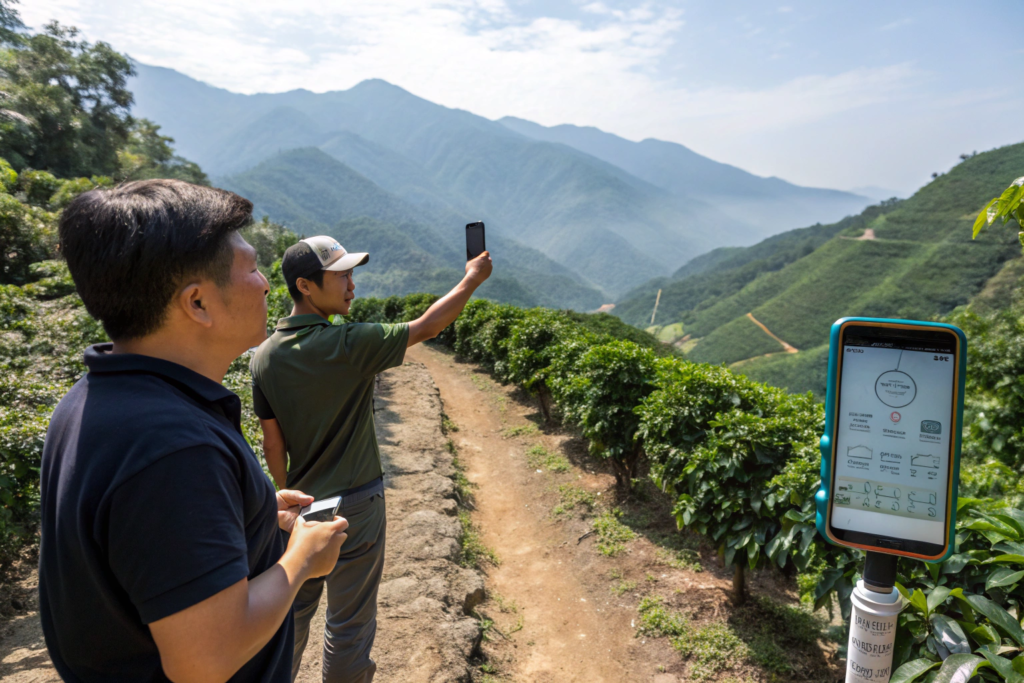
Verification starts with GPS. Every specialty lot we sell from Shanghai Fumao is traceable to a specific farm plot with verified GPS coordinates. The altitude is recorded at the plot level, not the farm gate level. A farm that spans from 1,200 to 1,600 meters cannot fairly label all its coffee as "1,600 meters." The plot elevation is what matters.
Importers can verify altitude claims by requesting GPS coordinates of the specific farm plot, using satellite mapping tools to confirm elevation data, and cupping the lot against altitude-anchored sensory expectations—a true high-grown lot will exhibit bright acidity and dense bean structure that low-grown coffee cannot replicate.
Satellite verification is easy. Google Earth Pro, with terrain data enabled, shows elevation at any coordinate. A buyer can type in the GPS coordinates provided by the supplier and read the elevation directly. If the satellite data says 1,300 meters and the spec sheet says 1,700 meters, something is wrong. For deeper verification tools, the Specialty Coffee Association has discussed geolocation traceability in various webinars, and there are now blockchain-based traceability platforms being piloted in the coffee sector.
What Sensory Cues Reveal True High-Grown Coffee?
Before you even cup the coffee, the green bean reveals clues. High-grown beans are smaller, denser, and have a tighter center cut. The color is a deeper blue-green compared to the paler, softer low-grown beans.
On the cupping table, high-grown coffee announces itself through acidity. A true strictly high grown lot will have a bright, crisp, clean acidity that is immediately noticeable on the first slurp. It may be citric—like lemon or tangerine—or malic—like green apple. It will not be sour, harsh, or vinegary. It will be pleasant and integrated.
The sweetness follows. High-grown coffees taste sweeter. The longer maturation allows more sucrose to develop. Even without sugar added, the coffee tastes sweet on the tongue. The body may be lighter than a low-grown coffee, but it will feel smooth and silky rather than thin and watery.
If a coffee labeled "1,700 meters" cups with low acidity, heavy earthy body, and no discernible sweetness, the altitude claim is suspect. Either the altitude is not as stated, or the processing was so poor that it destroyed the altitude advantage. Either way, the coffee is not meeting the sensory promise of its label. For calibrating cupping skills to identify these attributes, the Coffee Quality Institute provides Q-grader certification and sensory calibration resources.
Why Do Some Regions Need Less Altitude for Quality?
The relationship between altitude and quality is not the same everywhere. Latitude matters too. The further from the equator you go, the cooler the climate at any given elevation. A coffee grown at 1,200 meters in Brazil, which sits at 20 degrees south latitude, may cup similarly to a coffee grown at 1,600 meters in Kenya, which sits on the equator. The cooler subtropical climate of southern Brazil compresses the altitude requirement.
Yunnan sits at roughly 25 degrees north latitude. This is near the northern limit of where Arabica can be commercially grown. The latitude already provides a relatively cool climate. The altitude requirement for specialty grade is therefore slightly lower than in equatorial origins. Our 1,400-meter lots in Baoshan often cup comparably to 1,600-meter lots from Colombia, which sits at a lower latitude.
This does not mean altitude is less important in Yunnan. It means the altitude bands shift slightly. A "high-grown" standard that works for Costa Rica may not map one-to-one onto China. The buyer should calibrate expectations based on the specific origin's latitude, climate patterns, and historical cupping data, not on a generic global altitude chart. The International Coffee Organization publishes country-level coffee profiles that often include typical altitude ranges and their corresponding cup characteristics.
Conclusion
Altitude is not just a number on a coffee bag. It is a proxy for temperature, maturation speed, acid preservation, and sugar accumulation. A high-grown coffee bean is physically different—denser, harder, more compact—and chemically different—sweeter, more acidic, more aromatic—than a low-grown bean from the same variety.
The difference traces back to a simple biological fact: coffee cherries that mature slowly in cool mountain air develop more of the compounds that create a complex, vibrant cup. The same genetics that produce a flat, earthy coffee at 900 meters can produce a bright, floral coffee at 1,600 meters. The mountain transforms the bean.
For importers and roasters, altitude claims must be verified with GPS data and cupping evidence. A number on a spec sheet means nothing without the sensory proof in the cup. But when the altitude is real and the processing is clean, the quality is unmistakable.
If you are building a specialty coffee program and want to taste the difference that Baoshan altitude makes, reach out to Cathy Cai at BeanofCoffee. She can send samples from our different elevation plots—900 meters, 1,200 meters, and 1,600 meters—all the same Catimor variety, processed the same way. Cupping these side-by-side will teach you more about altitude than any article can. She can also provide GPS data, cupping scores, and lot traceability for every sample. Write to cathy@beanofcoffee.com. She ships samples quickly and will customize a tasting kit based on what you want to learn.