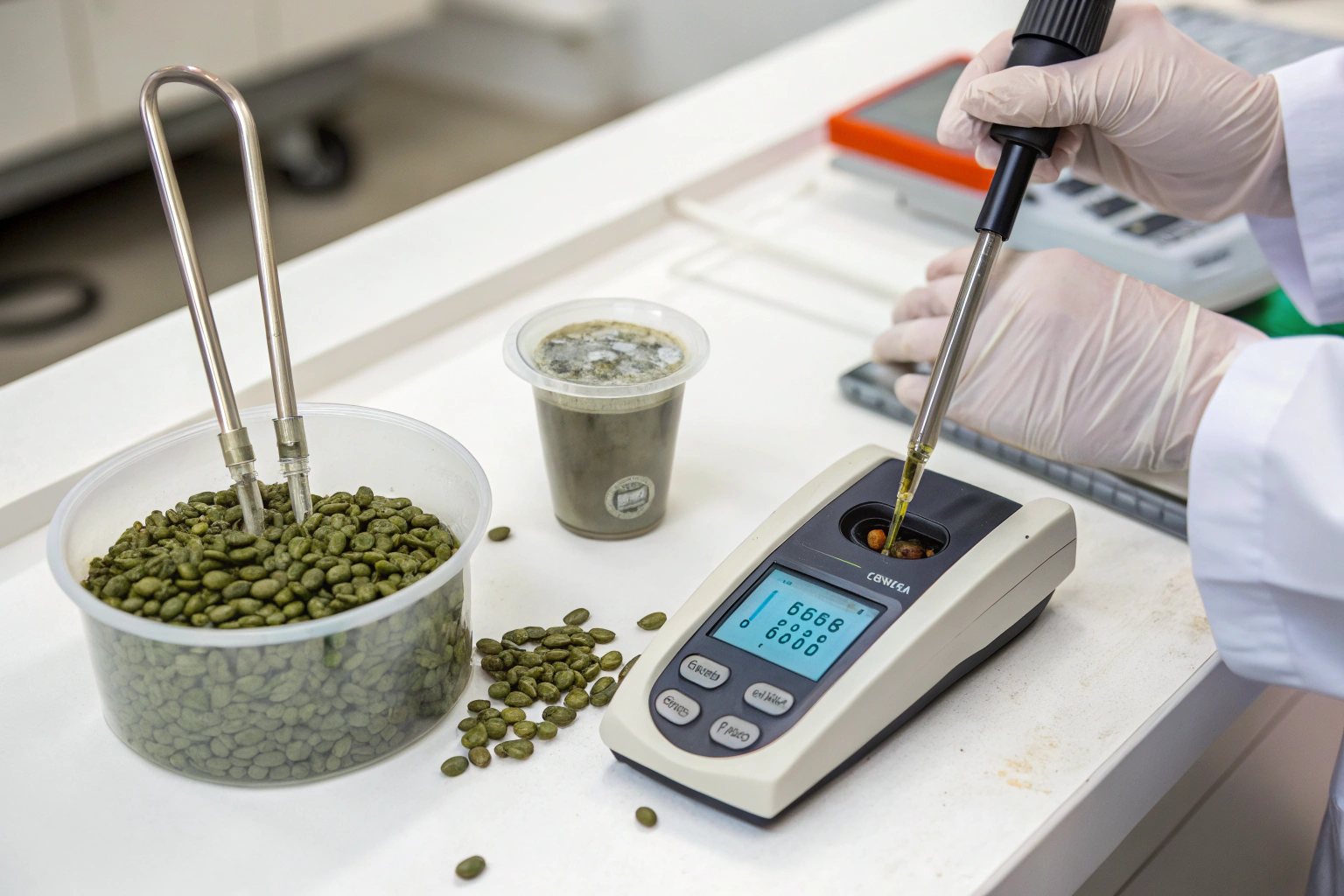
I used to be like most coffee producers. I obsessed over moisture content. "11%? Perfect. Ship it." Then I had a container of coffee arrive in Europe that was a moldy disaster. The moisture content was 11.2% when it left. It was well within spec. So what happened? The problem was the water activity. The water was there, and it was available for the mold to use. Moisture content told me how much water was in the bean. Water activity told me what that water was doing. That was the day I realized I had been flying blind with only half the data.
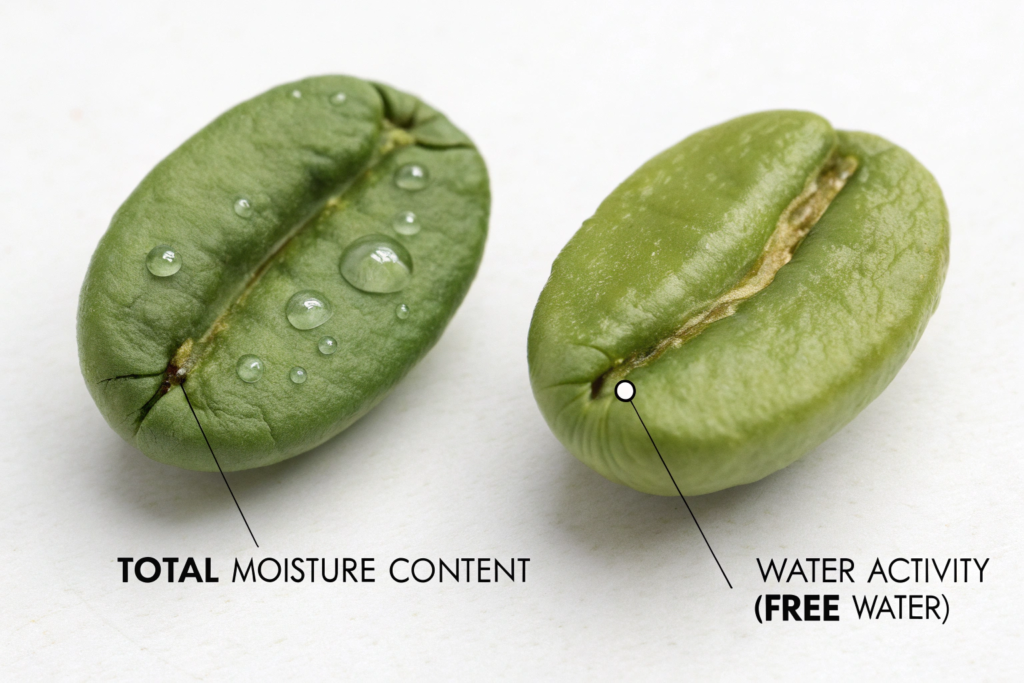
Water activity (aw) is just as important as moisture content because it measures the "free" or "unbound" water in the coffee bean that is available for microbial growth (mold, yeast, bacteria) and chemical reactions, whereas moisture content simply measures the total water present, including water that is chemically bound and biologically inert.
You can have two bags of coffee, both at 11.5% moisture. One is stable and safe. The other is a ticking time bomb for mold. The difference is the water activity. Let me explain the science and why it matters for your sourcing decisions.
What Is the Difference Between Moisture Content and Water Activity?
The terms are often used interchangeably, but they describe fundamentally different physical properties. Understanding this distinction is the key to mastering green coffee storage and shelf life.
Moisture content is a quantitative measure of the total mass of water in a material, expressed as a percentage of the total weight. Water activity (aw) is a qualitative measure of the energy status of that water, expressed on a scale from 0.00 (bone dry) to 1.00 (pure water), indicating the vapor pressure of the water relative to pure water.
Think of it like money in a bank. Moisture content is your total account balance. Water activity is the cash in your wallet. You can have a million dollars in a locked CD (bound water). It is there, but you cannot spend it. You can have twenty dollars in your pocket (free water). You can spend that immediately. Mold can only "spend" the free water.
How Is "Bound" Water Different from "Free" Water in a Coffee Bean?
This is the core concept. Inside the cellular structure of the green coffee bean, water exists in two states.
- Bound Water: This water is chemically or physically bound to the cellulose, starches, and proteins of the bean. It is held tightly by hydrogen bonds. It is not free to move around or participate in chemical reactions. It is essentially immobilized. It does not support mold growth.
- Free Water: This water is capillary water or loosely adsorbed water. It is found in the microscopic pores and spaces between the cell walls. It is mobile. It can evaporate. It can dissolve solutes. And most importantly, it is available for microorganisms like mold and bacteria to use.
When we dry coffee, we are trying to remove the free water while leaving the bound water intact. If we dry too much and remove the bound water, the bean's cellular structure collapses. The coffee is "dead" and will taste flat and papery. If we do not dry enough, too much free water remains, and the coffee is at high risk for mold.
The moisture meter just tells you the sum of Bound + Free water. The water activity meter tells you specifically about the Free Water. That is why it is a better predictor of stability and safety. At Shanghai Fumao, we use both measurements together. Moisture content tells us if the coffee is in the right range. Water activity tells us if it is safe.
Why Can Two Beans Have the Same Moisture but Different Stability?
This is the practical reality that confuses many buyers. Let's look at two scenarios.
| Bean Sample | Moisture Content | Water Activity (aw) | Stability Prediction |
|---|---|---|---|
| Sample A | 11.5% | 0.55 | Excellent. Free water is low. Safe for long-term storage. |
| Sample B | 11.5% | 0.68 | High Risk. Significant free water available. Mold growth likely if temperature rises. |
How is Sample B possible?
- Poor Drying: Sample B might have been dried too quickly at high temperatures. The surface of the bean dried out (case hardening), trapping free water inside the cellular structure. The total moisture reading looks normal, but the water inside is highly available.
- Reabsorption: Sample B might have been properly dried, but then stored in a humid environment. It absorbed moisture from the air. This reabsorbed water is loosely bound—it is "free water." It spikes the water activity without raising the total moisture content beyond the acceptable range.
This is the danger. A supplier who only checks moisture content might ship Sample B, thinking it is safe. It arrives, and if the container gets warm, the mold blooms. A supplier who checks water activity would catch Sample B immediately and either re-dry it or quarantine it. This is the standard of care we apply at BeanofCoffee.
What Is the Critical Water Activity Threshold for Green Coffee Storage?
Just as there is an ideal range for moisture content, there is a specific, scientifically established threshold for water activity. Crossing this threshold does not guarantee mold, but it opens the door.
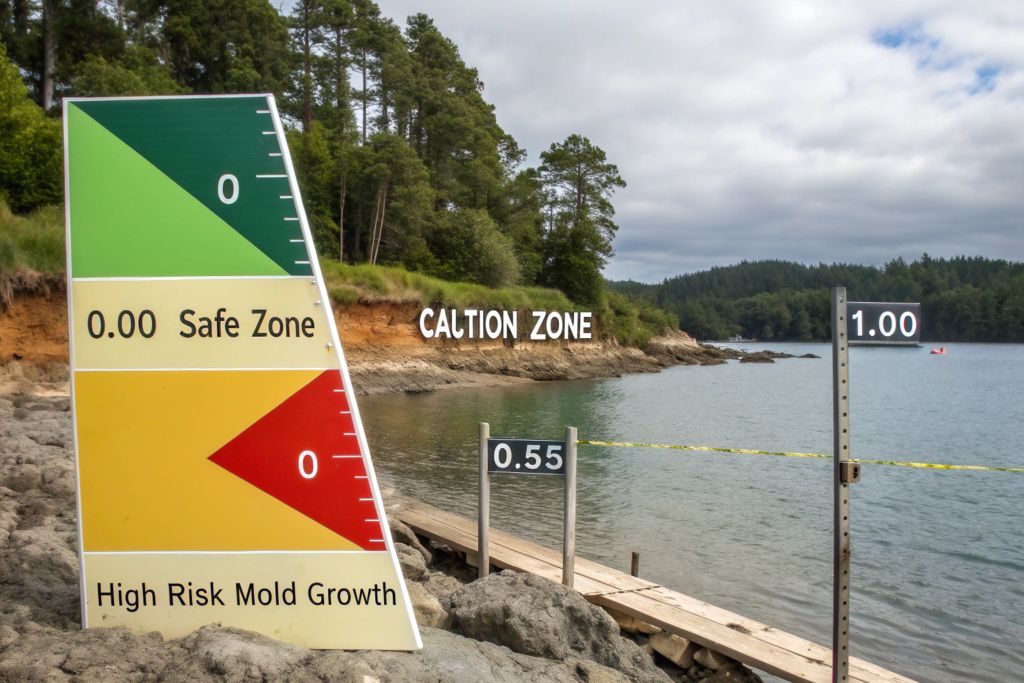
The critical water activity threshold for green coffee storage is 0.60 aw. Below this level, the growth of all common storage molds (Aspergillus, Penicillium) and the production of mycotoxins like Ochratoxin A are effectively suppressed. Above 0.65 aw, the risk of microbial spoilage increases exponentially, especially if temperatures exceed 25°C (77°F).
This 0.60 number is not arbitrary. It is based on decades of food science research. It is the benchmark used by the U.S. FDA and the European Commission for defining shelf-stable, low-moisture foods.
At What Water Activity Level Does Mold and Ochratoxin A Develop?
Molds are like plants. They need water to germinate and grow. Different molds have different minimum water activity requirements.
| Water Activity (aw) | Microbial Activity | Implication for Green Coffee |
|---|---|---|
| < 0.60 | No significant mold growth. | Safe Zone. Coffee is microbiologically stable. |
| 0.60 - 0.65 | Growth of Xerophilic (dry-loving) molds. | Caution Zone. Slow growth of specific molds possible over many months. Risk of OTA production is low but not zero. |
| 0.65 - 0.70 | Growth of Aspergillus ochraceus and Penicillium verrucosum. | Danger Zone. These are the primary Ochratoxin A (OTA) producers. Significant risk of mycotoxin contamination within weeks. |
| > 0.70 | Rapid growth of spoilage molds and bacteria. | Severe Risk. Visible mold, musty odors, and high OTA levels are likely. Coffee is unfit for export. |
The Key Takeaway: The difference between a safe 0.58 aw coffee and a risky 0.63 aw coffee is just 0.05 aw. This is a tiny, invisible margin. You cannot see it. You cannot feel it. You can only measure it with a water activity meter.
At Shanghai Fumao, we target an aw of 0.55 to 0.58 for all export coffee. This gives us a safety buffer. Even if the container gets slightly warm during transit, the water activity is low enough that the coffee remains stable. We are not just meeting the minimum standard; we are exceeding it. For more on the relationship between water activity and mycotoxins, the Food and Agriculture Organization (FAO) provides extensive scientific resources.
How Does Temperature Interact with Water Activity to Increase Risk?
This is a crucial dynamic. Water activity and temperature work together. A coffee with an aw of 0.62 might be stable in a cool warehouse at 15°C (59°F). But put that same coffee in a hot container crossing the equator at 35°C (95°F), and the risk profile changes dramatically.
The Relationship:
- Higher Temperature = Higher Effective Water Activity. As temperature rises, the vapor pressure of the free water increases. It becomes more available to the mold spores.
- The Danger Zone: The combination of aw > 0.60 AND Temperature > 25°C is the sweet spot for mold growth.
This is why transit temperature monitoring with data loggers is so important. If we know the container experienced high temperatures, we know the coffee's water activity needed to be extra low to survive the journey safely. This is also why GrainPro bags are so effective. They create a vapor barrier. Even if the container gets hot, the relative humidity inside the sealed bag stays low. The coffee's water activity remains stable because it cannot absorb moisture from the hot, humid air outside the bag.
How Does BeanofCoffee Measure and Control Water Activity in Baoshan?
Knowing the science is one thing. Applying it consistently in a production environment is another. At our mill in Baoshan, water activity testing is not an occasional check. It is integrated into our standard operating procedures.
BeanofCoffee measures and controls water activity by using a calibrated bench-top water activity meter to test every single finished export lot after dry milling, with a strict internal specification of 0.53 to 0.58 aw, and by reconditioning any lot that exceeds this threshold before it is approved for bagging and shipment.
This is a commitment of time and equipment. But it is the only way to guarantee the microbial stability and shelf life of our coffee.
What Instruments and Protocols Do We Use for Aw Testing?
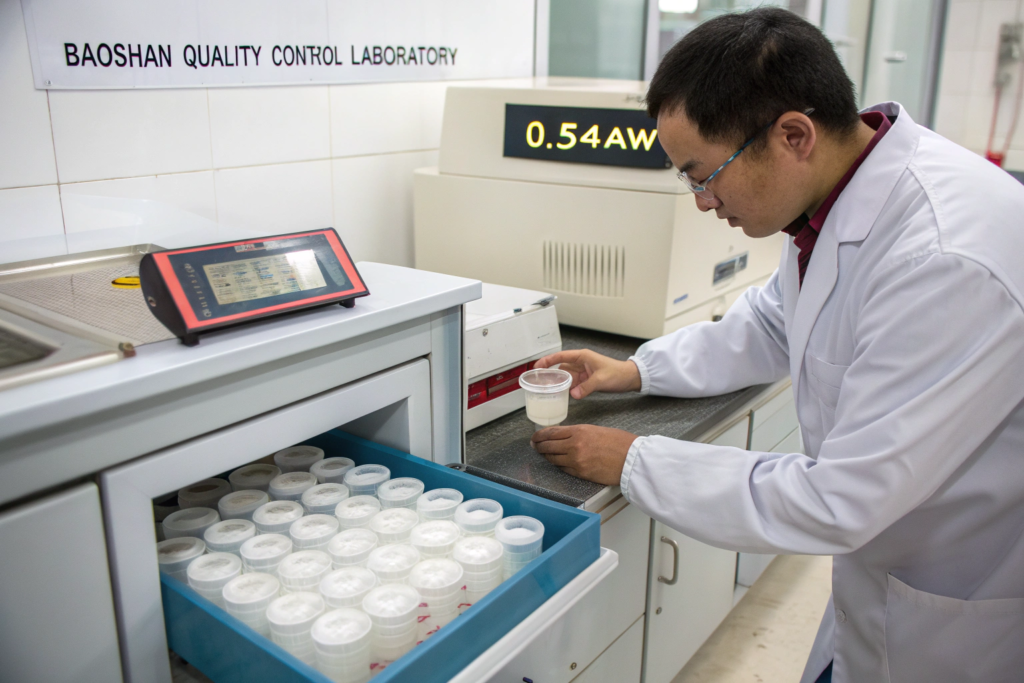
We use a professional-grade, bench-top water activity meter. This is not a cheap, handheld device. It is a precision laboratory instrument.
Our Protocol:
- Calibration: The meter is calibrated daily using certified salt standards of known water activity (e.g., 0.50 aw, 0.75 aw). This ensures accuracy.
- Sampling: A representative 50-gram sample is taken from the finished lot after gravity separation and sizing.
- Sample Prep: The beans are placed whole into a clean, dry sample cup. We do not grind the beans for aw testing, as grinding can release bound water and give a falsely high reading.
- Measurement: The cup is sealed in the meter's chamber. The instrument uses the chilled-mirror dewpoint technique to measure the vapor pressure of the air in equilibrium with the sample. This is the gold standard method.
- Stabilization: The measurement takes 5-10 minutes to stabilize.
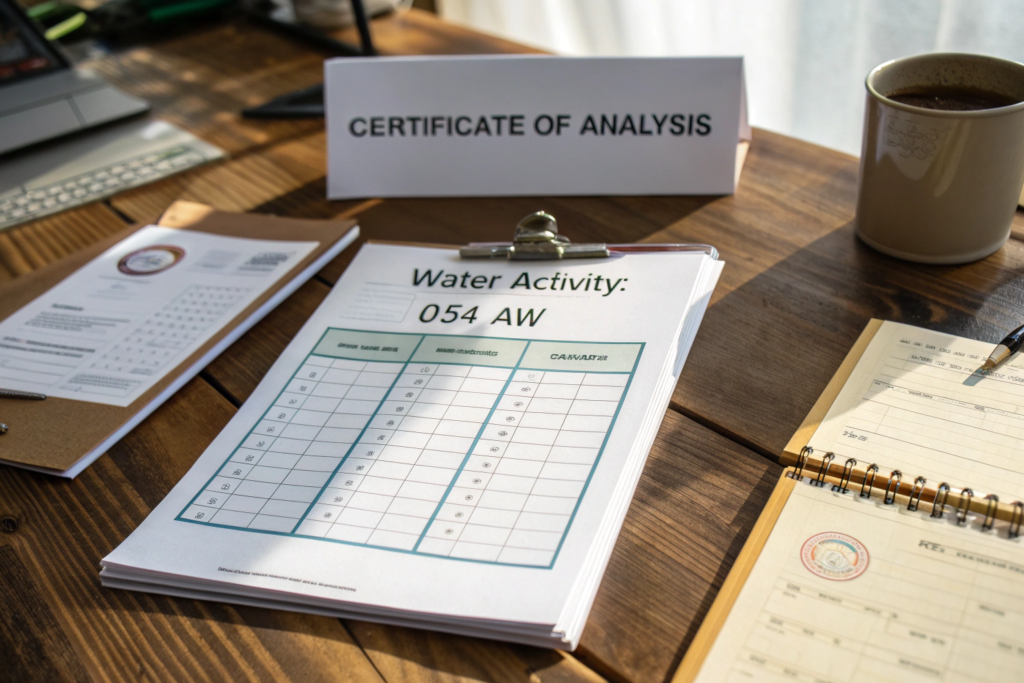
- Recording: The final aw value is recorded on the lot's Certificate of Analysis (CoA) and in our internal database.
This process is repeated for every single export lot. If a lot measures 0.59 aw, it is flagged. It is not a pass. We have a very narrow, strict window. This discipline is what separates a premium, food-safety-focused exporter from a commodity trader. At Shanghai Fumao, the water activity meter is one of the most important pieces of equipment we own.
How Does Our Drying and Storage Protocol Target Optimal Water Activity?
The target aw of 0.55 is achieved through a combination of controlled drying and stable storage.
- Sun Drying on Raised Beds: Our primary drying method. We dry the parchment slowly over 10-14 days. This gradual, low-temperature drying allows the bound water to equilibrate properly and prevents "case hardening." We use moisture meters in the field to track the drying curve, but we know the final target is an aw of 0.55-0.58 after the coffee has rested in parchment for 30 days.
- Mechanical Drying (Backup): If the weather turns, we have mechanical dryers. But we use them carefully, at low temperatures (<40°C), to avoid shocking the bean and trapping free water.
- Reposo (Resting): After drying, the parchment coffee rests in our cool, ventilated warehouse for 60-90 days. This is a critical period where the moisture and water activity equilibrate throughout the entire bean mass. A coffee might measure 0.62 aw right off the drying bed, but after 60 days of rest, it will settle to a stable 0.56 aw.
- GrainPro Storage: Once milled into green bean, the coffee is immediately packed in GrainPro hermetic bags. This locks in the 0.55 aw and prevents it from changing during transit or storage.
This integrated system—slow drying, resting, hermetic sealing—is designed to achieve and maintain the optimal water activity. It is a holistic approach to quality and safety.
How Can a Roaster Use Water Activity Data to Predict Shelf Life?
You have received the coffee. The CoA shows an aw of 0.55. What does this tell you about how long you can store this coffee in your roastery? This data is a powerful tool for inventory management.
Roasters can use water activity data to predict shelf life by understanding that a green coffee with an aw below 0.60 will remain microbiologically stable and resist staling for 9-12 months when stored in its original, sealed GrainPro liner in a cool, dry environment, whereas a coffee with an aw of 0.62-0.65 has a significantly shorter "safe" window of perhaps 3-6 months.
The aw number gives you a scientific basis for your "First-In, First-Out" (FIFO) decisions. The lower the aw, the longer you can safely hold it without quality loss.
What Is the Relationship Between Low Water Activity and Cup Quality Over Time?
This is the ultimate question for a specialty roaster. Does low water activity preserve flavor? The answer is a strong yes.
The Science of Staling:
- Oxidation: The lipids (fats) in the coffee bean react with oxygen, producing stale, cardboard flavors. Water activity influences the rate of oxidation. Interestingly, oxidation is fastest at moderate aw levels (around 0.40-0.50) and slower at very low aw. At the 0.55-0.58 aw level we target, oxidation is relatively slow.
- Enzymatic Activity: Enzymes that break down complex sugars and aromatics require some free water to function. Low water activity slows these enzymatic reactions.
- Acid Degradation: The bright, fruity acids in coffee (citric, malic) degrade over time. This degradation is accelerated by the presence of free water.
The Practical Result: A coffee with an aw of 0.55, stored in a sealed GrainPro bag at a stable room temperature, will show minimal flavor degradation over 9-12 months. The acidity will soften slightly, but the core flavor profile will remain intact. A coffee with an aw of 0.65, stored in the same conditions, might show noticeable flattening and the emergence of "baggy" or woody notes within 4-6 months.
When I provide a CoA with an aw of 0.55, I am giving you confidence. I am telling you that this coffee is built to last. You do not have to rush to roast it. You can hold it for the right seasonal blend release.
Should I Re-Test Water Activity Upon Arrival at My Roastery?
For most small to mid-sized roasters, re-testing aw upon arrival is not strictly necessary if you trust your supplier's CoA and the coffee has been shipped in sealed GrainPro. The aw should not have changed.
However, re-testing is highly recommended in specific situations:
- First-Time Supplier: You are building trust. Verify their CoA with your own measurement. A quality water activity meter costs around $1,500-$2,500. It is a worthwhile investment for any roaster importing multiple containers per year.
- Suspicious Conditions: The container arrived with a broken seal, or the data logger shows a severe temperature spike, or you notice condensation on the inside of the GrainPro liner. Re-test the aw immediately.
- Long-Term Storage: If you plan to hold the coffee for more than 9 months, it is prudent to test the aw every 3-4 months to ensure the storage environment has not caused it to creep up.
The Test Procedure:
Take a sample from the middle of the pallet, not just the top bag. The top bag is most exposed to temperature swings. Seal the sample in a ziplock bag and let it equilibrate to room temperature for 24 hours before testing. This prevents a false reading from thermal shock.
If you re-test and find an aw of 0.62 on a coffee that was certified at 0.55, contact your supplier immediately. This indicates a problem in transit or a potential issue with the original certification. At Shanghai Fumao, we stand behind our CoAs. We would want to investigate that discrepancy.
Conclusion
Water activity is not just another number on a spec sheet. It is the hidden code that determines the true stability, safety, and shelf life of your green coffee investment. Moisture content tells you the weight of the water. Water activity tells you the power of that water.
By sourcing from suppliers who understand and control water activity—who target that critical sub-0.60 aw threshold—you are protecting your business from the hidden risks of mold, mycotoxins, and premature staling. You are buying coffee that is built to last, that will arrive fresh, and that will hold its quality until you are ready to roast it.
At Shanghai Fumao, we have made the investment in the science of water activity. We test every lot. We record the data. We share it with you. Because we want you to have complete confidence in the stability and longevity of the coffee you buy from us.
If you would like to see a sample Certificate of Analysis that includes our water activity measurement, we are happy to provide one. Email Cathy Cai. She can send you a recent CoA from a current lot. Contact Cathy at: cathy@beanofcoffee.com.