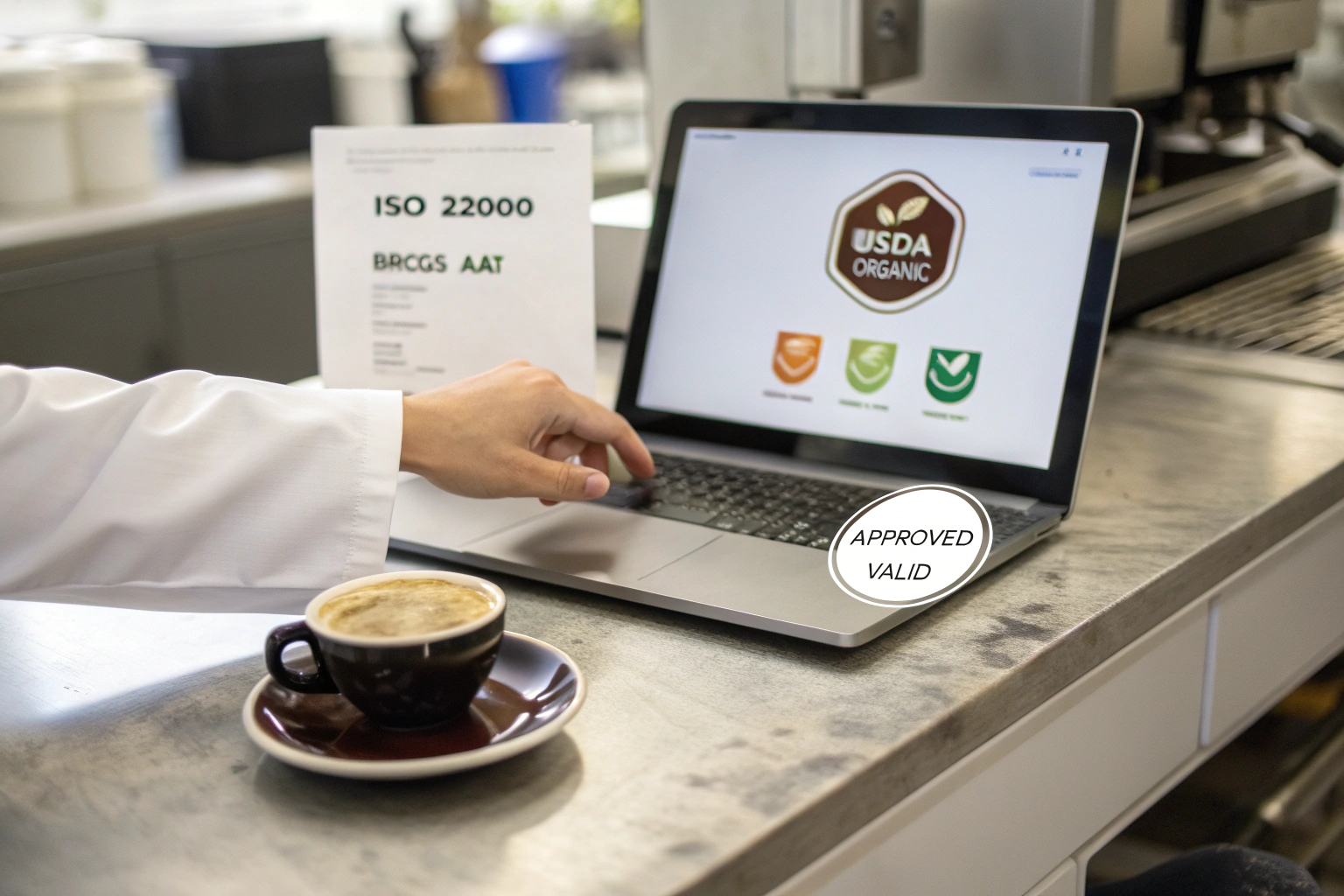
A few years ago, I was on a video call with a well-known European roaster. He was holding a sample of our coffee, and he had cupped it. He said, "Mr. Cai, I love your coffee. It's exceptional. But you're asking me to put my family's name, my brand, on a product from a factory I've never visited, in a country I don't fully understand. I'm scared." I did not get defensive. I understood. In that moment, I was not just a farmer trying to make a sale. I was the custodian of his reputation. I realized then that my real job was not just to grow great coffee, but to build a system of trust so transparent and so independently verified that he could stake his name on it without fear.
You can trust a Chinese coffee factory with your brand's reputation not on the basis of a single promise, but by verifying a complete, independently audited framework of globally recognized food safety certifications like BRCGS, validated by a history of unannounced audits, a deep culture of traceability, and transparent, available data that proves our processing protocols are a daily, documented, and certifiable reality.
Trust in a supply chain is not a feeling. It is a verifiable fact. At Shanghai Fumao, we do not ask for your blind faith. We give you the keys to verify everything yourself. You can start that verification on our Quality Control page.
How Can Independent Audits Prove a Factory's Commitment to Safety?
A promise is just words. A single scheduled audit is a performance. The only way to truly verify a factory's commitment to safety is through the lens of independent, unannounced, and globally respected scrutiny. This is the gold standard of trust. A supplier's willingness to be audited on a random Tuesday, without any time to prepare, is the ultimate test of their operational integrity.
Independent, unannounced audits from a GFSI-benchmarked standard like BRCGS are the definitive proof of a food safety commitment because they provide a real-time, randomized snapshot of a factory's daily operational culture, verifying that the documented safety protocols are not just filed policies but the lived, unscripted, and certifiable reality on the production floor.
This is the level of proof that protects your brand. It is the difference between a supplier who can talk about safety and a supplier whose safety system has withstood a surprise inspection from the most rigorous auditors in the world. The AA grade is the evidence.
What Does a BRCGS "AA" Grade Mean About Our Daily Operations?
A BRCGS certificate is good. A BRCGS AA grade is exceptional. It is the highest possible rating, and it cannot be achieved by luck or by cramming for a scheduled test. It is a direct reflection of a deeply embedded food safety culture that operates at a high level every single day.
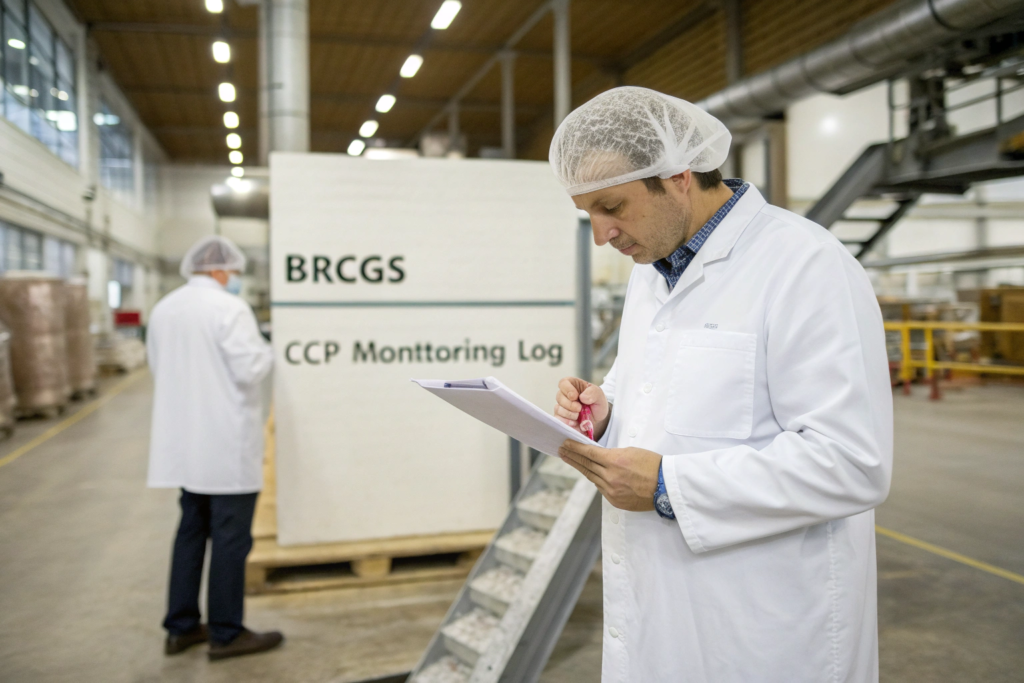
To achieve an AA grade, a factory must voluntarily opt into the unannounced audit program. This means the auditor can arrive at our gate on any day within a 90-day window. We do not know when they are coming. What they find is a genuine "day-in-the-life" snapshot of our facility: the real-time CCP monitoring logs, the actual cleanliness of the floor, the unscripted behavior of our staff. An AA grade certifies that our food safety systems were found to be fully compliant on a completely random day. This audited reality is the ultimate guarantee we provide. It is what protects your brand from a safety failure. You can learn more about finding a supplier with this certification in our guide on How to Find a Coffee Supplier with BRCGS Food Safety Certification?.
How Does Our "Radical Transparency" on Audits Build Unshakeable Trust?
For too long, the supply chain has been a black box. A supplier hands you a certificate and tells you to trust it. At BeanofCoffee, we believe that true trust is built on open-source verification. A fake certificate can be easily forged, but a public audit result cannot.
We operate with a philosophy of radical transparency. We do not just send you a PDF of our certificate. We provide you with our unique BRCGS site code and invite you to go directly to the official BRCGS public directory and verify our AA grade for yourself. You can also verify our organic and other certifications through their respective online databases, a process we outline in How Do I Know If a Coffee Factory Certificate of Analysis Is Real?. This is the ultimate act of trust. We are giving you the power to bypass our marketing department and go straight to the independent, third-party source. We believe that a supplier confident enough to do this is a supplier you can trust.
What Processes Protect Your Brand from Physical Contamination?
Beyond the management systems and the certificates, your brand is protected by specific, tangible, and meticulously documented physical processes that operate every minute of every production day. These systems exist for one reason: to absolutely guarantee that a physical contaminant does not reach a consumer in a bag with your name on it. This is where safety becomes a physical, auditable reality.
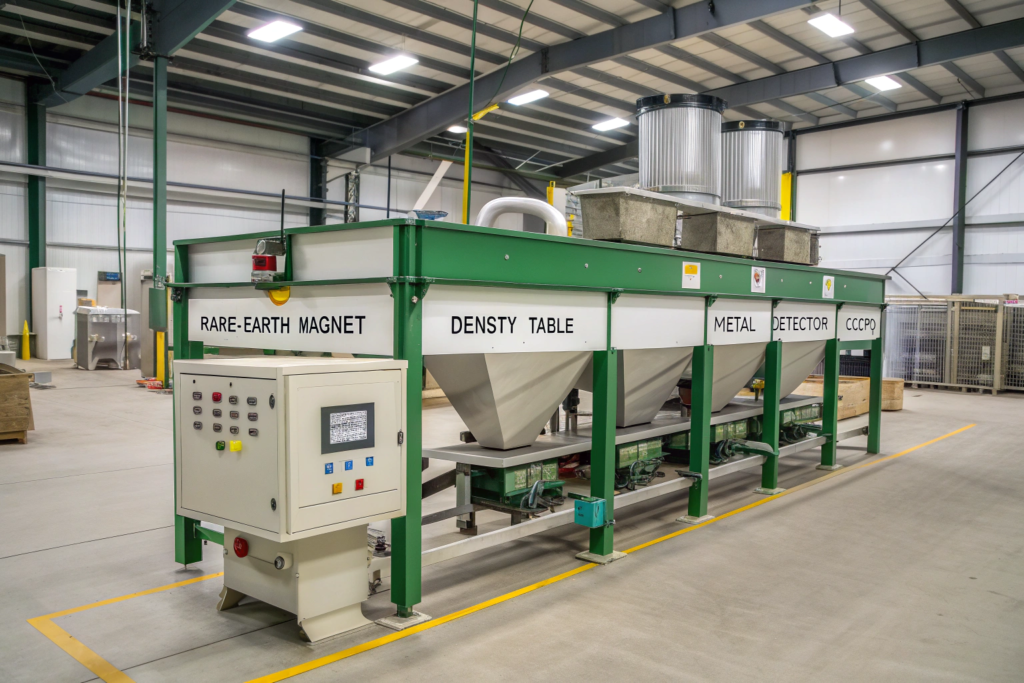
Your brand is protected from physical contamination by a multi-stage, HACCP-driven defense system that uses powerful magnets, density sorting, and a validated metal detector acting as a formal Critical Control Point, with every check, pass, and corrective action documented on real-time logs that are reviewed by our team and audited by external bodies.
These are the machines and the procedures that provide the physical guarantee. They are the reason a BRCGS auditor can verify our product safety. At Shanghai Fumao, this system is the bedrock of our operational integrity.
How Does a Validated Metal Detector Guarantee No Metal in the Bag?
The final metal detector before bagging is not just a piece of equipment; it is the most important gatekeeper in our dry mill. It functions as a formally designated Critical Control Point (CCP) within our HACCP plan, and it is managed with rigorous, audited discipline.
A "critical limit" is established: the machine must detect and reject a certified stainless-steel test sphere of a specific diameter, for example, 1.5mm. Our operator performs a documented CCP check every two hours, passing the test piece through the detector and recording the pass/fail result. If the machine fails the check, a pre-written corrective action is immediately triggered: all coffee processed since the last successful check is quarantined and re-run through a validated machine. All of these actions are recorded on a CCP log. This auditable proof that our physical hazard control is active and effective is the daily guarantee we provide for your brand's safety.
Why Are Our "Cutting-Edge" Glass and Brittle Plastic Protocols Your Best Defense?
This is one of the most famous and feared elements of a BRCGS audit. It is a simple, painstaking, but brilliantly effective system to eliminate a specific physical hazard that can cause serious consumer injury and catastrophic brand damage.
The BRCGS standard mandates a comprehensive "Glass and Brittle Plastic Register." Every single item on the production floor that could shatter—from a pressure gauge on the huller to the clock on the wall—is uniquely identified with a number and inspected at a defined frequency for cracks or chips. This rigorous system is your best defense against the invisible, razor-sharp shard that could end up in a bag of coffee. This is not a concept; it is a numbered list of auditable items and a documented inspection log. It is this level of obsessive, procedural detail that protects your brand's reputation from a single, devastating incident.
How Does Our Traceability System Make Fraud Impossible?
The final and most powerful way we protect your brand is by making the entire concept of fraud a logistical impossibility. If every single bag of coffee from a legitimate supplier is linked to a specific, traceable lot with a single, unbroken paper trail, it becomes impossible for a counterfeit product to enter the chain. Your reputation is protected by the integrity of our data.
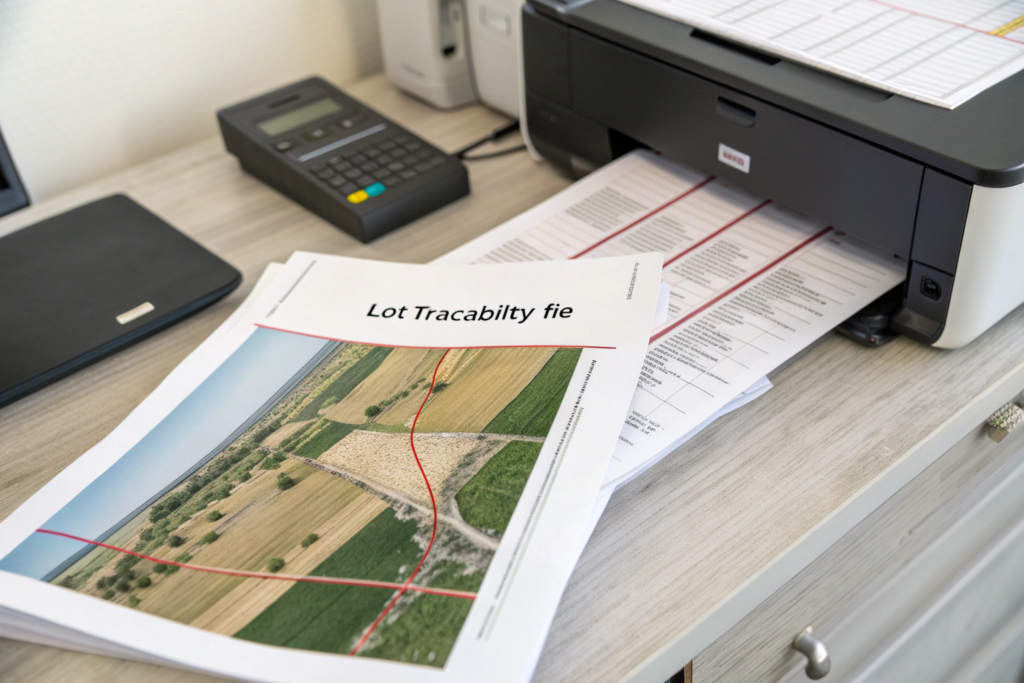
Our traceability system makes fraud and the mixing of lower-grade beans, a practice we discuss in our guide on How to Ensure Your Coffee Supplier Isn't Mixing Lower Grade Beans?, impossible by creating an unbroken, verifiable chain of custody for every single lot, linking the specific GPS coordinates of the farm block to the cupping score, the processing data, the export documents, and the final bag.
This is not a marketing story; it is a provable, documented reality. The lot number on your bag is the key to a forensic-quality evidence file.
What Data Links Your Specific Bag to Our GPS-Mapped Farm Block?
A commodity bag of coffee is anonymous. A premium bag from a trusted partner is an interactive, verifiable identity document. The lot number is the key.
When you scan a QR code on a bag of our traceable coffee, you are not just seeing a generic "about our farm" video. You are pulling up the specific, immutable data for that precise lot. You can see a satellite map of our farm with the exact block—for example, Block 14A at 1,650 meters—highlighted. You can see the specific varietal, the harvest date, and the cupping score. This is a conversation of radical transparency between you and your customer, powered by a system you can trust because you can verify every data point yourself. This is the same philosophy we explore in our article on Why Is Blockchain Being Used for Coffee Bean Traceability from China?.
How Does This Unbroken Chain of Custody Protect Your Brand's Story?
Your brand's story is its most valuable asset. It is the narrative of quality, ethics, and origin that you sell to your customers. That story is only as valuable as it is true. An unbroken chain of custody is the legal and forensic proof that authenticates your narrative.
If a customer ever questions your claims, you do not need to send them a vague email. You can provide them with a complete, auditable evidence package that traces your single bag of coffee from our GPS-mapped farm block, through our BRCGS-certified mill, and onto the vessel. This forensic-quality traceability turns your brand story from a marketing claim into a verifiable, legal fact. It is the ultimate defense of your reputation, and it is built into every container we export.
Conclusion
Trusting a Chinese coffee factory with your brand's reputation is not a leap of faith. It is a rational business decision based on the verification of independently audited, globally recognized systems. You should not trust our words, our story, or even our coffee samples alone. You should trust the unannounced BRCGS AA-grade audit that verifies our safety culture on a random Tuesday. You should trust the documented CCP logs that prove our metal detector is tested every two hours. You should trust the unbroken digital chain of custody that links your specific bag to a GPS coordinate on our farm.
This is the architecture of trust we have built at BeanofCoffee. It is a system designed to be verified, not just believed. If your brand's reputation is your most important asset, you should only partner with a factory that treats it that way. I invite you to put our systems to the test.
Email Cathy Cai. Ask for our full "Trust & Verification Documentation Package." She can provide our BRCGS site code, a sample CCP log, and a traceability file for a recent lot. Contact Cathy at: cathy@beanofcoffee.com